KIME Review 2026
AI search visibility platform that tracks brand presence across multiple LLMs, with reporting designed for marketing and SEO teams.
Key takeaways
- KIME tracks brand visibility, placement, sentiment, and share of voice across major LLMs including ChatGPT, Gemini, and Claude
- Monitoring-focused platform with an "Actions" module for optimization suggestions, but lacks AI content generation, crawler logs, AI traffic attribution, and prompt volume/difficulty scoring that Promptwatch provides
- Good fit for marketing and SEO teams at mid-size brands who want structured AI visibility reporting without a steep learning curve
- MCP (Model Context Protocol) integration is a genuinely interesting differentiator for teams that want to build custom workflows
- Free tier available; paid plans appear to start at accessible price points based on available information
KIME is a GEO (Generative Engine Optimization) monitoring platform built to help brands understand how they appear in AI-generated search responses. The product tracks visibility across the major LLMs -- ChatGPT, Gemini, Claude, and others -- and surfaces metrics like placement, share of voice, sentiment scores, and citation sources. It's aimed squarely at marketing and SEO teams who are starting to take AI search seriously but want something that fits into existing reporting workflows rather than requiring a full technical overhaul.
The platform appears to be a relatively young product, with a customer base that includes brands like Gymshark, Saxo, Chamberlain Coffee, and Flatpay. That's a reasonably credible early roster, particularly Saxo (the financial services company), whose paid search specialist noted in a testimonial that KIME helped them discover ChatGPT was being blocked from crawling their site -- a practical, real-world catch that speaks to the platform's diagnostic value.
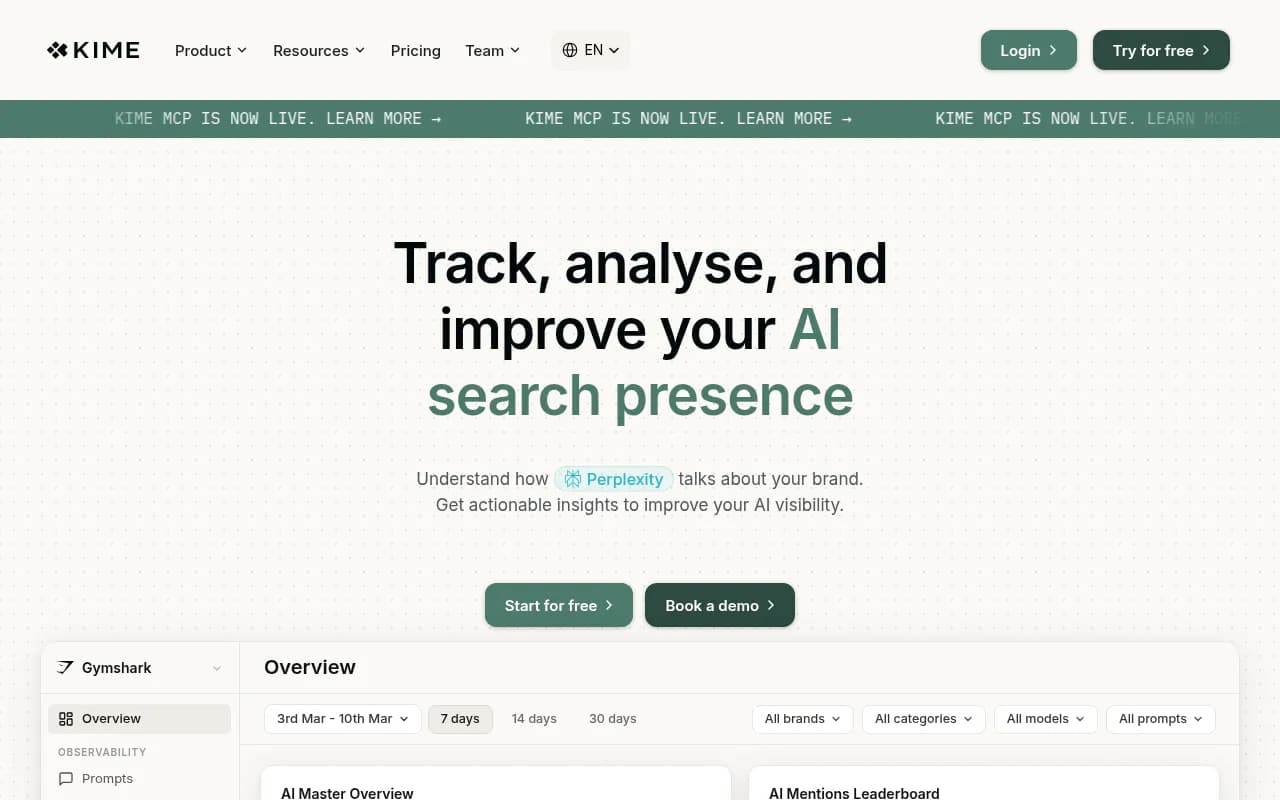
The target audience is clearly marketing-side rather than developer-side. The UI shown on the website is clean and dashboard-oriented, with pre-built views for visibility trends, competitor comparisons, and citation analysis. There's no heavy technical setup implied, which is either a strength or a limitation depending on what you need.
Key features
AI Performance Score and visibility dashboard
KIME's central interface is an overview dashboard that aggregates several metrics into a single "AI Performance Score." The score pulls together overall visibility (how often your brand appears in AI responses), placement (where in the response it appears), and sentiment (how positively the AI describes your brand). The dashboard supports filtering by date range, brand, category, model, and prompt -- which is the right set of controls for a marketing team doing weekly or monthly reporting.
The "AI Mentions Leaderboard" view shows your brand stacked against competitors with raw mention counts and sub-scores. It's a clean way to communicate competitive standing to stakeholders who don't want to dig into raw data.
Prompt tracking and categorization
Users define the prompts they want to track -- things like "best gym clothing for men" or "best place to shop online" -- and KIME monitors how the brand performs for each one across models. Each prompt gets its own visibility %, placement score, share of voice %, and volume estimate.
The ability to organize prompts into categories is useful for brands with multiple product lines or market segments. You can see aggregate performance by category, which helps prioritize where to focus optimization efforts. This is a sensible feature that most monitoring tools include in some form.
Competitor analysis
The competitor side-by-side view lets you compare your brand directly against named competitors across all tracked metrics. Share of voice trends are shown over time, so you can see if a competitor is gaining ground in AI responses even if your own numbers look stable. The industry ranking table (showing placement, sentiment, and SoV for each brand) is a particularly useful format for competitive reporting.
Citation and source tracking
This is one of the more practically useful features. KIME shows which sources AI models are pulling from when they mention your brand -- with breakdowns by domain, mention count, source type (editorial, UGC, influencer), and average citation rate. The example shown on the website includes sources like Reddit, YouTube, Marie Claire, and Runners World, which reflects how AI models actually construct their answers from a mix of media types.
Knowing that Reddit is driving 13.9% of your AI citations, for instance, is actionable: it tells you where to invest in community presence or content seeding. This kind of source-level visibility is genuinely useful and not always present in lighter monitoring tools.
AI Perception analysis
The AI Perception module shows how AI models describe your brand -- the language, associations, and framing they use. This goes beyond just "were you mentioned" to "how were you described," which matters for brand management. The sentiment score over time chart lets you track whether AI descriptions of your brand are improving or degrading.
Actions module
KIME includes an "Actions" section that surfaces personalized optimization recommendations. Based on the website copy, these are described as steps to "rank at the top of AI-generated responses." The specifics of what these recommendations look like in practice aren't fully detailed in the available information, but the existence of an optimization layer beyond pure monitoring is worth noting. That said, there's no indication that KIME generates actual content or provides AI-powered writing tools -- the Actions module appears to be recommendation-based rather than execution-based.
KIME MCP integration
The most technically interesting recent addition is KIME's MCP (Model Context Protocol) support. MCP is an open protocol that allows AI tools to connect and share context, and KIME's implementation lets users build custom workflows, create specialized reports, and execute tasks faster by connecting KIME's data to other tools in their stack. This is a forward-looking feature that puts KIME slightly ahead of most monitoring-only competitors on the integration front. For teams that want to pipe AI visibility data into custom dashboards or automate reporting, this is genuinely useful.
Multi-model and multi-region tracking
KIME tracks across ChatGPT, Gemini, Claude, and other major models, with support for multiple countries and languages. The prompt-level filtering by model lets you see if your visibility differs significantly between, say, ChatGPT and Gemini -- which it often does, since different models weight sources differently.
Who is it for
KIME fits best for marketing and SEO teams at mid-size consumer brands who are just starting to build an AI search strategy. The dashboard-first design and clean reporting views suggest it's built for people who need to present AI visibility data to stakeholders -- CMOs, brand managers, or agency clients -- rather than for technical teams running deep audits. A brand like Gymshark or Chamberlain Coffee, with a clear consumer identity and a set of obvious competitor brands to track, is the ideal user.
Agencies managing a handful of consumer brand clients would also find the competitor analysis and share of voice reporting useful for monthly reporting decks. The multi-brand and multi-region support makes it workable for agency use, though the depth of per-client customization isn't fully clear from available information.
Who should probably look elsewhere: brands that need to go beyond monitoring into actual content optimization. If you want to identify specific content gaps, generate articles engineered to rank in AI responses, track which of your pages AI crawlers are actually visiting, or connect AI visibility to revenue attribution, KIME's current feature set doesn't cover that ground. Similarly, developers or technical SEO teams looking for API access, crawler log analysis, or deep prompt intelligence (volume estimates, difficulty scores, query fan-outs) will find the platform limited.
Integrations and ecosystem
The MCP integration is the headline here -- it's a relatively rare feature in this category and opens up custom workflow possibilities for teams comfortable with the protocol. Beyond MCP, the website doesn't detail specific third-party integrations (no explicit mention of Google Search Console, Slack, Zapier, or similar).
There's no public API documentation visible from the website, and no mention of browser extensions or mobile apps. The platform appears to be primarily web-based. Import/export capabilities aren't detailed, though the reporting-focused design suggests some form of data export is likely available.
Pricing and value
KIME's pricing page exists (kime.ai/pricing) but specific tier names and prices weren't available in the scraped content. The website mentions both monthly and annual subscription options, and there's a free tier or free trial available (the homepage CTA says "Start for free"). Based on the product positioning and customer base, pricing likely sits in the range typical for this category -- somewhere between entry-level tools like Otterly.AI and mid-market platforms.
For a brand tracking 10-20 prompts across 3-4 competitors on a monthly basis, KIME's pricing would need to be competitive with alternatives like Peec.ai or Otterly.AI to justify the switch. Without confirmed numbers, it's hard to make a direct value comparison, but the free start option at least lets you evaluate the platform before committing.
Strengths and limitations
What KIME does well:
- The citation source breakdown (showing Reddit, YouTube, editorial sources, and their citation rates) is more detailed than many monitoring tools and directly actionable
- The AI Perception module, which tracks how AI models describe your brand over time, is a useful brand management feature
- MCP support is a genuine differentiator -- most competitors in this space haven't shipped this yet
- The dashboard design is clean and reporting-friendly, which matters for teams presenting to non-technical stakeholders
- Real customer testimonials from named brands (Saxo, THEMAGIC5, Superb) with specific use cases add credibility
Honest limitations:
- No AI content generation or writing tools. KIME tells you what to fix but doesn't help you fix it. Platforms like Promptwatch include content agents that generate articles, listicles, and briefs grounded in real prompt and citation data -- KIME stops at the recommendation layer.
- No AI crawler logs. One of the most practically useful features in the GEO category is knowing which pages AI crawlers are actually visiting, how often, and what errors they encounter. KIME doesn't appear to offer this. Promptwatch's crawler log feature is what helped Saxo's team identify the ChatGPT crawl block -- though notably, Saxo is also a KIME customer, suggesting they may have found that insight through KIME's monitoring rather than crawler logs.
- No traffic attribution. There's no indication that KIME connects AI visibility to actual website traffic or revenue. For teams trying to justify GEO investment to finance or leadership, this is a significant gap.
- Prompt intelligence is limited. No visible prompt volume estimates, difficulty scoring, or query fan-out analysis. These features help prioritize which prompts are worth tracking and optimizing -- without them, prompt selection is largely guesswork.
- No Reddit or YouTube tracking as dedicated channels. While KIME shows Reddit and YouTube as citation sources, there's no indication it surfaces Reddit discussions or YouTube content that influences AI recommendations as a proactive research tool.
Bottom line
KIME is a solid entry point for brands that want structured AI visibility reporting without a steep setup process. The citation source analysis and AI Perception module are genuinely useful, and the MCP integration shows the team is thinking about where the category is heading. For a marketing team that needs to track 10-20 prompts, monitor a handful of competitors, and report on AI visibility trends monthly, it does the job.
But if you need to move from monitoring to actually improving your AI search presence -- through content creation, crawler log analysis, traffic attribution, or deep prompt intelligence -- KIME's current feature set runs out of road quickly. For that level of optimization, Promptwatch covers the full loop from gap identification to content generation to result tracking, which is what separates a monitoring tool from an optimization platform.
Best use case: Mid-size consumer brands or small agencies that want clean AI visibility dashboards and competitive share-of-voice reporting without needing to build content or run technical audits.
Frequently asked questions
What is KIME?
Who is KIME designed for?
Does KIME have a free plan?
How does KIME compare to Promptwatch?
What AI models does KIME track?
What is KIME MCP?
Similar and alternative tools to KIME