Clearscope Review 2026
Content intelligence platform that uses search data to guide content creation, helping teams produce material relevant enough to appear in AI-generated search answers.
Key takeaways
- Clearscope has evolved from a pure SEO content optimization tool into a broader "discoverability platform" that now covers Google rankings and AI search visibility (ChatGPT, Gemini, and others)
- The term-based content grading system remains its strongest feature -- clear, actionable, and genuinely useful for writers who don't want to guess what to include
- Lacks the depth of a dedicated GEO platform: no AI crawler logs, no prompt volume/difficulty scoring, no query fan-outs, no ChatGPT Shopping tracking, no Reddit/YouTube citation tracking, and no traffic attribution from AI search -- capabilities that Promptwatch provides out of the box
- Best fit for content teams at mid-market and enterprise companies that are primarily optimizing for Google but want some visibility into AI search
- Pricing is on the higher end for what you get, especially compared to more specialized tools at similar price points
Clearscope launched around 2016 and spent its first several years as one of the cleaner, more user-friendly content optimization tools in the SEO space. The pitch was simple: analyze the top-ranking pages for a keyword, extract the terms and topics they cover, and give writers a graded checklist to follow. It worked well, and the tool built a loyal following among content teams at companies like IBM, Adobe, Shopify, and Webflow.
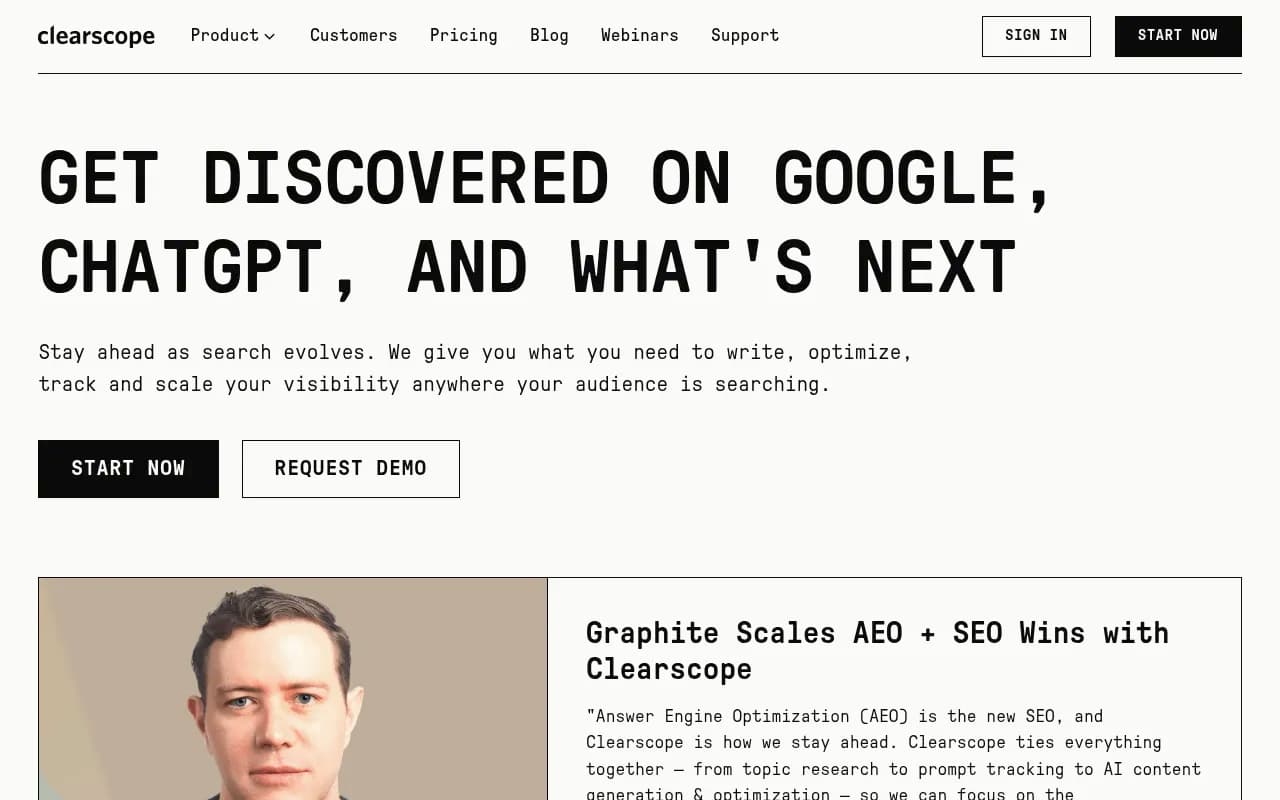
In 2024 and 2025, Clearscope started repositioning itself as a "discoverability platform" -- not just for Google, but for AI-powered search. The homepage now leads with ChatGPT and Gemini alongside Google, and the product has added LLM visibility tracking, AI drafting, and topic exploration features. It's a smart pivot given where search is heading, but the question worth asking is whether the AI search features are genuinely deep or more of a marketing layer on top of what's still fundamentally an SEO content tool.
The honest answer is somewhere in between. Clearscope's core optimization workflow is still excellent. The AI search features are real and useful, but they don't go as deep as dedicated GEO platforms. For teams that primarily care about Google rankings and want a window into AI visibility, that's probably fine. For teams that need to seriously compete in AI search, the gaps become more apparent.
Key features
Content reports and term grading
This is where Clearscope made its name, and it's still the best part of the product. When you create a report for a keyword, Clearscope analyzes the top-ranking pages and generates a list of terms your content should include, each weighted by relevance. As you write or paste in content, the editor grades your piece in real time -- typically on an A+ to F scale -- based on how well you've covered the relevant terms.
The grading system is genuinely useful in practice. It's not just keyword stuffing guidance; the terms are semantically related concepts that signal topical depth to search engines. Writers who follow the recommendations tend to produce more comprehensive content, which is the actual mechanism behind ranking improvement. The Webflow team reported 130% growth in non-branded SEO traffic in 2024 using this workflow, and Adobe's SEO team credits it with scaling optimization across large teams.
Topic explorations
Rather than optimizing one keyword at a time, Topic Explorations gives you a cluster view of an entire subject area. You can see related subtopics, content gaps across your existing pages, and opportunities to build out a content cluster before competitors do. This is a meaningful upgrade from single-keyword analysis and reflects how modern SEO actually works -- Google rewards topical authority, not individual page optimization.
In practice, this feature helps content strategists plan quarters of work rather than just the next article. You can identify which subtopics you're missing, which ones are high-priority, and how they connect to each other.
Search intent analysis
Clearscope's intent analysis goes beyond the standard informational/navigational/transactional classification. It tries to surface the specific questions and angles that searchers are looking for when they type a query -- the "why" behind the search. This feeds into both the content brief and the optimization recommendations, so you're not just covering terms but actually addressing what the audience wants.
The feature is useful for writers who struggle to structure long-form content. Knowing that searchers for "content marketing strategy" are primarily looking for step-by-step frameworks rather than definitions changes how you write the piece.
AI drafting and writing workflow
Clearscope has an AI drafting feature that generates a first pass of content informed by the term recommendations and search data. It's designed to break through writer's block and accelerate the first draft, not replace the writer entirely. The output is grounded in the keyword research rather than being generic, which makes it more useful than a standalone AI writer.
The Animalz team reported saving 1.5 to 3 hours per article using this workflow -- roughly a 10-20% reduction in total production time. That's a meaningful efficiency gain for high-volume content operations.
LLM visibility tracking
This is the newer addition and the one that's gotten the most attention in Clearscope's recent marketing. The feature lets you track how often your content appears as a source in AI-generated answers from ChatGPT, Gemini, and other LLMs. The idea is to show you "what sources LLMs are using to compile their answers" -- essentially citation tracking for AI search.
It's a real feature and it does provide visibility into AI citations. However, it's worth being clear about what it doesn't do: there's no prompt volume or difficulty scoring, no query fan-out analysis, no AI crawler logs showing which pages AI bots are actually reading, no ChatGPT Shopping tracking, no Reddit or YouTube citation tracking, and no traffic attribution connecting AI citations to actual website visits. For teams that need to seriously optimize for AI search rather than just monitor it, these gaps matter.
Content monitoring and analytics
Clearscope's monitoring features let you track the performance of published content over time -- rankings, traffic trends, content grade changes, and decay signals. You can set up custom views for different content segments (blog, landing pages, product pages) and get alerts when content starts losing ground. This is useful for protecting existing rankings rather than just chasing new ones, which is often where the real traffic value sits.
The integration with Google Search Console means the data is grounded in actual performance rather than estimates.
Collaboration and team workflows
Clearscope is built for teams, not solo users. Multiple editors can work on a document simultaneously, comments and feedback are built in, and you can share reports with external contributors (freelancers, agencies) without giving them full platform access. For content operations teams managing dozens of writers and hundreds of articles per month, this workflow infrastructure matters.
Who is it for
Clearscope fits best with content teams at mid-market and enterprise companies that have a serious SEO program and are producing content at scale. Think: a 5-15 person content team at a B2B SaaS company managing 200+ blog posts, or an in-house SEO team at a media company optimizing existing content for traffic recovery. IBM, Adobe, Shopify, Deloitte, and Condé Nast are all listed as customers, which gives you a sense of the company size that finds the price point reasonable.
Content agencies managing multiple client accounts are also a natural fit, particularly those that need to show clients a clear, graded output that justifies optimization recommendations. The report format is easy to share and explain to non-technical stakeholders.
Solo content creators and small teams will likely find the pricing hard to justify. The tool's strengths -- team collaboration, large-scale monitoring, topic cluster planning -- are less relevant when you're one person writing a few articles a month. Tools like Surfer SEO or Frase offer similar core optimization features at lower price points.
Teams that are primarily focused on AI search optimization rather than Google SEO should look carefully at whether Clearscope's AI features are deep enough for their needs. If you're trying to systematically improve your brand's visibility in ChatGPT, Perplexity, or Gemini -- tracking which prompts you're winning, identifying content gaps, understanding how AI crawlers are reading your site -- you'll hit the ceiling of what Clearscope offers fairly quickly.
Integrations and ecosystem
Clearscope integrates with Google Docs and WordPress, which covers the two most common writing environments for content teams. The Google Docs integration is particularly well-executed -- you can run the Clearscope grader directly inside a Google Doc without switching tabs, which fits naturally into most editorial workflows.
There's also a Google Search Console integration for pulling in actual performance data to inform content monitoring. This is standard for content tools at this level.
The platform doesn't have a public API, which limits custom workflow automation. There's no native Slack integration, no Zapier connector listed prominently, and no CMS integrations beyond WordPress. For teams using Contentful, Webflow CMS, HubSpot, or other platforms, you're copy-pasting content in and out, which adds friction at scale.
There's no mobile app, which is expected for a tool of this type.
Pricing and value
Clearscope's pricing isn't published transparently on the website -- you're directed to a pricing page that requires contact for enterprise tiers. Based on available market data, plans start around $170-200/month for the Essentials tier, with higher tiers running into the $400-600/month range for larger teams and more report credits. Third-party procurement data suggests average annual spend around $2,300, which implies most customers are on mid-tier plans.
The credit-based model (reports per subscription period) is a common approach in this category but can feel restrictive when you're doing large-scale content audits or want to experiment with topic explorations freely. Running out of report credits mid-month is a real friction point.
Compared to competitors: Surfer SEO starts around $89/month and covers similar core optimization features. Frase is even cheaper at around $45/month. MarketMuse, which targets a similar enterprise audience, is in a comparable price range to Clearscope. For the AI search visibility angle, dedicated GEO platforms like Promptwatch start at $99/month and go deeper on the AI-specific features.
The value proposition is strongest for teams that will use the collaboration features, topic exploration, and monitoring at scale. If you're primarily using it as a single-user content grader, the price-to-value ratio is harder to justify.
Strengths and limitations
What Clearscope does well:
- The content grading and term recommendation system is genuinely one of the best in the category -- clear, actionable, and well-calibrated. Writers understand what to do with the output.
- Topic Explorations is a real strategic planning tool, not just a keyword list. It helps content teams think in clusters rather than individual pages.
- The Google Docs integration is seamless and fits how most content teams actually work.
- Customer success and support quality is consistently praised in reviews -- the team is responsive and the onboarding is thorough.
- The UI is clean and accessible for non-technical users, which matters when you're training a team of writers who don't have SEO backgrounds.
Honest limitations:
- The AI search features are surface-level compared to dedicated GEO platforms. There are no AI crawler logs, no prompt volume or difficulty scoring, no query fan-outs, no ChatGPT Shopping tracking, no Reddit/YouTube citation analysis, and no traffic attribution from AI sources. If AI search visibility is a primary goal, Clearscope's monitoring is a starting point, not a complete solution. Promptwatch covers all of these gaps and adds content gap analysis and AI content generation grounded in real prompt data.
- No public API and limited CMS integrations beyond WordPress and Google Docs. Teams on Contentful, HubSpot, or custom CMSs will feel the friction.
- The credit-based pricing model can create artificial constraints on how freely teams explore the tool, particularly during content audits.
- Compared to tools like MarketMuse, the content brief depth is lighter -- there's less automated competitive analysis baked into the brief generation.
Bottom line
Clearscope is a well-built, genuinely useful content optimization tool that has earned its reputation among SEO and content teams at serious companies. The core workflow -- research a topic, get term recommendations, grade your content, monitor performance -- is clean and effective, and the recent additions around topic clustering and AI drafting make it a more complete platform than it was a few years ago.
The AI search visibility features are real but limited. Teams that need to go beyond basic LLM citation monitoring -- tracking prompt-level visibility, understanding AI crawler behavior, identifying content gaps in AI answers, or attributing traffic from AI search -- will find Clearscope's coverage insufficient and should look at a dedicated GEO platform like Promptwatch instead.
Best use case: Mid-market to enterprise content teams optimizing primarily for Google search who want a clean, collaborative writing workflow and some visibility into how their content performs in AI-generated answers.
Frequently asked questions
What is Clearscope?
How much does Clearscope cost?
Does Clearscope track AI search visibility?
How does Clearscope compare to Surfer SEO or Frase?
What integrations does Clearscope support?
Is Clearscope good for AI search optimization (GEO)?
Similar and alternative tools to Clearscope