Conductor Review 2026
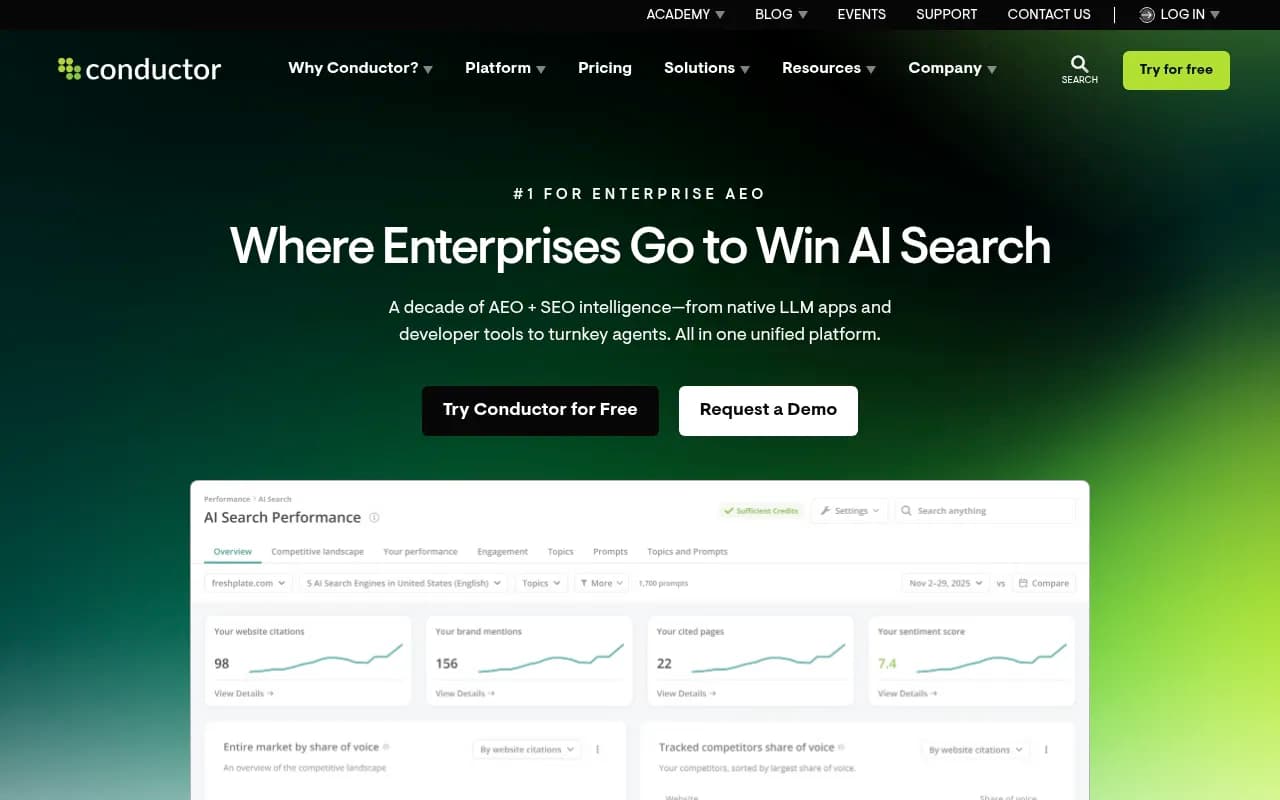
SEO and content intelligence platform for enterprise teams, with capabilities to track brand visibility as AI search engines become a larger part of the organic discovery landscape.
Key takeaways
- Conductor is a mature, enterprise-grade AEO + SEO platform with a decade of proprietary search data, trusted by Verizon, Microsoft, Adidas, and American Express
- Lacks several capabilities that Promptwatch offers, including Reddit and YouTube citation tracking, ChatGPT Shopping monitoring, prompt volume and difficulty scoring, query fan-outs, and dedicated AI crawler log analytics
- Strong end-to-end story: tracks AI visibility, generates content, monitors site health, and exposes intelligence via API and MCP server
- Pricing is enterprise-tier and not publicly listed, which makes it inaccessible for smaller teams or agencies without a sales conversation
- Best fit for large in-house marketing and SEO teams at global brands; overkill for SMBs, agencies managing many small clients, or teams that need granular prompt-level intelligence
Conductor has been around long enough to remember when "organic search" meant Google, full stop. Founded in 2010 and headquartered in New York, the company spent its first decade building what became one of the more respected enterprise SEO platforms on the market. Then AI search happened, and Conductor made a deliberate pivot. The platform now positions itself squarely as an Answer Engine Optimization (AEO) solution, and the rebrand feels genuine rather than cosmetic -- the product has real capabilities in AI visibility tracking, content generation, and agentic workflows that weren't bolted on overnight.
The target audience is unmistakably enterprise. The customer logos on the homepage read like a Fortune 500 roll call: Verizon, Kroger, FedEx, Citibank, PayPal, Ernst & Young, Siemens, Japan Airlines. Conductor claims a Forrester Wave leadership position, and the platform's architecture reflects that pedigree -- it's built for teams with dedicated SEO strategists, content managers, and developers who need a command center rather than a quick-start tool. If you're a solo consultant or a startup with a two-person marketing team, this probably isn't your tool.
The platform is organized into four main modules: Conductor Intelligence (AI and search visibility), Conductor Creator (content creation and optimization), Conductor Monitoring (technical site health), and Conductor AgentStack (agentic AEO workflows). Each module can be used independently or as part of a unified workflow, and the company has invested heavily in making the intelligence layer accessible outside the core app through LLM integrations, an API, and an MCP server.
Key features
AI and search visibility tracking (Conductor Intelligence)
This is the core of what Conductor now calls its AEO offering. The platform tracks brand visibility across ChatGPT, Gemini, Copilot, Claude, and traditional search results, then connects that presence to traffic, conversions, and revenue. The revenue attribution angle is notable -- many AI visibility tools stop at showing you whether you're cited, while Conductor tries to close the loop to business outcomes.
- Monitors multiple AI models including ChatGPT, Google Gemini, Microsoft Copilot, and Claude
- Tracks AI Overviews (Google's AIO) alongside traditional organic rankings
- Connects AI citations to downstream traffic and conversion data
- Competitor visibility comparisons across AI and traditional search
One gap worth noting: Conductor doesn't appear to track Perplexity, DeepSeek, Grok, Meta AI, or Mistral, which are increasingly significant in the AI search landscape. Promptwatch monitors 10+ models including all of these.
AI content creation (Conductor Creator)
Conductor Creator handles content generation and optimization for both traditional search and LLM visibility. The pitch is that the AI is "powered by your unique data" rather than generic language model outputs -- meaning it draws on Conductor's proprietary intent signals and your existing content performance data to generate more targeted output.
- Generates articles, optimizations, and content briefs grounded in search intent data
- Built for enterprise teams with workflow and approval features
- Designed to produce content that performs in both traditional search and AI answers
- Scales content production without requiring prompt engineering expertise
Technical site health monitoring (Conductor Monitoring)
The monitoring module runs 24/7 and specifically tracks how AI bots crawl your site -- not just traditional search crawlers. Real-time alerts flag issues before they become visibility problems, and the platform prioritizes fixes by potential revenue impact.
- Always-on crawl monitoring with AI bot tracking
- Real-time alerts for technical issues
- Prioritized fix recommendations based on revenue impact
- Covers both traditional SEO technical issues and AI crawlability
AgentStack: LLM apps, APIs, and turnkey agents
This is Conductor's most technically ambitious module, and it's clearly aimed at enterprise teams with development resources. AgentStack exposes Conductor's intelligence layer in three ways:
- LLM apps: Native integrations that bring Conductor's data directly into ChatGPT, Claude, and Microsoft Copilot. Teams can query their search and AEO data without leaving the AI tools they already use.
- API and MCP server: Agencies, enterprise IT teams, and MarTech partners can build custom applications on top of Conductor's intent signals, content signals, and technical signals. The MCP (Model Context Protocol) server support is a forward-looking move that positions Conductor's data as infrastructure for agentic workflows.
- Turnkey agents: Pre-built Content Agent and Technical Agent that automate full AEO workflows from insight to published content, with no prompt engineering or technical setup required. The company claims "insight to published content in under two minutes."
Developer playground and documentation
Conductor has published a developer playground with prompt libraries, real use cases, and API documentation. This is a meaningful differentiator for enterprise teams that want to build custom AEO workflows on top of a data layer rather than use a fixed UI.
Proprietary data engine
Conductor claims 10+ years of proprietary search data covering intent signals, content signals, and technical signals. This historical depth is a genuine advantage for trend analysis and benchmarking -- newer entrants to the AEO space simply don't have this longitudinal dataset.
Free AI visibility report
Conductor offers a free instant report showing how a brand appears across ChatGPT, Perplexity, Google AI Overviews, and more. This is a lead generation tool, but it's also genuinely useful as a quick diagnostic.
Who is it for
Conductor's natural home is the in-house enterprise marketing team at a large B2C or B2B brand. Think a global retailer managing thousands of product and category pages, a financial services company tracking brand visibility across multiple AI models, or a healthcare organization that needs to monitor how AI search engines represent its services. The case studies on the site -- including a 2x increase in AI search citations and 185% increase in AI mentions -- are all enterprise-scale outcomes.
The platform also fits large digital agencies that manage enterprise accounts and need a single platform to report on both traditional SEO and AI visibility. The API and MCP server capabilities make it attractive for agencies with development resources who want to build custom client-facing dashboards or automated reporting workflows.
Where Conductor is a poor fit: SMBs, early-stage startups, and solo practitioners will find the pricing and complexity excessive. The platform is engineered for teams with dedicated SEO, content, and technical resources -- not for a founder who wants to check whether ChatGPT mentions their product. Similarly, teams that need granular prompt-level intelligence (volume estimates, difficulty scores, query fan-outs) or tracking of niche AI models like DeepSeek or Grok will find gaps in Conductor's coverage.
Integrations and ecosystem
Conductor's integration story has evolved significantly with the AgentStack launch. The platform now connects to:
- ChatGPT, Claude, and Microsoft Copilot: Native LLM app integrations that surface Conductor's data inside these tools
- MCP server: Allows any MCP-compatible AI agent or workflow to pull Conductor's intelligence
- REST API: Full data API for custom integrations, reporting, and workflow automation
- Google Search Console: Standard SEO integration for organic performance data
- CMS integrations: Content publishing workflows connect to major enterprise CMS platforms
- Developer documentation: Public API docs and playground at conductor.com/docs
The MCP server support is worth calling out specifically -- it's one of the more forward-thinking infrastructure decisions in the AEO space, positioning Conductor as a data layer that can power third-party agents rather than just a standalone application.
There's no mention of a dedicated mobile app, and browser extension capabilities aren't prominently featured. The platform is clearly designed for desktop-first enterprise workflows.
Pricing and value
Conductor does not publish pricing on its website. Based on available information from third-party review sites and the platform's enterprise positioning, plans are custom-quoted and typically start in the thousands of dollars per month for enterprise contracts. A free trial is available, and there's a free AI visibility report tool that requires no signup.
This opaque pricing model is standard for enterprise software but creates friction for teams trying to evaluate the tool without a sales conversation. For comparison:
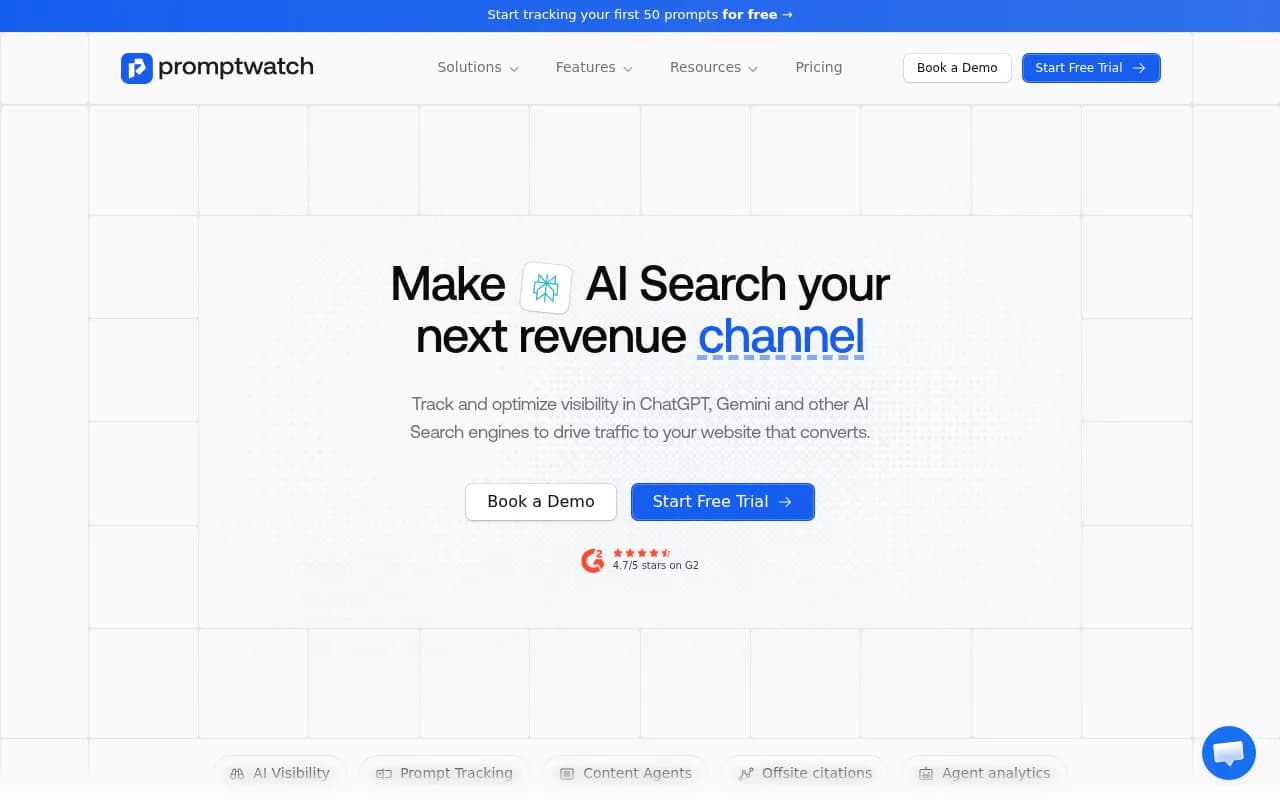
- Promptwatch publishes transparent pricing starting at $99/month (Essential), $249/month (Professional), and $579/month (Business), with agency and enterprise tiers available
- Semrush's enterprise plans also require custom quotes but have published starting points
- Smaller AEO tools like Otterly.AI and Peec.ai have published pricing in the $50-200/month range
For the enterprise teams Conductor targets, the pricing model is expected and the value proposition is clear -- a decade of proprietary data, Forrester Wave recognition, and a genuinely end-to-end platform justify a premium. For anyone outside that enterprise bracket, the lack of transparent pricing is a barrier.
Strengths and limitations
What Conductor does well
- Depth of proprietary data: Ten-plus years of search intelligence is a real moat. Trend analysis, benchmarking, and historical context are genuinely stronger here than at newer entrants.
- End-to-end workflow: The combination of visibility tracking, content generation, technical monitoring, and agentic execution in one platform reduces tool sprawl for large teams.
- Enterprise infrastructure: The MCP server, API, and LLM app integrations show genuine investment in making Conductor's data layer accessible to developers and power users.
- Technical site monitoring: 24/7 AI bot crawl monitoring with revenue-prioritized alerts is a practical capability that many AEO-focused tools skip entirely.
- Brand credibility: Forrester Wave recognition and a customer list that includes Microsoft, Verizon, and American Express carries weight in enterprise procurement conversations.
Limitations and gaps
- Narrower AI model coverage: Conductor tracks ChatGPT, Gemini, Copilot, and Claude, but doesn't appear to cover Perplexity, DeepSeek, Grok, Meta AI, or Mistral. Promptwatch monitors 10+ models including all of these, which matters as AI search fragments across more platforms.
- No Reddit or YouTube tracking: Conductor doesn't surface Reddit discussions or YouTube content that influences AI recommendations -- a meaningful gap given how heavily AI models draw on these sources. Promptwatch tracks both.
- No prompt-level intelligence: There's no visible equivalent to prompt volume estimates, difficulty scoring, or query fan-outs. Teams can't easily prioritize which prompts are worth targeting based on search demand data. Promptwatch's Prompt Intelligence module fills this gap.
- No ChatGPT Shopping tracking: As ChatGPT's shopping and product recommendation features grow, tracking brand presence in those surfaces matters. Conductor doesn't appear to cover this; Promptwatch does.
- Opaque pricing: The lack of published pricing makes it hard to evaluate without a sales call, which is a real friction point for teams in early evaluation stages.
Bottom line
Conductor is a serious platform for enterprise teams that need a unified AEO and SEO command center backed by a decade of proprietary data. If you're at a global brand with dedicated SEO, content, and development resources, the combination of AI visibility tracking, content generation, technical monitoring, and agentic infrastructure is genuinely compelling.
That said, teams that need broader AI model coverage, prompt-level intelligence, Reddit and YouTube tracking, or transparent pricing should look at Promptwatch as a stronger alternative -- it covers more AI models, goes deeper on prompt analytics, and offers content gap analysis and AI content generation at published price points that don't require a sales conversation.
Best use case: Large enterprise marketing teams that want a single platform to track, create, and optimize content for both traditional search and AI search, with the technical infrastructure to build custom AEO workflows on top of a proprietary data layer.
Frequently asked questions
What is Conductor?
Who is Conductor built for?
How much does Conductor cost?
Which AI models does Conductor track?
How does Conductor compare to Promptwatch?
Does Conductor have an API?
Similar and alternative tools to Conductor