Frase Review 2026
Content research and optimization tool that helps teams create content aligned with what AI search engines and traditional search results surface, with built-in brief and editor tools.
Key takeaways
- Frase combines SEO content research, AI writing, optimization scoring, and AI search visibility tracking in one platform -- a genuine all-in-one for content teams
- Competes directly with Promptwatch in the GEO/AI visibility space, but lacks the depth of Promptwatch's AI crawler logs, answer gap analysis, prompt volume scoring, Reddit/YouTube tracking, and ChatGPT Shopping monitoring
- Strong value for content teams that want to produce SEO-optimized articles at scale; the SEO research and editor workflow is genuinely well-built
- AI visibility tracking covers ChatGPT, Perplexity, Claude, and Gemini, but the feature appears to be a monitoring dashboard rather than an optimization loop with content gap analysis and actionable fix workflows
- Plans start at $39/mo with a 7-day free trial and no credit card required
Frase has been around long enough to earn a real user base -- thousands of teams, including names like GitLab, Coursera, Oracle, Thomson Reuters, and Under Armour appear on its customer list. The company started as a content research and brief-building tool, and for a while it was one of the cleaner options in a crowded space of SEO writing assistants. The pitch was simple: analyze the top SERP results, surface the topics and questions competitors cover, and help writers produce content that could compete.
In 2025 and into 2026, Frase repositioned itself as an "agentic SEO and GEO platform." That's a meaningful shift. The product now claims to handle the full content workflow -- competitive research, brief creation, AI writing, SEO optimization scoring, GEO optimization for AI search engines, content atomization, programmatic SEO, and AI visibility tracking across ChatGPT, Perplexity, Claude, and Gemini. Whether it delivers on all of that equally is worth examining closely.
The target audience is content marketers, SEO teams, and digital agencies who are tired of stitching together five different tools. The pitch is consolidation: one login, one workflow, one bill. For teams producing several articles per week, that's a genuinely appealing proposition. The question is whether the depth in each area is good enough to replace specialized tools.
Key features
AI Agent for content strategy
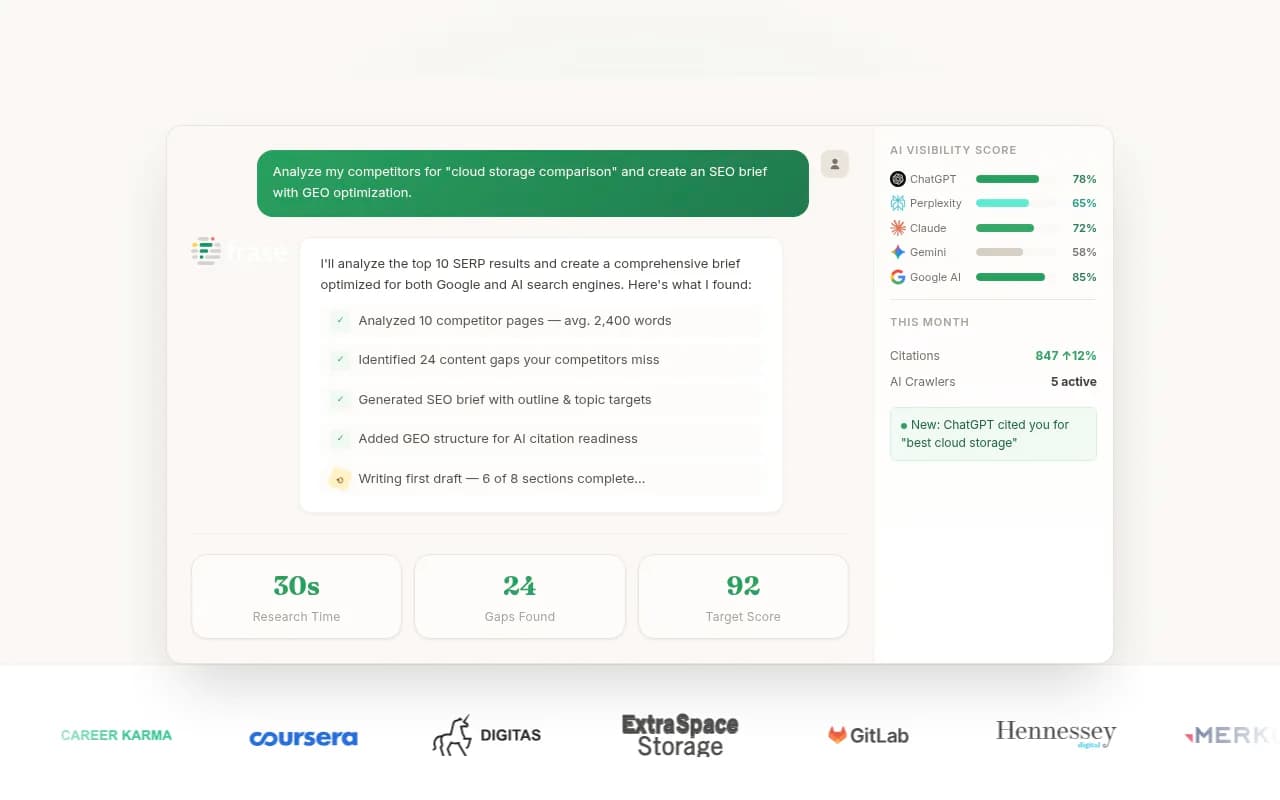
The centerpiece of Frase's current positioning is its AI Agent. You can prompt it with something like "analyze my competitors for 'cloud storage comparison' and create an SEO brief with GEO optimization" and it claims to return a competitive brief in roughly 30 seconds. In practice, it analyzes the top 10 SERP results, identifies content gaps, generates an outline, and applies both SEO and GEO scoring. This is the kind of workflow that used to require a researcher, a strategist, and a writer working in sequence. The agent collapses that into a single interaction.
The agent also handles what Frase calls "always working" tasks -- monitoring for declining pages, surfacing content opportunities, and flagging when AI engines change how they cite your brand. Whether this runs continuously in the background or requires manual triggers isn't entirely clear from the product documentation.
SEO content optimization
This is where Frase has the most history and arguably the most polish. The editor shows a real-time content score (the demo shows climbing from 40 to 90) based on topic coverage, keyword usage, and competitive benchmarks. Topic suggestions are pulled from the top-ranking pages for your target query, so you're not guessing what to include -- you're filling gaps that the SERP data shows matter.
The competitive benchmark view is useful: you can see how many topics each competitor covers and where your draft stands relative to them. This is a well-understood workflow at this point, and Frase executes it cleanly.
GEO content optimization
The GEO optimization layer is newer and more interesting. Frase claims to optimize content structure, citations, and formatting specifically so that ChatGPT and Perplexity are more likely to cite your content. The editor shows both an SEO score and a GEO score simultaneously, which is a practical design choice -- you're not toggling between modes.
What's less clear is the methodology behind the GEO score. How Frase determines what makes content "AI citation ready" isn't fully documented publicly. This matters because GEO optimization is still an evolving practice, and the quality of the scoring model determines whether the advice is actually useful or just surface-level formatting suggestions.
SERP research
The SERP research module analyzes the top 10 competitor pages for any query in about 30 seconds. It surfaces the topics, questions, and structural patterns those pages use, then generates an outline designed to fill the gaps they miss. This is the feature that built Frase's original reputation, and it's still one of the stronger implementations in this category. The output is genuinely useful for brief creation, especially for teams where writers aren't deep SEO specialists.
AI search tracking
Frase monitors brand visibility across ChatGPT, Perplexity, Claude, and Gemini. The dashboard shows share of voice, appearance rate, authority rate, and momentum trends. You get alerts when ChatGPT cites you or when Perplexity drops you, and you can see what competitors are doing differently.
This is a meaningful feature addition, but it reads as a monitoring dashboard rather than an optimization loop. There's no mention of prompt volume scoring, query fan-outs, AI crawler logs, or page-level citation tracking that would let you understand why you're being cited or not cited. For teams that want to go beyond knowing their share of voice and actually fix the gaps, this may not be sufficient on its own.
Content atomization
One blog post becomes LinkedIn carousels, Twitter threads, newsletters, and Instagram posts automatically. Frase claims this saves 4+ hours per piece. This is a useful feature for content teams that need to distribute across channels but don't have dedicated social media writers. It's not unique to Frase -- several tools offer similar repurposing workflows -- but having it integrated means one fewer tool in the stack.
Programmatic SEO
Frase can generate location pages, product comparisons, or directory listings at scale from structured data. The claim is 10,000+ pages in a single workflow. This is a legitimate enterprise use case, and the template-once-deploy-everywhere approach is well-suited to e-commerce, local SEO, and SaaS comparison pages.
Brand governance
Frase stores brand voice profiles and applies them to all AI generation automatically. This matters for agencies managing multiple clients and for enterprise teams where brand consistency is a compliance issue, not just a style preference. The claim that "your 20th article sounds as on-brand as your first" is the right goal; whether the implementation holds up at scale depends on how well the voice profiles are built.
Content clusters and topical authority
The content cluster feature maps topic relationships, identifies pillar pages and supporting content, and tracks internal linking opportunities. This is a strategic layer that goes beyond individual article optimization -- it's about building domain authority over time. The AI-powered cluster mapping is a useful starting point for teams planning a content strategy from scratch.
Who is it for
Frase fits best with content marketing teams at growth-stage companies and digital agencies that produce a high volume of articles and need to move faster without adding headcount. A team publishing three to four posts per week per client -- the use case mentioned in one of their customer testimonials from Red 11 Media -- is exactly the right profile. The research-to-draft workflow is fast enough to make that kind of output realistic without sacrificing competitive quality.
For SEO agencies managing 10 to 30 client sites, the combination of SERP research, brief generation, and content scoring in one tool is genuinely valuable. The brand governance feature makes it easier to maintain quality across clients. The programmatic SEO capability opens up large-scale page generation projects that would otherwise require custom development.
Frase also works for in-house content teams at mid-market SaaS companies, e-commerce brands, and media publishers where the content team is small (two to five people) but the content output expectations are high. The AI Agent is designed to make junior writers more productive, which is a real operational need.
Who should probably look elsewhere: teams whose primary need is deep AI search visibility analysis and optimization rather than content production. If you want to understand exactly why your brand is or isn't being cited by AI engines, track AI crawler behavior on your site, analyze prompt volumes and difficulty, or get into Reddit and YouTube citation analysis, Frase's AI tracking feature is too surface-level for that use case. Similarly, enterprise teams with complex multi-region, multi-language AI visibility requirements will find the monitoring depth insufficient.
Integrations and ecosystem
Frase supports publishing directly to WordPress, Sanity, Webflow, Wix, and its own FraseCMS. This covers the most common CMS environments for content teams and removes the copy-paste step that breaks most content workflows.
The platform has an API, which means teams can build custom workflows or integrate Frase into existing content operations pipelines. The website mentions API access as part of every plan, which is a generous inclusion at lower price points.
Frase also positions itself as compatible with AI agent frameworks, with a dedicated page for "Frase for AI Agents" targeting Claude and other LLM-based automation workflows. This suggests the product is being built to work within broader agentic content pipelines, not just as a standalone tool.
There's no mention of native Slack integration, Google Search Console connection, or Looker Studio export in the publicly available documentation, which are features that matter for teams that want to pipe data into existing reporting workflows.
Pricing and value
Frase's pricing starts at $39/mo, which is competitive for the feature set on offer. The website mentions plans from $39/mo with a 7-day free trial and no credit card required. The full pricing page breaks this into tiers, though the exact tier names and limits aren't fully detailed in the scraped content.
Third-party review sources suggest older pricing tiers ranged from $15/mo to $115/mo with an optional SEO add-on at $35/mo, but the current positioning ("plans from $39/mo") suggests the pricing structure has been updated to reflect the expanded feature set.
Every plan includes the complete AI Agent, research tools, optimization, AI visibility tracking, site audits, publishing, and API access. That's a broad inclusion for the entry price point.
For comparison, dedicated GEO platforms like Promptwatch start at $99/mo for a single site with 50 prompts and 5 articles per month, but offer significantly deeper AI visibility capabilities including crawler logs, prompt volume scoring, and content gap analysis tied directly to AI citation data. Frase's $39/mo entry point is more accessible, but the AI visibility depth is shallower.
For teams whose primary need is content production with basic AI visibility monitoring, Frase's pricing is strong value. For teams whose primary need is AI search optimization, the price difference between Frase and a dedicated GEO platform is worth paying.
Strengths and limitations
What Frase does well:
- The SEO research and content optimization workflow is genuinely fast and well-designed. Analyzing 10 competitors and generating a brief in 30 seconds is a real productivity gain, not just a marketing claim.
- The all-in-one positioning is credible for content production. Research, writing, optimization, and publishing in one tool is a real workflow improvement for teams currently using three or four separate tools.
- The content atomization and programmatic SEO features address real scale problems that content teams face, and having them integrated rather than bolted on is a meaningful advantage.
- The G2 rating of 4.8/5 across 500+ reviews is a strong signal of genuine user satisfaction, particularly for the core content optimization workflow.
- The 7-day free trial with no credit card required is a low-friction way to evaluate the tool.
Limitations and honest gaps:
- The AI visibility tracking is monitoring-only. There's no answer gap analysis that shows you which specific prompts competitors are visible for but you're not, no AI crawler logs to understand how AI engines are reading your site, no prompt volume or difficulty scoring, and no query fan-out analysis. For teams serious about GEO optimization, this is a significant gap compared to dedicated platforms like Promptwatch, which is built around the full loop of finding gaps, generating content to fill them, and tracking the results.
- Reddit and YouTube citation tracking -- which matter because AI engines heavily cite these sources -- don't appear to be part of the platform. Promptwatch tracks both as part of its offsite citation analysis.
- ChatGPT Shopping tracking and entity tracking are absent, which matters for e-commerce brands and product-focused companies trying to appear in AI-powered shopping recommendations.
- The GEO scoring methodology isn't publicly documented, which makes it hard to evaluate how reliable the optimization guidance actually is.
- No mention of multi-language or multi-region AI visibility monitoring, which limits the tool's usefulness for international brands.
Bottom line
Frase is a well-built content production platform that has added AI visibility monitoring on top of a strong SEO research and writing foundation. For content teams that need to produce more articles faster, with better competitive alignment, it's one of the more complete tools available at its price point. The $39/mo entry price, combined with a genuine all-in-one workflow, makes it easy to justify for small to mid-sized teams.
Where it falls short is in the depth of its GEO and AI visibility capabilities. Teams that want to go beyond knowing their share of voice -- that want to understand why they're being cited, fix the gaps, track AI crawler behavior, and connect AI visibility to actual traffic and revenue -- will find Frase's monitoring layer too thin. For that level of depth, Promptwatch is the stronger choice, built specifically around the optimization loop rather than content production.
Best use case: Content teams at growth-stage companies or agencies that need to scale article production with competitive SEO research and basic AI visibility monitoring in one tool.
Frequently asked questions
What is Frase?
How much does Frase cost?
Does Frase track AI search visibility?
How does Frase compare to dedicated GEO platforms?
What integrations does Frase support?
Is Frase suitable for agencies?
Similar and alternative tools to Frase