Rankscale Review 2026
Monitors brand and content visibility specifically within AI search engines, providing rank tracking and citation analysis across leading LLM platforms.
Key takeaways
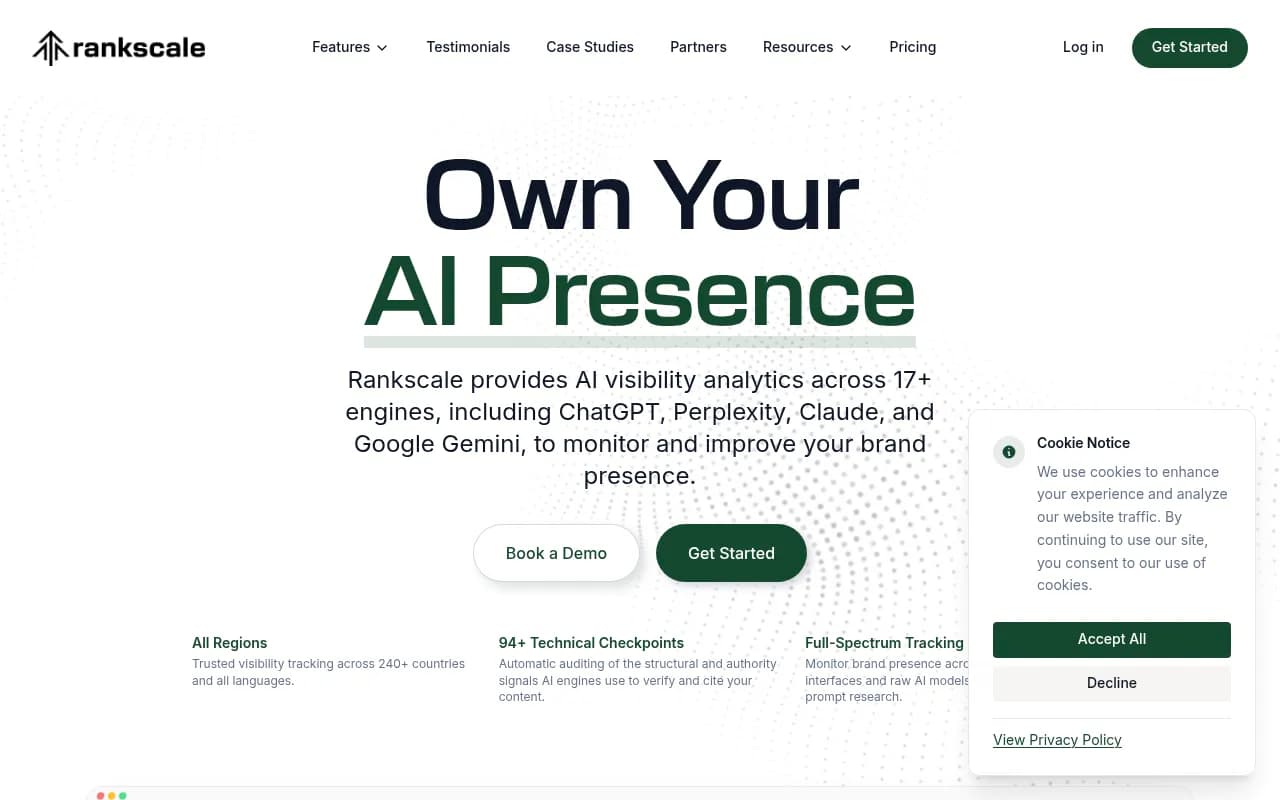
- Rankscale covers 17+ AI engines with granular prompt tracking, citation analysis, sentiment scoring, and competitor benchmarking -- solid breadth for a monitoring tool
- Lacks content generation, AI crawler logs, traffic attribution, and answer gap analysis that Promptwatch provides -- Rankscale shows you the data but stops short of helping you act on it
- Credit-based pricing starting around €20 makes it accessible for small agencies and freelancers managing multiple clients at different budget levels
- Strong agency fit: whitelabel reporting, flexible credit allocation per client, and an active Slack community are genuine differentiators
- Page audit feature (200+ factors, 94+ technical checkpoints) goes deeper than most competitors on the technical side
Rankscale is an AI search visibility platform built by Mathias Ptacek, a former corporate tech and marketing professional who started the project in October 2024. The core problem it addresses is one that every SEO team is now wrestling with: traditional rank trackers tell you nothing about how your brand appears in ChatGPT, Perplexity, or Google's AI Mode. Rankscale fills that gap by running your prompts across 17+ AI engines and surfacing where you appear, how you're cited, and how your sentiment compares to competitors.
The company incorporated as Rankscale GmbH in Germany in July 2025 and has grown to 1,000+ active users, with clients including Bosch, UBS, Cartier, O2, SiteGround, and agencies like Dentsu, WPP Media, and Publicis Sapient. That's a respectable roster for a tool that was in early access less than 18 months ago. The team tripled in size in early 2026, which suggests the product is past the "will it survive?" phase and into genuine scaling mode.
The target audience is marketing teams, SEO professionals, and digital agencies that need to report on AI search performance to clients or internal stakeholders. The credit-based pricing model is specifically designed for agencies managing clients with different budgets -- a thoughtful choice that sets it apart from the flat-subscription approach most competitors use.
Key features
Brand Visibility Dashboard The central hub shows your AI visibility score across all tracked engines, with the ability to slice by model, timeframe, and topic. You can manage multiple brands from one interface, which matters for agencies. The dashboard tracks share of voice, brand mentions, and citation frequency, and lets you compare trends over time. It's the kind of view that makes sense to screenshot for a client report.
AI Rank Tracker This is the core tracking engine. You define prompts (questions your target audience might ask AI engines), and Rankscale runs them across the supported models on a schedule you control -- up to 8 monitoring frequencies, including what appears to be hourly tracking. For each prompt, you get visibility scores, rankings, sentiment, and historical trend charts with actionable recommendations. The recommendations are a nice touch, though they're more "here's what to fix" than "here's the content to create."
Competitor Analysis Rankscale auto-identifies competitors appearing in AI responses for your tracked prompts. You can then compare AI visibility scores, citation counts, and sentiment side by side. The "uncover ranking gaps and strategic advantages" framing is accurate -- seeing that a competitor is cited 3x more often for a specific prompt category is genuinely useful intelligence. This is one of the stronger features in the product.
Citation Analysis When an AI engine cites a source in its response, Rankscale captures that citation and connects it back to your brand visibility. You can see which URLs are being cited, how often, and across which models. This helps answer the question "why is my competitor winning for this prompt?" -- often the answer is a specific piece of content or a third-party mention that's getting picked up. The citation data is presented at the source URL level, which is more useful than aggregate counts alone.
Sentiment Analysis Rankscale tracks how AI engines describe your brand -- positive, neutral, or negative -- and surfaces the specific keyword themes driving each sentiment direction. You can monitor sentiment by brand, topic, and model separately, which matters because Claude and ChatGPT don't always agree on how to characterize a brand. Competitor sentiment comparison is included, so you can see if a rival is being described more favorably and investigate why.
Page Audits The audit feature checks 200+ factors and 94 technical checkpoints related to AI readiness. This covers AI bot crawlability, site hierarchy, structured data, and technical SEO signals that AI engines use to verify and cite content. The output is an AI readiness score broken down by priority, with specific fixes. This is one of the more differentiated features -- most AI visibility tools don't go this deep on the technical side.
Prompt Research Rankscale estimates prompt search volume through semantic reconstruction and decodes intent and prompt density. The goal is to help you prioritize which prompts to track and optimize for. It's described as "LLM Native," meaning it's built around how people actually query AI engines rather than traditional keyword search patterns. Volume estimates in this space are inherently approximate (no one has ground truth data on ChatGPT query volumes), but having a relative prioritization signal is better than nothing.
Whitelabel and team features Rolled out in June 2025, the whitelabel solution lets agencies present Rankscale data under their own branding. Combined with the credit-based model that allows different tracking budgets per client, this is a genuine agency-first feature set that competitors like Otterly.AI and Peec.ai don't match.
Who is it for
Rankscale fits best with SEO agencies managing 5-30 client accounts who need a cost-effective way to report on AI search performance without paying enterprise prices for every client. The credit system means you can give a small local business client a basic AI visibility report for a few euros while running deeper tracking for your larger accounts. Several testimonials from agency owners specifically call out this flexibility as the deciding factor.
In-house SEO teams at mid-market brands (think SiteGround, Facile.it, or O2 -- all listed as users) will find the competitor benchmarking and sentiment tracking useful for quarterly reporting and content strategy. The page audit feature is particularly relevant for teams that have a developer or technical SEO resource who can act on the crawlability and structured data recommendations.
Publishers and media companies are a less obvious but real use case. The site lists APA and Frankfurter Allgemeine as users, which makes sense -- publishers need to know if AI engines are citing their content and whether that citation is driving brand recognition or being attributed to competitors.
Who should probably look elsewhere: teams that need to close the loop between monitoring and content creation. Rankscale tells you where you're invisible and what competitors are doing better, but it doesn't generate the content to fix those gaps. If your workflow requires going from "we're missing visibility for these 20 prompts" to "here are the articles to write," you'll need a separate tool or a manual process. Teams that need AI crawler log data -- seeing exactly which pages AI bots are crawling, how often, and what errors they're hitting -- won't find that here either.
Integrations and ecosystem
Rankscale's integration story is relatively lean at this stage. The platform supports data export, which several agency users mention using to build client reports. There's no native Looker Studio connector or API documented publicly, though the credit-based system and whitelabel features suggest some level of programmatic access may exist for enterprise customers.
The active Slack community is mentioned repeatedly in testimonials as a genuine differentiator -- users describe it as a place where the founding team is responsive and where feature requests actually get implemented. For a tool at this stage of development, that kind of direct access to the product team has real value.
No browser extension or mobile app is mentioned. The platform is web-based. HubSpot is used for demo booking, which is a minor but telling detail about the current sales motion.
Pricing and value
Rankscale uses a credit-based pricing model starting from €20, which is notably different from the flat-subscription approach of most competitors. The pricing page at rankscale.ai/pricing lists plans described as Pro, Agency Growth, and Enterprise, though specific credit amounts and monthly prices weren't fully available in public sources at time of review.
What's clear from user testimonials and the FAQ is that the credit system allows agencies to allocate different tracking budgets across clients -- running daily updates for high-priority accounts and weekly for smaller ones. This is genuinely useful for agencies that would otherwise be forced to pay for a tier that covers their biggest client even when most clients need much less.
The €20 entry point makes Rankscale accessible to freelancers and solo consultants who want to offer AI visibility tracking as a service without a large upfront commitment. For comparison, most dedicated AI visibility platforms start at $99-$249/month for their entry tiers.
A free trial or demo is available via the "Get Started" signup flow and the HubSpot demo booking link.
Strengths and limitations
What Rankscale does well:
- Breadth of AI engine coverage: 17+ engines including ChatGPT, Perplexity, Claude, Gemini, AI Overviews, AI Mode, DeepSeek, Grok, Copilot, and Mistral. Most competitors cover 5-8 engines.
- Technical page audits: The 200+ factor, 94-checkpoint audit is deeper than anything comparable tools offer. It's the kind of feature that gives SEO teams something concrete to act on.
- Agency-friendly pricing: The credit model with per-client budget allocation is a real differentiator. No other tool in this space has solved the "how do I offer this to small clients without losing money" problem as cleanly.
- Sentiment analysis depth: Tracking sentiment by brand, topic, and model separately -- with keyword-level themes -- goes beyond the binary positive/negative scoring most tools provide.
- Responsive team and community: Multiple independent testimonials specifically praise the founding team's responsiveness and the Slack channel. For a fast-moving product category, this matters.
Honest limitations:
- Monitoring only -- no content generation or gap analysis: Rankscale shows you where you're invisible and what competitors are doing, but it doesn't help you create the content to close those gaps. There's no equivalent to Promptwatch's Answer Gap Analysis or Content Agents. You get the diagnosis without the prescription.
- No AI crawler logs: Rankscale doesn't show you which pages AI bots are actually crawling, how often, or what errors they're encountering. This is a meaningful gap for teams trying to understand why certain pages aren't being cited despite appearing technically sound.
- No traffic attribution: There's no way to connect AI visibility improvements to actual website traffic or revenue. You can see your citation score go up, but you can't tie that to sessions, conversions, or pipeline. Promptwatch's visitor analytics and traffic attribution fill this gap.
- No Reddit or YouTube tracking: AI engines heavily cite Reddit threads and YouTube videos. Rankscale doesn't surface which off-site content is influencing AI recommendations for your category -- a blind spot that matters for brands in competitive consumer categories.
Bottom line
Rankscale is a well-built monitoring tool with genuine strengths in engine breadth, technical auditing, and agency-friendly pricing. For freelancers and small agencies that need to report on AI search performance without a large budget, it's one of the more practical options available in 2026. The credit model is genuinely clever and the page audit feature is deeper than most competitors.
The limitation is that it stops at monitoring. If you need to go from "here's where you're invisible" to "here's the content that will fix it" -- with AI crawler logs, traffic attribution, and content generation built into the same workflow -- Promptwatch is the stronger choice. Rankscale is best suited for teams that want solid visibility data and are comfortable handling the content strategy and creation work separately.
Best use case in one sentence: SEO agencies managing multiple clients at different budget levels who need clean, exportable AI visibility reports across 17+ engines without paying enterprise prices for every account.
Frequently asked questions
What is Rankscale?
How much does Rankscale cost?
How does Rankscale differ from traditional SEO tools?
Can Rankscale generate content to improve AI visibility?
Is Rankscale good for agencies?
How many AI engines does Rankscale monitor?
Similar and alternative tools to Rankscale