AirOps Review 2026
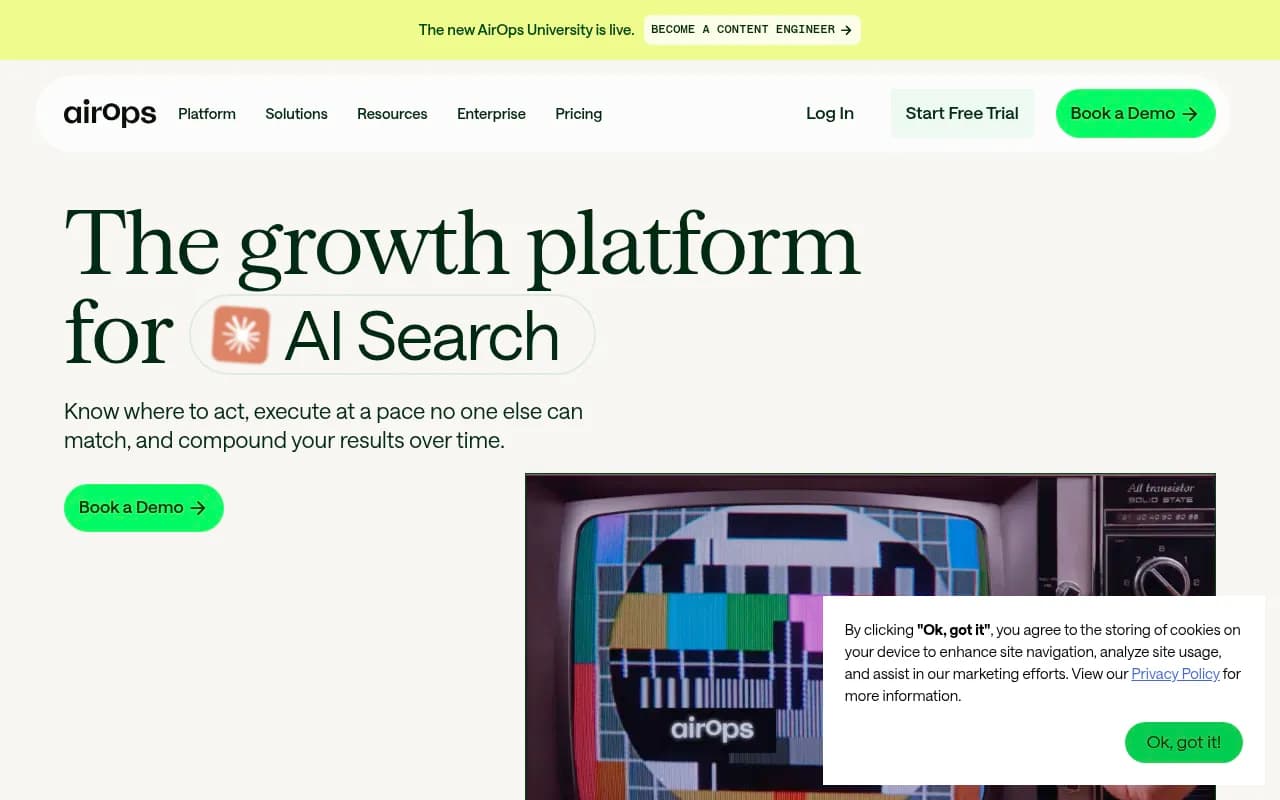
AI-powered content and workflow platform that helps teams create and optimize content for visibility in both traditional and AI-driven search engines.
Key takeaways
- AirOps combines AI search visibility tracking with content execution -- it's not just a monitoring dashboard, it helps teams actually create and refresh content to improve LLM citations
- Lacks several capabilities found in Promptwatch: no AI crawler logs, no prompt volume/difficulty scoring, no query fan-outs, no ChatGPT Shopping tracking, and no Reddit/YouTube citation tracking
- Quill, AirOps' AI agent, handles content creation and refresh workflows but requires significant setup and brand configuration to produce on-brand output
- Strong enterprise customer base (Webflow, Carta, Chime, Ramp, Apollo, Angi) with documented case study results
- Pricing starts at $200/month for Solo and jumps to $2,000/month for Pro -- a steep gap that leaves mid-market teams with limited options
- Free Insights tier available, but meaningful execution features require paid plans
AirOps started as an AI workflow builder for content teams and has since repositioned itself as a full "growth platform for AI search." The company, based in the US, has attracted a notable roster of enterprise customers and has built a product that genuinely tries to close the loop between visibility data and content execution. That's a meaningful distinction in a market where most tools stop at showing you a dashboard.
The core pitch is what AirOps calls the "Winning Loop": see where you stand in AI search, identify what to create or refresh, execute with Quill (their AI agent), and measure the results. It's a sensible framework, and the case studies suggest it works -- Chime reportedly went from being cited in 24 to 68 priority questions, Webflow saw a 500% increase in AI-attributed signups, and Carta achieved a 7x increase in AI search citations. Whether those numbers are typical or cherry-picked is hard to verify, but the pattern across multiple enterprise customers is at least consistent.
The target audience is marketing and SEO teams at mid-market to enterprise SaaS companies, particularly those already investing in content programs and looking to extend that investment into AI search. AirOps University, their certification program, and the "Content Engineer" framing suggest they're also trying to define a new professional category -- which is either visionary or a marketing play, depending on your cynicism level.
Key features
Quill, the AI agent captain
Quill is AirOps' central execution layer, introduced in May 2026. You write a strategy brief, add brand context, and Quill takes over -- drafting content, managing refresh workflows, and looping in human reviewers at the right checkpoints. In practice, this means Quill can handle the repetitive work (updating internal links, refreshing outdated sections, adding key takeaways) while your team focuses on strategic decisions. The "captain" framing is deliberate: Quill coordinates other agents and tools rather than just being a single writing assistant. How well this works in practice depends heavily on how thoroughly you've configured your Brand Kit.
Insights and citation tracking
AirOps tracks your brand's visibility across ChatGPT, Perplexity, Gemini, Google AI Overviews, and Claude. The Insights dashboard shows share of voice, citation frequency, and competitor comparisons across these platforms. There's a free tier for Insights starting at $0/month with 1,000 tasks, which gives teams a low-risk way to start monitoring before committing to paid execution features. The tracking covers both onsite citations (your own pages being referenced) and offsite mentions (third-party sources driving AI visibility).
Content gap analysis
AirOps monitors your content gaps in the background and surfaces opportunities proactively. This is one of the more useful features -- rather than manually auditing what topics you're missing, the platform flags where competitors are getting cited and you're not. The gap analysis feeds directly into Quill's content creation queue, so there's a reasonably tight loop between identifying a gap and acting on it.
Playbooks and Workflows
Playbooks are AirOps' term for repeatable content processes -- think "content refresh every 90 days" or "new product launch content sequence." Workflows are the underlying automation layer. The distinction matters because Playbooks are designed to be run repeatedly with minimal setup, while Workflows are more flexible but require more configuration. For teams managing large content libraries, Playbooks are the more practical entry point.
Offsite strategy
AirOps claims that up to 85% of AI visibility comes from content you don't own -- third-party sites, review platforms, industry publications. Their Offsite feature helps teams identify which external sources are driving citations in their category, find placement opportunities on those sites, and track the impact of each placement. This is a genuinely useful capability that many monitoring-only tools ignore entirely. That said, AirOps doesn't appear to track Reddit or YouTube specifically as citation sources, which are increasingly influential in AI model training and responses.
Brand Kit
Brand Kit is a centralized brand governance layer that feeds into every Quill output, workflow, and agent action. You define your brand voice, terminology, messaging guidelines, and content standards once, and the system applies them consistently across all generated content. This addresses one of the real problems with AI-generated content at scale: brand drift. The CMO of Carta specifically called this out in their testimonial -- "scaling without losing our brand's human touch."
Grids
Grids appear to be AirOps' structured data layer for managing content at scale -- essentially a spreadsheet-like interface for tracking content assets, their status, and their performance. For teams managing hundreds of pages, having a structured view of what exists, what needs refreshing, and what's performing is genuinely useful.
AirOps University and community
AirOps has invested in education and community in a way that most competitors haven't. The University offers certification in "Content Engineering," there's an active Slack community, a Champions program for practitioners, and a dedicated research team publishing reports on AI search trends. This ecosystem matters because AI search is changing fast and teams need ongoing guidance, not just software.
Who is it for
AirOps is best suited for marketing and SEO teams at growth-stage to enterprise SaaS companies that already have a content program and want to extend it into AI search. Think: a content team of 3-10 people at a B2B SaaS company with 200+ published pages, already investing in SEO, now trying to figure out why their competitors are getting cited in ChatGPT and they're not. Webflow, Carta, Chime, and Ramp are the clearest examples of the target customer -- well-funded, content-mature, and operating in competitive categories where AI search visibility is becoming a meaningful acquisition channel.
Marketing agencies managing multiple clients are also a stated target, with a dedicated agency solution. The Playbooks and Workflows architecture makes it feasible to run similar processes across multiple client accounts, though the pricing structure (per-site or per-account) can add up quickly at agency scale.
Who should probably look elsewhere: small businesses or solo marketers who don't have an existing content program to build on. AirOps assumes you have content to refresh and a team to review AI-generated drafts. If you're starting from scratch with limited resources, the $200-$2,000/month price range is hard to justify. Similarly, teams that primarily need monitoring and reporting without execution -- perhaps because they have a separate content team or agency -- may find the platform over-engineered for their needs.
Integrations and ecosystem
AirOps has built out a notable integration layer. The recently launched AirOps MCPs (Model Context Protocol connectors) allow the platform to connect to other tools in your stack and make updates via Claude, keeping workflows in tools teams already use. This is a smart move -- it reduces the friction of adopting a new platform by meeting teams where they already work.
The platform integrates with Google Search Console for traditional SEO data, and the Insights layer pulls from multiple AI search platforms. There's a Slack community (the AirOps Builders community) for peer support and knowledge sharing. Documentation is available at docs.airops.com.
An affiliate program exists via Rewardful, suggesting some investment in partner channels. The job board and Experts marketplace indicate AirOps is building a services ecosystem around the platform.
No public API documentation was prominently featured in the scraped content, though the MCP connectors suggest API-level access is available for enterprise customers. Export capabilities and CMS integrations (Webflow is a customer, which suggests some level of CMS connectivity) appear to exist but aren't prominently documented in public-facing materials.
Pricing and value
Pricing is a notable friction point for AirOps. Based on available information:
- Insights (Free): Starting at $0/month, 1,000 tasks -- covers basic visibility monitoring
- Solo: $200/month -- entry-level paid plan with execution features
- Pro: $2,000/month -- full platform access with advanced execution capabilities
- Enterprise: Custom pricing, with dedicated services and hands-on support
The jump from $200 to $2,000 is steep. There's no obvious mid-tier option for teams that need more than Solo but can't justify Pro pricing. This is a real gap -- a $500-$800/month tier would serve a lot of the mid-market companies that are the natural fit for this product.
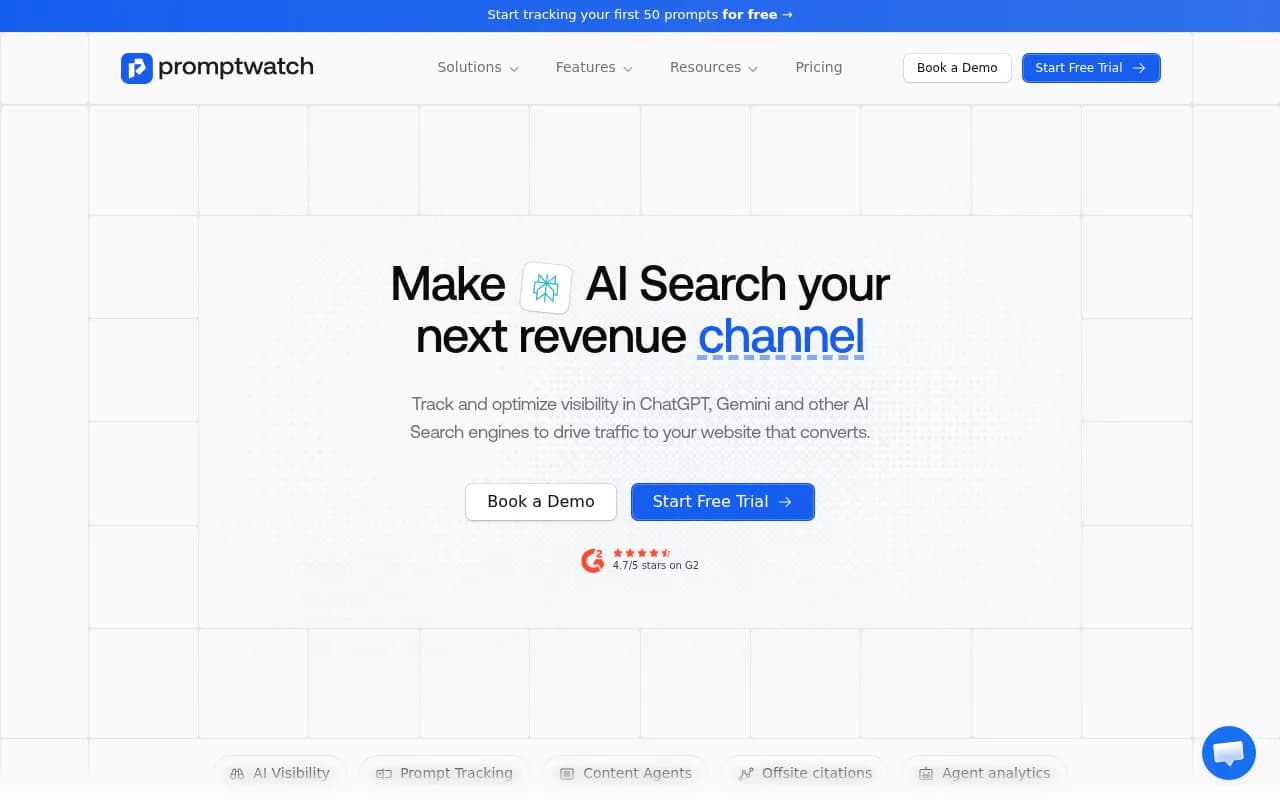
For comparison, Promptwatch offers its Professional plan at $249/month and Business at $579/month, with more granular tier options that don't force teams into a $2,000 commitment to access advanced features.
The free Insights tier is genuinely useful as a trial mechanism -- you can start tracking visibility before committing to paid execution features. AirOps also offers a free trial for paid plans.
For enterprise customers with large content libraries and dedicated marketing teams, the Pro pricing is defensible if the case study results are replicable. For everyone else, the Solo plan's limitations may push teams toward the Pro tier faster than expected.
Strengths and limitations
What AirOps does well:
- Content execution, not just monitoring: The Quill agent and Playbooks architecture genuinely close the loop between visibility data and content action. Most competitors show you a dashboard; AirOps helps you do something about it.
- Enterprise customer validation: The case studies from Webflow, Carta, Chime, Ramp, and Apollo are specific and credible. A 3x increase in AI citations for Chime and 7x for Carta are meaningful numbers.
- Brand governance at scale: The Brand Kit approach to maintaining brand consistency across AI-generated content is well-thought-out and addresses a real problem.
- Offsite visibility strategy: Acknowledging that 85% of AI visibility comes from third-party sources and building tooling around that is a more complete view of AI search than most competitors offer.
- Education and community investment: AirOps University and the Champions program give teams ongoing support that pure software tools don't provide.
Where it falls short:
- No AI crawler logs: AirOps doesn't appear to offer real-time logs of AI crawlers hitting your website -- which pages they read, errors they encounter, how often they return. This is a significant gap for teams trying to understand how AI engines discover and index their content. Promptwatch offers this natively.
- No prompt volume or difficulty scoring: AirOps doesn't surface data on how often specific prompts are asked or how competitive they are. Without this, prioritization relies on qualitative judgment rather than data. Promptwatch's Prompt Intelligence feature provides volume estimates and difficulty scores.
- No Reddit or YouTube tracking: These are increasingly important citation sources for AI models, and AirOps doesn't appear to track them. Promptwatch surfaces Reddit discussions and YouTube content that directly influence AI recommendations.
- No ChatGPT Shopping tracking: For e-commerce or product-led brands, ChatGPT's shopping recommendations are a meaningful channel. AirOps doesn't appear to cover this.
- Pricing gap: The jump from $200 to $2,000/month leaves mid-market teams with limited options.
- No query fan-outs: Understanding how one prompt branches into sub-queries is important for content strategy, and this capability isn't visible in AirOps' feature set.
Bottom line
AirOps is a serious platform for enterprise marketing teams that want to move beyond monitoring and actually execute an AI search strategy. The Quill agent, Playbooks, and Brand Kit architecture are genuinely differentiated, and the customer results are credible. If you're a content-mature SaaS company with a dedicated marketing team and budget to match, AirOps is worth evaluating seriously.
That said, for teams that need deeper diagnostic capabilities -- AI crawler logs, prompt volume data, Reddit/YouTube tracking, ChatGPT Shopping visibility, and query fan-outs -- Promptwatch covers more ground at a lower price point, particularly at the mid-market tier. AirOps is strong on execution; Promptwatch is stronger on intelligence. The best use case for AirOps in one sentence: a B2B SaaS marketing team of 5+ people that already has a content program and needs an AI agent to scale content refresh and creation for AI search visibility.
Frequently asked questions
What is AirOps?
How much does AirOps cost?
Who uses AirOps?
How is AirOps different from monitoring-only tools?
Does AirOps have a free plan?
What AI search engines does AirOps track?
Similar and alternative tools to AirOps