Ahrefs Brand Radar Review 2026
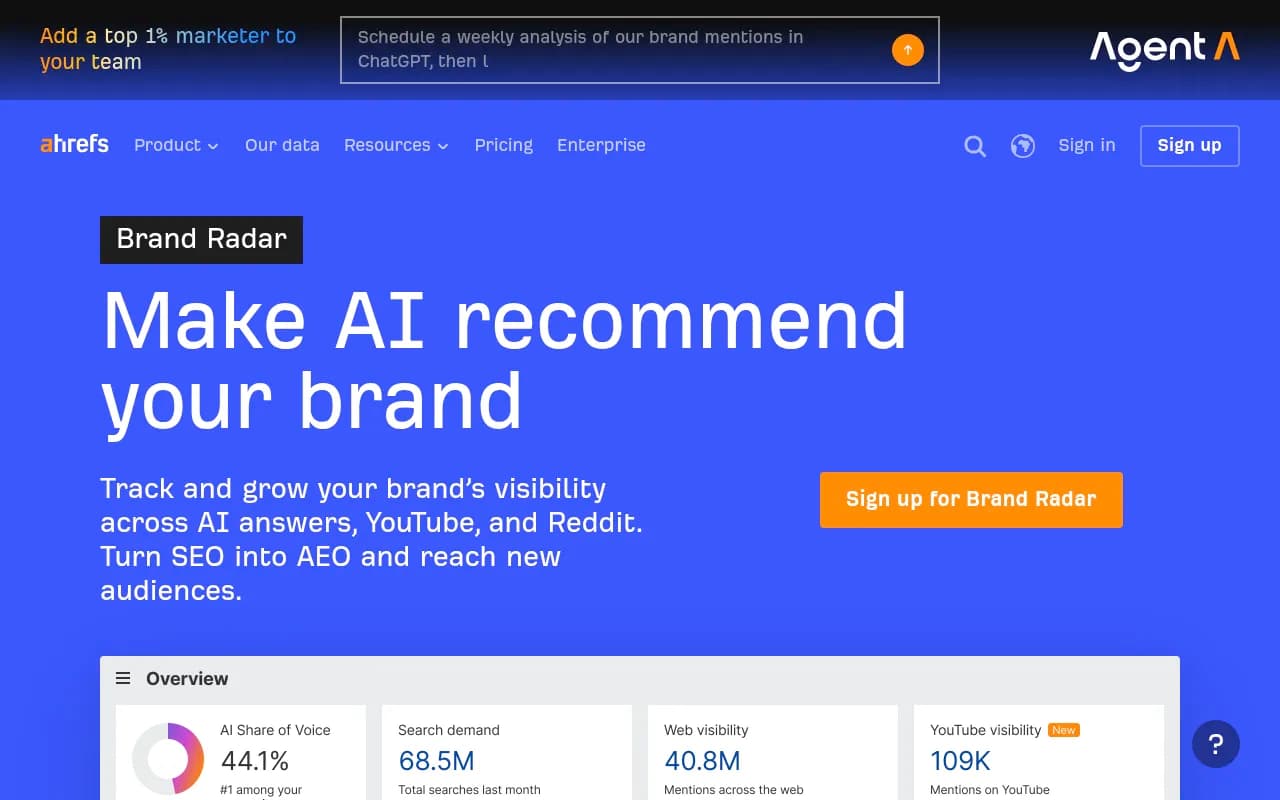
Ahrefs Brand Radar monitors how your brand appears in AI search outputs, extending Ahrefs' existing SEO data set into the AI visibility space.
Key takeaways
- Ahrefs Brand Radar is a monitoring-focused AI visibility tool built on top of Ahrefs' existing SEO data, covering 6 AI platforms with 386M+ organic prompts
- Lacks content generation, AI crawler logs, traffic attribution, and answer gap analysis that Promptwatch provides -- it shows you where you're visible but doesn't help you fix gaps
- Strong differentiator: prompt database is derived from real search data, not synthetic queries, which makes coverage feel more grounded than competitors using made-up prompts
- Pricing starts at $398/mo for select platforms or $699/mo for full access -- expensive for what is essentially a monitoring dashboard
- Best suited for established brands and SEO teams already inside the Ahrefs ecosystem who want a quick read on AI visibility without switching tools
Ahrefs Brand Radar is the AI visibility add-on from Ahrefs, the Singapore-based SEO software company that's been a fixture in the industry since 2011. The product extends Ahrefs' core data infrastructure into the AI search space, letting users track how their brand appears in AI-generated answers across platforms like ChatGPT, Perplexity, Google AI Overviews, Gemini, Microsoft Copilot, and Grok. It's positioned as a natural extension for existing Ahrefs customers who are already using the platform for keyword research, backlink analysis, and site auditing.
The pitch is straightforward: as AI search engines increasingly answer queries without sending users to websites, brands need to know whether they're being mentioned, recommended, or ignored. Brand Radar plugs into that concern by offering a monitoring layer on top of Ahrefs' existing 386M+ prompt database, which the company says is derived from real organic search queries rather than synthetically generated prompts. That distinction matters -- synthetic prompts can miss the actual questions real users are asking, so grounding the database in search behavior is a meaningful design choice.
The target audience is primarily SEO professionals and digital marketing teams at mid-to-large companies who are already Ahrefs subscribers and want to extend their workflow into AI visibility without adopting a separate platform. It's also being used by agencies managing multiple client brands, given the "unlimited projects" capability that lets you analyze any domain without additional setup.
Key features
Search-backed prompt database Brand Radar's core claim is that its 386M+ monthly prompts come from real search data, not synthetic generation. The breakdown across platforms is specific: 283M+ for AI Overviews, 32M for AI Mode, 14.7M each for ChatGPT and Gemini, 14.7M for Perplexity, 13.4M for Copilot, and 13.1M for Grok. This is a meaningful differentiator against tools that generate their own prompt lists, which can feel arbitrary. The tradeoff is that the database reflects what people search for, not necessarily the conversational queries they type into ChatGPT directly -- those can look quite different.
Multi-platform AI visibility tracking Brand Radar covers six AI platforms: Google AI Overviews, Google AI Mode, ChatGPT, Perplexity, Microsoft Copilot, and Gemini. You can either subscribe to all platforms at once or pick individual ones. For each platform, you get visibility scores, mention frequency, and the ability to see actual AI-generated responses where your brand appears. Grok is listed in the prompt database numbers but doesn't appear as a separately selectable platform in the current pricing structure, which is a bit confusing.
Competitor benchmarking You can compare your brand's AI visibility against competitors side by side. The benchmarking view shows which brands are appearing more frequently across AI answers for the same prompts, which is useful for understanding your relative position. This is table-stakes functionality for any AI visibility tool, and Brand Radar handles it cleanly.
AI citation tracking Brand Radar surfaces the specific sources that AI models are citing when they mention your brand. This includes web pages, but also YouTube videos, Reddit threads, and TikTok content. Knowing which external sources are driving AI recommendations is genuinely useful -- it tells you where to focus offsite content efforts. The YouTube and Reddit tracking in particular is a nice touch, since those platforms have outsized influence on AI recommendations and most SEO tools ignore them entirely.
YouTube, Reddit, and TikTok source analysis This is one of the more interesting features. Brand Radar scans YouTube thumbnails, video titles, descriptions, and transcripts; Reddit results in Google including subreddit snippets; and TikTok content. These are labeled as "free while in beta," which suggests they may eventually be priced separately. For brands where community content and video heavily influence AI recommendations, this is a real advantage over tools that only look at web citations.
Custom prompts Beyond the organic prompt database, you can add your own questions to track how your brand appears for specific queries. The $699/mo "All platforms" plan includes 2,500 custom prompt checks per month. Custom prompts are also available as a separate add-on purchase. This is important for brands with niche use cases or specific product categories that might not be well-represented in the organic search-derived database.
Zero-setup research Brand Radar is designed to work without any site verification or tracking code installation. You can look up any brand's AI visibility instantly, which makes it useful for competitive research and agency pitches. The "unlimited projects" framing means you're not paying per domain, which is a practical advantage for agencies or teams tracking many brands.
Web visibility and search demand data Alongside AI visibility, Brand Radar surfaces traditional web visibility metrics and search demand data, pulling from Ahrefs' existing keyword and traffic databases. This gives context -- you can see whether a brand's AI visibility correlates with its organic search presence, or whether there are gaps between the two.
Who is it for
Brand Radar fits best for SEO teams at mid-to-large companies who are already paying for Ahrefs and want to add AI visibility monitoring without adopting a new vendor. Think an in-house SEO team at a consumer brand with 10-50 people in marketing, already using Ahrefs for keyword tracking and backlink analysis. For them, Brand Radar is a logical extension -- same interface, same data philosophy, no new login.
Agencies managing multiple client brands will also find the unlimited projects model appealing. If you're running quarterly AI visibility reports for 15 clients, not having to pay per domain matters. The zero-setup research capability also makes it easy to pull together competitive snapshots quickly, which is useful for new business pitches or client check-ins.
That said, Brand Radar is probably not the right fit for teams that need to act on what they find. If your goal is to identify content gaps and then create content that fills them, Brand Radar stops at the identification step. It tells you where you're not showing up, but it doesn't help you figure out what to write or generate that content. Teams with a dedicated content operation might find the monitoring data useful as an input, but they'll need other tools to do anything with it.
Smaller brands or startups with limited budgets should also think carefully. At $398-699/mo, Brand Radar is priced for companies that can absorb that cost as part of a broader Ahrefs subscription. If you're not already an Ahrefs customer, the value proposition gets thinner -- you'd be paying a premium for monitoring-only functionality.
Integrations and ecosystem
Brand Radar lives inside the Ahrefs platform, so it inherits whatever integrations Ahrefs already supports. There's no standalone app or separate login -- you access it through your existing Ahrefs account. This is convenient if you're already there, but it means Brand Radar has no independent integration story.
Ahrefs does offer a developer API for accessing its broader data set, though Brand Radar-specific API access isn't prominently documented. Export functionality appears to be available (the Octopus Energy case study mentions exporting data directly), but the specifics of export formats and destinations aren't detailed on the product page.
There's no mention of native integrations with Slack, Google Data Studio/Looker Studio, or other reporting tools. For teams that want to pipe AI visibility data into dashboards or automated reports, this is a gap. You'd likely need to handle that manually or through Ahrefs' general API.
No browser extension or mobile app is specific to Brand Radar. The product is web-based and accessed through the main Ahrefs interface.
Pricing and value
Brand Radar is priced as an add-on to an existing Ahrefs subscription:
- Select platforms: $398/mo -- choose individual AI platforms from the available six
- All platforms: $699/mo -- full access to 386M+ organic prompts across all platforms, plus 2,500 custom prompt checks per month
- Both plans include YouTube, TikTok, and Reddit tracking free while in beta, plus search demand and web visibility data
- Custom prompts are available as a separate add-on purchase beyond the 2,500 included in the All Platforms plan
Annual billing likely carries a discount (Ahrefs offers 20% off on annual plans for its core products), though this isn't explicitly stated for Brand Radar on the product page.
For context, this puts Brand Radar in a similar price range to Promptwatch's Professional ($249/mo) and Business ($579/mo) tiers, but Promptwatch includes content generation, AI crawler logs, traffic attribution, and answer gap analysis at those price points. Brand Radar at $699/mo is monitoring only.
Compared to other AI visibility tools, Brand Radar's pricing is on the higher end for a monitoring-only product. The value case rests on the quality and scale of the prompt database (386M+ prompts is genuinely large) and the convenience of staying within the Ahrefs ecosystem. If you're already paying for Ahrefs and trust their data, the incremental cost may feel reasonable. If you're evaluating standalone, the math is harder to justify.
Strengths and limitations
What it does well:
- The search-backed prompt database is a genuine differentiator. 386M+ prompts derived from real organic search behavior is a more credible foundation than synthetic prompt generation, and the scale is impressive.
- YouTube, Reddit, and TikTok source tracking is ahead of most competitors. Understanding which community content is driving AI recommendations is a real insight that most tools miss.
- Zero-setup research and unlimited projects make it practical for agencies and teams doing competitive analysis at scale.
- The Ahrefs ecosystem integration means existing customers get AI visibility data alongside their existing SEO metrics without context-switching.
Honest limitations:
- Monitoring only -- no optimization. Brand Radar tells you where you're visible and where you're not. It doesn't help you close those gaps. There's no answer gap analysis, no content brief generation, no AI content writing tools. For teams that want to actually improve their AI visibility, not just measure it, this is a significant gap. Tools like Promptwatch are built around the full loop: find gaps, create content, track results.
- No AI crawler logs or traffic attribution. Brand Radar doesn't show you which AI crawlers are hitting your site, which pages they're reading, or whether AI visibility is translating into actual traffic and revenue. You can see that you're being cited, but you can't connect that to business outcomes.
- Fixed prompts with no gap analysis. The prompt database is large, but it's fixed -- you can't run an analysis that shows you which prompts your competitors rank for that you don't. There's no structured answer gap analysis that surfaces actionable content opportunities. Custom prompts help, but you have to know what to ask.
- Grok coverage is inconsistent. Grok appears in the prompt database statistics but isn't clearly available as a selectable platform in the pricing tiers, which creates confusion about actual coverage.
- No prompt volume or difficulty scoring. You can't prioritize which prompts to target based on search volume or how hard they are to win. This makes it harder to focus optimization efforts strategically.
Bottom line
Ahrefs Brand Radar is a solid monitoring tool for teams already inside the Ahrefs ecosystem who want a quick, data-rich read on their AI visibility. The search-backed prompt database is genuinely large and credibly sourced, and the YouTube/Reddit/TikTok source tracking is a real differentiator. If you're an Ahrefs customer who wants to add AI visibility to your existing workflow without adopting a new platform, it's a reasonable add-on.
But if your goal is to actually improve your AI visibility -- not just measure it -- Brand Radar stops short. It has no content gap analysis, no AI content generation, no crawler logs, and no traffic attribution. For teams that need to close the loop from "we're not showing up" to "here's what we published and here's how visibility changed," Promptwatch covers the full cycle that Brand Radar leaves incomplete.
Best use case: Established brands with existing Ahrefs subscriptions that want to add AI visibility monitoring to their current SEO reporting stack without switching tools.
Frequently asked questions
What is Ahrefs Brand Radar?
How much does Ahrefs Brand Radar cost?
How does Ahrefs Brand Radar differ from other AI visibility tools?
Does Ahrefs Brand Radar help you improve AI visibility or just track it?
Which AI platforms does Brand Radar cover?
Is there a free version of Ahrefs Brand Radar?
Similar and alternative tools to Ahrefs Brand Radar