Airtop Review 2026
Runs AI agents that browse and extract data from the web, useful for building custom AI search visibility workflows and tracking brand presence at scale.
Key takeaways
- Airtop is a no-code AI agent platform built specifically for sales and marketing teams, centered around an AI assistant called "Mark" that handles everything from lead research to campaign execution
- The platform goes well beyond simple web scraping -- it manages Google Ads, enriches contacts, verifies emails, and runs outbound sequences end-to-end
- Pricing starts free, with paid plans reportedly up to around $342/month, making it accessible for small teams and startups
- Strong integration ecosystem covering Apollo, Clay, ZoomInfo, n8n, Make, Salesloft, and more
- Best suited for growth-stage B2B companies and marketing teams who want to consolidate their GTM stack; less suited for developers who want raw API control or enterprises with complex compliance workflows
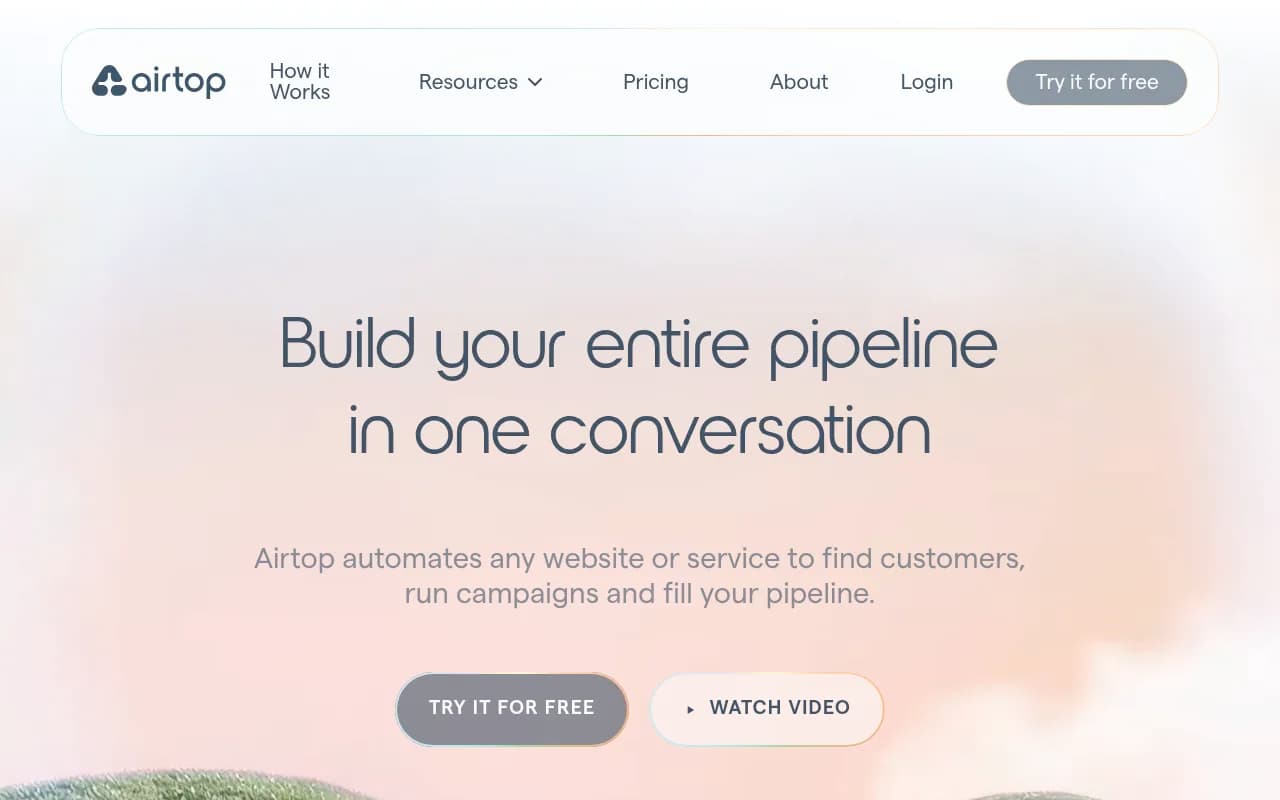
Airtop is a sales and marketing automation platform that lets you describe what you want to automate in plain language, then builds and runs AI agents to do it. The core pitch is simple: instead of stitching together Clay, Zapier, enrichment APIs, and a dozen SaaS tools, you tell Airtop what your pipeline needs and it handles the rest. The company positions itself squarely against developer-focused tools like Claude Code and OpenAI Codex, arguing that marketers shouldn't need to write code to automate their workflows.
The platform's central character is Mark, an AI marketer that Airtop describes as doing "the work of an entire GTM agency." Mark researches your product, identifies your ICP, proposes campaigns, builds the agents, runs them, and monitors results. It's an ambitious claim, and the reality is more nuanced -- but the direction is genuinely interesting. Airtop is trying to be the operating system for a modern marketing team, not just another point solution.
Customers listed on the site include Huel, FINN, Salespeak, and Flock, suggesting the platform has traction with growth-stage companies across e-commerce, fintech, and SaaS. The platform is SOC 2 Type II certified and HIPAA compliant, which opens doors to more regulated industries.
Key features
Mark, the AI marketer
Mark is Airtop's conversational AI layer that sits on top of all the platform's automation capabilities. You describe your business, your ICP, and what you want to achieve, and Mark proposes a campaign structure, selects channels, and builds agents to execute. In practice, this means you can go from "I want to find SaaS companies in the US with 50-200 employees that recently raised a Series A" to a running prospecting workflow without touching a line of code. One customer testimonial specifically calls out Mark handling "campaign structure, keyword research, and deployment, all in one shot" for Google Ads -- which is a genuinely useful use case that most AI tools can't touch.
Web automation and scraping
Airtop can interact with websites behind logins, scrape structured data, and take actions on web pages. This is more capable than simple web search -- the agents can navigate authenticated sessions, fill forms, extract data from dynamic pages, and interact with tools that don't have APIs. The platform uses a "code-first" approach to agent building, meaning the underlying agents run as deterministic code rather than relying on LLM reasoning at every step. This matters for reliability: agents that use AI at every decision point tend to fail unpredictably, while code-first agents behave consistently.
Unified contact database
Airtop waterfalls multiple enrichment providers (including ZoomInfo, Apollo, Clearbit, and 6sense based on the integration list) into a single contact database that agents can query directly. This replaces the need to manage separate enrichment subscriptions and manually combine data from different sources. For teams currently paying for multiple enrichment tools, this consolidation alone could justify the platform cost.
Email verification
Built-in email verification ensures outreach emails don't bounce before they're sent. This is a small but important feature that many automation platforms leave to third-party integrations, adding cost and complexity. Having it native means agents can verify emails as part of the same workflow that finds and enriches contacts.
Google Ads management
Airtop can create, manage, monitor, and optimize Google Ads campaigns directly. This is one of the more differentiated capabilities -- most AI marketing tools stop at content generation or lead research, but Airtop extends into paid media management. Mark can handle keyword research, campaign structure, and ongoing optimization, which is the kind of work that typically requires either a specialist or a dedicated tool like Optmyzr.
Password vault integration
Airtop integrates with 1Password, which lets agents access authenticated web sessions without exposing credentials in plain text. This is a practical security feature for teams that need agents to log into tools on their behalf -- CRMs, ad platforms, LinkedIn, etc.
GTM funnel coverage
The platform covers a wide range of GTM use cases: lead generation, account-based marketing, inbound capture, qualification and routing, SEO/AEO, social content, sales prep, deal acceleration, customer expansion, renewal risk monitoring, competitor monitoring, and paid ads. Not every team will use all of these, but the breadth means Airtop can serve as a genuine platform rather than a point solution.
Scheduled and event-triggered runs
Agents can run on schedules or be triggered by events, enabling always-on monitoring and automation. This is important for use cases like competitor monitoring (check competitor pricing every day) or renewal risk (flag accounts that haven't logged in for 30 days).
Who is it for
Airtop's sweet spot is growth-stage B2B companies with small-to-mid-sized marketing and sales teams who are currently stitching together too many tools. Think a 20-person SaaS startup where the head of marketing is managing Clay, Apollo, Zapier, and a handful of enrichment APIs, spending more time on workflow maintenance than actual strategy. Airtop's promise is to collapse that stack into one platform where you describe what you want and agents handle the execution.
It also fits well for demand generation managers at Series A/B companies who need to run outbound at scale without hiring a full SDR team. The combination of contact enrichment, email verification, and outreach automation means a single person can run campaigns that would otherwise require a team. The Google Ads management capability makes it particularly interesting for performance marketers who want AI assistance on paid campaigns without switching to a dedicated ad management platform.
Who should probably look elsewhere: developers who want to build custom AI agents with full code control will find Airtop's no-code approach limiting. Enterprise teams with complex compliance requirements or deeply customized CRM workflows may hit walls. And if your primary need is pure web scraping at scale for data pipelines (rather than marketing automation), there are more purpose-built tools like Apify or Browserbase that give you more control.
Integrations and ecosystem
Airtop's integration list is genuinely broad for a platform of its size. On the data and enrichment side: Apollo, ZoomInfo, Clearbit, 6sense. For automation and orchestration: n8n, Make, Tray, Zapier (implied). Sales engagement: Salesloft, HeyReach, AiSDR, Artisan, Drift. AI models: OpenAI, Claude. Productivity: Asana, Linear. Security: 1Password.
The platform also lists Clay as a comparable tool it can replace, which is notable -- Clay has become a standard in the B2B data enrichment space, so positioning against it signals Airtop's ambitions.
An API is available for teams that want to build on top of Airtop's capabilities or integrate it into existing workflows. The developer documentation covers session management, agent creation, and data extraction. There's also an agent template library (the site shows templates like "X Response Drafter") that lets teams start from pre-built workflows rather than building from scratch.
No dedicated mobile app appears to be available, which is expected for a platform focused on automated background workflows rather than real-time user interaction.
Pricing and value
Airtop offers a free plan to get started, with paid plans reportedly ranging up to around $342/month based on third-party pricing aggregators. The company's pricing page describes a model where Airtop researches your company and creates a custom plan, suggesting some degree of personalization in how plans are structured.
The free tier lets you try the platform before committing, which is the right approach for a tool that asks you to trust it with your entire GTM workflow. The upper end of $342/month is competitive when you consider what it replaces: Clay alone can run $800+/month at scale, and adding enrichment APIs, email verification, and ad management tools on top pushes the total stack cost significantly higher.
For a startup running outbound at any meaningful volume, the math on consolidation can work in Airtop's favor quickly. The main risk is that the platform's breadth means it may not be as deep as dedicated point solutions in any single area -- so teams with very specific needs (e.g., enterprise-grade ad management or highly customized CRM workflows) may still need specialized tools alongside it.
Strengths and limitations
What it does well:
- The no-code, conversational interface genuinely lowers the barrier to building complex automation workflows. Describing what you want in plain language and getting a working agent is a meaningful improvement over building in Zapier or n8n.
- The code-first agent architecture is a smart technical choice. Agents that run as deterministic code are more reliable than pure LLM-driven agents, and Airtop is right to call this out as a differentiator.
- The breadth of GTM coverage -- from lead gen to paid ads to renewal risk -- is unusual. Most tools pick a lane; Airtop is trying to cover the whole funnel.
- SOC 2 Type II and HIPAA compliance makes it viable for healthcare-adjacent companies and enterprises with strict security requirements.
- The 1Password integration for credential management is a thoughtful security feature that most competitors skip.
Honest limitations:
- The "Mark does everything" framing is ambitious to the point of being hard to evaluate. Real-world performance on complex, multi-step campaigns will vary significantly based on how well you describe your requirements and how standard your use case is.
- Pricing transparency is limited. The fact that third-party sites are the clearest source of pricing information suggests the actual cost structure may be more complex or variable than a simple tiered model.
- For teams with deep existing investments in specific tools (a heavily customized Salesforce instance, a complex HubSpot setup), Airtop's agent-based approach may not integrate as cleanly as native integrations would.
- The platform is relatively new and the agent template library, while growing, is still limited compared to the workflow libraries in more established tools like Make or Zapier.
Bottom line
Airtop is a genuinely interesting bet on the idea that AI agents can replace a significant chunk of a marketing team's tool stack. For growth-stage B2B companies tired of managing a fragmented collection of enrichment APIs, automation tools, and ad platforms, the consolidation story is compelling. The code-first agent architecture and built-in compliance certifications give it more credibility than most "AI marketing" tools that are essentially wrappers around LLM APIs.
Best use case in one sentence: a Series A SaaS company that wants to run sophisticated outbound and paid campaigns without hiring a full GTM team or managing five separate SaaS subscriptions.
Frequently asked questions
What is Airtop?
Who is Airtop built for?
How much does Airtop cost?
What makes Airtop different from tools like Clay or Zapier?
Does Airtop require coding skills?
Is Airtop secure and compliant?
Similar and alternative tools to Airtop