Peec AI Review 2026
AI search visibility platform offering brand tracking across LLMs with smart optimization suggestions to improve your presence in AI-generated answers.
Key takeaways
- Peec AI is a solid AI search monitoring tool for marketing teams that want clean, focused visibility data across ChatGPT, Perplexity, Gemini, and a handful of other models.
- Monitoring-only platform -- Peec AI lacks content gap analysis, AI content generation, AI crawler logs, traffic attribution, Reddit/YouTube tracking, and ChatGPT Shopping tracking that Promptwatch provides.
- Good fit for teams that want a simple, low-friction way to start tracking AI visibility without a steep learning curve.
- Pricing starts at around $89-95/month for the Starter plan, which is competitive for entry-level AI monitoring.
- The MCP integration (connecting Peec data to Claude, Cursor, n8n) is a genuinely interesting differentiator for developer-adjacent teams.
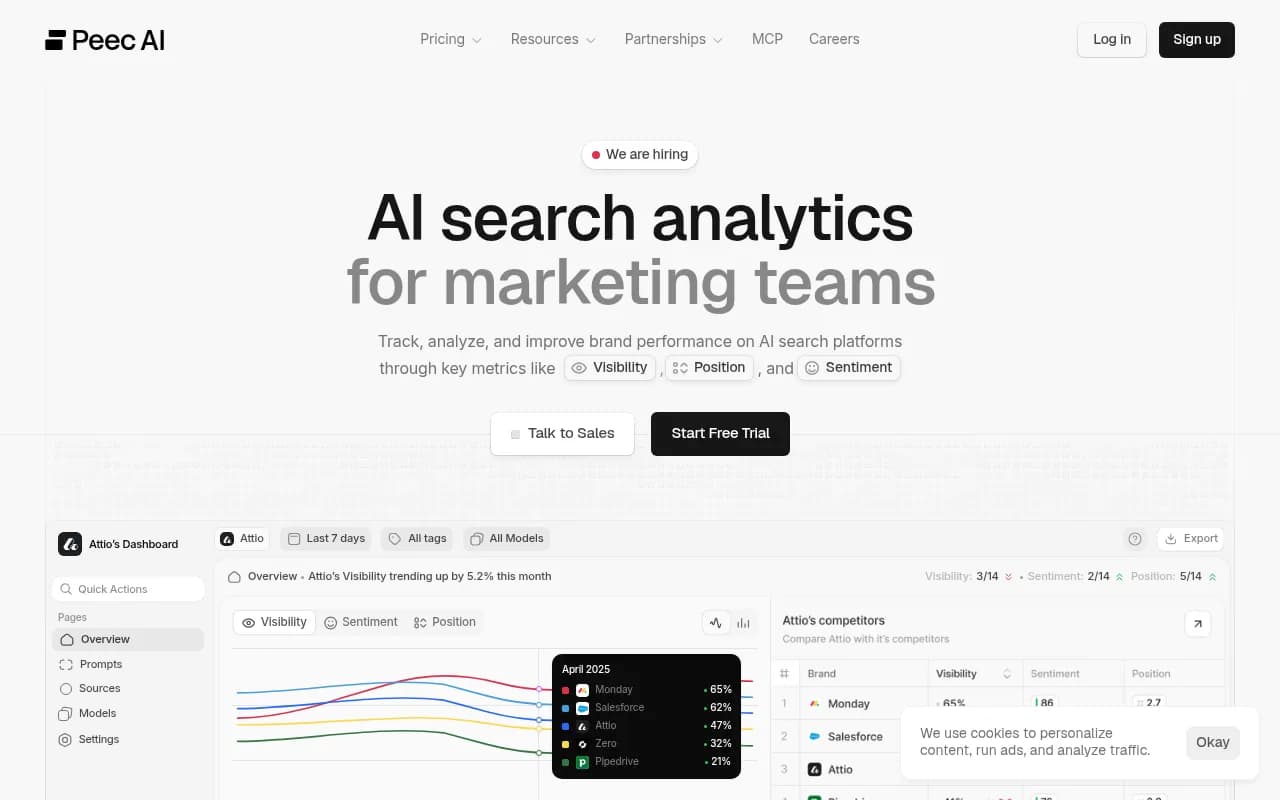
Peec AI is an AI search analytics platform built specifically for marketing teams who want to understand how their brand appears in AI-generated answers. The product tracks three core metrics -- Visibility (how often your brand is mentioned), Position (where you rank in AI responses), and Sentiment (how AI models describe your brand) -- across platforms like ChatGPT, Perplexity, Google AI Overviews, and Gemini. It's a clean, focused tool that claims 2,000+ marketing teams as customers, with testimonials from SEO professionals at Wistia, Graphite, and Glide.
The company positions itself squarely against traditional SEO tools like Semrush and Ahrefs, arguing that AI search requires a different kind of measurement. That's a fair argument. The problem is that the GEO space has matured quickly, and "measurement" alone is no longer enough. Peec AI sits in the monitoring-first camp -- it tells you what's happening, but leaves the "what to do about it" largely up to you.
The target audience is marketing teams at B2B SaaS companies, agencies managing client brands, and SEO strategists who are starting to take AI search seriously. The dashboard is designed to be approachable, not overwhelming -- which is both a strength and a limitation depending on what you need.
Key features
Visibility, Position, and Sentiment tracking
The three core metrics are well-implemented. Visibility shows the percentage of tracked prompts where your brand is mentioned. Position tells you where in the response your brand appears (first mention vs. third mention matters). Sentiment scores how positively or negatively AI models describe you. These are tracked over time with trend lines, so you can see whether your AI presence is improving or declining week over week.
In practice, the dashboard shows these metrics per brand, per prompt, and per model. You can filter by country, model, and prompt tags. The competitor heatmap view -- which plots brands on a visibility vs. sentiment matrix -- is one of the more useful visualizations in the product. Seeing that Salesforce has high visibility but low sentiment while a smaller competitor has low visibility but high sentiment tells you something actionable about positioning.
Prompt management and AI-suggested prompts
Prompts are the foundation of the platform. You set up the specific questions you want to track -- things like "What are the best CRMs for startups?" or "How does HubSpot compare to Salesforce?" -- and Peec runs those prompts daily across your selected models.
The platform suggests prompts based on your brand and industry, and shows estimated search volumes to help you prioritize. You can organize prompts with tags (by persona, funnel stage, geography) and track as many as your plan allows. This is genuinely useful for teams that don't know where to start.
Source citation analysis
Peec tracks which URLs and domains AI models cite when answering your tracked prompts. You can see whether your own pages are being cited, which third-party sources are driving AI mentions of your brand, and how citation frequency changes over time. The distinction between "used" (your content informed the answer) and "cited" (your URL is explicitly shown) is a useful nuance that not all tools in this space make.
This is where the tool starts to approach actionability -- if you can see that G2 reviews and a specific NYT article are regularly cited in responses about your category, you know where to focus your off-site efforts.
Competitor benchmarking
You can add competitor brands and track their visibility, position, and sentiment alongside your own. The competitor heatmap is the standout feature here -- it categorizes brands as Leaders, Niche Players, Laggers, or Controversial based on their visibility/sentiment combination. It's a clean way to communicate competitive positioning to stakeholders.
Multi-model and multi-region tracking
Peec tracks across ChatGPT, Perplexity, Google AI Overviews, Gemini, and a few others. You can filter by country IP to see how AI responses differ by region -- useful for brands with international audiences. The US vs. UK comparison use case is explicitly called out in their FAQ.
Peec MCP integration
This is the most technically interesting recent addition. Peec launched an MCP (Model Context Protocol) server that lets you connect your Peec visibility data directly to Claude, Cursor, n8n, and other tools in your stack. This means you can query your AI visibility data from within Claude, build automated workflows in n8n, or pull data into custom reporting pipelines. For developer-adjacent marketing teams, this is genuinely useful and ahead of where most competitors are on the integration side.
Reporting and exports
Peec has a Google Looker Studio community connector, CSV exports, and an API. The Looker Studio integration is well-suited for agencies that need to build client-facing dashboards. The API allows custom workflows and BI tool integration. These are table-stakes features for a B2B analytics tool, but they're implemented cleanly.
Strategy recommendations
The platform surfaces tactical recommendations based on your data -- things like "G2 is regularly cited, make sure you have a profile with reviews" or "Join r/CRM subreddit discussions." These are useful starting points, but they're fairly generic. The recommendations don't generate content or tell you specifically what to write -- they point you toward channels and leave the execution to you.
Who is it for
Peec AI fits best for marketing teams at B2B SaaS companies who are just starting to take AI search seriously and want a clean, low-friction way to get visibility data without committing to a complex platform. Think: an SEO manager at a 50-200 person SaaS company who needs to report on AI visibility to their CMO and wants something they can set up in an afternoon.
It also works well for digital agencies managing 5-20 client brands who need a straightforward way to track AI presence and generate client reports. The Looker Studio connector and multi-brand support make this a reasonable fit for agency use cases, though the per-prompt limits on lower tiers can get restrictive when managing multiple clients.
The tool is less suited for teams that have moved past the "what's happening" question and are now asking "what do we do about it." If you need to identify content gaps, generate AI-optimized content, understand which of your pages AI crawlers are actually visiting, or connect AI visibility to revenue, Peec AI doesn't have those capabilities. It's also not the right fit for enterprise teams that need deep prompt volume data, query fan-out analysis, or ChatGPT Shopping tracking.
Industries where it shines: B2B SaaS, professional services, and any category where AI search is already driving meaningful consideration (CRM, project management, marketing tools, HR software). Industries with complex buying journeys or heavy product catalog needs (e-commerce, retail) will find the feature set too limited.
Integrations and ecosystem
- Google Looker Studio: Community connector for building custom dashboards and client reports
- API: Available for custom workflows and BI tool integration
- MCP (Model Context Protocol): Connect Peec data to Claude, Cursor, n8n, and other MCP-compatible tools -- this is a genuinely useful addition for technical teams
- CSV exports: Standard export functionality for offline analysis
- No native CRM or Slack integrations are mentioned on the site
The MCP integration is worth highlighting because it's a meaningful step toward making the data actionable in other tools. Being able to query "what prompts is my brand losing to competitors?" directly from Claude is a different kind of workflow than logging into a dashboard.
There's no browser extension, no mobile app, and no native integration with Google Search Console or website analytics platforms. The lack of a website integration (like a tracking snippet or server log connector) means Peec has no visibility into actual AI crawler activity on your site -- a meaningful gap compared to platforms that offer crawler log analysis.
Pricing and value
Based on available pricing data, Peec AI has four tiers:
- Starter: ~$89-95/month -- 25 prompts, 3 countries, ChatGPT/Perplexity/AIO tracking, unlimited seats
- Pro: ~$245/month -- expanded prompt limits, more models, more countries
- Advanced: ~$495/month -- further expanded limits
- Enterprise: Custom pricing -- unlimited prompts
The Starter tier is reasonably priced for a team that wants to dip their toes in. The unlimited seats policy is a nice touch -- you're not paying per user, which matters for marketing teams that want to share access broadly.
Compared to the broader market: Peec is priced similarly to Otterly.AI and slightly below Profound at the entry level. It's meaningfully cheaper than full-featured platforms like Promptwatch at the equivalent tier, but also offers significantly fewer capabilities -- no content generation, no crawler logs, no traffic attribution.
A free trial is available (sign up at app.peec.ai). There's no permanent free tier mentioned.
The value proposition is clearest at the Starter level for teams that just need basic monitoring. At the Pro and Advanced tiers, the price-to-capability ratio becomes less compelling when compared to platforms that include content optimization and traffic attribution at similar price points.
Strengths and limitations
What Peec AI does well:
- Clean, focused UX: The dashboard is genuinely easy to use. You're not drowning in features. For teams that want to get up and running quickly, this matters.
- Competitor heatmap visualization: The Leaders/Niche Players/Laggers/Controversial quadrant view is one of the better competitive visualization approaches in the space.
- MCP integration: Connecting visibility data to Claude and n8n workflows is ahead of the curve and useful for technical teams.
- Looker Studio connector: Well-suited for agencies that need client-ready reporting without building custom dashboards from scratch.
- Prompt suggestion and volume data: Helps teams that don't know which prompts to track get started faster.
Honest limitations:
- Monitoring only -- no content optimization: Peec tells you where you're invisible but doesn't help you fix it. There's no content gap analysis, no AI content generation, no briefs. You get the data and then you're on your own. Platforms like Promptwatch close this loop with Answer Gap Analysis and Content Agents that generate articles grounded in real prompt data.
- No AI crawler logs or traffic attribution: Peec has no visibility into which of your pages AI crawlers are actually visiting, how often they return, or whether AI visibility is translating into actual website traffic and revenue. This is a significant gap for teams that need to connect AI search to business outcomes.
- No Reddit, YouTube, or ChatGPT Shopping tracking: These channels are increasingly important for AI visibility. Reddit discussions and YouTube videos are frequently cited in AI responses, and ChatGPT Shopping is a growing channel for product discovery. Peec doesn't track any of these.
- Limited model coverage: The site prominently features ChatGPT, Perplexity, and Gemini. Coverage of newer or less mainstream models (Grok, DeepSeek, Mistral, Meta AI, Copilot) appears limited compared to platforms tracking 10+ models.
Bottom line
Peec AI is a well-designed entry point into AI search monitoring. If your team is just starting to track AI visibility and wants something clean and approachable, it's a reasonable choice -- especially at the Starter tier. The MCP integration and Looker Studio connector are genuine differentiators for technical and agency users.
The limitation is that monitoring is only half the job. Once you know you're invisible for a set of prompts, you need to know why and what to create to fix it. Peec doesn't help with that. Teams that have moved past the awareness stage and need to actually improve their AI visibility -- through content gap analysis, AI-optimized content creation, and crawler log insights -- will quickly outgrow what Peec offers and should look at Promptwatch instead.
Best for: Marketing teams at B2B SaaS companies or agencies that want a simple, affordable way to start tracking AI search visibility and reporting on it to stakeholders.
Frequently asked questions
What is Peec AI?
How much does Peec AI cost?
Which AI models does Peec AI track?
Does Peec AI help you create content to improve AI visibility?
How does Peec AI compare to Promptwatch?
Is there a free trial for Peec AI?
Similar and alternative tools to Peec AI