Birdeye Search AI Review 2026
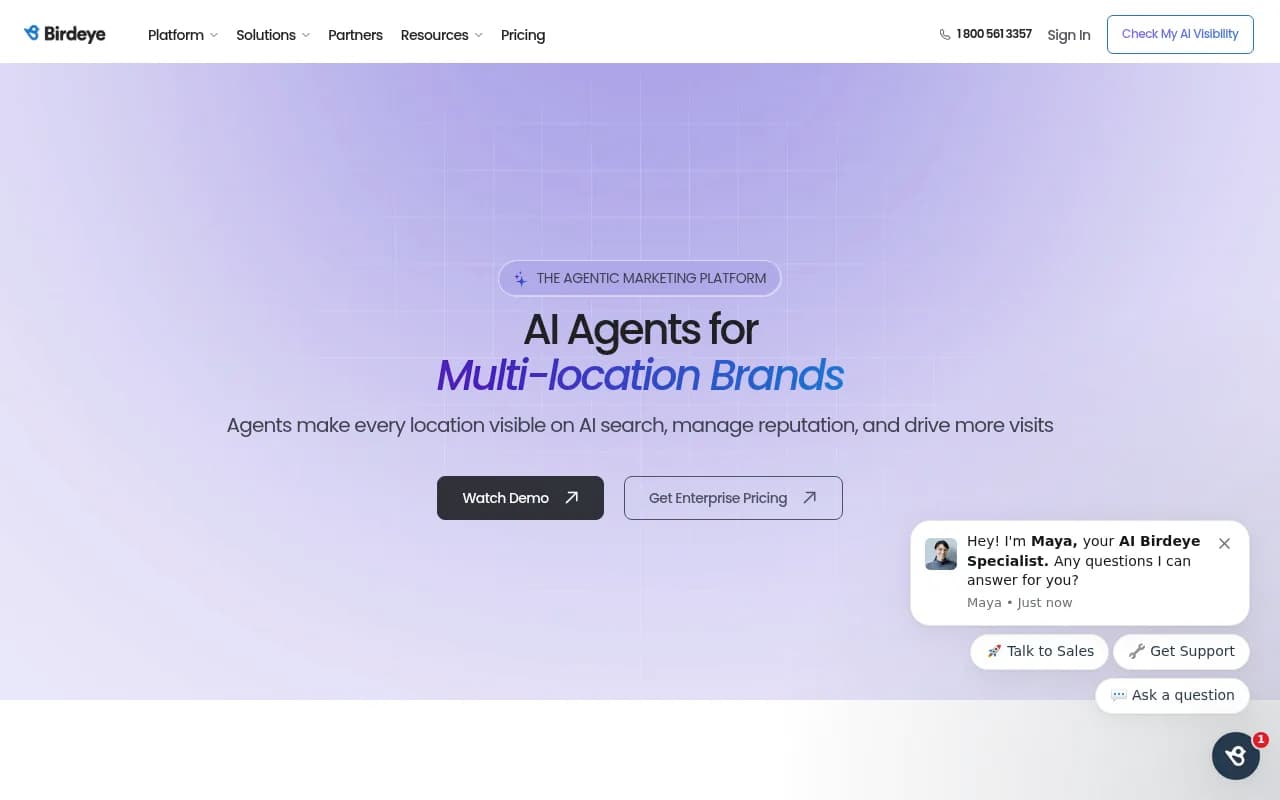
Tracks brand AI visibility across ChatGPT, Gemini, Perplexity, and Bing AI with location-level granularity. Includes agentic automation for local and multi-location businesses.
Key takeaways
- Birdeye Search AI is a strong fit for multi-location brands (franchises, dental chains, healthcare groups, restaurants) that need location-level AI visibility tracking alongside reputation management
- Lacks core GEO optimization capabilities that Promptwatch offers -- no content gap analysis, no AI content generation, no AI crawler logs, no prompt volume/difficulty scoring, and no traffic attribution from AI search
- The AI search monitoring is one module inside a much larger reputation and marketing platform -- if you only need GEO/AEO, you're paying for a lot you won't use
- Genuinely strong at what it was built for: managing reviews, listings, and local presence at scale across hundreds or thousands of locations
- Pricing is custom/enterprise-oriented and not publicly listed for the Search AI module specifically, which makes it hard to evaluate standalone value
Birdeye is a Palo Alto-based company that has been in the online reputation management space since around 2012. For most of its history, it was known as a review management and local listings platform -- the kind of tool a dental chain or auto dealership group uses to collect reviews, respond to them at scale, and keep their Google Business Profiles accurate across 200 locations. That's still the core of what it does.
The "Search AI" module is a more recent addition, reflecting the broader industry shift toward AI search visibility. As ChatGPT, Perplexity, and Google's AI Overviews started eating into traditional local search traffic, Birdeye recognized that its 200,000+ business customers needed to know how they were showing up in those AI-generated answers -- not just on Google Maps. So they built a monitoring layer on top of their existing platform and branded it as an "agentic" AI search tool.
The target audience is specific: multi-location businesses in industries like healthcare, dental, restaurants, automotive, real estate, and self-storage. Think a regional dental group with 80 locations, a franchise restaurant chain, or a property management company with properties across multiple states. These are businesses where local visibility at the individual location level matters enormously, and where managing that visibility manually is impossible at scale.
Key features
Location-level AI visibility tracking
This is the feature that genuinely differentiates Birdeye Search AI from most GEO tools. Rather than tracking brand visibility at a national or domain level, it can track how individual locations appear in AI search results. If you have 150 dental offices across the US, you can see which locations are being mentioned when someone in Phoenix asks ChatGPT for a dentist recommendation versus someone in Atlanta. This granularity is genuinely useful for multi-location operators and is something most pure-play GEO tools don't offer.
Multi-model monitoring
Birdeye tracks AI visibility across ChatGPT, Google Gemini, Perplexity, and Bing AI (Copilot). That's a reasonable coverage set for local search use cases, though it's narrower than platforms like Promptwatch that monitor 10+ models including Claude, DeepSeek, Grok, Meta AI, and Mistral. For local businesses, ChatGPT and Google AI Overviews are probably the most important, so the coverage is adequate if not exhaustive.
Listings Optimization Agent
Birdeye syncs business information across 50+ directories and platforms -- Google, Yelp, Facebook, Apple Maps, and dozens of others. The idea is that accurate, consistent NAP (name, address, phone) data across the web is a prerequisite for AI models to correctly identify and recommend your locations. This is a legitimate insight: AI models pull from structured data sources, and inconsistent listings hurt your chances of appearing in local AI answers. The agent monitors for changes, flags discrepancies, and pushes corrections automatically.
Review Response Agent
One of Birdeye's oldest and most mature features. The AI drafts responses to reviews across Google, Yelp, and Facebook in your brand voice, which you can approve and publish. For a chain with hundreds of locations generating dozens of reviews daily, this is a real operational time-saver. The AI can be trained on brand guidelines and tone, and responses can be customized by location or region.
Social Publishing Agent
Creates and schedules location-relevant social content across multiple platforms. The agent can generate posts that reference local context (a specific city, local events, seasonal relevance) while staying on-brand. For multi-location brands that want a local social presence without hiring a social media manager per location, this is genuinely useful. Birdeye claims a 400% increase in social publishing output for some customers, which is plausible given the automation involved.
Insights Agent
Aggregates data across all locations and surfaces what's working and what needs attention. This includes review sentiment analysis, competitive benchmarking, and performance trends by location, region, or brand-wide. The insights layer is designed for marketing directors and operations managers who need to understand performance patterns across a large footprint without manually pulling reports.
Competitor AI tracking
Birdeye can track how competitors appear in AI search results alongside your own brand. This gives multi-location businesses a sense of whether a competitor in a specific market is getting more AI mentions and what might be driving that. The depth of this analysis is harder to assess without hands-on access, but the feature exists.
Industry-specific integrations
Birdeye has built integrations for specific verticals: EHR/PMS systems for healthcare, DMS for automotive, POS for restaurants, property management software for real estate. This is a meaningful differentiator for enterprise buyers in regulated industries. A healthcare group can connect their patient management system and have review requests triggered automatically after appointments, with HIPAA-compliant workflows throughout.
Who is it for
Birdeye Search AI makes the most sense for multi-location brands that are already using or evaluating Birdeye's broader platform. If you're a franchise operator with 50+ locations, a regional healthcare group, or a restaurant chain trying to manage reputation and local visibility from a single platform, the Search AI module fits naturally into that workflow. The location-level tracking is genuinely valuable when you have locations in different markets competing for local AI recommendations.
The sweet spot is enterprise and mid-market companies in the industries Birdeye has built vertical integrations for: dental, healthcare, automotive, self-storage, restaurants, and real estate. A dental group like Aspen Dental (listed as a customer) or a restaurant chain like Black Bear Diner (also listed) gets real value from the combination of review management, listings sync, and AI visibility tracking in one platform.
Who should probably look elsewhere: single-location businesses or small teams that don't need the full platform. The pricing and complexity are oriented toward enterprise buyers. Also, if your primary need is deep GEO optimization -- understanding why you're not appearing in AI answers and generating content to fix it -- Birdeye's Search AI module is monitoring-focused and won't give you the content gap analysis, AI content generation, or crawler log data that a dedicated GEO platform provides.
Pure-play digital agencies doing GEO work for clients will also find the tool limiting. It's not built for managing multiple client brands; it's built for managing multiple locations of a single brand.
Integrations and ecosystem
Birdeye's integration list is one of its genuine strengths, particularly for enterprise buyers in specific verticals:
- CRM and practice management: Salesforce, HubSpot, various healthcare EHR/PMS systems
- Automotive: DMS integrations for dealership groups
- Restaurants: POS system integrations, reservation platforms
- Real estate: Property management software
- Review platforms: Google Business Profile, Yelp, Facebook, Tripadvisor, Healthgrades, Zocdoc, and 50+ others
- Social platforms: Facebook, Instagram, Google Posts, and others for the social publishing agent
- Listings networks: 50+ directories for the listings sync feature
There is an API available, though it's primarily documented for data access and integration purposes rather than as a developer-first platform. The platform is web-based with no notable browser extension. Mobile app availability exists for review management workflows.
The platform is SOC 2 certified, ISO 27001 certified, HIPAA compliant, and GDPR compliant -- which matters a lot for healthcare and finance customers.
Pricing and value
Birdeye does not publish straightforward pricing for the Search AI module specifically. The broader platform pricing, based on third-party sources like TrustRadius, runs approximately:
- Standard: ~$299/month
- Professional: ~$399/month
- Premium: Custom pricing
These figures likely reflect the core reputation management platform. The Search AI module and agentic features appear to be positioned as enterprise add-ons or bundled into higher tiers. Birdeye's website directs visitors to "See Enterprise Pricing" rather than a public pricing page, which suggests the Search AI features are primarily sold as part of larger enterprise contracts.
For comparison, dedicated GEO platforms like Promptwatch start at $99/month for a single site with 50 prompts, scaling to $249/month for multi-site professional use. Birdeye's pricing reflects its broader platform scope, but if you're only buying it for AI search visibility, you're likely paying significantly more than you would for a focused GEO tool.
A free demo is available, and Birdeye does offer trials, though the terms aren't prominently advertised.
Strengths and limitations
What it does well:
- Location-level granularity is a real differentiator. Tracking AI visibility by individual location, city, or region is something most GEO tools don't offer, and it's genuinely valuable for franchise and multi-location operators.
- Platform breadth means you can manage reviews, listings, social, and AI visibility from one place. For enterprise marketing teams that are already managing these functions separately, consolidation has real operational value.
- Vertical depth in healthcare, dental, automotive, and restaurants. The industry-specific integrations and HIPAA compliance are meaningful for regulated industries.
- Scale is proven. 200,000+ businesses and enterprise clients like Aspen Dental and Cracker Barrel suggest the platform handles large footprints reliably.
Where it falls short:
- Monitoring-only for AI search. The Search AI module shows you where you appear (or don't) in AI answers, but it doesn't help you fix it. There's no content gap analysis to identify which prompts competitors rank for that you don't, no AI content generation to close those gaps, and no AI crawler logs to understand how AI models are discovering your pages. Platforms like Promptwatch are built around this optimization loop -- find gaps, generate content, track results -- which Birdeye doesn't replicate.
- No prompt volume or difficulty scoring. Birdeye doesn't appear to offer data on which prompts have the most search volume or which are most winnable, so you can't prioritize your optimization efforts intelligently.
- No AI traffic attribution. There's no way to connect AI search visibility to actual website traffic or revenue, which makes it hard to justify the investment or measure ROI from the AI visibility features specifically.
- No Reddit or YouTube tracking. AI models heavily cite Reddit threads, YouTube videos, and third-party content. Birdeye doesn't surface which of these external sources are influencing AI recommendations about your brand.
- Pricing opacity. The lack of transparent pricing for the Search AI module makes it hard to evaluate value without going through a sales process.
Bottom line
Birdeye Search AI is the right tool if you're a multi-location enterprise brand that needs location-level AI visibility tracking bundled with a mature reputation management platform. The combination of listings sync, review automation, and AI search monitoring in one platform -- with vertical integrations for healthcare, dental, and automotive -- is genuinely useful for the franchise operators and regional chains it's built for.
If your primary need is understanding and improving your AI search visibility -- finding content gaps, generating content that ranks in AI answers, tracking which pages AI models are citing, and attributing AI traffic to revenue -- you'll hit the ceiling of what Birdeye's Search AI module can do quickly. For that use case, Promptwatch is the stronger choice: it's built specifically around the optimization loop, not just monitoring.
Best use case in one sentence: Multi-location franchise brands and enterprise operators who want AI search visibility tracking as part of a broader reputation and local marketing platform, not as a standalone GEO optimization tool.
Tags:
Frequently asked questions
What is Birdeye Search AI?
How much does Birdeye cost?
Who is Birdeye best suited for?
Does Birdeye help you optimize for AI search or just monitor it?
What AI models does Birdeye Search AI track?
How does Birdeye compare to dedicated GEO platforms?
Similar and alternative tools to Birdeye Search AI