Nightwatch Review 2026
SEO rank tracking platform that has expanded into AI search visibility, letting users monitor how their content performs in both traditional and AI-powered search results.
Key takeaways
- Nightwatch is a mature rank tracking platform (13+ years of data) that has expanded into AI search visibility, making it a solid choice for SEO teams who want both in one place
- Monitoring-focused: Nightwatch tracks and reports on AI visibility but lacks content gap analysis, AI content generation, AI crawler logs, and traffic attribution that Promptwatch provides -- it shows you what's happening but offers limited tools to fix it
- Best fit for SEO agencies and in-house teams already invested in rank tracking who want to add AI visibility without switching platforms
- Pricing starts at €79/month with a 14-day free trial and no credit card required
- White-label reporting and unlimited seats are included on every plan, which is genuinely unusual and makes it attractive for agencies
Nightwatch has been around for over a decade as a rank tracking tool, and it's built a real reputation in that space. The platform tracks keyword positions across Google, Bing, YouTube, DuckDuckGo, and Yahoo with what it claims is 99.9% accuracy -- backed by raw HTML snapshots stored for every ranking check, so you can actually verify results rather than just trust a number. That's a meaningful differentiator from tools that approximate data from cached results.
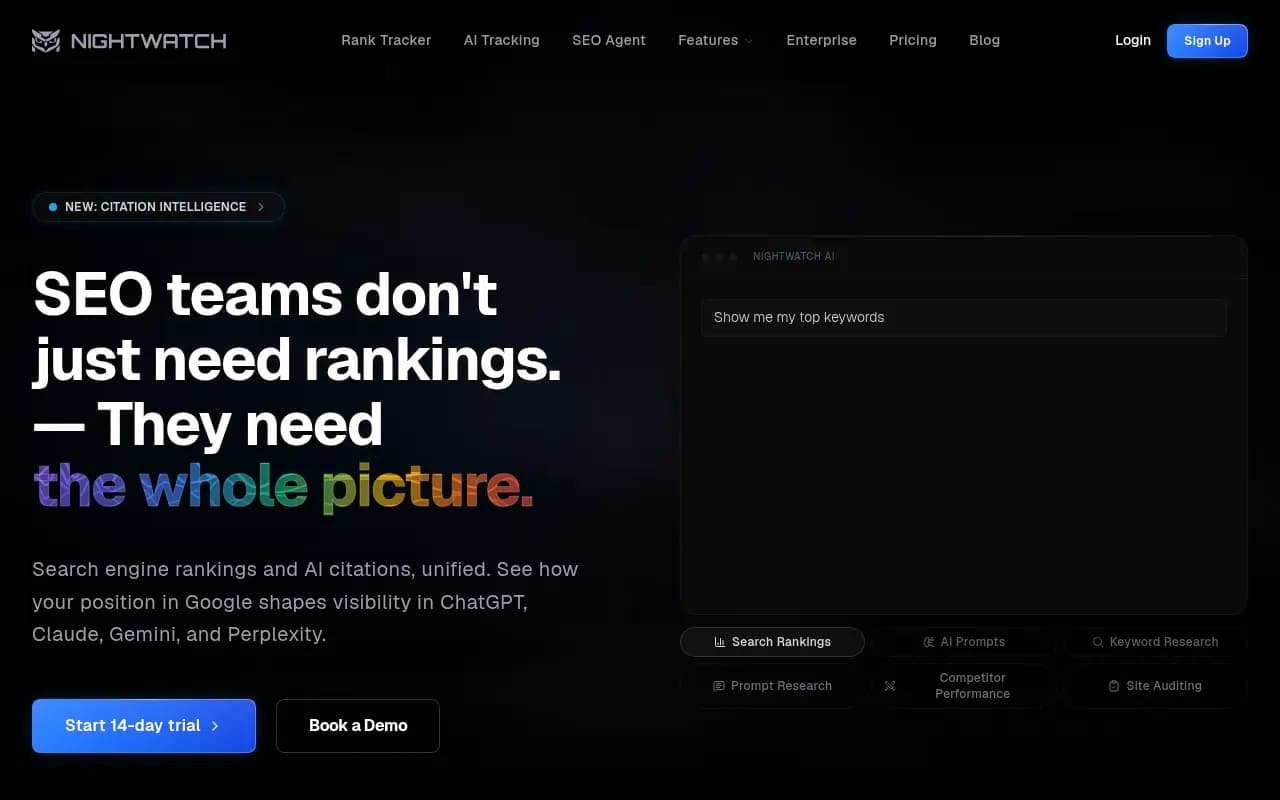
The AI tracking expansion is newer and reflects where the market is going. The pitch is straightforward: AI models like ChatGPT and Gemini pull from search indexes, so your Google rankings directly influence your AI citations. Nightwatch calls this connection "Citation Intelligence" and it's the centerpiece of their current positioning. For SEO teams who've been asking "how do I connect my traditional SEO work to AI visibility?" it's a compelling answer -- at least conceptually.
The platform serves around 10,000+ SEO teams, ranging from solo consultants to digital agencies running client portfolios. It's a bootstrapped or lightly funded company (no major funding announcements are public), which may explain why pricing is competitive and the feature set has grown organically rather than through acquisition.
Key features
Rank tracking across 107,000+ locations
This is where Nightwatch has always been strongest. You can track keyword positions down to zip code level across 190+ countries, which is more granular than most competitors. The platform supports Google, Bing, YouTube, DuckDuckGo, and Yahoo. Every ranking check stores the raw HTML snapshot of the SERP, which means you can go back and audit any result at any point -- useful when a client disputes a ranking or when you want to understand exactly what Google was showing on a specific date. On-demand refreshes let you pull live rankings during algorithm updates or critical campaign moments without waiting for the daily cycle.
Citation Intelligence
This is Nightwatch's newest and most interesting feature. The idea is that AI platforms don't crawl the web independently -- they retrieve from search indexes. So when your Google ranking drops, your AI citation rate drops with it. Citation Intelligence maps that relationship, showing you which ranking changes are driving shifts in your AI visibility. It's a genuinely useful framing for SEO teams trying to explain AI visibility to clients who already understand rankings. The feature is positioned as exclusive to Nightwatch, and it does fill a real gap in how most teams think about the search-to-AI pipeline.
AI & LLM tracking
Nightwatch simulates user interactions with ChatGPT, Claude, Gemini, Perplexity, and Google AI Overviews to detect brand mentions, citations, and recommendations. The output includes an AI Visibility Score, Share of Voice (your brand mentions vs. competitors), sentiment analysis on how your brand is described, and generative rankings showing your position in AI snapshots. Coverage spans four major AI platforms, which covers most of the market but is fewer than some dedicated GEO platforms.
NightOwl SEO Agent
This is Nightwatch's automation layer. The NightOwl agent runs competitor gap analysis, surfaces content opportunities, and handles meta optimizations -- described as "running while you sleep." It's positioned as an action-oriented feature, though in practice it's more of an automated audit and suggestion engine than a full content generation tool. It can identify what's missing but doesn't generate the content to fill those gaps.
Keyword research and prompt research
Beyond tracking existing keywords, Nightwatch includes keyword discovery tools and a "Prompt Research" feature that surfaces the prompts people are using in AI search. This is useful for understanding what questions your audience is asking AI models, though the depth of prompt volume data and difficulty scoring appears limited compared to dedicated AI search intelligence platforms.
Site audit
A technical SEO audit tool with smart prioritization -- it surfaces the issues most likely to hurt rankings first rather than dumping a flat list of errors. Core Web Vitals tracking is included. This is a solid supporting feature rather than a differentiator; most rank tracking platforms at this price point include site auditing.
Reporting and white-label
Nightwatch's reporting is genuinely strong. White-label reports with custom branding, scheduled automated delivery, and shareable live report links are included on every plan -- including the free trial. That's unusual; most competitors charge extra for white-labeling or restrict it to higher tiers. Reports are customizable enough to tailor the level of detail to different client audiences, which several G2 reviewers specifically called out as valuable.
Looker Studio integration and API
Nightwatch connects to Looker Studio for custom dashboard building and has a developer API for extracting ranking data, audit reports, and AI insights into external systems. There's also an SEO MCP (Model Context Protocol) integration, which lets AI coding assistants and agents interact with Nightwatch data -- a niche but forward-looking feature for technical SEO teams.
SERP feature tracking
Beyond raw position, Nightwatch tracks Featured Snippets, Knowledge Panels, and Local Packs. The side-by-side comparison of Local Pack rankings vs. organic rankings is something several reviewers highlighted as missing from other tools they'd used.
Who is it for
Nightwatch fits best for SEO agencies managing multiple client sites who want a single platform for rank tracking, reporting, and a baseline level of AI visibility monitoring. The unlimited seats and white-label reporting on every plan make the economics work for agencies -- you're not paying per user or per client seat, which adds up fast with tools like Semrush or Ahrefs. An agency running 20-30 client accounts can use Nightwatch's reporting features to deliver branded, automated reports without the manual overhead.
In-house SEO teams at mid-sized companies (think a 5-15 person marketing team at a SaaS company or e-commerce brand) will find the platform covers most of what they need day-to-day: keyword tracking, competitor monitoring, technical audits, and now a layer of AI visibility. The Citation Intelligence feature is particularly useful for teams that need to explain AI visibility to executives who already understand Google rankings -- it provides a familiar bridge.
Local SEO specialists and multi-location businesses will appreciate the zip-code level tracking across 107,000+ locations. If you're managing SEO for a franchise network or a business with dozens of physical locations, that granularity matters.
Who shouldn't use Nightwatch: teams whose primary goal is improving their AI search visibility rather than tracking it. If you need to understand exactly which content gaps are causing you to lose AI citations, generate content engineered to fill those gaps, monitor AI crawler behavior on your site, or attribute AI-driven traffic to revenue, Nightwatch's current feature set won't get you there. It's a monitoring and reporting platform with some optimization hints -- not an end-to-end GEO optimization workflow.
Integrations and ecosystem
- Google Search Console: Connects for additional traffic and impression data
- Google Analytics: Integration for session and revenue data
- Looker Studio: Native connector for custom reporting dashboards
- API: Full REST API for extracting rankings, audit data, and AI insights into external tools
- SEO MCP: Model Context Protocol support for AI agent workflows
- Search Simulator: A built-in tool to simulate searches from specific locations
- White-label reporting: Shareable live links and scheduled PDF/email delivery
There's no native Slack integration mentioned, no Zapier connector listed prominently, and no direct CRM or content management integrations. The ecosystem is focused on data extraction and reporting rather than workflow automation.
Pricing and value
Nightwatch pricing is in euros, which reflects its European roots:
- Starter: €79/month -- covers basic rank tracking needs for smaller sites
- Professional: €159/month -- the most popular tier, includes more keywords and AI tracking features
- Agency: €399/month -- designed for agencies managing multiple client accounts
All plans include unlimited user seats, white-label reporting, and a 14-day free trial with no credit card required. Annual billing discounts are available but specific percentages aren't prominently listed.
For context, AccuRanker starts around $116/month for 1,000 keywords, Semrush's comparable plan runs $140-$250/month, and Ahrefs starts at $129/month -- all with per-seat fees or limited seats. Nightwatch's unlimited seats policy is a genuine cost advantage for agencies and growing teams.
The value proposition is strongest for agencies: white-label reporting plus unlimited seats plus competitive per-keyword pricing adds up to meaningful savings vs. the major platforms. For individual consultants or small teams, the value is solid but less differentiated.
Strengths and limitations
What Nightwatch does well:
- The raw HTML snapshot approach to rank verification is genuinely useful and rare -- you can audit any result at any point in time, which builds trust with clients and helps diagnose ranking volatility
- Unlimited seats on every plan is a real differentiator for agencies; most competitors charge per seat or limit users on lower tiers
- White-label reporting included at every tier (even the free trial) is unusual and valuable for client-facing work
- Local tracking granularity at 107,000+ locations and zip-code level precision is best-in-class for local SEO use cases
- Citation Intelligence is a smart conceptual bridge between traditional SEO and AI visibility that resonates with teams already fluent in rank tracking
Limitations worth knowing:
- AI model coverage is limited to four platforms (ChatGPT, Claude, Gemini, Perplexity, AI Overviews). Platforms like Grok, DeepSeek, Copilot, and Meta AI are not tracked, which matters as those models grow in usage
- No content gap analysis or AI content generation: Nightwatch can tell you your AI visibility is dropping but doesn't help you create content to fix it. There's no Answer Gap Analysis, no content brief generation, and no writing agent
- No AI crawler logs: you can't see which pages AI crawlers are visiting on your site, how often they return, or what errors they encounter. This is a significant gap for teams trying to understand why certain pages aren't being cited
- No traffic attribution from AI to revenue: Citation Intelligence connects rankings to citations, but there's no visitor-level attribution showing which sessions originated from AI recommendations
- Prompt volume and difficulty data appears limited compared to dedicated AI search intelligence platforms -- the "Prompt Research" feature exists but depth is unclear
Bottom line
Nightwatch is a well-built rank tracking platform that has made a credible move into AI visibility monitoring. For SEO agencies and in-house teams who want to consolidate rank tracking and basic AI citation monitoring into one tool with strong reporting, it's a reasonable choice -- especially given the unlimited seats and white-label reporting at every price point.
But if your goal is to actually improve your AI search visibility rather than just track it, Nightwatch's monitoring-only approach hits a ceiling quickly. For teams that need content gap analysis, AI content generation, crawler log monitoring, and traffic attribution, Promptwatch is the stronger option -- it's built around the full optimization loop rather than just the reporting layer.
Best use case: SEO agencies managing 10-50 client accounts who need unified rank tracking and AI citation monitoring with white-label reporting, and don't yet need deep GEO optimization capabilities.
Frequently asked questions
What is Nightwatch and what does it do?
How much does Nightwatch cost?
Does Nightwatch have a free trial?
How does Nightwatch track AI rankings?
How does Nightwatch compare to dedicated GEO platforms like Promptwatch?
Is Nightwatch good for agencies?
Similar and alternative tools to Nightwatch