Key takeaways
- Promptwatch is an AI search visibility platform first -- it tracks brand citations across 10 LLMs, logs AI crawler activity, and generates content to close visibility gaps. Surfer SEO is a content optimization tool built around Google rankings, with AI visibility features added on top.
- Both start at roughly $99/month, but they're solving different problems. Buying the wrong one is a real risk if you don't clarify your priority upfront.
- If your team is asking "why isn't our brand showing up in ChatGPT answers?" -- Promptwatch is the direct answer. If your team is asking "how do we rank higher on Google?" -- Surfer is the more natural fit.
- Surfer has a much larger user base (150,000+ users vs Promptwatch's 1,480+ brands) and a longer track record for traditional SEO content workflows.
- Promptwatch's crawler logs, prompt volume scoring, and Answer Gap Analysis have no real equivalent in Surfer. Surfer's content editor, NLP scoring, and SERP analysis have no real equivalent in Promptwatch.
- These tools are more complementary than competitive. The real question is which one to prioritize given your current search strategy.
Overview
Promptwatch
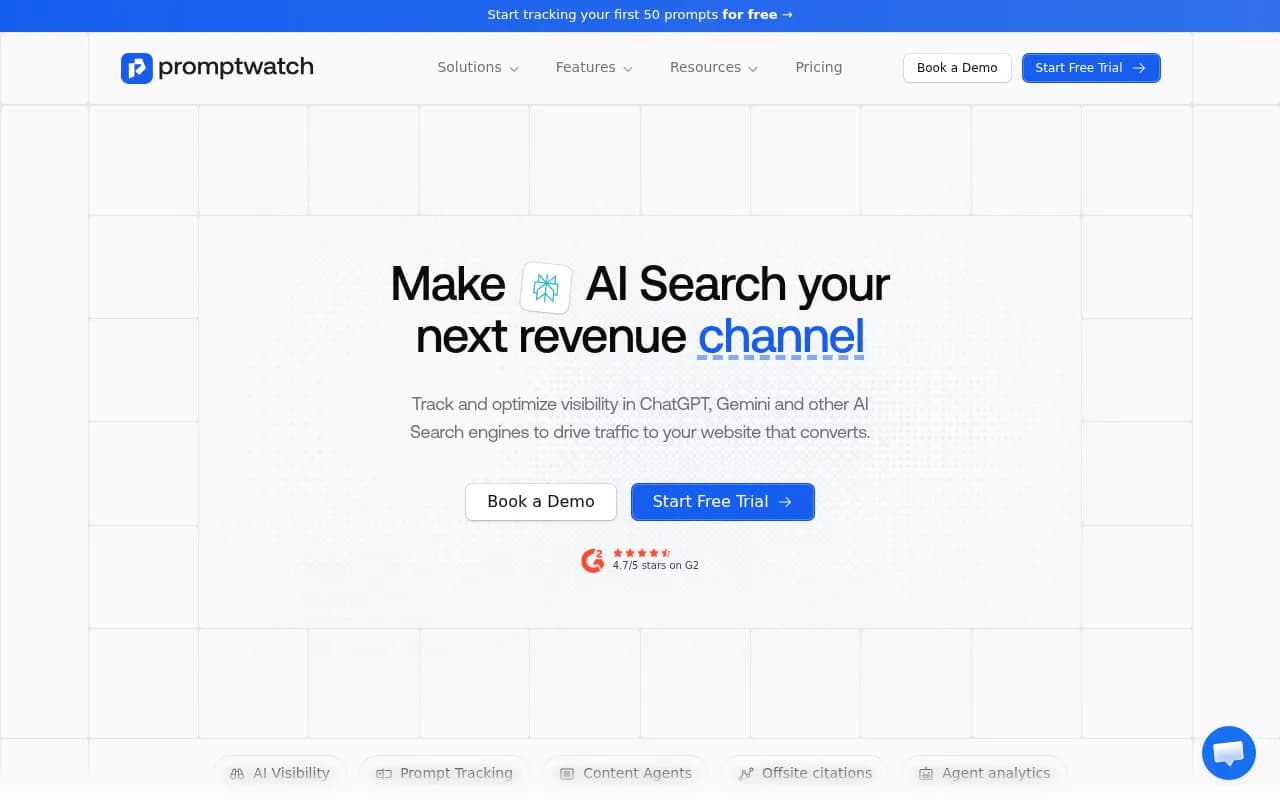
Promptwatch is an end-to-end GEO (Generative Engine Optimization) platform. The core idea is a three-step loop: find the prompts where competitors are visible but you're not, generate content that fills those gaps, then track whether AI models start citing your new pages. It monitors ChatGPT, Perplexity, Gemini, Claude, Grok, DeepSeek, Copilot, Meta AI, Mistral, and Google AI Overviews -- all in one dashboard. The platform has processed over 4.5 billion citations and is used by brands like Booking.com, Duolingo, Typeform, and Yelp.
What makes it different from most GEO tools is that it doesn't stop at monitoring. Crawler logs show you exactly which pages AI agents are reading (and which ones they're ignoring), while Content Agents generate articles grounded in real prompt data rather than generic SEO briefs.
Surfer SEO

Surfer SEO built its reputation as the go-to content editor for on-page optimization. You paste in a target keyword, and Surfer analyzes the top-ranking pages to give you a content score, recommended word count, NLP terms to include, and structural suggestions. It's genuinely useful for writers who want data-driven guidance rather than gut instinct.
In 2024-2025, Surfer expanded into AI visibility with features that track brand mentions across AI search engines. The product is now positioning itself as an "AI Visibility Platform" -- but the content editor and SERP analysis tools remain the core of what most users actually pay for.
Side-by-side comparison
| Feature | Promptwatch | Surfer SEO |
|---|---|---|
| Primary use case | AI search visibility & GEO | Content optimization & on-page SEO |
| AI models tracked | 10 (ChatGPT, Perplexity, Gemini, Claude, Grok, DeepSeek, Copilot, Meta AI, Mistral, Google AI Overviews) | Limited (newer feature, fewer models) |
| Traditional SEO (Google rankings) | No | Yes -- core feature |
| Content editor | No | Yes -- NLP scoring, keyword density, structure |
| AI content generation | Yes -- Content Agents grounded in prompt data | Yes -- Surfer AI article writer |
| Answer Gap Analysis | Yes | No |
| AI crawler logs | Yes -- real-time logs per page | No |
| Prompt volume & difficulty scoring | Yes | No |
| Citation tracking (page-level) | Yes | Limited |
| Reddit & YouTube insights | Yes | No |
| ChatGPT Shopping tracking | Yes | No |
| Competitor heatmaps (AI visibility) | Yes | No |
| SERP analysis | No | Yes -- detailed |
| Keyword research | No | Yes |
| Internal linking suggestions | No | Yes |
| Multi-language support | Yes | Yes |
| Agency/white-label plans | Yes | Yes |
| Free trial | Yes | Yes |
| Starting price | $99/mo | ~$99/mo |
| G2 rating | 4.7/5 | 4.8/5 |
| User base | 1,480+ brands | 150,000+ users |
Head-to-head feature deep-dive
AI search visibility tracking
This is where the gap between the two tools is widest.
Promptwatch was built for this from day one. It runs real queries through actual AI search interfaces (not just APIs), which matters because user-facing answers can differ from what the API returns. You get citation tracking at the page level, competitor visibility scores across each LLM, and a heatmap showing who's winning for which prompts. The crawler logs are particularly useful -- you can see ChatGPT's crawler reading your pages, spot errors, and understand the timeline from crawl to citation.
Surfer added AI visibility monitoring more recently. It tracks brand mentions across some AI engines, but the depth of data -- prompt volumes, difficulty scores, query fan-outs, per-model breakdowns -- isn't at the same level. If AI search visibility is your primary concern, Surfer's current feature set feels like a bonus feature rather than a core capability.
Verdict: Promptwatch wins clearly on AI visibility depth and breadth.
Content optimization for Google
Flip the question around, and Surfer wins just as clearly.
Surfer's content editor is genuinely good. You get a real-time content score as you write, NLP term suggestions pulled from top-ranking pages, recommended heading structures, and word count guidance. The SERP analyzer shows you what the top 10 results have in common. Internal linking suggestions help you connect new content to your existing site structure. These are mature, well-tested features that have helped a lot of teams improve Google rankings.
Promptwatch doesn't do any of this. It's not trying to. If your team writes content for Google and wants data-driven optimization, Promptwatch won't help you there.
Verdict: Surfer wins on traditional SEO content optimization -- it's not close.
Content generation
Both tools generate content with AI, but the inputs are very different.
Surfer AI writes articles based on keyword research and SERP analysis. You give it a target keyword, it analyzes what's ranking, and produces a draft optimized for that keyword. The output is generally solid for SEO-focused blog content.
Promptwatch's Content Agents generate content based on prompt data -- the actual questions people are asking AI search engines, which competitors are getting cited for those questions, and what your site is currently missing. The briefs include brand guidance, competitor analysis, citation data, and screenshots. The goal isn't to rank on Google (though that might happen); it's to become the source AI models cite when someone asks a relevant question.
Verdict: Different tools for different goals. Surfer for Google-targeted content, Promptwatch for AI-targeted content.
Answer Gap Analysis
Promptwatch has a feature called Answer Gap Analysis that shows you exactly which prompts competitors rank for in AI search results but you don't. You see the specific topics and questions where you're invisible, ranked by prompt volume and difficulty. It's the starting point for any GEO strategy.
Surfer has no equivalent. Its keyword gap analysis is focused on Google rankings.
Verdict: Promptwatch only.
Crawler logs and agent analytics
Promptwatch logs every time an AI crawler (ChatGPT, Claude, Perplexity, etc.) hits your website -- which pages they read, how often they return, any errors they encounter, and when a page moves from "crawled" to "cited." You can connect this through Cloudflare, Fastly, Vercel, server logs, or a tracking snippet.
This is genuinely useful for diagnosing why certain pages aren't getting cited despite having good content. Surfer has no equivalent feature.
Verdict: Promptwatch only.
Ease of use and onboarding
Surfer has a shallower learning curve for most SEO practitioners. The content editor is intuitive -- you open a document, start writing, and the score updates in real time. Most users are productive within an hour.
Promptwatch has more moving parts. Setting up prompt tracking, configuring competitor comparisons, connecting crawler logs, and interpreting citation data takes more time. The payoff is richer data, but the onboarding is heavier. That said, the platform has improved significantly in 2025-2026 and the dashboard is cleaner than it was.
Verdict: Surfer is easier to get started with. Promptwatch rewards more investment.
Integrations and reporting
Surfer integrates with Google Docs, WordPress, Jasper, and a few other content tools. Reporting is mostly in-platform.
Promptwatch integrates with Google Search Console, Cloudflare, Fastly, Vercel, and Looker Studio. It also has an API for custom workflows. The Looker Studio integration is particularly useful for agencies that need to build custom client reports.
Verdict: Promptwatch has stronger data export and reporting options. Surfer has better content workflow integrations.
Pricing comparison
| Plan | Promptwatch | Surfer SEO |
|---|---|---|
| Free / trial | Free trial (50 prompts) | Free trial available |
| Essential / Starter | $99/mo -- 1 site, 50 prompts, 5 articles | ~$99/mo -- content editor, limited AI articles |
| Professional | $249/mo -- 2 sites, 150 prompts, 15 articles, crawler logs, city tracking | ~$219/mo -- more articles, team seats, audit |
| Business | $579/mo -- 5 sites, 350 prompts, 30 articles | ~$399/mo -- higher limits, priority support |
| Agency / Enterprise | Custom pricing | Custom pricing |
| Annual discount | Yes | Yes |
Pricing is broadly similar at the entry level. As you scale up, the features you're paying for diverge significantly -- Promptwatch's higher tiers unlock more AI models, more prompts, and deeper crawler data. Surfer's higher tiers unlock more content editor seats and article credits.
Pros and cons
Promptwatch
Pros:
- The most comprehensive AI search visibility platform available in 2026
- Crawler logs and agent analytics are genuinely unique -- no other tool shows you this
- Answer Gap Analysis makes it clear exactly what content to create next
- Tracks 10 AI models including newer ones like Grok, DeepSeek, and Mistral
- Reddit and YouTube insights surface off-site citation opportunities
- ChatGPT Shopping tracking is useful for e-commerce brands
- Strong agency and enterprise support with Looker Studio integration
Cons:
- Does nothing for traditional Google SEO -- you'll need a separate tool
- Steeper onboarding than Surfer
- Smaller user community means fewer third-party tutorials and resources
- The $99 entry plan is limited to 50 prompts, which may feel restrictive for larger sites
Surfer SEO
Pros:
- Best-in-class content editor for Google-targeted content
- Large, active user community with extensive documentation
- Integrates smoothly into existing content workflows (Google Docs, WordPress)
- SERP analysis and keyword research are mature and reliable
- 150,000+ users means the product is battle-tested
- Easier to onboard for writers and content teams
Cons:
- AI visibility features are newer and less deep than Promptwatch's
- No crawler logs or agent analytics
- No prompt volume or difficulty scoring for AI search
- No Answer Gap Analysis for LLMs
- Content generation is Google-focused, not AI-search-focused
- Reddit and YouTube citation tracking is absent
Who should pick which tool
Pick Promptwatch if:
- Your team is actively working on GEO or AI search visibility
- You want to understand why competitors appear in ChatGPT answers and you don't
- You need to track citations at the page level across multiple AI models
- You want AI crawler logs to diagnose indexing issues with LLMs
- You're an agency with clients asking about AI search performance
- You want content generation grounded in actual prompt data, not just keyword research
Pick Surfer SEO if:
- Your primary goal is ranking higher on Google
- You have a content team that writes regularly and needs real-time optimization guidance
- You want a content editor with NLP scoring and SERP analysis built in
- You're already invested in traditional SEO workflows and want to improve efficiency
- You need keyword research and internal linking tools
- You want a tool with a large community and lots of third-party resources
Use both if:
- You're running a full search strategy that covers both Google and AI search
- You have separate SEO and GEO workstreams that need different tools
- Budget allows for it -- the two tools genuinely don't overlap much
It's worth noting that if you're building out an AI search strategy, Promptwatch covers the full loop from gap identification to content creation to citation tracking -- which is the part most teams are currently missing.
Final verdict
These two tools are less competitors and more representatives of two different eras of search optimization. Surfer SEO is the right tool for teams whose primary battleground is Google. Promptwatch is the right tool for teams whose primary battleground is AI search engines.
The honest answer in 2026 is that most serious marketing teams need both -- or at least need to decide which front matters more right now. If you're still building Google traffic and haven't started thinking about AI visibility, start with Surfer. If you're watching competitors show up in ChatGPT answers and you're not, start with Promptwatch. If you're trying to do both simultaneously, the tools don't conflict -- they just cover different ground.