Promptwatch Review 2026
End-to-end GEO and AI visibility platform. Tracks brand citations across ChatGPT, Perplexity, Gemini, and more. Includes content gap analysis, AI content generation, and crawler logs.
Key takeaways
- Promptwatch is the most complete GEO/AI visibility platform available in 2026, covering the full loop from tracking to content creation to revenue attribution
- Monitors 10 AI models including ChatGPT, Claude, Gemini, Perplexity, Grok, DeepSeek, Copilot, Mistral, Meta AI, and Google AI Overviews -- more than any direct competitor
- Goes well beyond monitoring: Answer Gap Analysis, AI Content Agents, and crawler logs make it an optimization platform, not just a dashboard
- Rated "Leader" across all categories in a 2026 comparison of 12 GEO platforms, the only tool to achieve this
- Pricing starts at $99/month with a free trial; mid-tier at $249/month unlocks crawler logs and city-level tracking
- Best fit for marketing and SEO teams at growth-stage and enterprise companies, and digital agencies managing multiple clients
Most tools in the GEO space do one thing: show you a number. Your brand appeared in 34% of AI responses this week, up from 31% last week. Congratulations. Now what? That's the gap Promptwatch was built to close. It's not just a tracker -- it's a platform that takes you from "we're invisible in AI search" to "here's the content we need to write, here's the draft, and here's proof it's getting cited."
Promptwatch is a Dutch company (Promptwatch B.V.) that launched as one of the first platforms collecting real prompt and crawler data from AI search engines. The data scale is notable: over 4.5 billion citations, clicks, and prompts processed, which has made its research findings credible enough to appear in the Wall Street Journal, Yahoo Finance, Axios, and Seeking Alpha. The platform now serves 1,480+ brands and agencies, including Booking.com, Center Parcs, Duolingo, Typeform, Shutterstock, and Yelp -- a customer list that spans e-commerce, SaaS, finance, and media.
The target audience is marketing teams, SEO leads, and digital agencies who understand that AI search is already eating into their organic traffic and want to do something about it. This isn't a tool for people who want to "monitor the landscape." It's for people who want to rank in AI answers the same way they once fought for page-one Google rankings.
Key features
Prompt tracking and AI visibility scoring
The core of the platform is prompt tracking: you define the queries your customers are actually asking AI engines, and Promptwatch monitors how AI models respond to those queries over time. It tracks whether your brand is mentioned, how prominently, and with what sentiment. The visibility score aggregates this into a single metric you can trend over time. What makes this different from competitors is that Promptwatch collects data from real user interfaces, not just API calls. This matters because ChatGPT's user-facing answers, shopping recommendations, and citations can differ meaningfully from what the API returns.
- Track up to 50 prompts on the Essential plan, 150 on Professional, 350 on Business
- Persona-based prompting: configure prompts to simulate specific customer types (e.g., a CFO evaluating enterprise software vs. a small business owner)
- Multi-language and multi-region support across any country
- Prompt volume estimates and difficulty scores help you prioritize which queries are worth winning
Answer Gap Analysis (content gap analysis)
This is where Promptwatch separates from monitoring-only tools. The Answer Gap Analysis maps your existing content against what AI models are actually citing in their responses. You can see, prompt by prompt, where competitors are getting cited and you're not -- and specifically what content is missing from your site. It's not a vague recommendation to "create more content." It shows you the exact topics, angles, and question formats that AI models want answered but can't find on your domain.
Content Agents (AI content generation)
Once you know the gaps, the Content Agents fill them. These are AI writing agents that generate articles, listicles, comparisons, and content briefs grounded in real citation data, prompt volumes, competitor analysis, live web screenshots, news context, and any brand documents you upload. The agent workflow is detailed: it runs through topic analysis, news research, YouTube video analysis, content writing, internal linking, SEO optimization, competitor analysis, schema markup, and social preview generation -- 14 steps in total, with timing shown for each. The output isn't generic SEO filler. It's content engineered around the specific prompts and citation patterns the platform has already identified.
- Essential plan: 5 articles/month; Professional: 15; Business: 30
- Upload brand guidelines, knowledge base files, and tone-of-voice docs to shape output
- Content briefs include live screenshots of search results and competitor pages
- Built-in AI suggestions flag specific improvements (e.g., replacing vague claims with cited statistics)
Agent Analytics (AI crawler logs)
This feature is genuinely rare in the GEO space. Promptwatch shows you in real time when AI crawlers from ChatGPT, Perplexity, Claude, Copilot, and others are hitting your website -- which pages they read, how often they return, what errors they encounter, and when a page moves from "crawled" to "cited." You can see the full timeline from publish to citation. This is the kind of data that lets you diagnose why a page isn't getting cited (crawler errors, slow response times, content structure issues) rather than just noticing that it isn't.
- Connects via Cloudflare, Fastly, Vercel, server logs, Google Search Console, or a tracking snippet
- Page-level citation tracking: see exactly which URLs are being cited by which AI models
- Error tracking to catch indexing issues before they become visibility problems
- Available on Professional and Business plans
Offsite citation analysis
AI models don't only cite your own website. They cite Reddit threads, YouTube videos, LinkedIn articles, review sites, and third-party listicles. Promptwatch tracks all of this. You can see which external sources are driving AI visibility for your brand (or your competitors), filtered by source type: corporate, organic, forum, social. Reddit and YouTube tracking are specifically called out as channels most competitors ignore entirely.
ChatGPT Shopping tracking and entity tracking
As ChatGPT has expanded into product recommendations and shopping carousels, Promptwatch added tracking for these surfaces. You can monitor when your brand appears in ChatGPT's shopping recommendations, what position you hold, and how that changes over time. Entity tracking monitors brand, product, and competitor mentions across AI responses more broadly.
Competitor heatmaps and share of voice
Compare your AI visibility against competitors across all monitored LLMs. The heatmap view shows who's winning for each prompt and why, making it straightforward to identify where you're losing ground and to whom. Share of voice metrics give you a percentage-based view of how often your brand appears relative to competitors in a given topic area.
Traffic attribution and visitor analytics
Promptwatch connects AI visibility to actual website traffic and revenue. You can see which AI-driven visits are converting, not just which pages are being cited. This closes the loop between GEO activity and business outcomes -- something most monitoring tools don't attempt.
Who is it for
The clearest fit is marketing and SEO teams at companies where organic search is a meaningful revenue channel and where AI search is already showing up in traffic analytics. Think SaaS companies tracking 50-200 branded and category prompts, e-commerce brands monitoring product recommendation queries, or financial services firms watching how AI models describe their offerings versus competitors. The platform's customer list -- Duolingo, Typeform, Shutterstock, Yelp -- suggests it works well for companies with established content programs that need to adapt to AI search, not just startups building from scratch.
Digital agencies are a strong secondary audience. Promptwatch has a dedicated agency offering, and the multi-site structure of the Business and Enterprise plans is designed for managing multiple clients. An agency running GEO programs for 5-10 clients would find the Business plan ($579/month for 5 sites) reasonable compared to buying separate tools for tracking, content, and reporting.
Enterprise brands with complex needs -- multi-region, multi-language, custom reporting via Looker Studio or API -- are also well served. The platform's data depth (4.5B+ data points) and press coverage suggest it's taken seriously at that level.
Who should probably look elsewhere: very early-stage startups with no content program and no budget for a $99-249/month tool, or companies whose customers don't use AI search at all (still rare, but some B2B niches with highly specialized audiences). Also, if you only need basic brand mention monitoring and have no interest in content creation or traffic attribution, simpler tools exist at lower price points.
Integrations and ecosystem
Promptwatch's website integration options are more flexible than most competitors. You can connect through:
- Cloudflare (CDN-level integration for real-time crawler data)
- Fastly (low-latency agent traffic routing)
- Vercel (for Next.js and modern web app deployments)
- Server logs (direct log ingestion)
- Google Search Console (for correlating AI traffic with traditional search data)
- Tracking snippet (JavaScript tag for sites without CDN access)
On the reporting and data side, there's a Looker Studio integration for custom dashboards and an API for building custom workflows or feeding data into existing BI tools. The API is available on higher-tier plans and is documented for developer use.
There's no native Slack or email alerting integration prominently featured, though the platform does support team collaboration features. A GitHub presence exists at github.com/promptwatch-com, suggesting some open-source or developer-facing components, though the core platform is proprietary SaaS.
Mobile app support isn't highlighted -- this is primarily a web-based platform, which is standard for the category.
Pricing and value
Promptwatch's pricing is structured around three self-serve tiers plus custom agency/enterprise pricing:
- Essential: $99/month -- 1 site, 50 prompts, 5 articles/month. Good for a single brand doing initial GEO exploration.
- Professional: $249/month -- 2 sites, 150 prompts, 15 articles/month, plus crawler logs and state/city-level tracking. This is where the platform gets genuinely powerful.
- Business: $579/month -- 5 sites, 350 prompts, 30 articles/month. Designed for agencies or brands with multiple properties.
- Agency/Enterprise: custom pricing -- for larger prompt volumes, more sites, white-label reporting, and dedicated support.
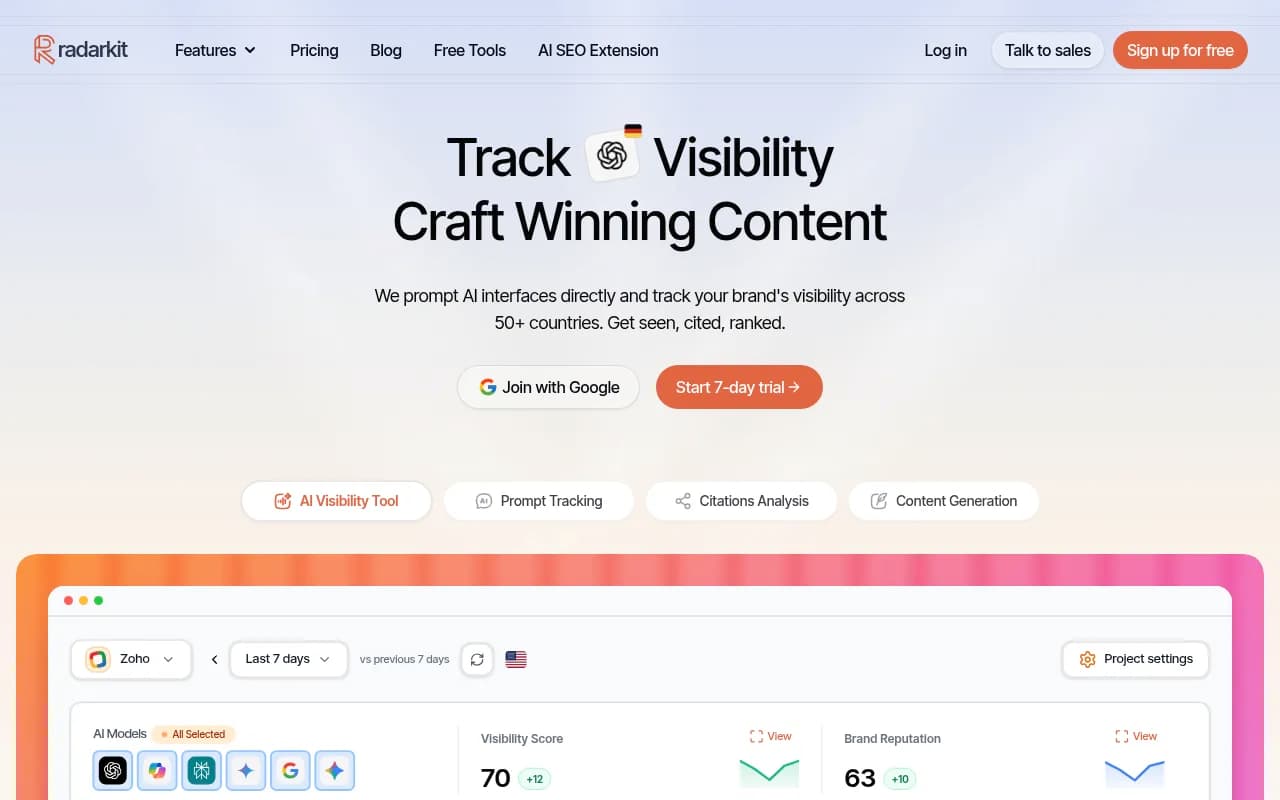
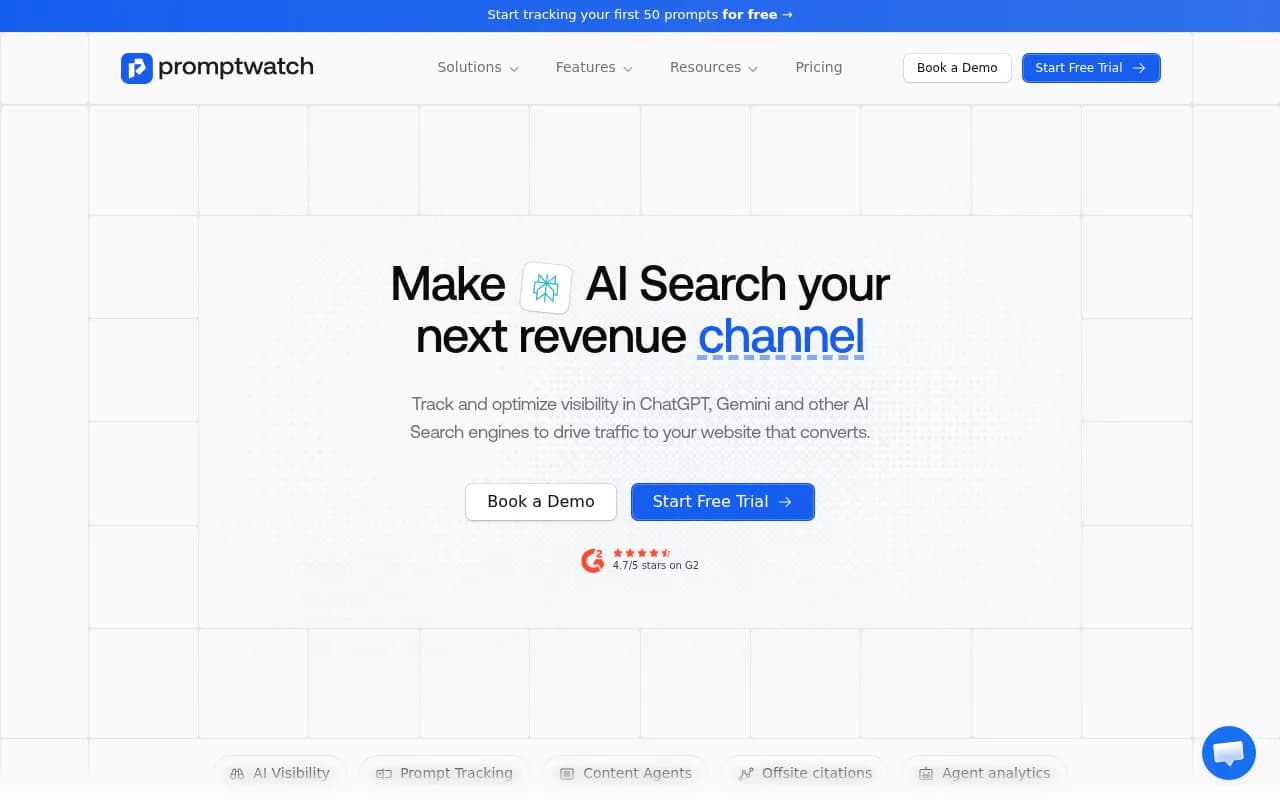
A free trial is available, and annual billing comes with a discount. The pricing search results also reference a free starting tier for the first 50 prompts, which aligns with the homepage CTA ("Start tracking your first 50 prompts for free").
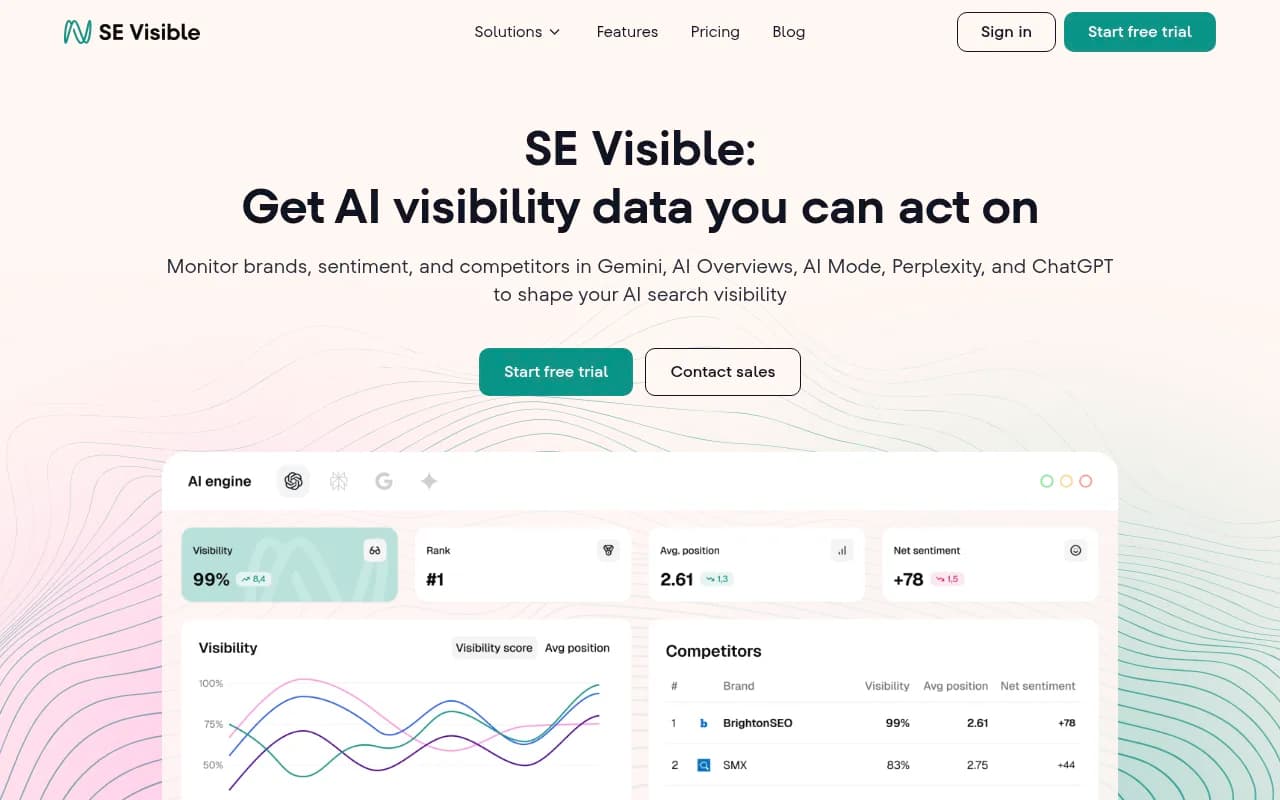
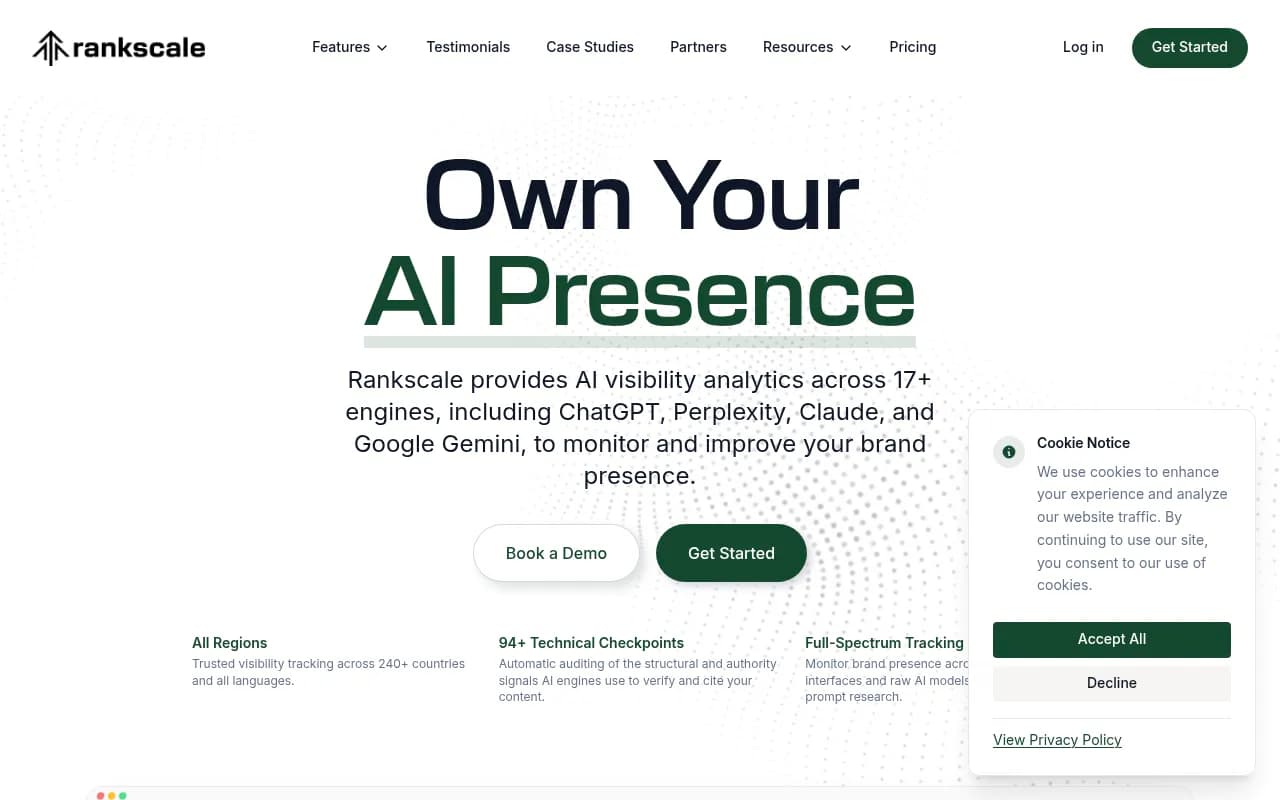
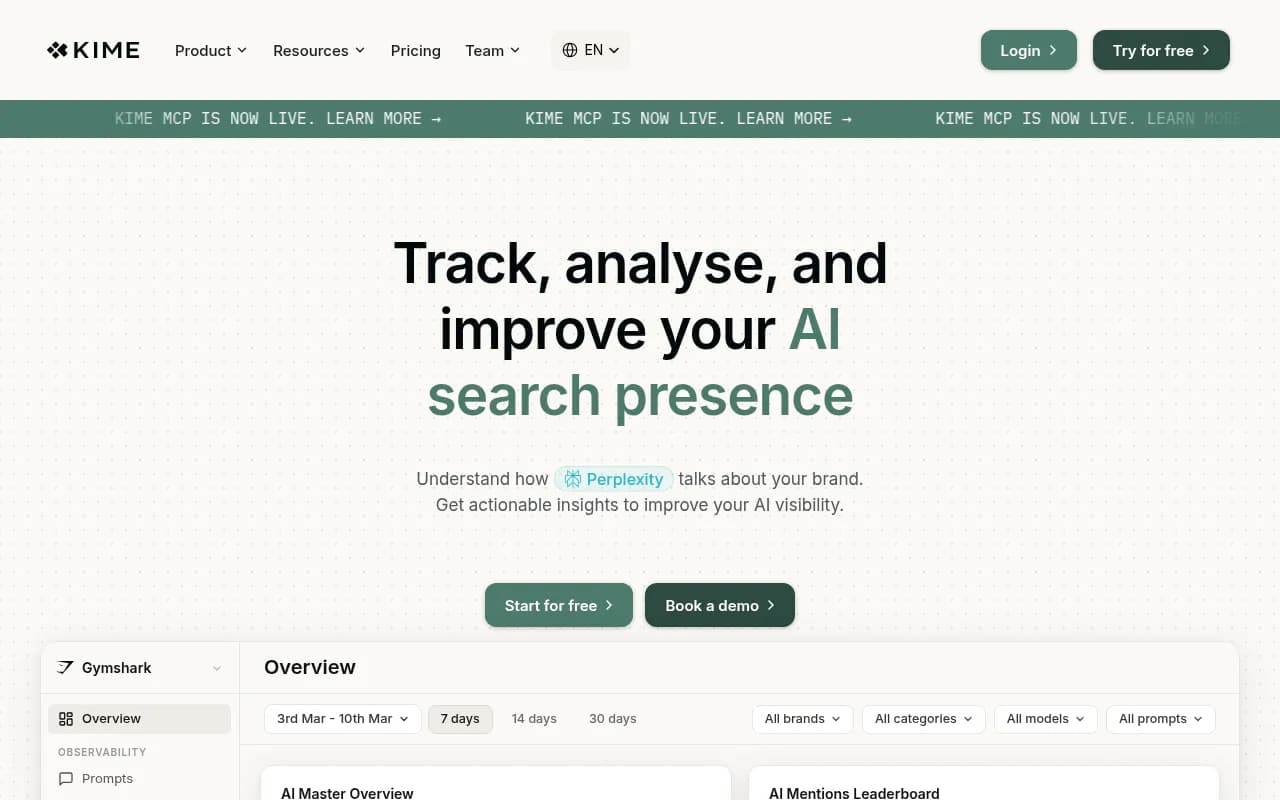
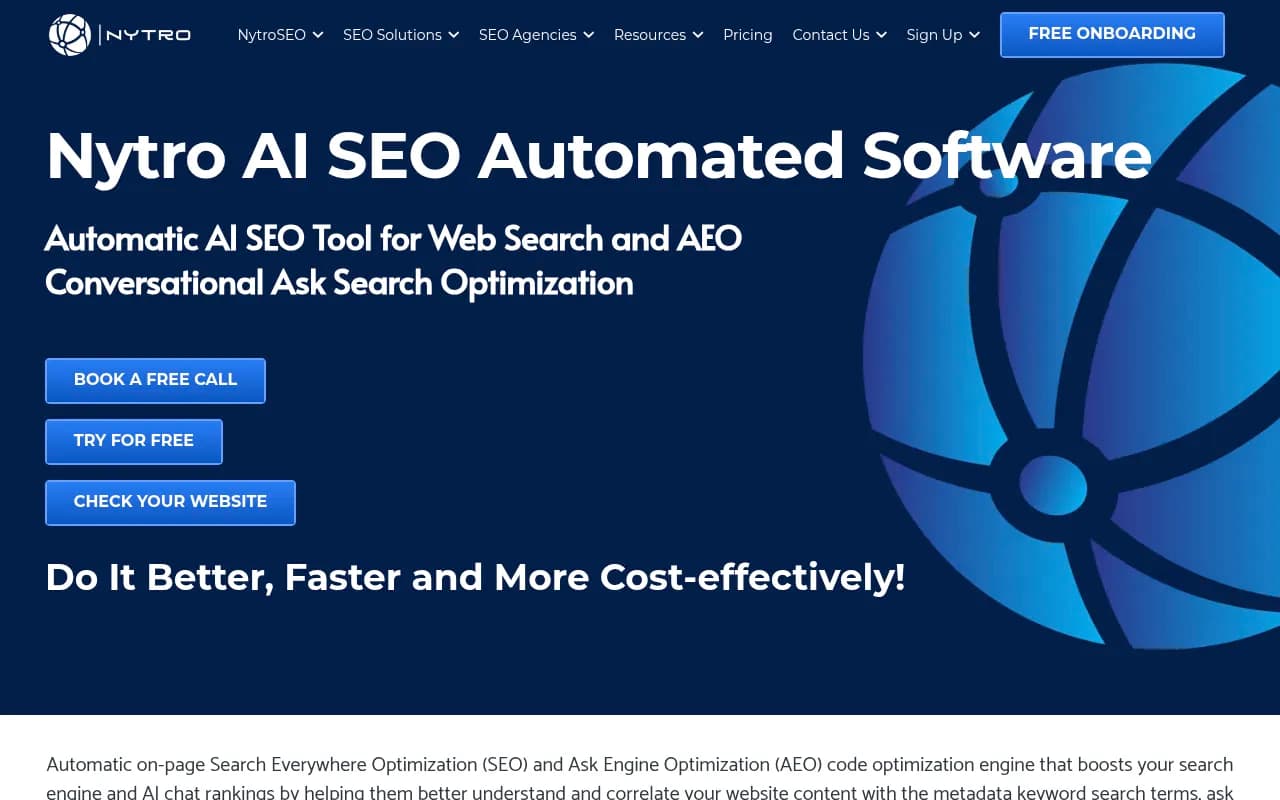
For context: Otterly.AI runs around $199/month for comparable monitoring features but without content generation or crawler logs. Profound and Scrunch have strong feature sets but sit at higher price points. Semrush and Ahrefs offer AI visibility features as add-ons to traditional SEO tools, but with fixed prompt sets and no traffic attribution. At $249/month, Promptwatch's Professional plan is competitive for what it delivers -- especially if you're replacing a monitoring tool plus a content tool with a single platform.
Strengths and limitations
What it does well:
- The action loop is real. Most GEO tools show you data and leave you to figure out what to do. Promptwatch's combination of Answer Gap Analysis, Content Agents, and citation tracking creates a genuine workflow: find gaps, create content, measure results. This is the core differentiator.
- Crawler log data is rare and valuable. Knowing when ChatGPT's crawler hits your pages, which pages it reads, and when those pages move to citation is the kind of operational intelligence that lets you actually fix problems. Competitors like Otterly.AI, Peec.ai, and AthenaHQ don't offer this.
- Model coverage is the broadest in the category. Ten AI models including DeepSeek, Mistral, Meta AI, and Grok -- not just the obvious three. As AI search fragments across more platforms, this breadth matters.
- Reddit and YouTube tracking. These are real citation sources for AI models, and most competitors ignore them entirely.
- Data credibility. 4.5B+ data points and press coverage in the WSJ and Axios isn't marketing fluff -- it means the underlying data is being taken seriously by journalists and analysts who could verify it.
Honest limitations:
- Article limits feel tight at lower tiers. Five articles per month on the Essential plan won't move the needle for a brand with significant content gaps. You'll hit the ceiling quickly if you're serious about GEO content production.
- Prompt limits require careful curation. 50 prompts on Essential means you have to be selective. For brands in competitive categories with dozens of relevant queries, this forces prioritization that might miss important signals.
- No native Slack/email alerting prominently featured. For teams that want real-time notifications when their brand drops out of AI responses or when a competitor gains ground, the absence of push alerting is a gap worth noting.
Bottom line
Promptwatch is the right choice for any marketing or SEO team that has moved past "should we care about AI search?" and is now asking "how do we actually win in it?" The combination of real prompt data, crawler logs, content generation, and traffic attribution puts it in a different category from monitoring-only tools -- and the pricing, while not cheap, is defensible against the cost of buying separate tools for each function.
Best use case in one sentence: a growth-stage SaaS or e-commerce brand, or a digital agency managing GEO for multiple clients, that wants to identify exactly where AI models aren't citing them and then create the content to fix it.
Tags:
Frequently asked questions
What is Promptwatch?
How much does Promptwatch cost?
Is there a free plan or trial?
Which AI models does Promptwatch monitor?
How is Promptwatch different from tools like Otterly.AI or Peec.ai?
Can agencies use Promptwatch for multiple clients?
Similar and alternative tools to Promptwatch