Key takeaways
- Generic GEO advice assumes a blog is your main citation surface. For developer tools, it is your documentation. When an engineer asks an AI how to implement something, the answer gets assembled from reference docs, tutorials, and code samples, not marketing pages.
- The most-repeated generic tactics have near-zero payoff for AI search. Promptwatch's analysis of 1.6 million+ citations found HTML made up 99.94% of citations and markdown just 0.05%. Markdown and llms.txt only earn their keep for developer tools because coding agents fetch them directly, which is a different channel entirely.
- Accuracy is binary in devtools. A deprecated API call or a code sample that no longer runs destroys trust twice: once with the developer who tries it, and once with the model that learned from it.
- Measurement has to be per-engine, not blended. ChatGPT averages around 5 sources per response while Google AI Overviews and Perplexity sit near 10, so content that misses ChatGPT's shortlist can still make Google's longer list.
- Check your crawler access before anything else. A CDN bot rule that silently blocks ClaudeBot or GPTBot undoes every other optimization, and Claude's citation crawler grew more than 100x in four months.
The advice you keep hearing, and why it was never written for you
Most GEO content in 2026 follows the same script: publish listicles, add FAQ schema, get mentioned on Reddit, create an llms.txt file, and screenshot every time ChatGPT says your brand name. Daniel Hebert called this out bluntly when he described most GEO advice as screenshot marketing, and he has a point. The playbook was reverse-engineered from consumer and B2B SaaS brands whose citation surface is a blog.

If you market a developer tool, that playbook misfires at almost every step, because your buyers behave differently at every stage. Developers were the first audience to stop reading marketing content and the first to start asking a model instead. Stack Overflow question volume has collapsed from a peak of roughly 207,000 questions per month in 2014 to around 1,400 per month by mid-2026, with DevClass reporting an 80% year-over-year drop as of January 2026. The forum channel that used to generate organic citations for devtools is gone. AI assistants replaced it. That changes what your content has to be.
Here is the uncomfortable version: your documentation is now the marketing. The blog is a supporting asset. And most GEO advice never mentions docs at all.
What AI actually cites, according to the data
Before building a devtools-specific playbook, it helps to know what generative engines are really pulling into answers. Promptwatch's citation data from July 2026 shows ChatGPT Search citing product pages more than anything else, at roughly a third of all citations, nearly double their share from March. Listicles, how-tos, and comparison pages are much smaller but growing, and they remain low-competition citation opportunities. For a devtools brand, that means your product and reference pages carry more citation weight than the content calendar suggests.
The markdown story is even more direct. Across a sample of 1,665,674 citations spanning ChatGPT, Claude, Perplexity, and Google AI Overviews, HTML accounted for 99.94% of citations and markdown files just 0.05%, a ratio of roughly 2,000 to 1. Promptwatch's conclusion was blunt: markdown is for AI agents, not AI search. Publishing .md mirrors of your marketing pages for AI search visibility has essentially zero payoff.
And the community advice everyone repeats? Reddit's share of ChatGPT Search citations collapsed from roughly 4% to 0.5% in a single day in August 2026, after already dropping about 40% month-over-month from May to June. Meanwhile GitHub's share rose from 0.23% to 0.27% in the same period. If your GEO plan leans on Reddit mentions, it is built on a surface that is shrinking fast. For devtools, the redistribution toward code-hosting domains is the more interesting signal.
Why devtools break the generic playbook
The citation surface is your docs, not your blog
When an engineer asks a model how to implement rate limiting with your API, the retrieved answer comes from your reference docs, tutorials, and code examples. Marketing pages rarely make it in. A GEO strategy built around a content calendar of blog posts is optimizing the surface your buyers use least. This sounds like a small distinction. It is not. It changes where your budget, your engineering time, and your measurement should go.
Accuracy is binary and unforgiving
In most categories, slightly stale content is a minor cost. In devtools, a deprecated API call or a snippet that throws on the first run actively destroys trust. It does so twice: once with the developer who pastes it into their terminal, and again with the model that learned from the page. Freshness is not a ranking nicety here. It is a correctness requirement. Every doc page needs a visible last-updated date, and versioned docs need stable, distinct canonical URLs so a model can tell your v2 guide from your v3 guide.
Coding agents are a surface most advice ignores
Engineers increasingly evaluate tools inside Claude Code, Cursor, Copilot, and similar assistants, and those assistants lean heavily on examples. This surface barely existed two years ago, and most GEO agency proposals still do not mention it. Promptwatch's crawler data shows Claude's citation crawler growing from roughly 30 visits a day in December 2025 to a 1.73% share of all tracked AI citation crawler traffic by April 2026, a more than 100x increase in four months. That growth is tied directly to Claude and Claude Code adoption. If your docs are not machine-fetchable, you are invisible in the environment where your buyers actually work.
The llms.txt inversion
Here is where generic advice and devtools reality genuinely diverge, and it is worth being precise.
For most brands, the consensus in 2026 is that llms.txt does nothing for AI search visibility. Google's own guidance says it does not affect Google Search or AI Overviews, and analyses of actual crawler behavior found LLM search crawlers largely ignore the file. Any agency that opens with "you need llms.txt" as a blanket recommendation is waving a red flag.
Developer tools are the documented exception. AI coding assistants fetch llms.txt directly because it gives them a curated, machine-readable map of your documentation instead of forcing them to crawl the whole site. The token efficiency gain is real and reproducible in this one category. The same logic applies to markdown mirrors: near-worthless for AI search, genuinely valuable when Claude Code or Codex fetches /docs/quickstart.md to get clean content without parsing your HTML wrapper. Promptwatch's server logs show heavy crawling of /docs/**/*.md paths specifically by Anthropic and OpenAI crawlers.
So the rule for devtools is: skip the llms.txt hype for marketing pages, but do maintain a well-structured llms.txt at your docs root, organized into Getting Started, API Reference, Common Tasks, and Troubleshooting, with a one-line description per link. And serve a markdown version of every doc page. Just be honest about which channel each one serves.
Technical hygiene that decides everything
Before you invest a single dollar in content, fix the plumbing. None of this is glamorous, and all of it is cheap.
Crawler access. Each AI crawler needs its own explicit robots.txt user-agent rule. GPTBot, ClaudeBot, PerplexityBot, OAI-SearchBot, Claude-User, and Claude-SearchBot are all separate, and blocking one does not block another. Worse, CDN and WAF bot-management rules can silently block AI crawlers even when your robots.txt looks fine. A block that was harmless in December 2025 now quietly excludes you from a citation channel that grows every month. Check the CDN layer separately from the file.
Server-side rendering. Assistants and crawlers do not reliably execute JavaScript. If your docs are a client-rendered SPA, the model may see an empty shell. Code blocks need to be real HTML, tagged with their language, not rendered by a JS widget.
Site architecture. On August 8, 2026, ChatGPT Search started using the site: operator at scale, jumping from about 0.4% to roughly 17% of all fanout queries overnight, with searches per response nearly doubling. ChatGPT can now target your domain directly, which makes clean sitemaps, logical URL structure, and crawlable internal linking more valuable than they were last quarter.
Query-shaped headings. ChatGPT's average fanout query length dropped from about 117 characters in December to roughly 53 by April 2026. It increasingly searches like someone typing terse keywords. Your doc headings should read like short queries with the entity front-loaded, not conversational questions. And re-audit this after major ChatGPT updates, because phrasing that matched last quarter may already be stale.
Code samples built for extraction. Complete, runnable examples with imports included. Explicit language tags. Comments on non-obvious lines, because models tend to preserve comments in citations. Descriptive variable names. Expected output shown. A tutorial with a working snippet does more for you in a coding agent than any comparison page.
Measure per-engine, or you are measuring nothing
Generative engines are probabilistic, and they differ sharply from each other. Promptwatch's data shows ChatGPT averaging around 5 sources per web-search response, while Google AI Overviews and Perplexity both sit near 10 and are remarkably steady, which makes Perplexity the best GEO test bench for technical audiences, given how heavily developers and researchers use it. Microsoft Copilot swings wildly between under 2 and around 17 sources, so it is not yet a reliable place to focus budget.
The practical consequence: content that narrowly misses ChatGPT's shortlist can still make Google's longer list. A single blended visibility score hides that. You want cited URLs and competitor share of voice per engine, run more than once, because one run on one engine establishes nothing.
This is where a visibility platform earns its keep. Promptwatch tracks citations across ChatGPT, Claude, Gemini, Perplexity, Google AI Overviews, and AI Mode, and its crawler logs show exactly when AI systems visit your docs, what they read, and whether they hit errors, which is the fastest way to catch a silent bot block. It also tracks coding assistants like Claude Code and OpenCode as first-class surfaces, which most competitors do not.

A few other options worth knowing, depending on your stack and budget:

| Tool | Best for devtools because | Watch out for |
|---|---|---|
| Promptwatch | Crawler logs catch silent bot blocks; tracks Claude Code and OpenCode; Reddit and YouTube citation tracking | More platform than a casual tracker |
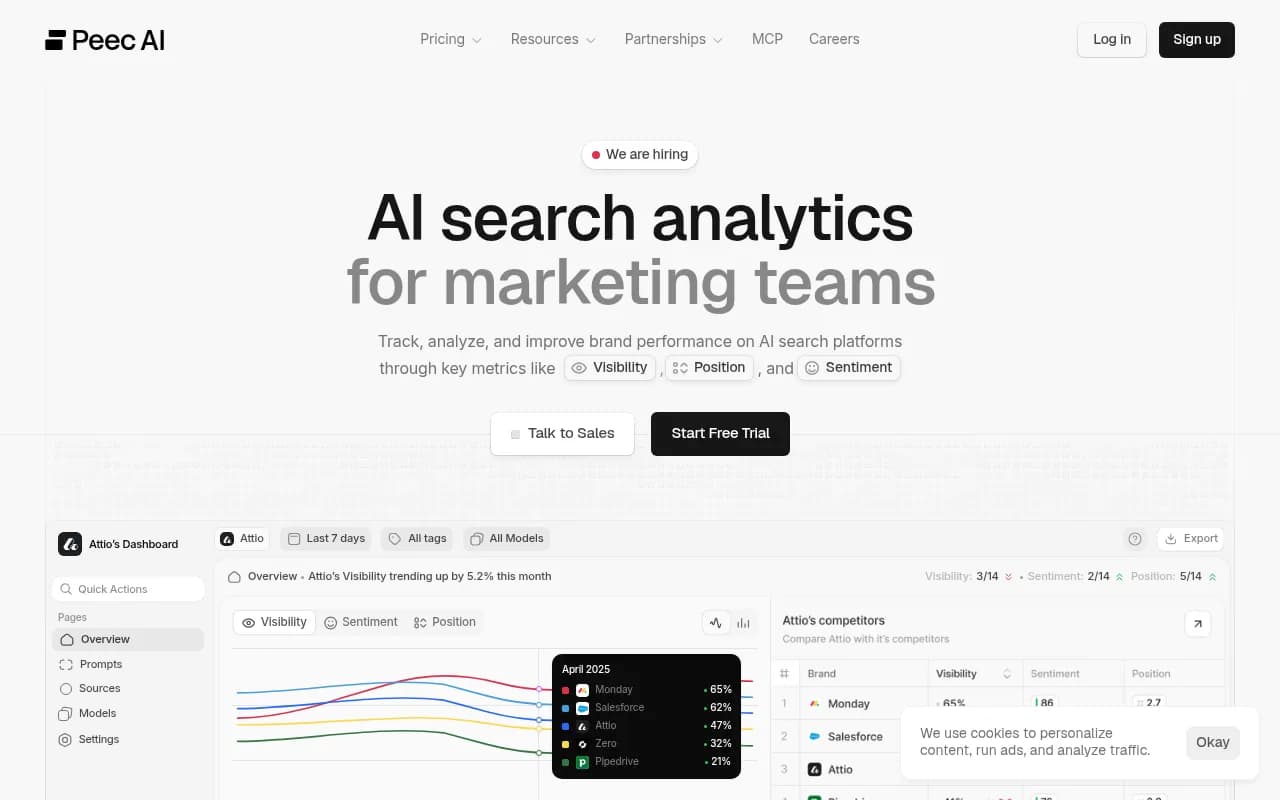
| Peec AI | Budget-friendly prompt tracking across multiple engines | Monitoring-focused, no crawler logs |
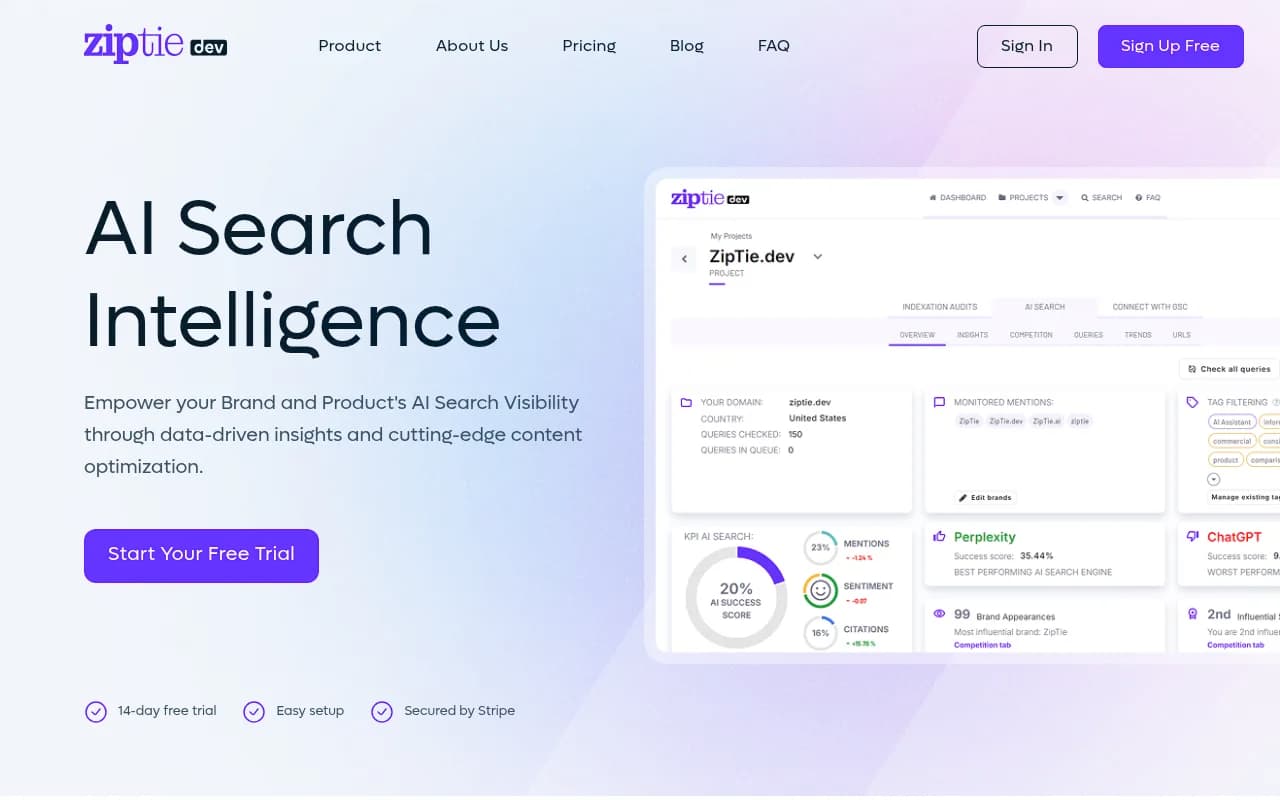
| ZipTie | Focused, lightweight AI visibility tracking built with developers in mind | Narrower feature set |
| Elmo | Open-source and self-hosted, so your data stays yours | You maintain it yourself |
| Profound | Strong enterprise monitoring and analytics | Higher price points, no agentic execution |
If you want a broader view of the category, the GEO software directory at bestgeosoftware.com keeps an updated list, and agenticseotools.com covers the newer tools that go beyond monitoring into execution.
What a devtools GEO plan actually looks like
Here is the priority order I would argue for, based on where citations actually come from:
- Crawler access and technical discoverability. Verify robots.txt, CDN bot rules, SSR, and sitemap cleanliness. This costs engineering hours, not a retainer, and it is the highest-return work available.
- Documentation and reference quality. Versioned canonical URLs, visible freshness dates, query-shaped headings, HowTo schema on tutorials with each step marked up.
- Tutorials with working examples. Complete, runnable, commented, tagged. These are what coding agents lift.
- llms.txt and markdown mirrors for the docs only. Skip them for marketing pages.
- Community and earned presence. GitHub READMEs, examples, and issues matter more than Reddit right now, and the data backs that up.
- Measurement and attribution. Per-engine visibility, share of voice, and actual AI-driven traffic, not mention counts.
Notice what is missing: a content calendar of blog posts. Blogs still have a role, mostly for comparison and alternatives content, which remains a low-competition citation type. But they are the supporting act, not the headliner.
When to bring in outside help
You can do most of the above in-house, and for an early-stage devtools company that is what I would do: the work costs engineering time rather than a retainer. At some point though, you will want either a platform subscription or a partner, and the vetting questions matter more than the portfolio.
Ask who writes the content and who reviews it technically, by name. If both answers are "our content team," your developers will notice before the model does. Ask the partner to review a page of your docs and tell you what is wrong; it is the fastest competence test available and costs them an hour. Ask how many hours per month of your engineers' time they need, because every credible model needs some. Red flags: guaranteed citations (nobody controls a generative engine's output), a content calendar with no documentation work, and blanket llms.txt advice.
If you would rather hand this to an agency than build it internally, 1001 SEO Media publishes this site and runs GEO programs that combine technical SEO, content production, and generative engine optimization, including work for technical products where docs are the asset. The same vetting questions apply whoever you hire.
The honest summary
Generic GEO advice fails technical products because it was built for brands whose citation surface is a blog and whose buyers tolerate marketing language. Yours is not, and yours do not. The devtools version of GEO is mostly an engineering discipline: fix crawler access, make your docs machine-fetchable, keep every code sample running, and measure per-engine instead of screenshotting brand mentions. The data is unambiguous about where citations come from, and it is not the content calendar.