Key takeaways
- Rankability is a legitimate all-in-one agency tool (keyword research, content, rank tracking, AI visibility) starting at $79-199/mo, but its AI visibility data is built from scheduled scans of keywords you configure, not real prompt volume from actual AI conversations.
- Dedicated platforms like Profound, Peec.ai, and Promptwatch track real prompt demand, crawler-level attribution, and citation accuracy, at a real cost premium (category average starting price is around $337/month per Rankability's own benchmark survey).
- AI search behavior changes fast enough that snapshot audits go stale within weeks. Citations per ChatGPT response dropped roughly 27% after the GPT-5.3 rollout in March 2026, and Reddit's ChatGPT citation share collapsed from about 4% to 0.5% in a single day in August 2026.
- If you're a small agency or in-house team wanting one dashboard for SEO, content, and a directional AI visibility score, Rankability covers real ground. If you need to explain why visibility moved, attribute AI traffic to revenue, or catch platform-level shifts as they happen, you need something built for that specifically.
- The honest answer is usually "both, at different stages": Rankability (or a similar bundled tool) for content ops, and a dedicated AI visibility platform layered on top once AI-driven traffic actually matters to the business.
The question agencies keep asking
A lot of agencies already own Rankability, or a tool like it, because it does five things reasonably well in one subscription: keyword research, content drafting, rank tracking, client reporting, and now, AI visibility monitoring bolted on top. So the question that keeps coming up isn't "which GEO tool should I buy" — it's "do I actually need to buy another one, on top of what I already have?"
I don't think there's a universally correct answer here. But there is a specific, checkable difference between what Rankability measures and what a dedicated AI visibility platform measures, and once you understand that difference, the decision mostly makes itself.
What Rankability actually does
Rankability was built by the team behind Gotch SEO and launched in 2023 as an agency operating system, not a purpose-built AEO tool. It rolls together keyword research, AI-assisted content drafting through its Copywriter module, optimization scoring, traditional rank tracking, and AI visibility monitoring across up to nine platforms on its top tier.
Pricing runs Solo $79/mo, Core $199/mo, Team $399/mo, and Agency $799/mo when billed annually. Scan frequency matters here: AI visibility checks run weekly on Core and Team, and only the $799/mo Agency plan gets daily scans. Compare that to dedicated platforms, most of which scan daily on every paid tier.
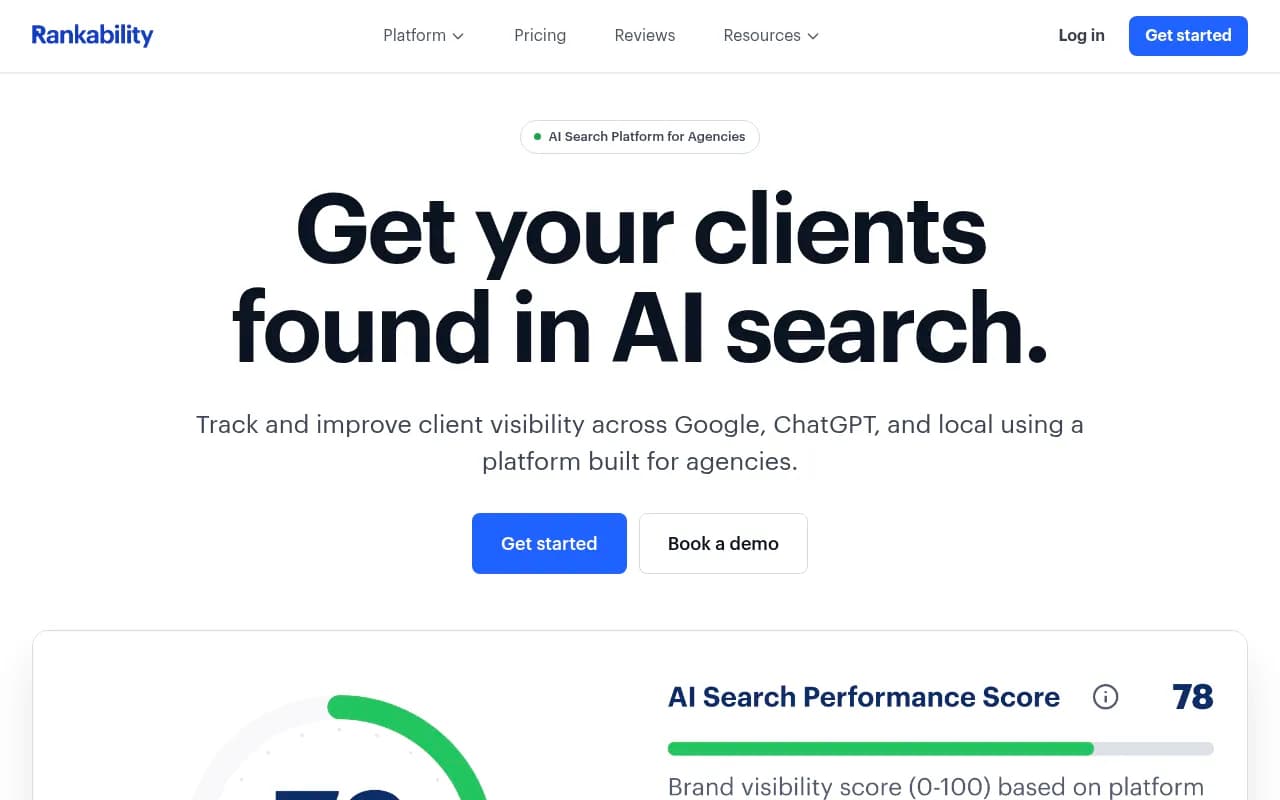
Rankability's genuinely useful feature is its Search Performance Index, a single 0-100 score that blends traditional rankings, local visibility, AI mentions, and YouTube presence. For client reporting, that's a clean number to put in a slide. It also captures up to 25 competitor brands mentioned per AI response, which gives you a wide competitive picture for any given keyword.
Where the gap actually is
Here's the part that gets glossed over in a lot of comparison posts: Rankability's AI visibility data is keyword-configured. You pick a set of keywords or prompts, Rankability runs them against AI engines on a schedule, and reports what came back. That's a real signal, but it's an assumption about what people ask, not an observation of what they actually ask.
Dedicated platforms like Profound built their entire pitch around this distinction. Profound's "Prompt Volumes" feature is drawn from more than 1.35 billion real user prompts, broken down by intent, age, income, and region. That's the difference between guessing which questions matter and watching which questions people actually type into ChatGPT. Independent reviews of the category (including Profound's own comparison, which I'd normally discount, but the point holds up against Ziptie's independent review too) flag the same three limitations for Rankability specifically: no prompt volume data, no crawler-level attribution, and no automated accuracy alerts when an AI model states something wrong about your brand.
That last one matters more than it sounds. Getting mentioned and getting mentioned accurately are two different outcomes. A tool that only counts mentions can tell you you're visible while missing that the AI is describing your pricing wrong or attributing a competitor's feature to you.
Why the timing of this question matters in 2026 specifically
If AI search behavior held still, a weekly keyword scan would be fine. It doesn't hold still, and the volatility has gotten worse this year, not better.
Promptwatch's data on citation behavior around the GPT-5.3 rollout shows average citations per ChatGPT response dropped from roughly 6.4 to under 5 within weeks of the March 4, 2026 update, and never recovered. That's a platform-wide change affecting GPT-5.3, GPT-5.4, and GPT-5-Mini at once. If your monitoring only checks weekly and doesn't distinguish causes, you'd see your visibility score drop and have no idea whether it's your content or the platform.
Something similar happened with ChatGPT's search mechanics in August. Promptwatch's fanout data shows the share of fanout queries using the site: operator jumped from 0.37% to nearly 17% in a single day, on August 8, 2026, while queries per response nearly doubled. And separately, Reddit's citation share inside ChatGPT collapsed from about 4% to 0.5% on August 14, 2026, a single-day move that would make any "top cited domains" list from a month earlier meaningfully wrong.
Content type mix moves fast too. ChatGPT's citation type breakdown for July 2026 shows product pages going from about 18% of citations in March to nearly 33% by July, while listicles grew from 8% to over 10% within July alone. If you're planning content based on a snapshot from three months ago, you're optimizing for a mix that's already changed.
None of this is an argument that Rankability is bad software. It's an argument that weekly, keyword-configured scans are a lagging indicator in a market where the underlying rules can change overnight.
Comparing the two approaches directly
| Capability | Rankability | Dedicated AI visibility platform (e.g. Profound, Peec.ai, Promptwatch) |
|---|---|---|
| Prompt source | User-configured keywords/prompts | Real observed user prompts (where available) or UI-scraped live responses |
| Scan frequency | Weekly (Core/Team), daily only on $799/mo Agency tier | Daily on most paid tiers |
| Crawler-level attribution | None | Yes, CDN-level bot tracking (Cloudflare, Akamai, Fastly, etc.) tied to traffic |
| Accuracy/sentiment alerts | None advertised | Yes, on most dedicated platforms |
| Content generation bundled | Yes, Copywriter module with briefs and drafts | Varies; some (Promptwatch) publish directly to CMS, others are monitoring-only by design |
| Starting price | $79/mo (Solo) | $95-245/mo typical for a real single-site setup; category average starting price is about $337/mo |
| Best fit | Agencies wanting one dashboard for SEO + content + directional AI score | Teams that need to explain visibility changes, attribute AI traffic to revenue, or catch platform shifts fast |
What a dedicated platform adds that a bundled tool doesn't
The clearest way to see the difference is to look at what happens after you notice a visibility drop. With a keyword-configured tool, you see the number move and that's mostly it. With a platform built around crawler logs and citation-level detail, you can trace it.
Promptwatch is a case in point, and it's the platform I'd point most teams to if they've outgrown a bundled tool. It tracks real UI-rendered answers (not just API responses) across ChatGPT, Gemini, Claude, Perplexity, Grok, DeepSeek, Copilot, Google AI Overviews, and AI Mode, and pairs that with AI crawler logs (Agent Analytics) that show exactly when ChatGPTBot, ClaudeBot, PerplexityBot, and 400+ other bots hit your pages, what they read, and whether they errored out. That crawler-to-citation path is something Rankability doesn't offer at all, and it's the piece that turns "we're less visible" into "here's the specific page that stopped getting crawled, and here's why."

It also closes the loop rather than stopping at a score: Content Agents plan, write, and publish GEO-optimized articles directly to Webflow, Framer, or WordPress on a schedule, and Unified Actions turns visibility, citation, and crawler data into a prioritized to-do list instead of a dashboard you have to interpret yourself. Crisp, one of its customers, used this to scale to 5-10 published articles a day and saw 2x higher conversion from AI traffic than from traditional channels. Pricing starts at $95/mo for a single site with 50 prompts, running up to $579/mo for larger multi-site setups, which puts it in a similar band to Peec.ai and below Profound's Growth tier.
Where Rankability is genuinely the right call
I don't want to overstate the case against Rankability. If you're a small agency running client reporting across SEO, content, and a directional AI visibility score, and you don't need to prove ROI down to the crawler hit, Rankability's SPI score and bundled Copywriter module save real time. Weekly scans are a real limitation, not a fatal one, if your clients aren't in categories where AI answers move fast (a lot of local service businesses, for instance, don't see the same volatility as SaaS or ecommerce).
The honest breakdown:
- Use Rankability alone if you need one dashboard for SEO plus a rough AI visibility check, budget is under $200/mo, and your clients aren't demanding attribution-level proof of AI traffic.
- Add a dedicated platform once a client asks "why did this happen" and you can't answer, once AI-referred traffic becomes big enough to matter in a board deck, or once you're managing accounts in categories (finance, healthcare, travel, ecommerce) where AI answer composition shifts fast and being wrong in an AI answer has real cost.
- Run both if you're an agency: Rankability (or a similar bundled tool) for content production and client-facing scorecards, a dedicated platform like Promptwatch or Peec.ai for the accounts where visibility is a growth lever, not just a line item.
A quick note on Peec.ai and other monitoring-only tools
Worth mentioning: not every dedicated platform tries to do everything. Peec.ai, for example, is explicitly monitoring-only, "by design," with no content generation at all. It offers unlimited seats on every plan (no per-seat cost creep), 80+ countries and languages tracked at no extra charge, and MCP server access that connects to Claude Desktop, Cursor, and VS Code Copilot. Starting price is $95/mo for 50 prompts on one project. That's a reasonable fit if you already have a content workflow elsewhere and just want clean, UI-scraped tracking.

Otterly.ai sits at the budget end, $29/mo for 15 prompts across four platforms, which makes it a fine starting point if you've never tracked AI visibility at all and want to see the shape of the problem before committing to anything bigger.

The bottom line
Rankability isn't a weak tool. It's a bundled tool, and bundled tools trade depth for convenience by design. The question isn't whether Rankability is "enough" in the abstract, it's whether your business has reached the point where guessing at prompt volume and checking weekly is too slow for how fast AI answers are actually changing this year. For a lot of small agencies, it isn't there yet. For anyone whose revenue is starting to show up as "referred from chatgpt.com" in analytics, it probably already is.
If you want to browse the broader category before deciding, the GEO software directory at bestgeosoftware.com and the AI visibility rankings at aisearchtoolrank.com are both good places to compare tools side by side rather than take any one vendor's word for it.