Key takeaways
- Profound is the enterprise category leader with $155M raised and Fortune 500 clients, but it's monitoring-only and priced well above most teams' budgets.
- Peec AI is the fastest-growing mid-market option at $29M raised, with clean analytics and strong momentum, but still stops at showing you the problem.
- Otterly.AI is the most accessible entry point at $29/month, good for teams that just want to start measuring AI visibility without a big commitment.
- Promptwatch is the only platform in this comparison that closes the full loop: find gaps, generate content to fix them, then track whether it worked.
- If your goal is to actually improve your AI visibility (not just measure it), the monitoring-only tools will leave you with data and no clear next step.
The AI visibility tools market has gotten crowded fast. Between summer 2025 and spring 2026, platforms in this space collectively raised over $300M. Everyone has a dashboard. Everyone tracks citations. Everyone shows you a score.
But here's the thing most comparison posts skip: tracking your AI visibility and improving it are two completely different problems. Most platforms solve the first one. Very few solve the second.
This guide breaks down four of the most-discussed platforms right now -- Otterly.AI, Promptwatch, Profound, and Peec AI -- with honest assessments of what each one actually delivers, who it makes sense for, and where the gaps are.
What these tools actually do (and don't do)
Before getting into specifics, it's worth being clear about the job these tools are hired to do. At the most basic level, AI visibility platforms answer one question: "When someone asks ChatGPT or Perplexity something relevant to my business, does my brand show up?"
That's monitoring. It's useful. But it's table stakes.
The more valuable question is: "What do I do about it?" That's where the platforms diverge significantly.
Otterly.AI: the entry point
Otterly.AI is the most accessible platform in this comparison. Starting at $29/month, it's aimed squarely at smaller teams and individuals who want to start tracking AI brand mentions without committing to a serious budget.
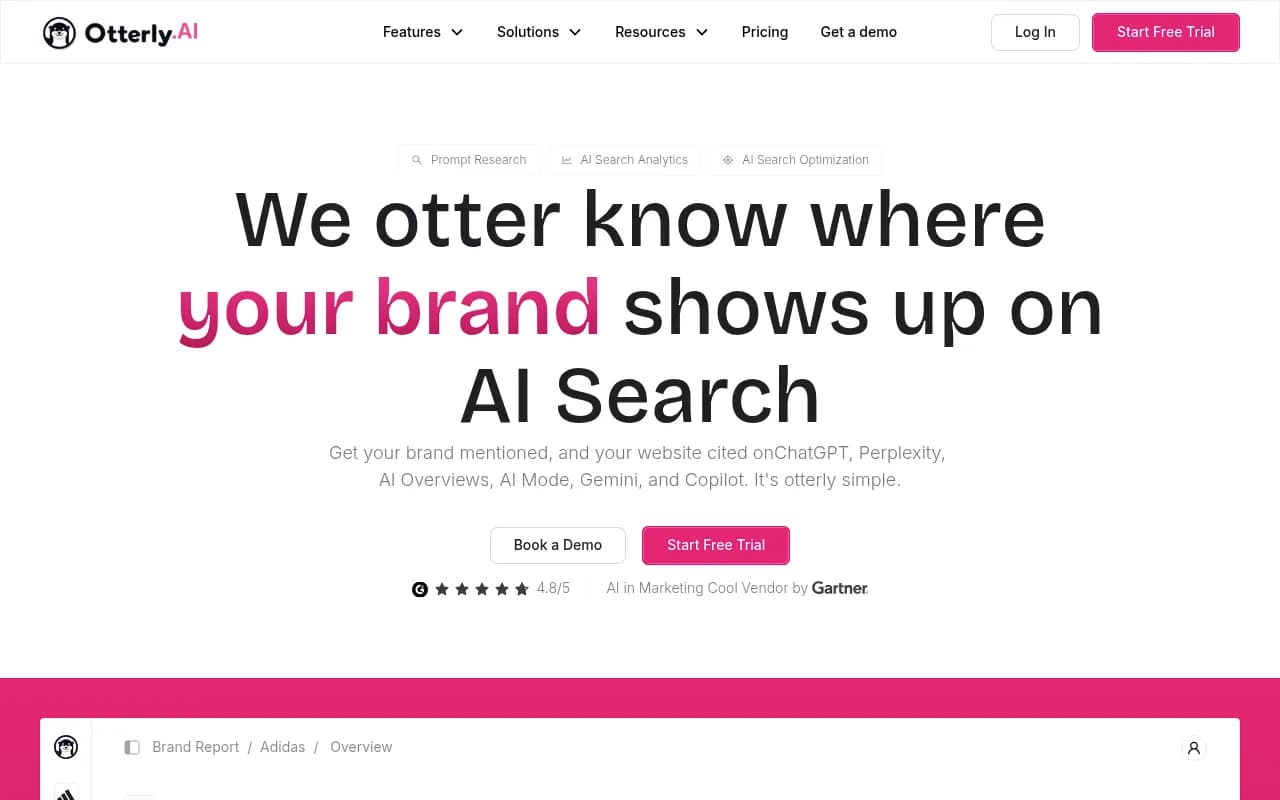
It covers a handful of AI models (roughly 3-4 on the base plan, with additional LLMs available as paid add-ons), captures screenshots of how your brand appears in AI responses, and gives you a basic monitoring dashboard. For what it is, it works.
The limitation is that it's purely observational. You can see whether you're being cited. You can't do much about it from within the platform. There's no content gap analysis, no content generation, no crawler logs, no traffic attribution. If you're a solo marketer or a small business just trying to get a baseline read on your AI presence, Otterly is a reasonable starting point. If you're trying to actually move the needle, you'll outgrow it quickly.
Pricing starts at $29/month, which makes it the cheapest option in this group by a significant margin.
Peec AI: the mid-market challenger
Peec AI is a Berlin-based platform that raised $29M in funding and reportedly crossed $4M ARR within ten months of launch. Those numbers are real, and they reflect genuine product-market fit in the mid-market segment.
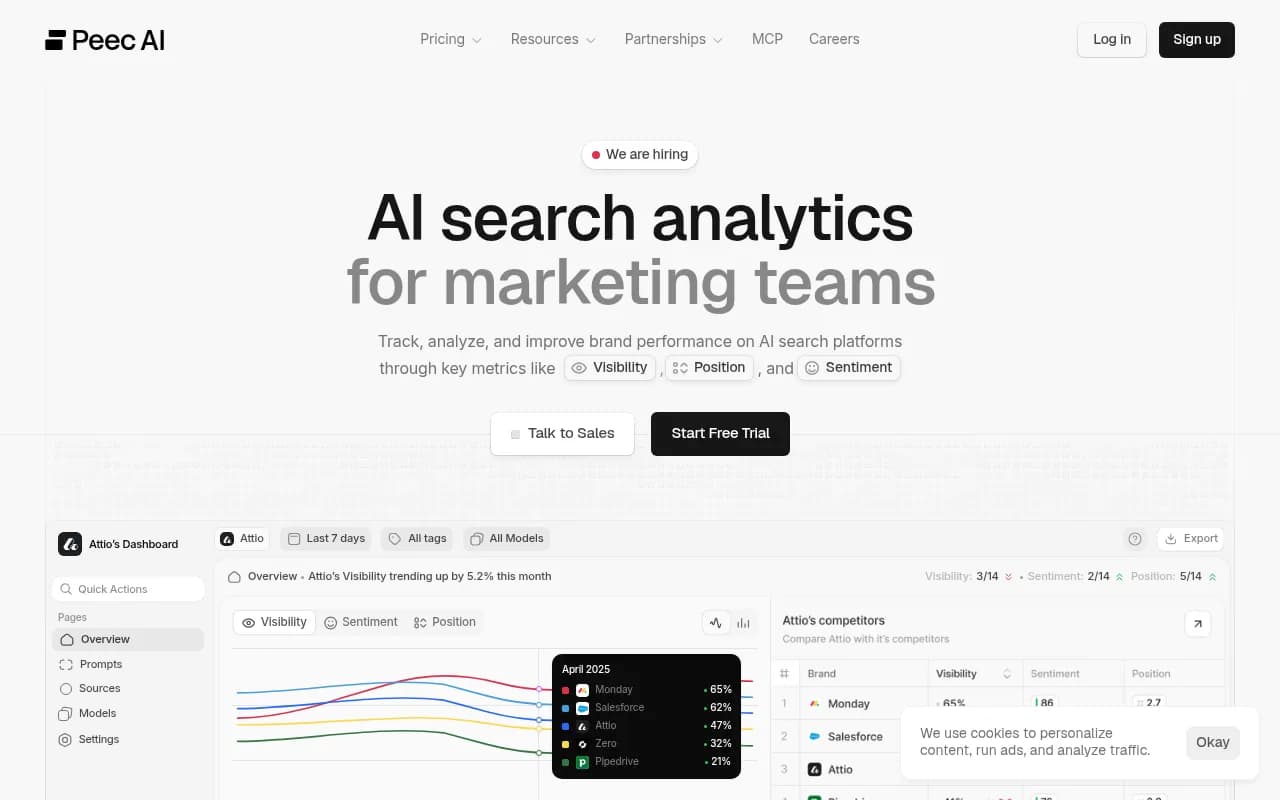
Peec's strengths are clean UX and solid analytics. The dashboards are well-designed, the data is easy to interpret, and the platform is fast. Like Otterly, it covers 3-4 base platforms with paid add-ons for additional LLMs -- so if you need broad model coverage out of the box, that's a consideration.
Where Peec falls short is the same place Otterly does: it's a monitoring platform. The data is better presented and the analytics go deeper, but the workflow still ends at "here's where you're invisible." There's no built-in path to fixing it. No content generation, no actionable briefs, no crawler logs showing you how AI engines are actually reading your site.
For mid-market teams that want clean, reliable AI visibility data and are comfortable building their own content workflow on top of it, Peec is a strong option. For teams that want a more integrated loop from insight to action, it's half a solution.
Pricing sits in the mid-market range, making it more accessible than Profound but more expensive than Otterly.
Profound: the enterprise standard
Profound is the category leader by most measures. $155M raised. $1B valuation. Fortune 500 clients. If you're evaluating AI visibility platforms and someone on your team asks "what's the gold standard?", Profound is the answer they're looking for.
The analytics are deep. The data is trusted. The enterprise integrations are real. For large organizations with complex reporting needs, dedicated analytics teams, and budgets to match, Profound delivers.
But there are two problems that come up repeatedly when teams evaluate it against alternatives.
First, the price. Profound is reportedly priced about 48% above the market average, with the most useful features locked behind enterprise tiers. For mid-market teams, that's a hard sell.
Second, and more importantly: Profound is monitoring-only. It shows you where you're invisible in AI search with impressive precision, but it doesn't help you create the content to fix it. You get the diagnosis without the treatment. For enterprise teams with large content operations that can act on the data independently, that's fine. For everyone else, it means paying a premium for a dashboard that tells you what's wrong and then leaving you to figure out the rest.
Promptwatch: the full-loop platform
Promptwatch takes a different approach to the problem. Where the other three platforms are fundamentally monitoring tools, Promptwatch is built around what happens after you see the data.
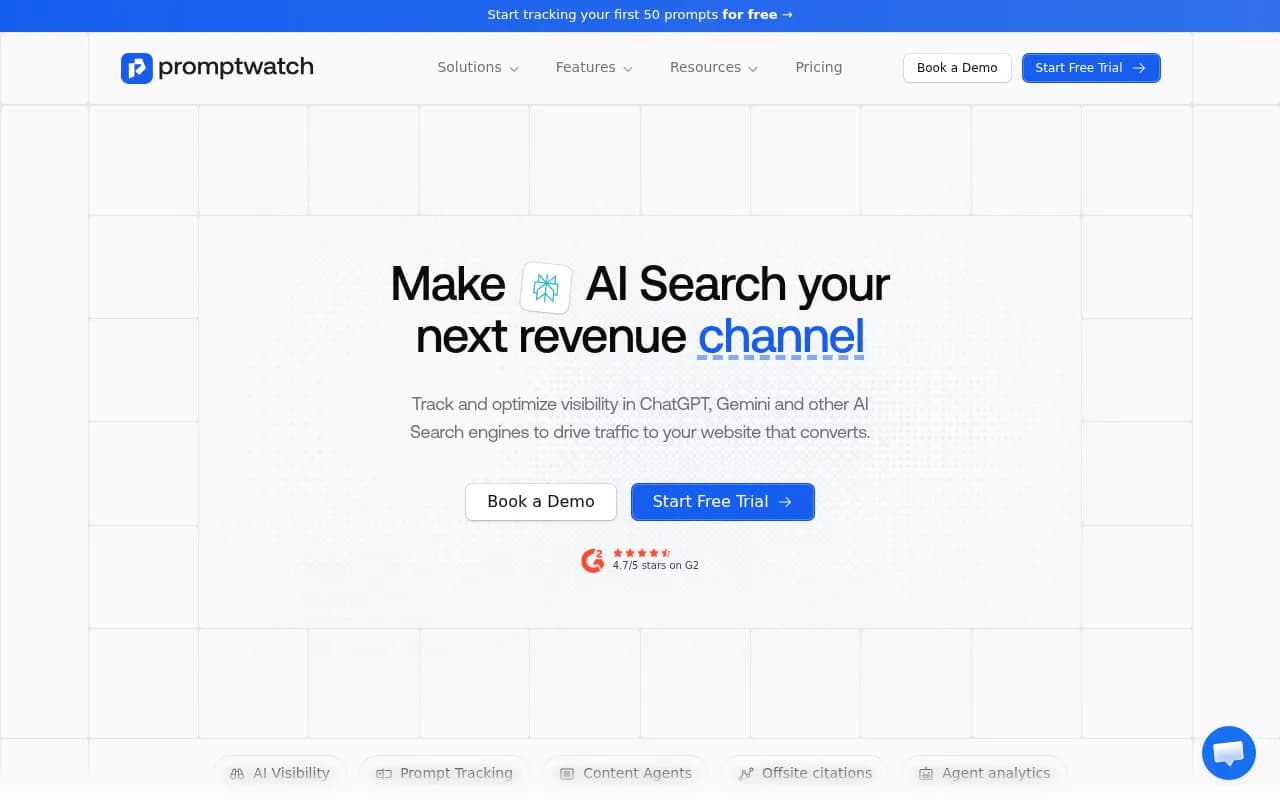
The core workflow works in three stages. First, Answer Gap Analysis shows you exactly which prompts competitors are visible for that you're not -- not just "you're missing here" but the specific topics, angles, and questions AI models want answers to but can't find on your site. Second, Content Agents generate articles, listicles, comparisons, and briefs grounded in that real prompt data, citation patterns, prompt volumes, persona targeting, and competitor analysis. Third, page-level tracking shows you which pages are being cited, how often, and by which models -- with agent analytics that trace the timeline from publish to crawl to citation.
That loop -- find gaps, create content, track results -- is what separates it from the monitoring-only tools. Most competitors stop at step one.
A few other things worth noting: Promptwatch tracks 10 AI models on every plan (ChatGPT, Perplexity, Google AI Overviews, Google AI Mode, Claude, Gemini, Meta/Llama, DeepSeek, Grok, Mistral, Copilot), which is broader coverage than Otterly or Peec out of the box. It also includes AI Crawler Logs -- real-time logs of AI crawlers hitting your website, which pages they read, errors they encounter, and when pages move from crawl to citation. Most competitors don't have this at all.
Reddit and YouTube tracking is another differentiator. Promptwatch surfaces discussions that directly influence AI recommendations, a channel the other platforms in this comparison largely ignore.
Pricing: Essential at $99/month (1 site, 50 prompts, 5 articles), Professional at $249/month (2 sites, 150 prompts, 15 articles, crawler logs), Business at $579/month (5 sites, 350 prompts, 30 articles). A free trial is available.
Side-by-side comparison
| Feature | Otterly.AI | Peec AI | Profound | Promptwatch |
|---|---|---|---|---|
| Starting price | $29/mo | Mid-market | $499+/mo (enterprise) | $99/mo |
| AI models covered | 3-4 base + add-ons | 3-4 base + add-ons | Multiple (enterprise) | 10 on every plan |
| Monitoring / citation tracking | Yes | Yes | Yes | Yes |
| Content gap analysis | No | No | No | Yes |
| Content generation | No | No | No | Yes |
| AI crawler logs | No | No | No | Yes |
| Traffic attribution | No | No | Limited | Yes |
| Reddit / YouTube tracking | No | No | No | Yes |
| ChatGPT Shopping tracking | No | No | No | Yes |
| Prompt volume / difficulty | No | Limited | Limited | Yes |
| Best for | Solo / small teams | Mid-market analytics | Enterprise reporting | Teams wanting to improve visibility |
The monitoring-only problem
It's worth being direct about this, because it affects how you should think about budget allocation.
If you pay for a monitoring-only platform and it shows you that competitors are being cited for 40 prompts you're invisible on, what happens next? You take that data to your content team, brief them manually, they write something, you wait weeks to see if it moves the needle, and you check the dashboard again. The platform had nothing to do with the fix.
That's not a knock on Otterly, Peec, or Profound specifically -- it's a structural limitation of the monitoring-only model. The data is valuable. But the gap between "here's the problem" and "here's the solution" is where most teams get stuck.
Platforms that close that loop -- showing you the gap, helping you create content to fill it, then tracking whether the content worked -- are doing something fundamentally more useful. That's the case for Promptwatch, and it's worth weighing seriously when you're deciding where to put your budget.
Who should use which platform
The honest answer depends on where you are and what you're trying to accomplish.
If you're just starting out and want to understand what AI visibility even means for your brand, Otterly.AI at $29/month is a low-risk way to get a baseline. Don't expect it to tell you what to do with the data.
If you're a mid-market team with solid analytics capabilities and you want clean, well-presented AI visibility data that you can act on independently, Peec AI is worth a serious look. The product is well-built and the momentum is real.
If you're an enterprise with a large analytics team, Fortune 500 reporting requirements, and budget to match, Profound is the category standard. Just go in knowing it's monitoring-only and price accordingly.
If you want a platform that doesn't just show you the problem but helps you fix it -- content gap analysis, AI content generation, crawler logs, traffic attribution, broad model coverage -- Promptwatch is the one platform in this comparison built around that full workflow. It's used by 1,480+ brands and agencies including Booking.com and Center Parcs, and it's the only platform rated as a "Leader" across all categories in a 2026 comparison of 12 GEO platforms.
A note on pricing relative to value
One thing that gets lost in pure price comparisons: the relevant question isn't "which tool is cheapest?" but "which tool produces the most value per dollar?"
A $29/month monitoring tool that shows you gaps you can't act on is less valuable than a $249/month platform that shows you the same gaps and helps you close them. The math changes when you factor in the content team hours saved, the faster path from insight to published content, and the ability to directly attribute traffic to AI visibility improvements.
That's not an argument to overspend. It's an argument to be clear about what you're actually buying.
Bottom line
The four platforms in this comparison are solving related but meaningfully different problems. Otterly and Peec are monitoring tools at different price points. Profound is the enterprise monitoring standard. Promptwatch is the only one in this group that treats monitoring as the starting point rather than the end product.
If your goal is to understand your AI visibility, any of these will help. If your goal is to improve it, the choice narrows considerably.