Key takeaways
- Reddit accounts for roughly 21% of citations in Google AI Overviews, and YouTube has overtaken Reddit as the most-cited social source across major LLMs — 16% vs 10% as of early 2026.
- Brandlight.ai tracks both channels, but its pricing starts around $199/mo and scales to $4K-$15K/mo for enterprise contracts, with no self-serve option.
- Several alternatives cover Reddit and YouTube citations with transparent, self-serve pricing — some starting under $100/mo.
- The best choice depends on whether you need monitoring only, or a platform that also helps you create content to close the gaps AI models are exposing.
- Promptwatch is the only platform in this comparison that closes the full loop: find gaps, generate content, track results.
Reddit and YouTube are no longer just social platforms. They're citation sources that directly shape what AI engines say about your brand. When someone asks ChatGPT "what's the best project management tool for remote teams," the answer often draws from Reddit threads and YouTube reviews — not just your website.
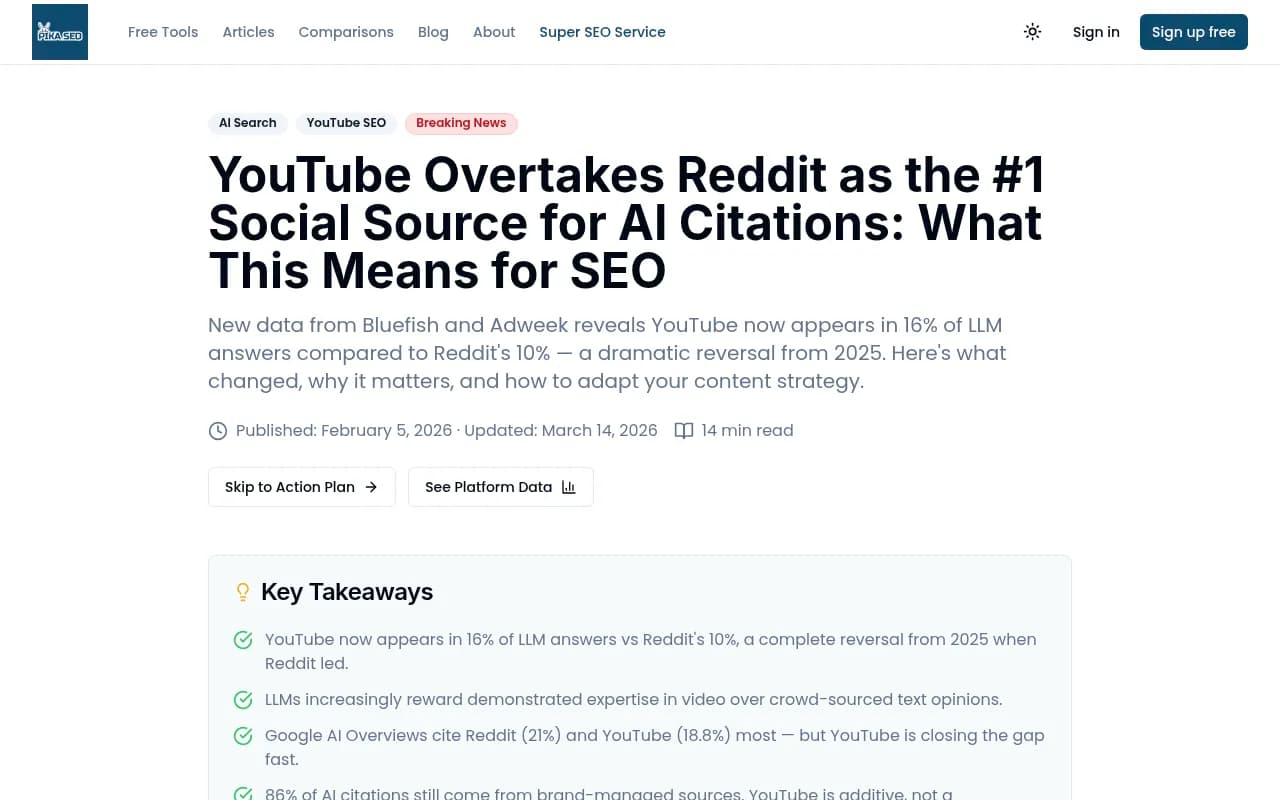
The numbers back this up. According to data from Bluefish reported by Adweek in January 2026, YouTube now appears in 16% of LLM answers, while Reddit appears in 10%. That's a reversal from mid-2025, when Reddit led. In Google AI Overviews specifically, Reddit still holds 21% of social citations, with YouTube close behind at 18.8%.
For brands, this means community conversations you didn't write and can't edit are influencing AI-generated recommendations. Brandlight.ai built a product specifically to track this. But it's not the only option — and for many teams, it's not the right one.
Here's what Brandlight does well, where it falls short, and six alternatives worth considering in 2026.
What Brandlight.ai actually does (and where it falls short)
Brandlight tracks brand mentions across ChatGPT, Gemini, Perplexity, Copilot, Grok, and several other AI engines. It surfaces Reddit citations specifically, showing when and where community content is influencing your AI visibility. It also covers sentiment analysis, share-of-voice benchmarking against competitors, and a multi-brand command center aimed at enterprise teams.
The product is genuinely good. Volkswagen, LG, and TD Bank use it. After raising a $30M Series A, the team built something with real depth.
The friction is the buying process. Brandlight doesn't publish pricing. Entry is reportedly around $199/mo, but enterprise contracts run $4K to $15K/mo. There's no self-serve trial — you book a demo, talk to sales, and get a custom quote. For a Fortune 500 CMO with a dedicated AI strategy team, that's fine. For an in-house marketing team at a $50M company or an agency managing 20 client accounts, it's a lot of friction for a category that's still evolving fast.
That's the gap these alternatives fill.
The 6 best Brandlight.ai alternatives in 2026
1. Promptwatch — best for teams that want to act on what they find
Promptwatch is the most complete option here if your goal is to actually improve AI visibility, not just measure it. Most platforms in this space show you a dashboard and leave you to figure out what to do next. Promptwatch is built around a different idea: find the gap, fix it, track the result.
The Reddit and YouTube tracking is real. Promptwatch surfaces which external citations — including Reddit threads, YouTube videos, and third-party listicles — are driving AI visibility in your category. You can see which specific pages AI models are citing, how often, and across which engines. That's the monitoring piece.
What separates it is what comes after. Answer Gap Analysis shows you exactly which prompts competitors are visible for that you're not. Content Agents then generate articles, comparisons, and briefs grounded in that prompt data — not generic SEO content, but material engineered to answer the specific questions AI models are already pulling from Reddit and YouTube because your site doesn't cover them.
AI Crawler Logs show when ChatGPT, Claude, Perplexity, and others are hitting your pages, which pages they're reading, and when a crawl turns into an actual citation. Most competitors don't have this at all.
Pricing is transparent: $99/mo (Essential), $249/mo (Professional), $579/mo (Business). Free trial available. No sales call required.
If Brandlight's pricing model is the main blocker, Promptwatch is the most direct replacement. If you want to go beyond monitoring, it's in a different category entirely.
2. Otterly.AI — best for small teams that just need the basics
Otterly.AI is a lightweight monitoring tool that tracks brand mentions across ChatGPT, Perplexity, Gemini, and a handful of other engines. It's affordable, easy to set up, and doesn't require a sales conversation.
It does cover some citation tracking, but Reddit and YouTube-specific insights are limited compared to Brandlight or Promptwatch. If you're a small brand that wants to know whether you're showing up in AI answers at all — and you don't need deep source analysis — Otterly is a reasonable starting point.
It won't help you fix anything. There's no content generation, no gap analysis, no crawler logs. But for teams that just want a monitoring baseline without committing to a larger platform, it's a low-risk entry point.
3. Scrunch AI — best for agencies managing multiple brands
Scrunch AI is built with agencies in mind. It handles multi-brand monitoring, tracks AI citations across major engines, and gives account managers a cleaner way to report AI visibility to clients.
Citation source tracking is part of the product, though the depth of Reddit and YouTube-specific analysis varies. Scrunch is stronger on the reporting and multi-client workflow side than on the "here's what to do about it" side — similar to Brandlight in that way, but with a more agency-friendly interface and pricing structure.
If you're running an agency and Brandlight's enterprise pricing is out of reach, Scrunch is worth evaluating. It won't give you content generation capabilities, but it handles the monitoring and client reporting use case well.
4. AthenaHQ — best for teams that want structured monitoring with good UX
AthenaHQ has built a clean, well-designed monitoring platform that tracks brand visibility across AI search engines. The interface is one of the better ones in this category, and the data is presented in a way that's easy to share with stakeholders who aren't deep in GEO.
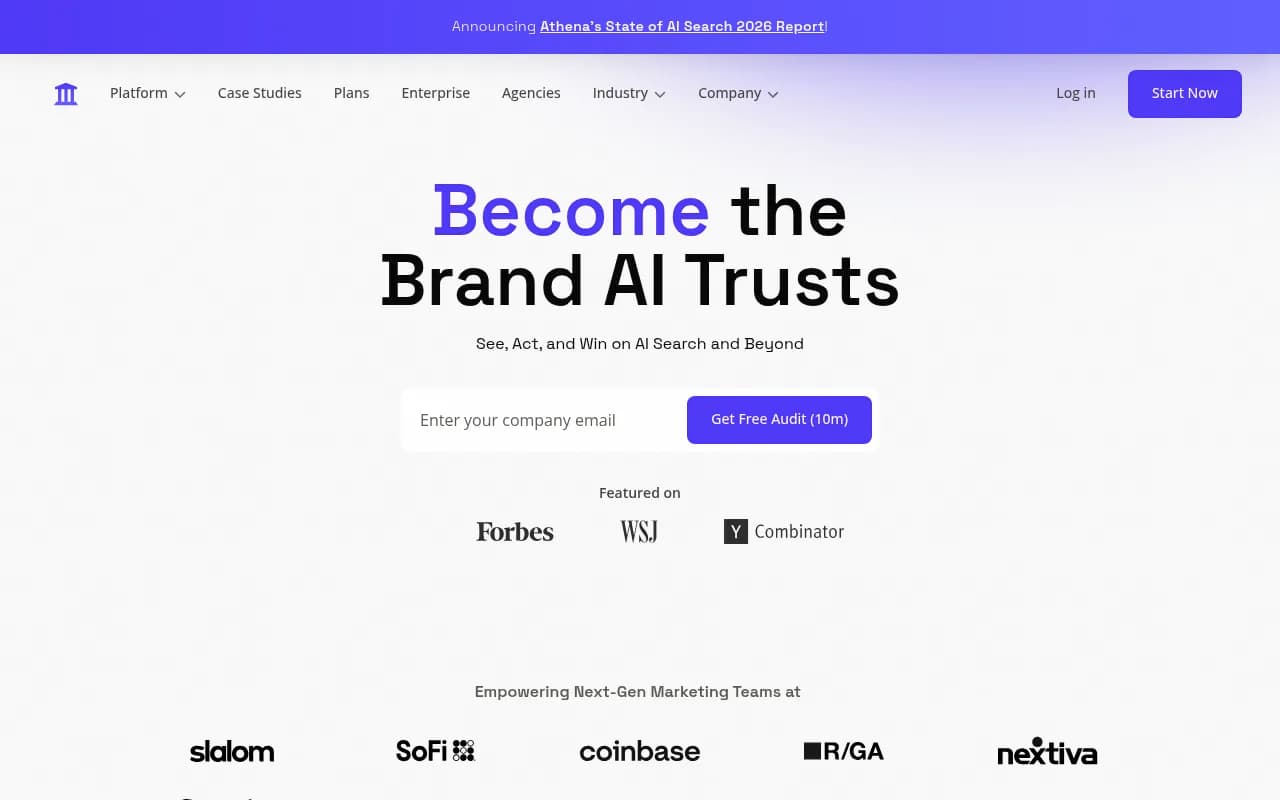
On Reddit and YouTube tracking, AthenaHQ covers citation sources but doesn't go as deep as Promptwatch on offsite citation analysis. You'll see that Reddit is influencing your category, but you may not get the granular thread-level or video-level data that tells you exactly which content is driving AI recommendations.
Like most monitoring-focused platforms, AthenaHQ stops at the data layer. There's no content generation or gap analysis to help you act on what you find. But if clean dashboards and stakeholder-friendly reporting matter to your team, it's a strong monitoring option.
5. Peec AI — best for teams that want monitoring with some optimization hints
Peec AI sits between pure monitoring tools and full optimization platforms. It tracks AI visibility across major engines and surfaces some suggestions for improving your presence — more than Otterly, less than Promptwatch.
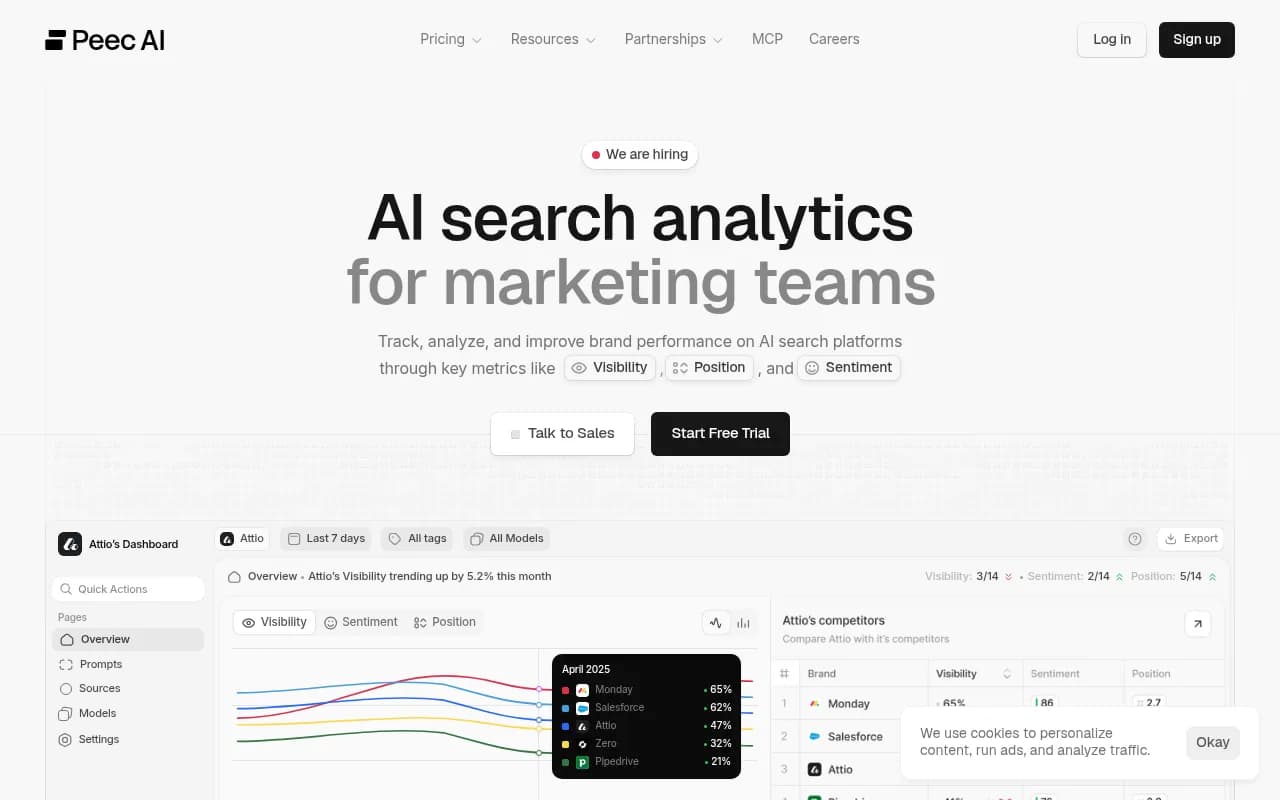
Citation tracking covers the main sources, and Peec does surface some Reddit-related visibility data. The "smart suggestions" feature gives you direction on what to improve, though the depth of those recommendations depends on your plan.
Pricing is more accessible than Brandlight, and there's a self-serve option. For teams that want a step up from basic monitoring but aren't ready to commit to a full optimization platform, Peec sits in a reasonable middle ground.
6. Profound — best for enterprise teams that want Brandlight-level depth at comparable pricing
Profound is the closest feature-for-feature competitor to Brandlight at the enterprise level. It tracks brand visibility across multiple AI engines, covers citation analysis, and is built for large organizations with complex monitoring needs.
Reddit and YouTube tracking is part of the product, and the citation analysis goes reasonably deep. Profound also covers competitive benchmarking and share-of-voice analysis in a way that enterprise teams expect.
The honest caveat: Profound is also enterprise-priced and sales-led. If you're evaluating Brandlight and want a like-for-like comparison at a similar budget, Profound belongs in that conversation. If the goal is to escape enterprise pricing and sales-led buying, Profound doesn't solve that problem.
How these tools compare
| Tool | Reddit tracking | YouTube tracking | Content generation | Crawler logs | Self-serve pricing | Starting price |
|---|---|---|---|---|---|---|
| Brandlight.ai | Yes | Yes | No | No | No | ~$199/mo |
| Promptwatch | Yes (offsite analysis) | Yes (offsite analysis) | Yes (Content Agents) | Yes | Yes | $99/mo |
| Otterly.AI | Limited | Limited | No | No | Yes | Low |
| Scrunch AI | Partial | Partial | No | No | Yes | Mid |
| AthenaHQ | Partial | Partial | No | No | Yes | Mid |
| Peec AI | Partial | Limited | Hints only | No | Yes | Low-Mid |
| Profound | Yes | Yes | No | No | No | Enterprise |
The pattern is clear. Most alternatives cover Reddit and YouTube citations to some degree, but few go deep on source-level analysis. And almost none of them help you do anything about what you find.
What "tracking Reddit and YouTube citations" actually means in practice
It's worth being specific about what you're actually buying when a platform claims to track Reddit and YouTube in AI search.
At the basic level, a tool might tell you "Reddit is cited in 18% of AI responses in your category." That's useful context, but it doesn't tell you which threads, which subreddits, or which specific claims are shaping AI answers about your brand.
At a deeper level, a platform surfaces the specific Reddit posts and YouTube videos that AI engines are actually pulling from. You can see that a 2024 Reddit thread in r/personalfinance is being cited by ChatGPT when users ask about your product category, or that a competitor's YouTube review is appearing in Perplexity answers. That's actionable.
The deepest level goes further: it tells you what those sources are saying, how that compares to what AI engines are saying about you, and what content you'd need to create to shift the narrative. That's where Promptwatch's Answer Gap Analysis and Content Agents come in.
Most brands start by asking "are we visible in AI search?" The more useful question is "what is AI search saying about us, where is it getting that from, and what can we do about it?"
Which alternative should you choose?
The right answer depends on what you actually need:
- If you're a small team that just wants to know whether you're showing up in AI answers, Otterly.AI or Peec AI are low-friction starting points.
- If you're an agency managing multiple client brands, Scrunch AI's multi-account structure is worth a look.
- If you want enterprise-level monitoring comparable to Brandlight without the sales process, Profound is the closest match — though it's still enterprise-priced.
- If you want to understand your AI visibility and actually improve it, Promptwatch is the only platform here that closes the full loop. It finds the gaps, generates content to fill them, and tracks whether that content is getting cited.
The Reddit and YouTube citation shift isn't slowing down. YouTube's citation share grew 78% in six months. Reddit's grew 73% across tracked categories in Q1 2026 alone. The brands that figure out how to influence what AI engines pull from these sources — not just monitor it — are the ones that will have an advantage in AI search.
Monitoring tells you the score. Optimization changes it.