AthenaHQ Review 2026
Monitors brand visibility across AI search engines and LLMs. Focused on tracking citations and share of voice in AI-generated responses.
Key takeaways
- AthenaHQ monitors brand visibility across 8 major AI platforms (ChatGPT, Perplexity, Gemini, Google AI Overviews, Google AI Mode, Claude, Copilot, Grok) with solid cross-platform coverage
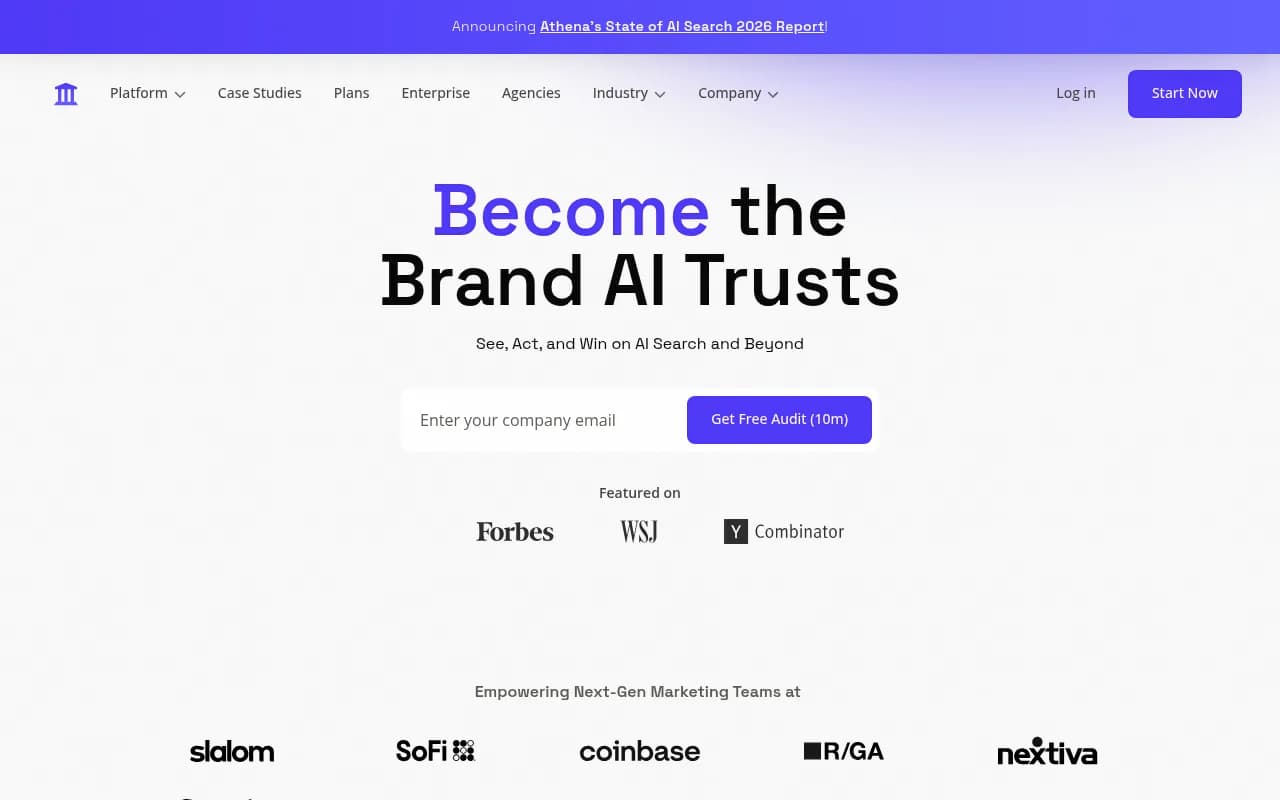
- Backed by Y Combinator and trusted by recognizable enterprise clients including Coinbase, PagerDuty, Twilio, and SoFi
- Monitoring-focused platform with content recommendations, but lacks the full content generation pipeline, AI crawler logs, and traffic attribution that more complete platforms like Promptwatch offer
- Self-Serve plan starts at $295/month (first month discounted to ~$95), with Enterprise pricing on request -- credit-based model means costs can scale unpredictably
- Best suited for mid-market and enterprise marketing teams that want structured AI visibility reporting and competitive benchmarking
AthenaHQ is a Y Combinator-backed AEO (Answer Engine Optimization) and GEO (Generative Engine Optimization) platform built for commercial and enterprise marketing teams. The company positions itself as a "command center" for AI search -- a place where SEO managers, CMOs, content teams, and PR professionals can see how their brand appears across AI-generated answers and take action to improve that presence. It came out of stealth in 2025 and has since attracted a notable client roster that includes Coinbase, PagerDuty, Twilio, SoFi, Slalom, and Nextiva, among others.
The platform targets a real and growing problem. As AI search engines like ChatGPT, Perplexity, and Google's AI Mode become primary research tools for buyers, traditional SEO metrics stop telling the full story. A brand can rank #1 on Google and still be invisible when someone asks ChatGPT "what's the best project management tool for remote teams?" AthenaHQ was built to close that gap -- tracking AI citations, monitoring share of voice, and surfacing content recommendations to help brands get mentioned more often and more favorably.
The company has received coverage in Forbes and the Wall Street Journal, and its advisory board includes former CMOs from Algolia and Scentbird, as well as Ethelbert Williams from PepsiCo's retail media team. The team itself draws from Google, DeepMind, OpenAI, and Anthropic, which gives the product some credibility in understanding how these AI systems actually work.
Key features
Cross-platform AI visibility tracking is the core of what AthenaHQ does. The platform monitors brand mentions, citations, and share of voice across ChatGPT, Perplexity, Gemini, Google AI Overviews, Google AI Mode, Claude, Copilot, and Grok. All eight are included on every plan, which is a meaningful differentiator compared to tools that gate certain models behind higher tiers. You can track how often your brand appears in responses, what context it appears in, and how that compares to competitors.
Competitive intelligence and share of voice analysis lets teams benchmark their AI visibility against specific competitors. You can see which brands are being cited more frequently for a given category of prompts, track changes over time, and identify where competitors are winning ground you're not. The platform surfaces these comparisons in dashboard views designed for both day-to-day managers and executive reporting.
Content gap analysis identifies prompts and queries where AI models either don't mention your brand or actively misrepresent it. The idea is to surface the specific questions your audience is asking AI assistants where you're not showing up -- so your content team knows what to create or update. This is genuinely useful, though the depth of the gap analysis (how granular it gets, how it prioritizes gaps by potential impact) varies by plan.
AthenaHQ Content is the platform's recommendation engine for on-page and off-page optimization. Rather than generating full articles, it tells you what to fix -- which passages to update, which sources to earn mentions in, which structural changes to make. It maps recommendations to the actual sources AI models pull from in your category. The Enterprise tier adds a "Content Optimization AI Agent with Deep Research" and "self-improving content creation workflows," suggesting more automated content generation at the top tier, though the Self-Serve plan is more advisory than generative.
Ask Athena is an agentic AI copilot built into the platform. You can ask plain-language questions like "Why is my competitor ranking above me on ChatGPT for project management prompts?" and get answers grounded in your account's real-time data. It pulls from prompt monitoring, citation tracking, competitor benchmarks, and sentiment scores. Think of it as a ChatGPT interface trained on your AEO data rather than the open web. For executives who don't want to dig through dashboards, this is a practical shortcut to insight.
Hallucination detection and brand sentiment monitoring track not just whether your brand appears in AI responses, but how it appears. If an AI model is saying something factually wrong about your company -- wrong pricing, wrong product features, wrong founding story -- AthenaHQ flags it. The PR-focused view includes real-time brand mention alerts, sentiment analysis across AI platforms, and crisis detection tools. This is a genuinely useful capability for brands in regulated industries or those with complex product lines where AI misinformation is a real risk.
Athena Citation Engine (ACE) is an Enterprise-tier feature that appears to be a proprietary system for improving citation rates. The details are sparse on the public site, but it's positioned as a core differentiator for enterprise teams that want to move beyond monitoring into active citation building.
Multi-region and multi-language tracking covers 60+ countries and languages, with persona targeting by buyer role. This matters for enterprise brands with global footprints -- you can track how AI models respond to prompts in German, French, or Japanese markets separately from English-language results.
Integrations include GA4, Google Search Console, Shopify, Webflow, and Framer on standard plans, with Tableau, Power BI, and Looker added at the Enterprise tier. The GA4 and GSC connections let you compare traditional SEO performance against AI visibility side by side, which is useful for teams trying to justify AEO investment to leadership.
Credit-based usage model is worth understanding before you sign up. Each AI response queried costs one credit. The Self-Serve plan includes 3,600 credits per month, and additional credits can be purchased. This means your actual monthly cost depends on how many prompts you're tracking and how frequently you refresh data -- a factor that can make budgeting less predictable than flat-rate alternatives.
Who is it for
AthenaHQ is clearly built for mid-market and enterprise marketing teams -- the kind of organizations where a CMO needs board-ready reporting on AI visibility ROI, an SEO manager needs prompt-level tracking across multiple competitors, and a content team needs specific recommendations rather than generic advice. The client list (Coinbase, PagerDuty, Twilio, SoFi, Slalom) confirms this positioning. These aren't small businesses experimenting with AI search; they're companies with dedicated marketing functions and real budget for visibility tools.
The platform also works well for digital agencies managing AI search strategy for multiple clients. R/GA and Ignite Visibility are listed as clients, and the unlimited seats with role-based access control (RBAC) makes it practical for agency teams to give clients their own access without paying per seat. The multi-brand portfolio tracking is particularly relevant for agencies running campaigns across several accounts simultaneously.
Industries where AthenaHQ has documented case studies include software/SaaS, CPG, e-commerce, financial services, education, healthcare, travel, beauty, and wellness. The financial services and healthcare use cases are interesting because those are categories where AI hallucinations carry real risk -- a buyer asking ChatGPT about a financial product or a patient asking about a medication needs accurate information, and brands in those spaces have strong incentive to monitor and correct AI outputs.
Who shouldn't use AthenaHQ: small businesses or solo marketers who need a simple, affordable way to track a handful of prompts. The $295/month starting price and credit-based model are oriented toward teams with real budgets. Also, if you need a full content generation pipeline -- not just recommendations but actual AI-written articles grounded in prompt data -- AthenaHQ's Self-Serve tier won't fully deliver that. The content generation capabilities are gated behind Enterprise.
Integrations and ecosystem
AthenaHQ's integration story is reasonably solid for an enterprise-oriented tool. The GA4 connection is the most practically useful -- it lets you attribute traffic and conversions to AI search visibility, which is the question every CMO is asking right now. The Google Search Console integration lets teams compare traditional organic performance against AI citation rates, which is helpful for making the case that AEO investment is complementary to (not competing with) existing SEO work.
The Shopify integration is purpose-built for e-commerce brands that want to appear in ChatGPT Shopping results. It lets you publish AEO-optimized content and attribute revenue back to AI search discovery, which is a meaningful capability as ChatGPT's shopping features expand.
Webflow and Framer integrations are a nice touch for content-forward brands that build on those platforms. Enterprise plans add Tableau, Power BI, and Looker for teams that need to pull AEO data into existing BI infrastructure.
API access is available on Enterprise plans only, which limits flexibility for teams that want to build custom workflows or pull data into proprietary dashboards without paying for the top tier. SAML and OIDC SSO are also Enterprise-only, which is standard for this category but worth noting for procurement teams.
There's no mention of Slack or other communication tool integrations for alerts, which is a gap for teams that want real-time brand mention notifications pushed to their existing workflows.
Pricing and value
AthenaHQ runs two public tiers:
- Self-Serve: $295/month (first month at ~$95, roughly 67% off). Includes 3,600 credits, all 8 LLMs, competitor monitoring, basic AI content optimization, citation intelligence, AI blindspot detection, and unlimited seats with RBAC. Additional credits can be purchased.
- Enterprise: Custom pricing. Adds LLM traffic analysis, self-improving content workflows, Content Optimization AI Agent with Deep Research, Athena Citation Engine (ACE), SSO, audit logs, dedicated GEO specialist, and API access.
The credit model deserves scrutiny. At 3,600 credits per month and 1 credit per AI response, the Self-Serve plan gives you 3,600 AI queries per month. If you're tracking 50 prompts across 8 models daily, that's 400 credits per day -- you'd burn through the monthly allocation in 9 days. In practice, you'd likely track prompts less frequently or be selective about which models you query for each prompt, but it's worth modeling your actual usage before committing.
Compared to alternatives: Promptwatch's Professional plan at $249/month includes flat-rate prompt tracking (150 prompts), AI crawler logs, and content generation -- features that AthenaHQ either gates behind Enterprise or doesn't offer at all. For teams that want predictable pricing and a more complete optimization workflow, that comparison matters.
The first-month discount is a reasonable way to test the platform, and the free audit (listed as a 10-minute process) gives you a sense of your current AI visibility before committing to a paid plan.
Strengths and limitations
What AthenaHQ does well:
- Breadth of LLM coverage: All 8 major AI platforms on every plan, including Google AI Mode, which some competitors don't yet track. This is genuinely comprehensive.
- Enterprise-grade security and compliance: SOC II Type 2, GDPR compliance, NIST Cybersecurity Framework Tier 3. For large organizations with procurement requirements, this matters and not every competitor can match it.
- Ask Athena copilot: The natural-language interface for querying your own AEO data is a practical time-saver for executives and managers who don't want to navigate dashboards. It's a smart UX decision.
- Hallucination detection: Actively monitoring for AI misinformation about your brand is a capability that goes beyond basic citation tracking and is particularly valuable in regulated industries.
- Documented case study results: The Grüns (2% to 12.6% share of voice in 60 days), Popl (38% MoM lead growth), and Lago (50% demo increase) case studies are specific and verifiable, not vague marketing claims.
Where AthenaHQ falls short:
- No AI crawler logs: AthenaHQ doesn't show you which AI crawlers are hitting your website, which pages they're reading, what errors they encounter, or how often they return. This is a significant gap for teams that want to understand how AI engines discover and index their content. Promptwatch's crawler log feature fills this gap directly.
- Content generation is thin at Self-Serve: The platform gives recommendations but doesn't generate full articles, listicles, or content briefs at the standard tier. If you want AI-written content grounded in prompt data and citation analysis, you need Enterprise -- or a different tool.
- No AI traffic attribution at Self-Serve: Understanding how AI search visibility translates to actual website traffic and revenue requires the Enterprise tier's LLM traffic analysis. For teams trying to prove ROI without an enterprise contract, this is a real limitation.
- No Reddit or YouTube tracking: AI models frequently cite Reddit threads and YouTube videos in their responses. AthenaHQ doesn't appear to surface which Reddit discussions or YouTube content is influencing AI recommendations in your category -- a blind spot that matters for brands trying to understand the full citation ecosystem.
- Credit-based pricing creates unpredictability: Unlike flat-rate plans, the credit model means your bill can vary based on usage, which complicates budgeting for finance teams.
Bottom line
AthenaHQ is a capable AI search monitoring platform with genuine enterprise credentials -- strong LLM coverage, solid security compliance, a useful AI copilot, and documented client results. For large marketing teams at companies like Coinbase or PagerDuty that need structured reporting, competitive benchmarking, and executive dashboards, it's a reasonable choice.
The honest limitation is that it's primarily a monitoring and recommendation platform. It shows you where you're losing and tells you what to fix, but the actual fixing -- generating content, tracking AI crawler behavior, attributing traffic to AI visibility -- requires either the Enterprise tier or a more complete platform. Teams that want the full optimization loop (find gaps, create content, track results) should evaluate Promptwatch alongside AthenaHQ, since Promptwatch includes content generation, AI crawler logs, and traffic attribution at its mid-tier plans rather than gating them behind enterprise pricing.
Best for: Mid-market and enterprise marketing teams at B2B SaaS, financial services, or e-commerce companies that need structured AI visibility reporting, competitive share-of-voice tracking, and enterprise-grade security -- and have the budget for a custom Enterprise contract to unlock the full feature set.
Frequently asked questions
What is AthenaHQ?
How much does AthenaHQ cost?
Is there a free plan or trial?
Which AI platforms does AthenaHQ monitor?
How does AthenaHQ compare to alternatives like Promptwatch?
Is AthenaHQ suitable for agencies?
Similar and alternative tools to AthenaHQ