Key takeaways
- ChatGPT and Meta AI do not draw on the same sources, so the same brand can be named in one and missing from the other.
- ChatGPT leans heavily on product pages, landing pages and listicles. For branded prompts, reviews matter more than usual (Promptwatch Data, Sep 28 to Oct 4, 2026).
- Meta is building crawler infrastructure fast. Meta-WebIndexer went from about 2.2% to 37.8% of tracked AI crawler requests in under a month.
- Nobody has published verified Meta AI citation data yet, so run your own test with a fixed prompt set and log the results.
- Treat any viral claim about overlap percentages as a lead, not a fact, until you can see the methodology.
The question behind the question
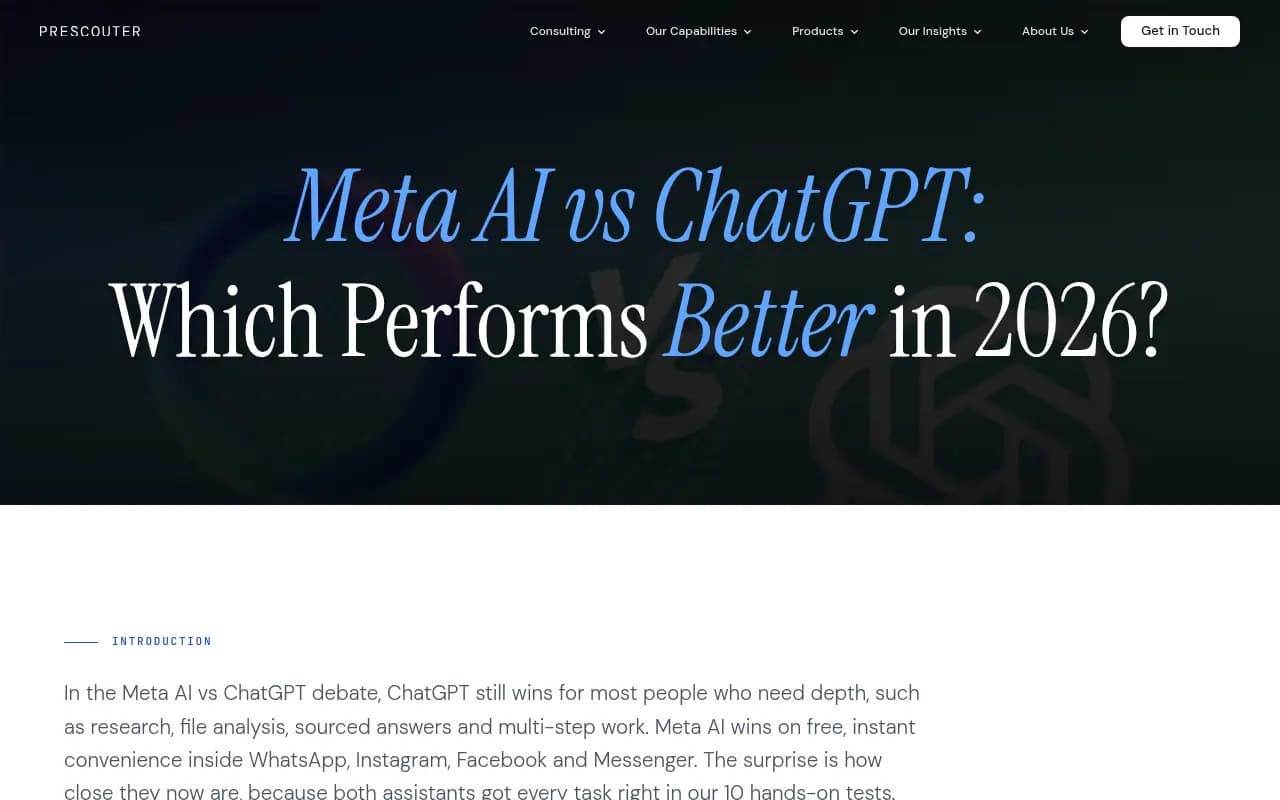
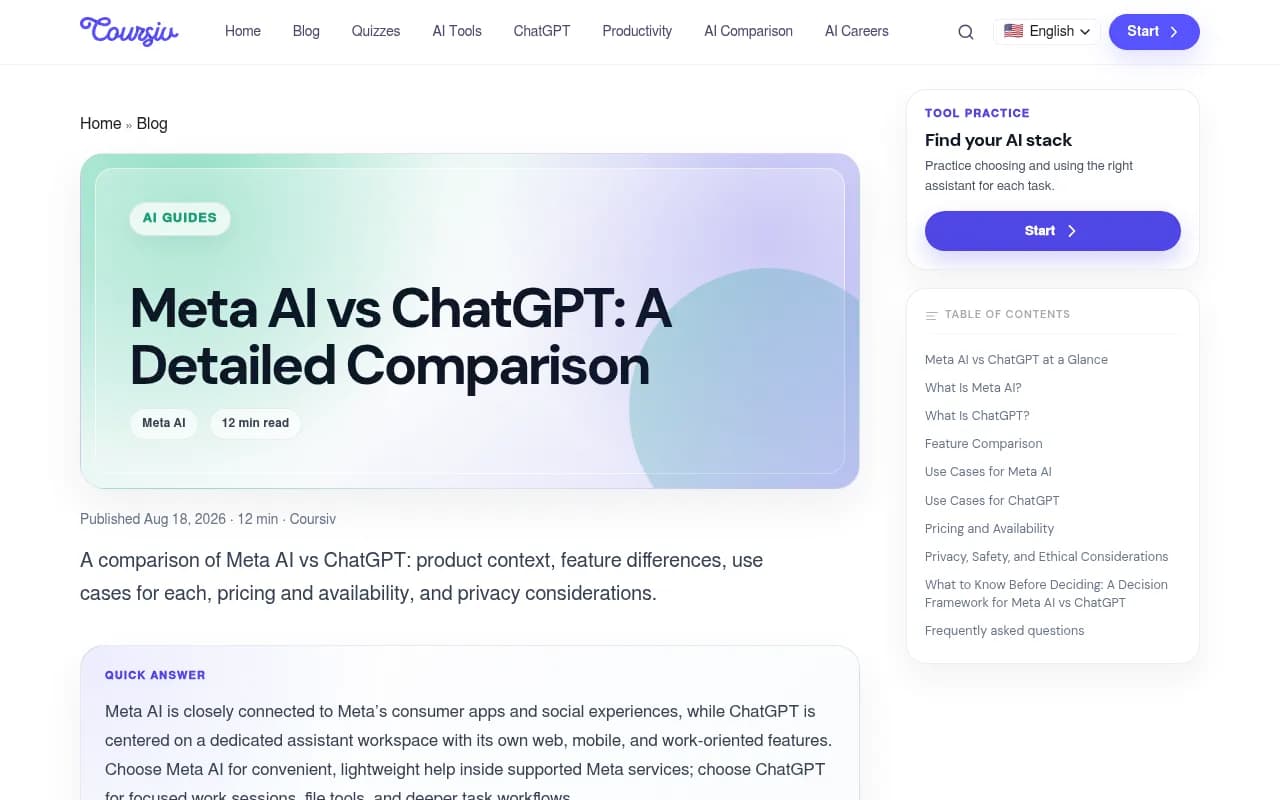
Most Meta AI vs ChatGPT comparisons are capability shootouts. Math, writing, speed, image generation. The PreScouter piece ran 10 head-to-head tests and found the differences showed up in speed, depth and small details, not in right or wrong answers. Coursiv lands in a similar place: Meta AI is tied to Meta's consumer apps, ChatGPT is a dedicated assistant workspace, and neither is automatically more accurate.
That is useful if you are picking an assistant for yourself. It is useless if you run a brand and want to know whether either assistant will recommend you. That is a different question, and nobody I found has answered it with clean data.
There is a claim floating around Instagram that fewer than half of the brands ChatGPT names in a buying answer are also named by Meta AI. It has no author and no methodology, so I would not quote it. But it matches what anyone sees when they run the same prompt in both products: the shortlists overlap, they do not match.
The interesting part is why.
Why the same brand is recommended differently
An AI assistant answering a buying question does roughly three things. It decides what to search for, it pulls pages from some index, and it writes an answer weighted toward what those pages say. Change any of those three steps and the brand list changes.
Different search behavior
ChatGPT breaks a prompt into several web searches, called query fan-outs. Promptwatch Data shows this behavior shifts without warning. On August 8, 2026, ChatGPT started using the site: operator at scale, jumping from about 0.4% to about 17% of all fan-out queries overnight, and searches per response nearly doubled (ChatGPT site: operator data). If your brand's visibility depends on a specific query pattern, one rollout can move it.
We have no equivalent public data on how Meta AI fans out queries. That is a gap, and it is worth saying plainly.
Different source mixes
This is the part with real numbers behind it. Between Sep 28 and Oct 4, 2026, ChatGPT got 0.46% of its citations from the seven major social platforms. Google AI Overviews got 12.2% from the same platforms, about 26x more. Perplexity sat at 2.7% (Social media citations by AI model, October 2026).
| Engine | Share of citations from social platforms | Top social source |
|---|---|---|
| ChatGPT | 0.46% | LinkedIn (about 0.3%) |
| Google AI Overviews | 12.2% | YouTube (4.28%) |
| Perplexity | 2.7% | LinkedIn and Reddit (0.86% each) |
Reddit is the dramatic example. reddit.com's share of ChatGPT citations fell from roughly 4% to 0.5% on August 14, 2026 (Reddit citations in ChatGPT). A brand that built its reputation through Reddit threads could have been recommended by ChatGPT in July and quietly dropped in September.
Now think about Meta AI. It lives inside Instagram, WhatsApp, Facebook and Messenger. I have not found verified data on what it cites, and Promptwatch has no Meta AI citation report. So I will not pretend to know. But a product built by a social company, sitting inside social apps, is a reasonable candidate for a different source mix than ChatGPT. Test it rather than assume it.
Different ideas of what a good source is
ChatGPT, per Promptwatch's content-type data (Sep 28 to Oct 4, 2026), cites product pages at 22.4%, landing pages at 16.8% and listicles at 13.6%. Product and landing pages together are about 39% of citations. Editorial formats together are about 43% (ChatGPT citation share by content type).
The breakdown by prompt type is where brand teams should look:
| Prompt type | Product pages | Landing pages | Other notable types |
|---|---|---|---|
| Commercial | 26.0% | 20.6% | Listicles 15.0%, comparisons 7.9% |
| Informational | 19.1% | 13.9% | Listicles 13.6%, how-tos 10.7%, docs 8.5% |
| Branded | 23.3% | 22.8% | Reviews 5.6%, FAQ 4.8%, social posts 3.0% |
Two takeaways. For commercial prompts, four content types make up almost 70% of citations, so the pages you control matter a lot. And for branded prompts, reviews are cited at more than 3x their overall share. If someone asks ChatGPT about you by name, third-party reviews shape the answer.
Meta's crawler build-out changes the picture
Here is the part I find genuinely interesting. Promptwatch's crawler logs show Meta-WebIndexer making up about 2.2% of tracked AI crawler requests in mid-July 2026. By August 9 it was 37.8%, roughly a 17x jump in under a month, making it the heaviest AI crawler in the logs (Meta-WebIndexer data).
Promptwatch's read is that the surge comes from the indexing crawler specifically, not Meta's training or link-fetching bots, and that its purpose is improving Meta AI search results and citing sources. There is also a claim, originally from a post by @levelsio on August 6, that Meta staff told him the company is building its own search index so Meta AI does not rely on Google or Bing. That is explicitly "allegedly" and unverified. Treat it as reported, not confirmed.
Even so, the practical implication holds. If Meta AI is moving to its own index, then whether your site is in it depends on whether Meta's crawlers can read you. Check your server logs and robots.txt for these user agents:
meta-webindexer
meta-externalagent
meta-externalfetcher
FacebookBot
Blocking them may decide whether your content is in Meta's index at launch. Also budget for crawl load, since the scraping reportedly triggered server alerts for at least one site owner.
How to run your own Meta AI vs ChatGPT brand test
I would not trust anyone's single screenshot, including mine. Here is a setup that gives you something you can repeat.
1. Build a fixed prompt set
Twenty to fifty prompts is enough to start. Split them into the same three types Promptwatch uses: commercial ("best CRM for a 10-person agency"), informational ("how do I choose a CRM"), and branded ("is [your brand] any good"). Add a few competitor comparisons.
2. Use the real interfaces
API answers and consumer app answers can differ. Test the actual ChatGPT app and Meta AI inside the surface your customers use, in the right country and language. Log the date, since results drift.
3. Record the same fields every time
- Whether your brand is named
- Position in the list
- Which competitors appear
- Sentiment of the description
- Which sources are cited, if any
- Whether the answer links to your own domain
4. Diagnose the pattern
If you appear in ChatGPT but not Meta AI, check crawler access first, then whether your product and landing pages are clear and indexable. If Meta AI names you but ChatGPT does not, look at which third-party pages and reviews ChatGPT is pulling for your category. If both ignore you, the problem is upstream: thin product pages, no reviews, or blocked crawlers.
Doing this by hand for fifty prompts every week gets old fast. Tools like Promptwatch track ChatGPT, Google AI Overviews, Gemini, Perplexity and Meta AI through their real interfaces, so you can compare engines on the same prompt set without copy-pasting.

Tools worth knowing for multi-engine comparison
Most AI visibility trackers cover ChatGPT, Perplexity and Gemini. Meta AI coverage is rarer, so confirm it before you buy. Here is a quick orientation, not a ranking.
| Tool | What it does | Check before buying |
|---|---|---|
| Promptwatch | Tracks real UIs including Meta AI, plus crawler logs and content fixes | Meta AI included on paid plans |
| Profound | Enterprise AI visibility analytics | Which engines and price tier |
| Peec AI | Prompt tracking with suggestions | Whether Meta AI is covered |
| Otterly.AI | Affordable monitoring | Crawler logs and traffic data are not its focus |
| Semrush AI Visibility Toolkit | AI tracking inside an SEO suite | Fixed prompt sets |



For a wider list, the GEO software directory at bestgeosoftware.com is a decent place to compare options.
One difference matters for this specific problem. A monitor tells you that Meta AI skipped you. It does not tell you whether Meta's crawler ever reached your pages. Promptwatch's IP-verified crawler logs show which AI bots visited, what they read and what errors they hit, which is the step that explains a Meta AI gap if Meta really is building its own index.
What to fix once you see the gap
Make your own pages the best answer
Since ChatGPT cites product and landing pages so heavily for commercial and branded prompts, those pages need plain, specific claims: what the product does, who it is for, pricing, and comparisons against alternatives. Vague marketing copy gives a model nothing to quote.
Earn reviews and listicle placement
Branded prompts pull reviews at more than 3x their normal rate, and listicles are 13.6% of all ChatGPT citations. Getting included in credible third-party roundups and collecting reviews on the platforms in your category is not glamorous, but the data points straight at it.
Do not bet on one social channel
Because source mixes differ so much, a Reddit-led or YouTube-led strategy works unevenly. YouTube is 4.28% of AI Overviews citations and almost nothing in ChatGPT. Pick channels per engine, and recheck monthly. The Reddit drop in ChatGPT happened in a single day.
Keep crawlers out of the way
Audit robots.txt and your CDN rules for Meta's four user agents. If you blocked everything Meta-related years ago over privacy or load concerns, revisit that decision now. Whether to allow them is a business call, but make it deliberately.
Recheck on a schedule
ChatGPT changed fan-out behavior in August, cut Reddit in August, and dropped average citations per response around the GPT-5.3 rollout in March (ChatGPT citation drop). A one-off test goes stale within weeks. Weekly or daily tracking is the only way to tell a real trend from a model update.
What we do not know yet
I would rather be upfront about this than fill space. There is no verified public data on Meta AI's search provider, its citation behavior, or how often it names a given brand compared with ChatGPT. The overlap claim circulating on Instagram is unsourced. The capability comparisons from PreScouter and Coursiv cover writing, math and workflow, not brand recommendations.
So the honest conclusion is narrow. The same brand gets recommended differently because the engines use different search behavior, different source mixes and, increasingly, different indexes. The ChatGPT side is measurable today. The Meta AI side is the one to watch, and the crawler data says Meta is investing heavily in it.
If you do one thing this week, check your logs for meta-webindexer and run twenty prompts in both products. Write down what you find. That small dataset is more than most brands have.