Key takeaways
- No free ChatGPT rank checker gives you a reliable trend. Free tools run one prompt once and show a snapshot.
- Good free options in 2026 include the LPagery ChatGPT Rank Tracker, Mencoro's free checkers, the Ahrefs AI Visibility Checker, and the HubSpot AEO Grader.
- ChatGPT has roughly five citation slots per web-search answer, so "rank" really means "cited or not", not position 3 versus position 4.
- Fan-outs, model updates, and content decay all make single-run checks go stale fast. Paid tracking pays off once you need history across many prompts.
- Use free checkers to find out whether you have a problem. Use a paid tracker once you need to prove you fixed it.
What a ChatGPT rank checker actually checks
There is no ranked list of ten blue links in ChatGPT. It runs a few web searches, reads some pages, and writes one answer that names a handful of brands. So a "rank checker" is really a mention and citation checker. It asks ChatGPT a question and logs whether your brand was named, whether your domain was linked, and which competitors showed up instead.
That difference matters for how you read results. Position in a list is not the main signal here. Presence is. According to Promptwatch's data on average sources per response, ChatGPT cites about 5 sources per web-search answer, while Google AI Overviews cites about 10 and Perplexity almost exactly 10. With around five slots, you are either in the answer or you are not.
The tools below fall into three rough modes:
- One-off checkers that run a prompt and show you the answer.
- Free tiers or trials of full trackers.
- Visibility audits that scan your site for AI crawler access rather than querying ChatGPT at all.
The best free ChatGPT rank checkers in 2026
QuickSEO opens its own roundup with a line I agree with: there is no perfect free ChatGPT rank tracker in 2026. What exists is a set of decent snapshot tools with different strengths. Here are the ones worth ten minutes.
LPagery ChatGPT Rank Tracker
LPagery's tracker is completely free and pairs with free Gemini and Perplexity versions that work the same way. It shows where ChatGPT places a business and which rivals it names, and it adds page-level suggestions. For a local business or a small brand that wants a quick read on competitors, it is probably the most useful free starting point on the list.

Mencoro free tools
Mencoro has no free plan (the cheapest paid plan is EUR 15 a month), but its free tools need no sign-up. The AI visibility checker asks ChatGPT, Gemini, and Perplexity three buyer questions about your category. There are also separate free checkers for ChatGPT, Perplexity, and AI Overviews. Their own FAQ is blunt about the limit: useful for a first look, useless for a trend, because one run of one prompt tells you nothing about variance. I like that honesty.
Ahrefs AI Visibility Checker
Ahrefs offers a free visibility check, and it sits alongside its paid Brand Radar product. If you already know the Ahrefs interface, it is a low-friction way to see how your domain shows up in AI answers.

HubSpot AEO Grader
HubSpot's AEO tools include a grader that scores your brand's visibility in answer engines. It is aimed at marketers who want a score and a few recommendations rather than raw responses.

Free tiers and trials of paid trackers
Several paid trackers let you try before you pay. Xofu lists a free tier alongside a $99/month plan, and Leapd's Alex starts at $39 a month with a 2-day free trial. Neither is free long term, but a trial is the only way to see what repeated tracking looks like without paying.
If you want a free option that has nothing to do with querying ChatGPT, run the Agentic Readiness Check or AI SEO Audit from Promptwatch, or the Website AI Audit from Leapd, which checks robots.txt, llms.txt, and crawlability. Many sites unknowingly block GPTBot, and that is a fixable problem that takes minutes once identified.
Free checkers compared
| Tool | Cost | Sign-up needed | What you get | Main limit |
|---|---|---|---|---|
| LPagery ChatGPT Rank Tracker | Free | Varies | Where ChatGPT places your business, rivals named, page-level suggestions | Snapshot, no history |
| Mencoro free checkers | Free | No | Buyer-question checks on ChatGPT, Gemini, Perplexity, plus AI Overviews | One run per check |
| Ahrefs AI Visibility Checker | Free | Varies | Domain-level AI visibility view | Light data without a paid plan |
| HubSpot AEO Grader | Free | Varies | Visibility score and recommendations | Score, not raw tracking |
| Xofu | Free tier / $99 mo | Yes | High-intent prompt tracking | Free tier is limited |
| Leapd Alex | $39 mo, 2-day trial | Yes | 50 prompts every 48 hours | Trial only |
Where free checkers stop being useful
This is the part most roundups skip. A free checker is not bad. It just answers a narrower question than people think.
One prompt is not your visibility
ChatGPT does not match your content against the user's prompt directly. It generates its own search queries, often called fan-outs, and then matches pages against those. Promptwatch's ChatGPT query fanout data shows the average number of web searches per response fell from 2.15 in early December to about 1.84 by early March, and average query length dropped from about 117 characters to the high 80s. A fixed single prompt checker sees only the surface of that process. Run the same prompt twice and you can get two different answers.
ChatGPT's search behaviour also shifts without warning. On August 8, 2026, ChatGPT started using the site: operator at scale, jumping from about 0.4% to about 17% of fan-out queries overnight, per Promptwatch Data. A one-off check cannot tell you whether that changed anything for you.
Models change under your history
Average citations per ChatGPT response dropped across GPT-5.3, GPT-5.4, and GPT-5-Mini around the March 4, 2026 rollout, according to Promptwatch's citation drop report. If your visibility dipped that week, was it your content or the model? A snapshot can't answer that. Trend lines across many prompts can, because you see the whole market move together.
Citations decay
Content does not stay cited forever. Promptwatch's content half-life study followed every page ChatGPT cited on July 6, 2026. Landing pages and docs stayed cited longest, while news lost half its pages within 36 days. A check you ran last month may already be wrong.
The citation mix shifts too
Reddit's share of ChatGPT citations fell from roughly 4% to 0.5% on August 14, 2026 (Promptwatch Data). Product pages were the most cited content type at 22.4% of citations between Sep 28 and Oct 4, 2026 (Promptwatch Data). Those are the kinds of shifts that change what you should be publishing, and none of them show up in a single free check.
No competitor history, no alerts, no attribution
Free tools rarely store past runs, track competitors over time, alert you to drops, or connect mentions to traffic. That is fine for curiosity and bad for reporting to a boss.
How to get the most from a free checker
You can squeeze more out of a snapshot tool with a bit of discipline.
- Write 8 to 10 prompts that match how buyers ask: category questions, comparison questions, and a couple of brand-specific ones.
- Run each one at least three times on different days and note how often you appear.
- Record who gets named instead of you, and which domains are cited.
- Put it all in a spreadsheet with dates. You are building your own crude history.
- Check robots.txt and crawler access before blaming your content.
This takes an hour or two and tells you more than any single run. It also tells you whether paying for tracking is worth it. If you appear in 2 of 30 runs and a competitor appears in 25, you know where you stand.
When to move to a paid tracker
Move when any of these are true:
- You need to report visibility to a client or executive every month.
- You want to see whether a published page was cited afterwards.
- You operate in more than one country or language.
- You need to track more than about ten prompts.
- You want to know whether AI traffic converts.
The category is crowded, so here is how some of the better-known options compare on entry price and focus. Prices come from the vendors' own comparison pages and can change, so confirm on each site.
| Tool | Entry price | Focus |
|---|---|---|
| Otterly.AI | $29/mo | Cross-engine brand monitoring |
| Nightwatch | $39/mo + AI add-on | SEO plus AI rank tracking |
| Morningscore | $49/mo | Beginner-friendly tracking |
| ZipTie | $69/mo | Actionable optimisation |
| KIME | EUR 99/mo | Multi-engine tracking and an action centre |
| Profound | Higher tiers for enterprise | Enterprise AI narrative control |
| Peec AI | $95/mo (Starter, per Geoptie) | Prompt-level tracking |
Budget trackers worth a look
Otterly.AI is the cheapest paid entry in several roundups, though Geoptie notes its lite plan excludes Claude. It also scored well in an AI-recommendation test run by Mencoro, appearing in 83.3% of answers about ChatGPT rank trackers.

Peec AI covers ChatGPT plus a choice of other engines and is popular with agencies.

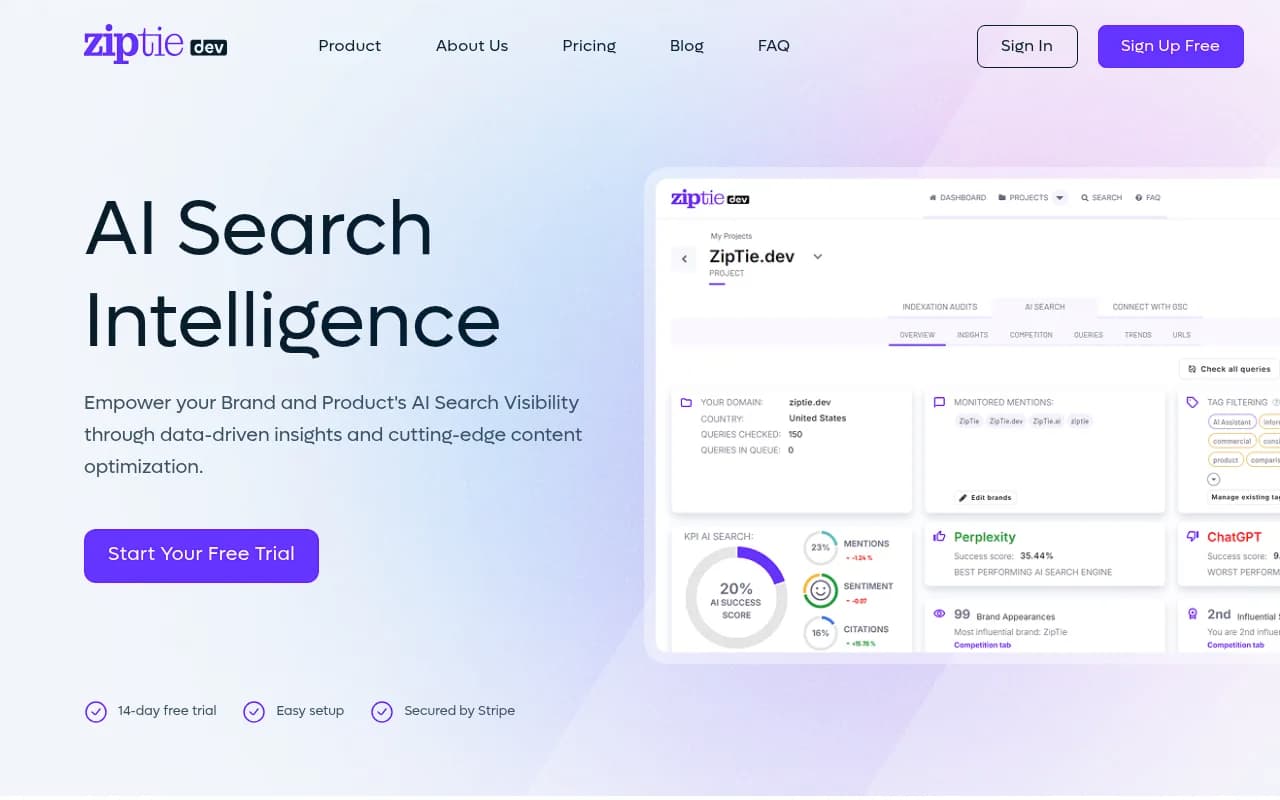
ZipTie leans toward telling you what to do next rather than just charting mentions.
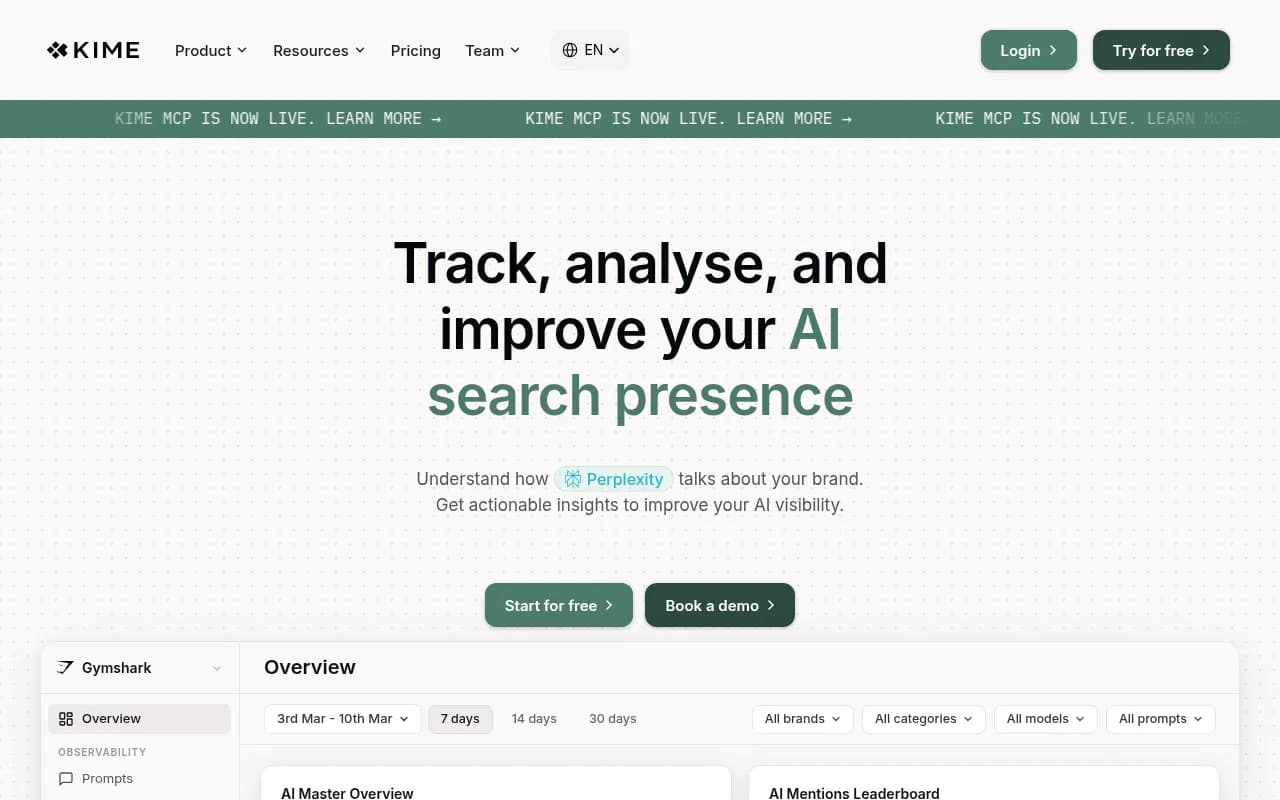
KIME tracks ChatGPT in real time alongside other engines and includes an action centre.
Where the platform tier starts
Once you want the tracking to lead somewhere, the question changes from "was I mentioned?" to "what do I fix, and did it work?" Promptwatch is built for that second question. It tracks the real ChatGPT interface rather than only API output, logs which AI crawlers hit your site, ties AI visits to conversions, and uses an Action Board and Content Agent to suggest and draft the fixes. That is a different job from a prompt tracker, and it costs more than one. Plans start at $95 a month, with a free Explore tier for ChatGPT only. Confirm current pricing at promptwatch.com/pricing.

Profound is the other name that comes up most for larger brands, and it was the most frequently recommended tool in Mencoro's AI-answer test (91.7% of answers).

Semrush and Ahrefs are the suite options if you would rather add AI tracking to an existing SEO subscription, though prompt sets are usually fixed and the AI data is shallower than in dedicated tools.
For a broader list, the GEO software directory and the AI rank tracking directory both list dozens more.
What the tool screenshots show
Roundups from SE Ranking and others show how quickly the category has standardised on a similar dashboard: visibility score, sentiment, top sources, and competitor benchmarks.
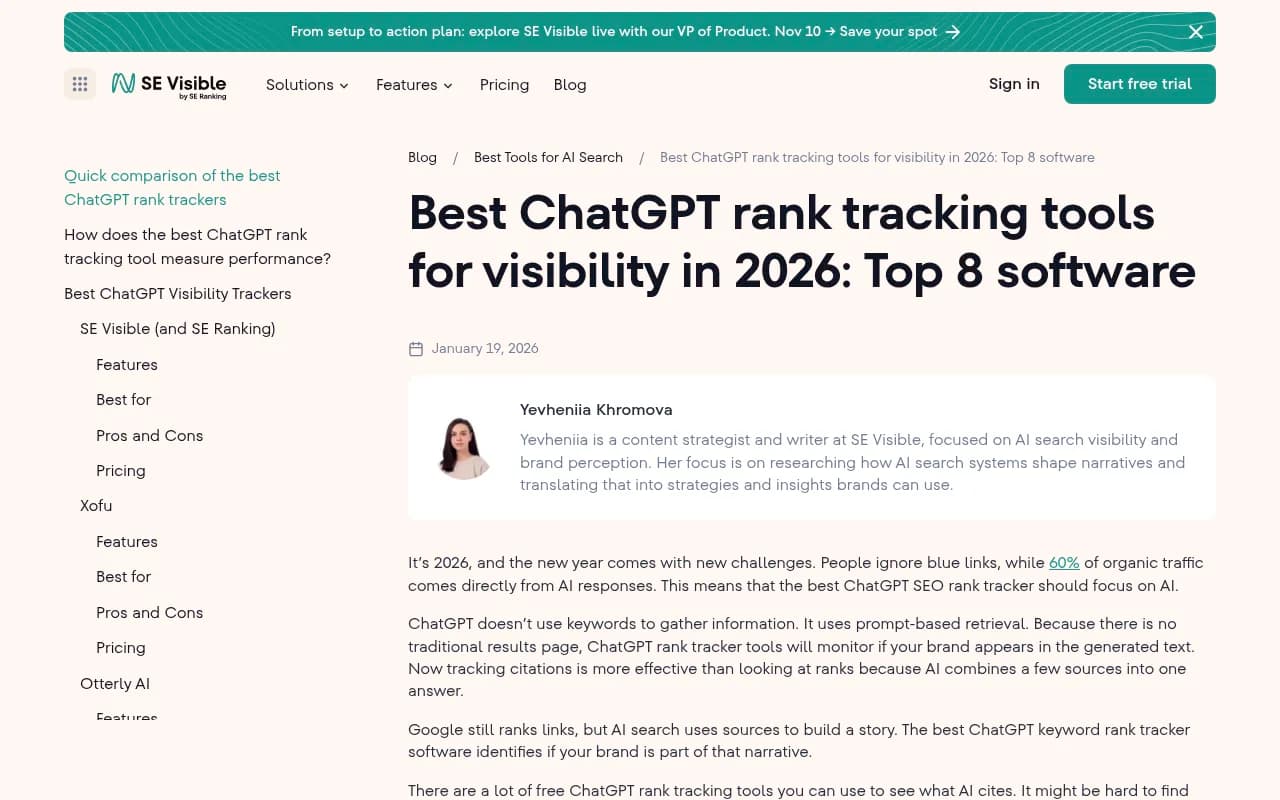
AI Rank Checker, listed in several of these roundups, takes a pay-as-you-go approach at about $0.13 per keyword check. That is not free, but it is a sensible middle path for consultants who run an occasional audit rather than a monthly subscription.
A quick decision guide
- Just curious whether ChatGPT knows you exist: use LPagery or Mencoro's free checker.
- Checking whether AI crawlers can read your site: run a free site audit first.
- Need to compare yourself against competitors this quarter: take a trial of a paid tracker and load 20 to 50 prompts.
- Reporting monthly to clients: pay for history, alerts, and exports.
- Want fixes and attribution, not just charts: look at platforms that connect visibility, crawler logs, and traffic.
Bottom line
Free ChatGPT rank checkers are good at one thing: telling you whether there is a problem. They cannot tell you how big it is, whether it is getting better, or what caused it. Run two or three of them, repeat your prompts a few times, and keep a spreadsheet. If the gap between you and your competitors is real, that hour of work is the business case for a paid tool.