Key takeaways
- Brandlight is an enterprise-first platform with no published pricing, a paid 3-month pilot, and a strategist team on each account. Promptwatch is self-serve, with public pricing and a 7-day free trial.
- Brandlight tracks 12 engines in 10 markets (per Orchly's review). Promptwatch tracks the real interfaces of ChatGPT, Google AI Overviews, AI Mode, Gemini, Perplexity, Copilot, Meta AI, Alexa and more, with country and language control.
- The real split is workflow. Brandlight leans on people (strategists) to act on findings. Promptwatch builds the act-and-verify loop into the product: Action Board, Content Agent, CMS publishing, crawler logs and visitor analytics.
- Fortune 500 buyers should check security, multi-brand structure and procurement fit. Promptwatch is ISO/IEC 27001 certified and GDPR compliant, with SSO, audit logs and a white-label portal on Enterprise.
- One claim deserves a skeptical read: Brandlight says roughly 85% of AI citations come from third-party or social sources. Promptwatch's data shows ChatGPT cites social media very little.
Why this comparison matters for large brands
A Fortune 500 company rarely has one brand, one market or one team that owns AI search. You have product lines, regional sites, a PR group, an SEO team, an agency or three, and a legal team that wants to know exactly what ChatGPT says about your pricing. Picking a tool for that setup is different from picking one for a 20-person SaaS company.
Brandlight and Promptwatch both target this buyer, but they get there from opposite directions. Brandlight positions itself as an enterprise AI visibility operating system. Its own guide describes itself as best for "Fortune 500-class, multi-brand, multi-market organizations that need to change how AI represents them, not just watch a number." Promptwatch is an AI search visibility and GEO platform that closes the loop itself: it monitors, traces why, acts, and measures.
One disclosure. This site is published by 1001 SEO Media, which uses Promptwatch as its GEO platform. Where Brandlight's details come from third parties, I say so, and I did not verify everything about either product.
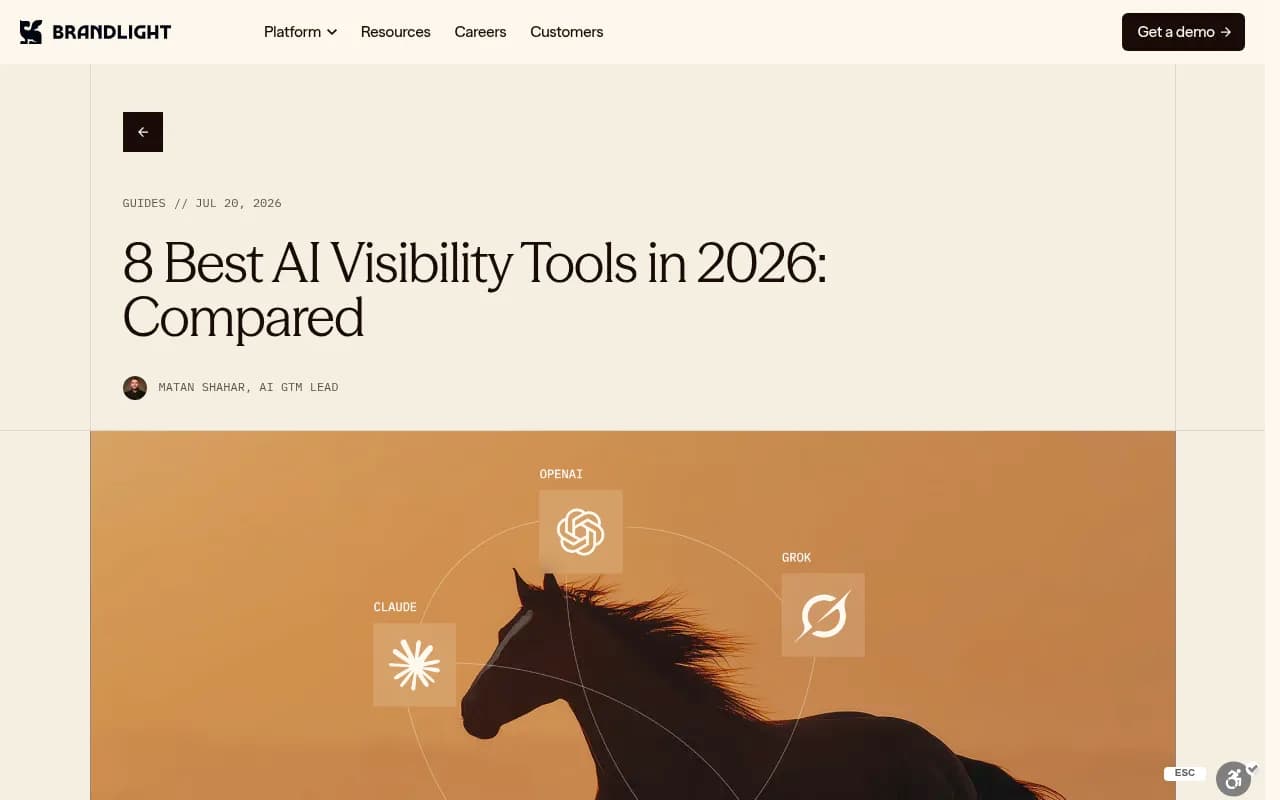
Brandlight at a glance

What is known, mostly from Orchly's review and Brandlight's own blog:
- No public pricing. Engagements start with a paid 3-month pilot.
- Customers named by Orchly include Samsung, TD Bank and Publicis Groupe.
- 12 engines tracked across 10 markets: ChatGPT, AI Overviews, AI Mode, Gemini, Perplexity, Claude, Copilot, Grok, DeepSeek, Qwen, Mistral and Naver, scoped per contract.
- A strategist team on every account, plus content drafts.
- A CB Insights ESP "Leader" ranking for GEO monitoring platforms, dated December 2025 by a third-party listing. I could not verify that independently.
The model is clear: a managed, high-touch engagement for big organizations that want people alongside the software. That suits teams with budget and little internal GEO expertise. It is slower to start, and harder to evaluate before you commit, because you cannot just sign up and run your own prompts.
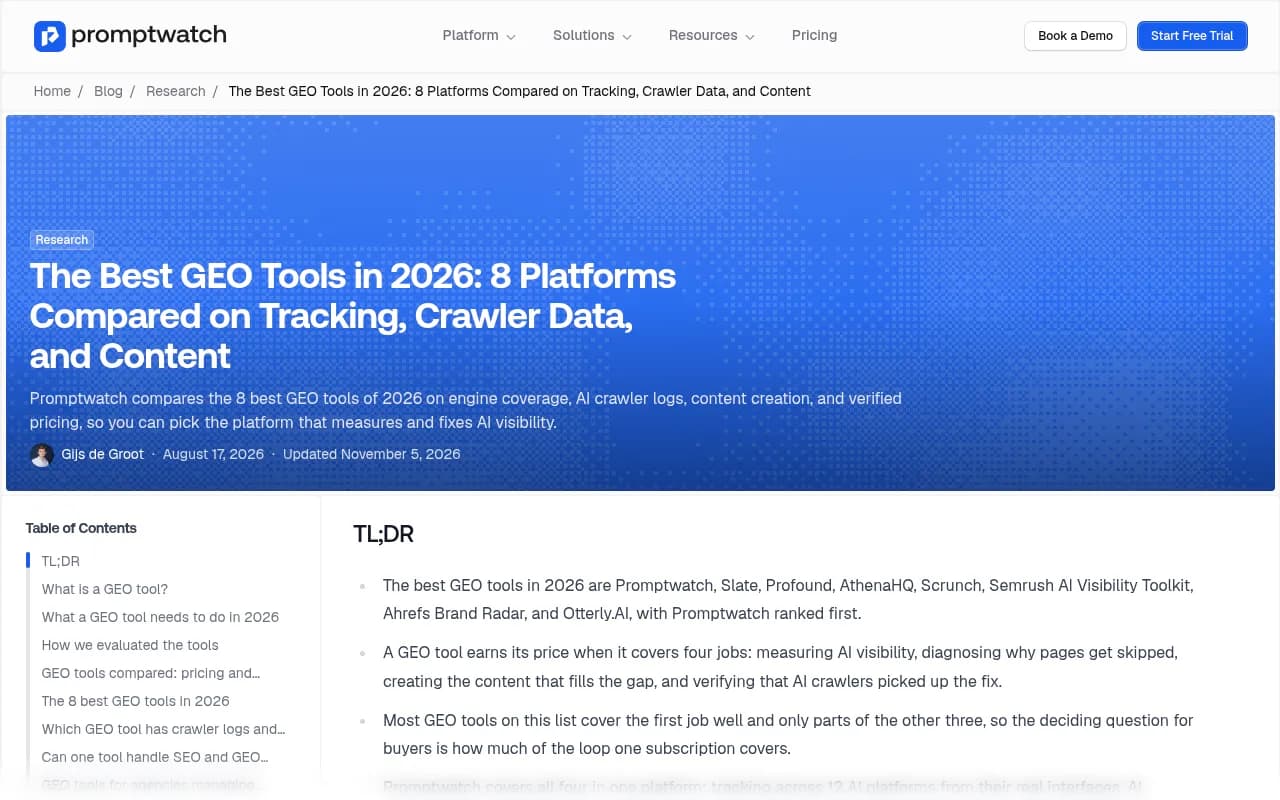
Promptwatch at a glance
Promptwatch is an end-to-end AI visibility platform used by 1,840+ brands and agencies, rated 4.7/5 on G2, with customers like Yelp, Typeform, Shutterstock, Rabobank and ABN AMRO.

It works as one loop:
- Monitor what AI says about you: prompts, responses, Visibility Score, sentiment, competitors, and Brand Narrative (the individual claims AI makes about you).
- Trace where answers come from: cited pages, Reddit, YouTube, LinkedIn and Instagram sources, and offsite mentions.
- Act on gaps with the Action Board, content gap analysis, Agent Chat and the Content Agent, which writes and publishes to WordPress, Webflow or Framer.
- Measure with IP-verified AI crawler logs, page tracking and visitor analytics, so you can see if a fix got crawled, cited and clicked.
Side-by-side comparison
| Area | Brandlight | Promptwatch |
|---|---|---|
| Buying model | Paid 3-month pilot, no public pricing | Self-serve, public pricing, 7-day free trial on monthly billing |
| Engine coverage | 12 engines, 10 markets (per Orchly) | Real interfaces of ChatGPT, AI Overviews, AI Mode, Gemini, Perplexity, Copilot, Alexa, Meta AI, plus API models like Claude, Grok, DeepSeek and Mistral |
| Who acts on the data | Strategist team, content drafts | Action Board, Agent Chat, Content Agent with CMS publishing |
| Crawler logs | Not verified | IP-verified logs across Cloudflare, CloudFront, Fastly, Vercel, WordPress and more |
| AI traffic attribution | Not verified | Visitor analytics with AI-referred traffic and conversions |
| Reddit, YouTube, LinkedIn, Instagram citations | Not verified | Dedicated reports |
| Shopping and ads | Not verified | ChatGPT Shopping and Ads Radar on Business and up |
| Enterprise controls | Custom contract | ISO/IEC 27001, GDPR, SSO, audit log, white-label portal (Enterprise) |
Where I wrote "not verified," I could not confirm the feature from the research I had. Ask Brandlight directly rather than assuming it is missing.
Monitoring versus the full loop
The pattern I keep seeing in this category: monitoring is the easy part. Anyone can run prompts and show a score. The hard part is turning that score into pages that get cited, and then proving it worked.
Siftly's roundup puts it bluntly: monitoring without action is half a solution. Brandlight does address action, but mostly through its strategist team and content drafts. That is a legitimate model. A senior human who understands your brand can be worth more than a dashboard. But it ties your throughput to headcount on the vendor side, and it is hard to audit.
Promptwatch's bet is that the action layer should be software that your own team controls. The Content Agent plans, writes and publishes against visibility gaps on a calendar and budget you set, with a review inbox if legal wants to approve everything. Content Refresh gives diff-style updates to existing pages. Then Page Tracker, crawler logs and visitor analytics tell you whether each page was read, cited and clicked. Pages that underperform come back as actions.
Two real-world examples of that loop: Crisp saw 2x higher conversion rates from AI traffic than from traditional channels (case study), and TreeHouse, behind Pararius, grew AI search to about 25% of organic conversions (case study). Neither is a Fortune 500 company, so treat them as proof of the mechanism, not of scale.
The crawler question large sites should ask
Big sites often have layered CDNs, WAF rules and bot management that block AI crawlers without anyone noticing. A monitoring score will tell you that you are invisible. It will not tell you that GPTBot is getting 403s.
Promptwatch Data's AI crawler traffic report (IP-verified requests, June 8 to September 6, 2026) shows OpenAI made up 79.8% of requests in the week of August 31 to September 6, down from 94.8% in the week of June 8. The report's advice is practical: compare your own logs against that mix, and if a large provider is near zero in your logs, suspect a block. Meta-WebIndexer is another one to watch; it grew from about 2% to nearly 38% of tracked crawler requests between mid-July and August 9, 2026.
If you run a large estate, ask every vendor, Brandlight included, whether they can show you crawler-level evidence. It separates an access problem from a content problem.
About the 85% third-party claim
Brandlight's guide says roughly 85% of the sources AI cites for category questions are third-party or social. That is Brandlight's own analysis, and I could not verify it. The "third-party" half is plausible. The "social" half is shakier.
Promptwatch's social media citations report (September 28 to October 4, 2026) found ChatGPT got only 0.46% of its citations from social platforms, while Google AI Overviews got 12.2%. And reddit.com's share of ChatGPT citations fell from about 4% to 0.5% on August 14, 2026. The mix differs by engine and changes by month, which is exactly why a single blended number is a weak planning input. Promptwatch Data's average sources per response page shows ChatGPT citing about 5 sources per web-search answer versus roughly 10 for AI Overviews and Perplexity, so measure visibility per engine.
For your content plan, what ChatGPT actually cites matters more. In the same period, product pages were the most cited type at 22.4%, and sites with domain rank 46 to 75 earned almost half of citations in August 2026. Big brand domains do not get a free pass.
Pricing and procurement
Brandlight publishes no prices. Budget for a paid pilot and negotiate from there.
Promptwatch publishes its prices, which you should confirm at promptwatch.com/pricing:
| Plan | Monthly price | Notable inclusions |
|---|---|---|
| Essential | $95 | 1 project, 50 prompts, 6,000 responses |
| Professional | $245 | 2 projects, 150 prompts, 25M crawler logs, 5 AEO articles |
| Business | $579 | 5 projects, 350 prompts, Content Agent, hourly tracking option, local targeting, Fact Check, Ads Radar |
| Enterprise | Custom | SSO, audit logs, white-label portal, dedicated success manager |
A caveat from Orchly's review: Essential's 6,000 responses do not stretch to 50 prompts on every model daily, so you pick models or check less often. A Fortune 500 team would realistically sit on Business or Enterprise anyway. Business is also the first plan with the Content Agent, faster-than-daily tracking, state and city tracking, and Fact Check.
For procurement, Promptwatch is ISO/IEC 27001 certified and GDPR compliant, handled by an EU-based company, with scoped API keys, roles and an audit log that records whether a change came from the dashboard, API, MCP client or Agent Chat.
Multi-brand, multi-market fit
Brandlight's pitch is portfolios, and that is where its strategist model may earn its fee: aligning ten brands across ten markets is partly a people problem.
Promptwatch handles structure with projects and monitors. A monitor's country and language are fixed at creation so markets never mix, and Business and above add state and city tracking plus local GEO targeting at exact coordinates for store and franchise queries. Custom personas let you prompt like specific buyers, and Brand Narrative with Fact Check helps legal and comms teams find which page is teaching AI the wrong claim about pricing or features. Agent Chat, the MCP server and the REST API let central teams pull data into their own BI stack.
Which should you pick?
Choose Brandlight if:
- You want a vendor-managed engagement and have the budget for a paid pilot.
- Your internal team has little GEO experience and you want strategists doing the interpretation.
- Your coverage needs include engines like Qwen or Naver and you have confirmed they are in scope.
Choose Promptwatch if:
- You want to test on your own prompts before signing a large contract.
- You need the fix-and-verify loop in software: content generation, CMS publishing, crawler logs, and traffic attribution.
- Your SEO and content teams will do the work and need an Action Board, not a deck.
- Security reviews matter, and ISO/IEC 27001 and GDPR are on your checklist.
Or use both in sequence: a pilot with Brandlight for strategy, Promptwatch for execution and measurement. I would not recommend that for most budgets, but it is not absurd for a very large brand.
How to run a fair evaluation
- Write 30 to 50 real buyer prompts across two or three brands and two markets.
- Run the same set through each vendor. Check whether results come from real interfaces or APIs, because answers can differ.
- Ask each vendor to show crawler evidence for one page that AI ignores.
- Ask for one concrete fix, executed end to end, and how success would be measured.
- Compare cost per tracked response, not just headline price.
- Put security and audit requirements in writing before the pilot starts.
To start cheaply, run the free AI visibility report or the Agentic Readiness Check on a main brand domain. For the wider field, including Profound, Scrunch and Bluefish, see the Promptwatch comparison of GEO platforms or browse the GEO software directory.
Bottom line
Brandlight is a credible managed option for portfolio-scale brands that want strategists in the room. Promptwatch is the better fit when you want the whole loop in software you can trial, audit and measure yourself. If you can only ask one question in a vendor meeting, ask this: show me a page you fixed, and prove AI crawled it, cited it and sent traffic. You can book a Promptwatch demo or start the 7-day trial to see that evidence on your own site.