Key takeaways
- Brandlight is built for large, multi-brand, multi-market enterprises with a dedicated AI marketing team. Smaller teams will likely pay for capacity they don't use.
- Pricing is not published. Third-party estimates range from about $199/mo to $15,000+/mo, and none are verified, so get a written quote.
- Most comparison content on Brandlight is written by competitors. Treat every claim, including ratings, as something to verify yourself.
- The real question is not "can it track my brand in AI answers?" (many tools can) but "does it help us act on what it finds, and can we measure the outcome?"
- Run a 30-day pilot against one or two alternatives using the same prompts before signing a contract.
What Brandlight is
Brandlight positions itself as an AI visibility platform for enterprise brands. Its site claims the "#1 AEO platform globally", lists Google, McKinsey and Microsoft as partners, and shows a G2 score of 4.9/5 from 240 reviews. Those are vendor claims, and I would not put them in a board deck without checking.

The G2 number is a good example of why. A third-party review aggregator, checkthat.ai, cites 4.7/5 from 19 verified G2 reviews. The gap probably comes from different dates or sources, but check the live G2 page before quoting either figure.
What the available sources agree on:
- It tracks the major AI engines. LLM Pulse lists ChatGPT, Gemini, Perplexity, Copilot and Grok; checkthat.ai says "10+ AI engines".
- It has SOC 2 Type II, SSO and RBAC, which matters if procurement and InfoSec are involved.
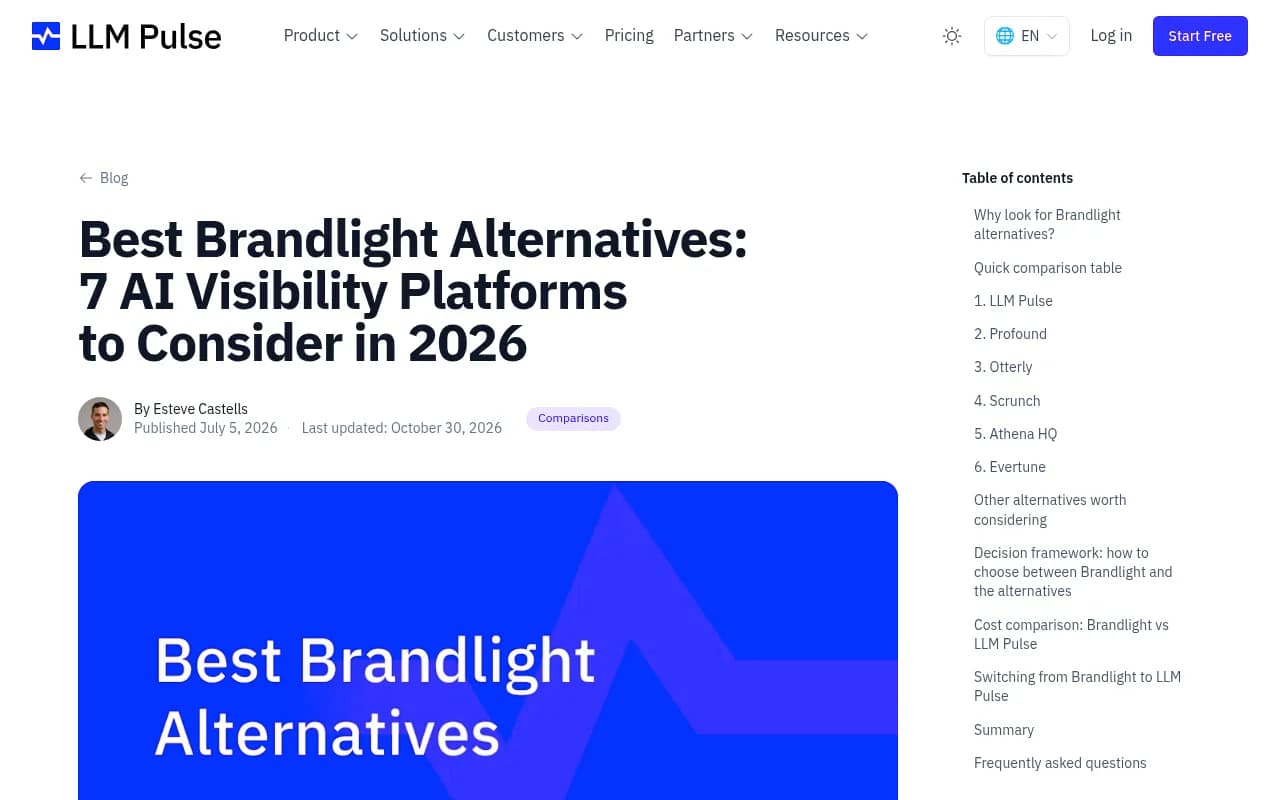
- It recently added an AI Ads capability covering both organic and paid AI answers, aimed at spotting irrelevant placements and cutting wasted spend, per a Business Insider press release.
- Onboarding and support are built around dedicated AI strategists.
- A G2 reviewer described using it to manage multiple brands across markets, serving content, brand, SEO and paid media teams.
- LLM Pulse, a competitor, reports a $30M Series A.
The pricing problem
Brandlight's /pricing page returns a 404. Buyers contact sales. G2's AI-generated summary flags the lack of transparent pricing as a common complaint, and I understand why. It makes budgeting a guessing game.
Third-party estimates are all over the place:
| Source | Estimate | Notes |
|---|---|---|
| checkthat.ai | Entry around $199/mo, activation tier near $750/mo | Enterprise $4K to $25K+/mo |
| LLM Pulse | Enterprise about $4K to $15K/mo | Varies by brands, regions and add-on modules |
| cited.best | From about $199/mo, $15,000+/mo for enterprise | Unverified |
Treat all of these as unverified. They do agree on one thing: a real enterprise deployment is a five-figure-per-year commitment at minimum, and it can run well past $100K annually once you add brands, regions and modules.
For context, here are published or third-party price points for alternatives, also unverified except where noted:
| Tool | Starting price | Typical buyer |
|---|---|---|
| Peec AI | About 89 EUR/mo (~$97) | SMBs and small teams |
| Profound | $99/mo (ChatGPT only, 50 prompts); $399/mo for 3 platforms | Mid-market to enterprise |
| BrightEdge | $30,000+/year | Enterprise SEO suites |
| Promptwatch | $95/mo Essential, $245/mo Professional, $579/mo Business (confirm at promptwatch.com/pricing) | Brands and agencies |
Who Brandlight fits
Combining what checkthat.ai and LLM Pulse say, the sweet spot is:
- Fortune 500 or $500M+ revenue companies
- Regulated industries where security reviews decide vendors
- Multi-brand, multi-market organizations
- Teams with dedicated AI marketing staff and budget for sales-led onboarding
LLM Pulse also says SMB and mid-market teams may pay for capacity they won't use. That claim comes from a competitor, but it matches how enterprise-first products are usually priced and packaged.
A decision framework in six questions
Score each question honestly. If you answer "yes" to four or more, Brandlight deserves a serious evaluation. If you answer "no" to most, price alternatives first.
1. Do you need a managed, strategist-led relationship?
Brandlight's model leans on dedicated AI strategists. That is valuable if your team is stretched and your leadership wants a named person to call. It is wasted money if you already have SEO and content people who will live in the dashboard.
2. How many brands and markets are you running?
Multi-brand, multi-region management is where enterprise platforms earn their price. One brand in two countries is a different problem from twelve brands in thirty markets. Ask any vendor how monitors, languages and locations are packaged, and what each additional one costs.
3. Do procurement and security gate the decision?
SOC 2 Type II, SSO and RBAC are table stakes in regulated industries. Check that any alternative you shortlist can pass the same review. Promptwatch, for example, is ISO/IEC 27001 certified and GDPR compliant, and SSO is on its Enterprise plan.
4. Does it close the loop from insight to action to measurement?
This is where I'd push hardest in a demo. Plenty of platforms report a visibility score. Fewer help you fix the gaps and then prove the fix worked. Ask to see, live:
- How a content gap becomes a published page
- Whether the tool shows AI crawler activity on your own site (IP-verified logs, not just prompt outputs)
- Whether it connects AI referrals to conversions
- How it separates a citation problem from a crawlability problem
5. Can you trust the data collection method?
User-facing answers in ChatGPT, AI Overviews and Gemini can differ from API outputs. Ask whether the tool collects responses from the real interfaces, and per country and language. Also ask how it handles the natural volatility in citations. Promptwatch Data shows that ChatGPT cites about 5 sources per web-search answer, while Google AI Overviews cites about 10, and that Microsoft Copilot's average swung from under 2 to nearly 17 within a few weeks. A shift in your numbers may come from the engine, not your content, so a tool should report each engine separately.
6. Can you defend the ROI to a CFO?
Gartner's research says only one in three CMOs see expected AI returns, and that high performers focus on outcomes rather than efficiency. Apply the same lens here. A monitoring dashboard is not an outcome. Revenue, qualified pipeline or conversion rate from AI referrals is. If a vendor cannot show you how to attribute traffic and conversions, you are buying reporting.
What to ask in the Brandlight demo
I found no verified Brandlight contract terms, ROI case studies or independent benchmarks in my research. That is not proof they don't exist, but it means you should ask for them directly.
- A written quote with line items for brands, regions, prompts, seats and modules, including the AI Ads add-on
- Contract length, renewal terms and exit clauses. Competitors in this space often push annual terms
- Reference customers in your industry and at your size, with a call, not a slide
- Prompt and response volume limits, and how often prompts run
- Whether you can export raw data (responses, citations) and connect via API or a BI tool
- What the dedicated strategist actually does each month, and how many clients they carry
- A pilot or proof-of-concept option before the full commitment
Alternatives to price against it
You don't need to evaluate 100 tools. Pick one from each category below and run the same prompt set through all of them.
Other enterprise-oriented platforms
Profound is the most frequently named rival, with a strong monitoring feature set and agent features worth a look.

Evertune takes a different angle, analyzing AI responses at scale for brand perception.

Bluefish pitches an enterprise marketing suite and agentic commerce.

Scrunch pairs monitoring with agent-ready pages for your site.

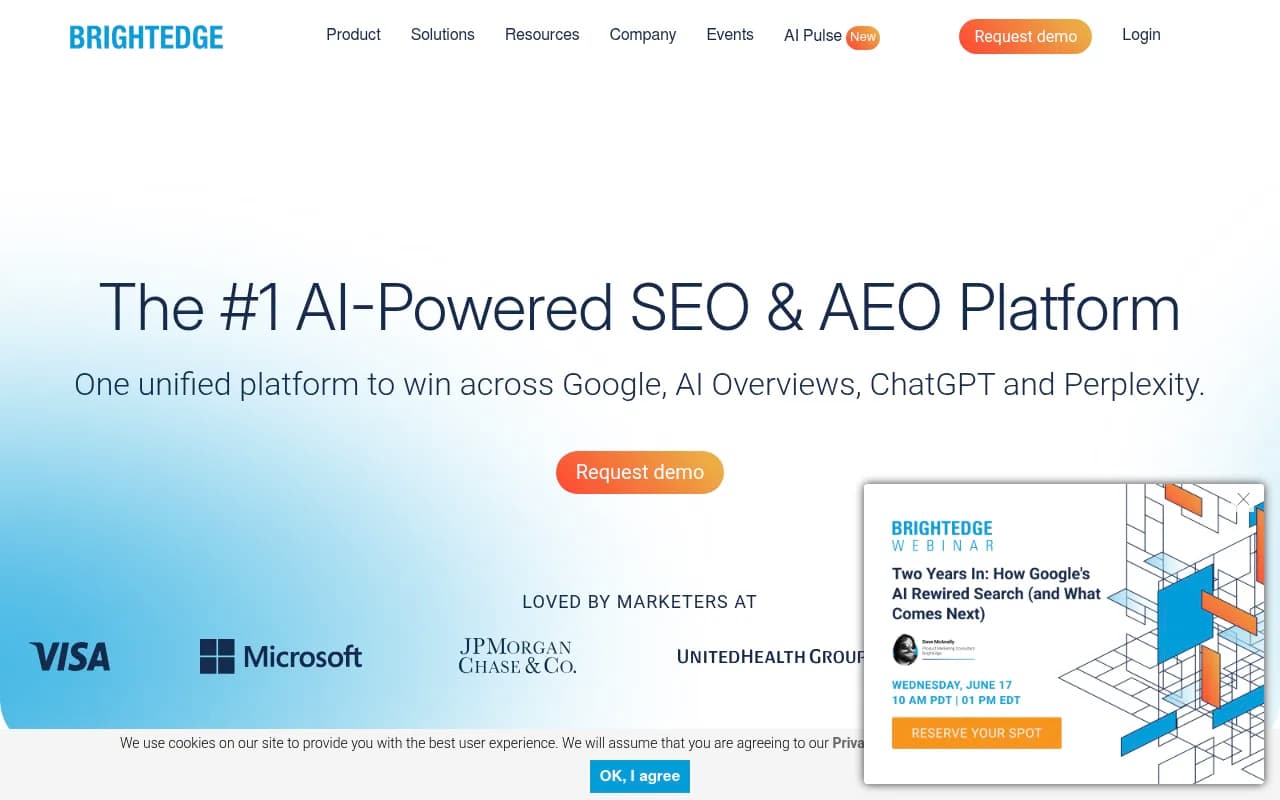
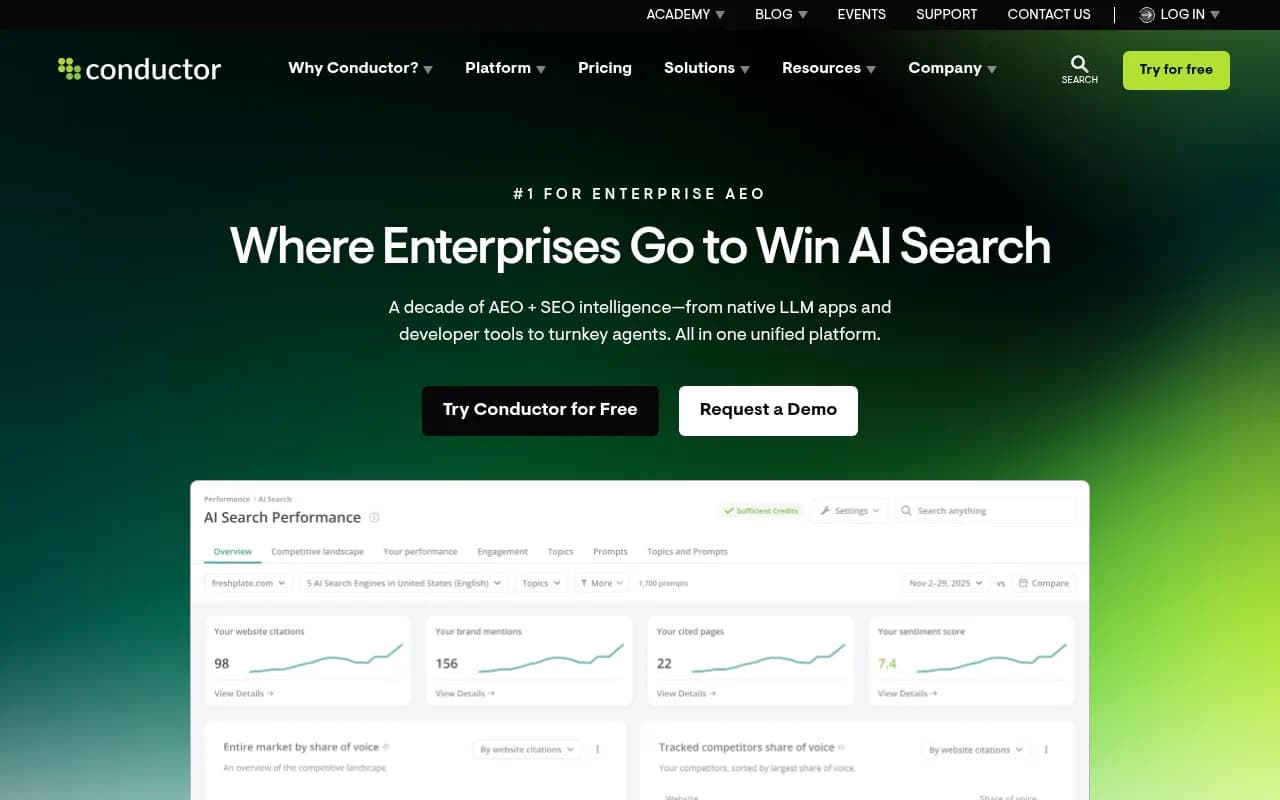
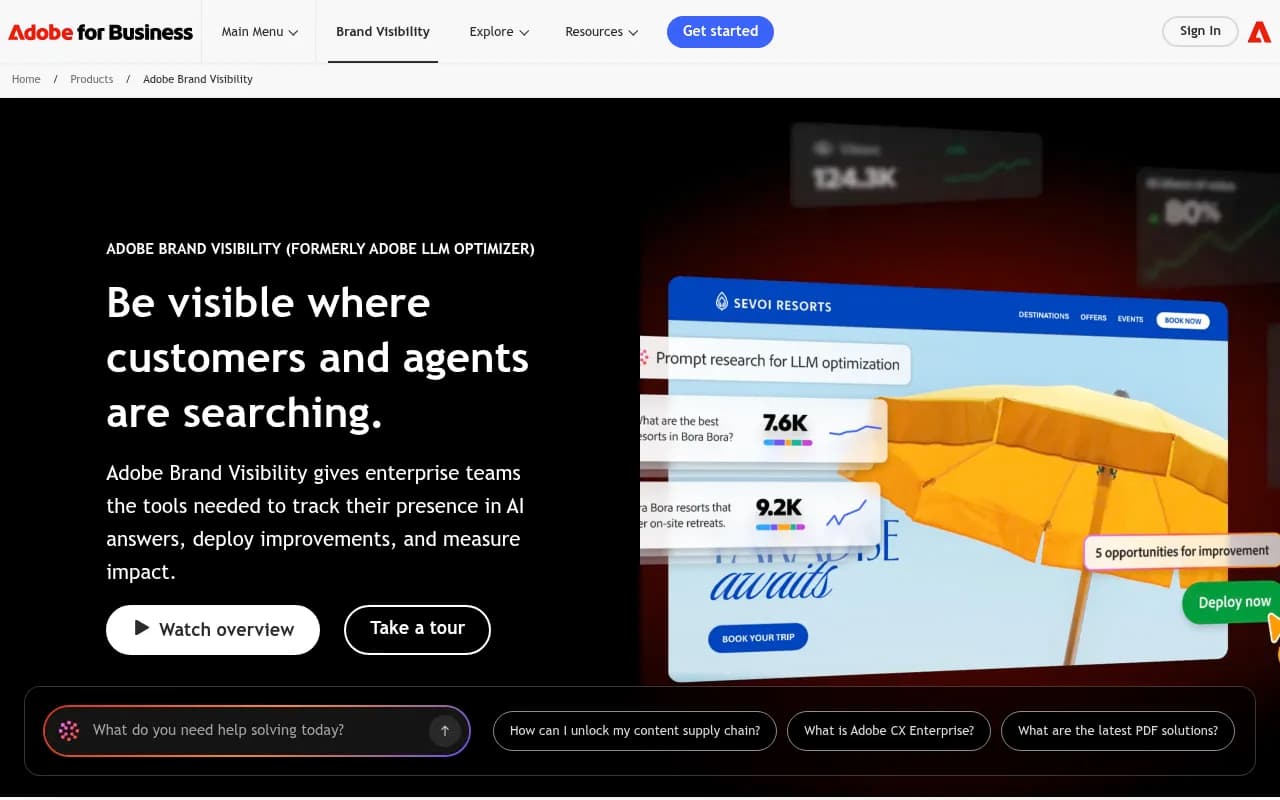
If your organization already lives inside an SEO suite, check what your incumbent offers before buying a standalone product. BrightEdge, Conductor, seoClarity and Adobe all sell AI search modules.
Platforms that act, not just report
If your team wants the tool to help produce the fixes, not just tell you where you're invisible, Promptwatch is worth putting in the bake-off. It tracks ChatGPT, Gemini, Claude, Perplexity, Google AI Overviews, AI Mode, Copilot and more from the real interfaces, then goes further: a Content Agent writes and publishes pages to WordPress, Webflow or Framer, and IP-verified AI crawler logs and visitor analytics show whether those pages get crawled, cited and clicked. It also covers Reddit, YouTube and LinkedIn citation tracking, which many enterprise tools skip.

The Content Agent and local GEO targeting start on the Business plan ($579/mo, confirm at promptwatch.com/pricing). For the head-to-head view, see Promptwatch vs Brandlight and the 2026 GEO platform comparison. Enterprise teams can book a demo, and anyone can run the free AI visibility report first.
Lighter-weight monitors
For smaller teams that mainly need to know whether the brand is mentioned, Peec AI and Otterly.AI are the budget end of the market. Neither is built for multi-brand enterprise governance.


For more options, the GEO software directory at bestgeosoftware.com lists dozens more.
Side-by-side: how the options differ
| Capability | Brandlight | Profound | Peec AI | Promptwatch |
|---|---|---|---|---|
| Public pricing | No | Yes (entry tiers) | Yes | Yes |
| Target buyer | Fortune 500, multi-brand | Mid-market to enterprise | SMB | Brands, agencies, enterprise |
| Managed strategist onboarding | Yes, core to model | Varies by plan | No | Optional managed optimization |
| Content creation and publishing | Verify in demo | Content features, verify | No | Content Agent with CMS publishing |
| AI crawler logs | Verify in demo | Verify in demo | No | IP-verified logs |
| AI traffic attribution | Verify in demo | Verify in demo | No | Visitor analytics |
| Compliance | SOC 2 Type II, SSO, RBAC | Verify | Verify | ISO/IEC 27001, GDPR, SSO on Enterprise |
Cells that say "verify" are where I could not confirm details from independent sources. Make each vendor fill them in, in writing.
How to run a fair pilot
A 30-day bake-off beats any amount of reading. Here is a setup that works:
- Build a single list of 50 to 100 prompts. Include branded, competitor comparison and category prompts, drawn from real customer questions and Search Console queries.
- Run the same list in every shortlisted tool, same countries and languages.
- Pick two or three pages you will fix based on each tool's recommendations. Compare how specific and actionable the advice is.
- Check whether each tool can show you crawler access to those pages and any resulting AI referrals.
- Score on four things: data accuracy against manual spot checks, quality of recommendations, time to first action, and how easy it is to share results with executives.
Spot check manually. Open ChatGPT and AI Overviews yourself for 10 prompts and compare. If a tool's answers don't match what you see, that tells you more than any feature list.
Before you buy anything: the internal checklist
Vendor choice matters less than readiness. Make sure you have:
- A named owner for AI search (not "everyone")
- Content and web resources able to ship fixes within weeks
- Technical access to your CDN or CMS for crawler logs and publishing
- A baseline: your current visibility, share of voice and AI referral traffic
- A target tied to revenue, such as conversion rate from AI traffic
This is the part many enterprises skip. Aprimo's 2026 piece makes a similar point about AI in marketing generally: the highest performers redesign workflows rather than bolt a tool onto existing processes. A visibility platform is the same. If nobody owns the actions it generates, it becomes an expensive dashboard.
If you'd rather hand the strategy and execution to specialists than staff it internally, an agency is another route. 1001 SEO Media runs technical SEO, content and generative engine optimization for brands that want results in Google and AI answers without hiring a full in-house team.
So, is Brandlight worth it?
It depends on who you are.
Brandlight is likely worth a serious look if you are a large, regulated, multi-brand enterprise with a dedicated AI marketing team, a security review to pass, and an appetite for a strategist-led engagement. The compliance posture and the multi-brand focus are real strengths, and users on G2 praise the usability and support.
It is probably not the right first purchase if you are a mid-market team, you want transparent pricing, you want to self-serve, or your priority is shipping content and measuring AI-driven revenue. In those cases, start with a pilot of two or three alternatives, and make Brandlight justify its premium against them with the same prompts and the same success criteria.
The unverified pricing, the competitor-authored comparisons and the lack of public ROI cases are the three reasons I'd insist on a pilot. Ask for a quote, run the test, and let your own data decide.