Key takeaways
- There is no verified churn data on why teams leave Profound. The reasons below are inferred from vendor comparisons, pricing pages, and procurement guidance, so read them as patterns to test, not statistics.
- The two most repeated reasons are pricing that climbs early (engines, prompts, API and SSO move you toward a quote) and measurement that stops short of fixing anything.
- Credit-based Agent pricing and vague overage terms are the hardest part of a renewal to forecast. Get the policy in writing.
- Before blaming any vendor for a dip, check whether the platform moved. ChatGPT citations per response fell about 27% after the GPT-5.3 rollout in March 2026.
- Renew, renegotiate, or switch based on a short checklist: prompts and engines, credits, contract terms, prompt mix, platform events, and attribution.
Start with what we know and don't know
I went looking for hard numbers on Profound churn. They don't exist, at least not publicly. No survey, no review dataset, no first-hand customer study that says "X% of teams leave after twelve months." Anyone who claims otherwise is guessing.
What does exist is a set of vendor comparisons, Profound's own pricing page, procurement guidance, and a few analyst pieces. Several of those come from competitors (Frase ranks itself first in its Profound alternatives roundup, and Tim Soulo writes at Ahrefs, which lists its own Brand Radar first). So treat this guide as a decision framework built from those signals. G2, Reddit, and Trustpilot reviews are the next place to look if you want first-hand complaints.
It's also worth saying that Profound is a serious product. On November 6, 2026 it was named a Major Player in the IDC MarketScape for Worldwide Agentic Marketing for B2C Enterprises, and it tracks up to nine answer engines on its Enterprise plan. Leaving isn't an indictment. It's usually a fit question that only becomes visible after a year of use.

What Profound looks like in late 2026
The plan structure matters because the sources disagree about it.
The current pricing page
Profound's own pricing page, as I found it, lists two plans:
- A free trial: 50 prompts run daily for 7 days on ChatGPT, Gemini, and Google AI Overviews. It has limited AI Marketer credits, one language, one region, no exports, no API, no history, no support, and no SSO.
- Enterprise (custom pricing): up to 9 answer engines (ChatGPT, Perplexity, Google AI Mode, Gemini, DeepSeek, Claude, AI Overviews, Exa Search, and Muse Spark), tailored prompt tracking at daily frequency, ChatGPT Shopping, CSV and JSON exports, API, all-time history, SSO/SAML, SOC 2, unlimited seats, and support options up to a dedicated specialist with a 24-hour SLA.
The page also now frames Profound as an "AI Marketer" with Agents, Context Manager, Projects, and Sheets, not only a tracker.
The older self-serve tiers
Frase's September 2026 comparison lists a Starter plan at $99/month (ChatGPT only, 50 prompts, 100 credits, 1 seat) and a Growth plan at $399/month (3 engines, 100 prompts, 400 credits, 3 seats), both with a yearly option worth two months. Tim Soulo's roundup cites the same $99 and $399 figures. The pricing page I checked no longer shows Starter or Growth, so confirm directly with Profound whether those tiers still exist for your account before you plan around them.
There is also an Agency Growth plan with 400 credits per month per client workspace.
Why teams look elsewhere after year one
These are the recurring themes, ordered by how often they show up in the sources.
Pricing climbs earlier than expected
Frase's comparison describes the ladder plainly. At $99 you get one engine, 50 prompts, and one seat. Perplexity and AI Overviews arrive at $399. The API, SSO, and wider engine coverage need a quote. A team that signs up for a pilot and then needs more engines, more prompts, or an API for their data warehouse in month six is suddenly in a sales conversation.
There's also an ownership angle. One M&A analysis, by Deepak Gupta, calls Profound "expensive enough that it is now more likely to be an acquirer or an IPO candidate than a target." That's an opinion, but it's a reasonable prompt for a renewal question: what does the roadmap and pricing look like as the company scales upmarket?
Credit burn is hard to forecast
Agents consume credits each time they run, in proportion to the agent's complexity. Going past your allotment can bill overages or pause usage, depending on account configuration. Higher credit tiers require an Enterprise package. Profound's FAQ on exceeding prompt limits only says it will notify you as you approach the limit and "help you explore the best expansion options." That is not a price.
G2's 2026 buyer research frames the question well: it's whether the pricing model makes the risk of spending overruns worth taking. Usage-based pricing is fine if you can predict usage. After a year, you should be able to. If you still can't, that's a sign.
Measurement is half the job
Frase's second argument is that teams want the tool to carry a finding through to a corrected, published page. Profound has moved in that direction with Agents, which is worth acknowledging. Still, plenty of teams run a monitoring tool for a year, learn where they're invisible, and then discover their bottleneck was never knowing. It was shipping content fast enough to change the answer.
If your team looks at the dashboard every Monday and nothing changes in the content calendar, you're paying for awareness, not outcomes.
Attribution stays fuzzy
Siteimprove calls AEO's attribution gap structural: visibility is hard to tie to revenue, so teams need proxy measurement frameworks. That isn't a Profound-specific flaw. But by renewal time, finance wants a line from spend to pipeline, and a tool that can't help draw it gets scrutinized. Profound does have Agent Analytics integrations (Cloudflare, AWS, GA and others), so check whether you actually turned them on.
Check the platform before you blame the vendor
Before you decide the tool failed, rule out the platform. This is the most common mistake in AI visibility renewals.
According to Promptwatch's ChatGPT citation drop data, average citations per search-enabled ChatGPT response fell from about 6.4 to roughly 4.7-4.9 after the GPT-5.3 rollout on March 4, 2026. That is around 27% fewer citations, it hit GPT-5.3, GPT-5.4, and GPT-5-Mini at once, and there was no recovery a month later. If your visibility dipped in March and you blamed content or the vendor, you were probably looking at a platform-wide shift.
The lesson for a renewal: ask whether the tool reports citations per response, so you can separate a market-wide change from your own performance. Single-snapshot audits are unreliable here. Continuous monitoring is the point.
The prompt mix matters just as much. In Promptwatch's data on unique domains per ChatGPT response (Sep 28 to Oct 4, 2026), 47.6% of cited responses cite 10 or more unique domains, but the split by prompt type is large:
- Organic prompts: 52.5% cite 10 or more domains
- Competitor comparison prompts: 49.1%
- Brand-specific prompts: only 21.3%, with 5 domains the most common count
So a small prompt set that only answers "cited or not" tells you very little. You want position, tone, and coverage across many prompts and all three types.
The renewal checklist
Here's the list I'd actually run through with the account team 60 to 90 days before renewal.
- Compare prompts and engines to need. How many prompts did you really use, and which engines drove decisions? Entry plans in this category often cap at 15-50 prompts, so check the limit before the price.
- Get credits in writing. Ask for an estimate of Agent credit use for the next twelve months and the overage policy: bill or pause.
- Negotiate contract terms. Enterprise procurement guidance from LightSite says to put usage limits, overages, support response times, availability commitments, renewal terms, and an exit export into the order form. Ask for a price cap on renewal too.
- Confirm you can leave. Verify CSV or JSON export of your full history. All-time history is only useful if it's yours.
- Audit the prompt mix. Organic, brand, and comparison prompts, in the markets you sell in.
- Check platform events. Did your worst week line up with a model change?
- Test attribution. Can you connect AI visits to conversions today? If not, what's the plan?
- Count the actions shipped. How many content or technical fixes came out of the tool in twelve months?
The last one is blunt, but it usually settles the decision.
Renew, renegotiate, or switch
Renew if
- You are an enterprise team using multiple engines, SSO, API, and ChatGPT Shopping.
- You have a dedicated specialist and use the Agents regularly.
- Your credit use is predictable and the overage policy is written down.
Renegotiate if
- You like the data but pay for engines or prompts you don't use.
- Credit overages surprised you once already.
- You need price caps and an export clause.
Switch if
- Nothing changed in your content calendar because of the dashboard.
- Your prompt cap forces you to track too narrow a set.
- You can't tie visibility to traffic or revenue.
- You need a tool that writes and publishes, not only reports.
Alternatives and what they cost
All prices below come from Frase's September 2026 vendor-page checks unless noted, and roundups like this are vendor-affiliated, so verify on each vendor's site.
| Tool | Entry price | Notes |
|---|---|---|
| Otterly.AI | $29/mo (15 prompts) | Standard $189, Premium $489, Enterprise from $1,000 |
| ZipTie | From $35.63/mo | Usage-based pricing |
| Writesonic GEO | $79/mo (annual) | Basic $199, Enterprise by quote |
| Peec AI | $80/mo (50 prompts) | Pro $205 (150 prompts), Advanced $420 (350 prompts) |
| Ahrefs Brand Radar | $50/mo | $699/mo covers all models |
| Semrush AI Visibility Toolkit | Add-on to a Semrush plan | Entry SEO plan $117.33/mo billed annually |
| AthenaHQ | $295/mo | Free tier, Enterprise by quote |
| Promptwatch | $95/mo | Essential; Professional $245, Business $579, agency plans from $199 |
Promptwatch
Promptwatch is the option I'd look at first if your complaint is "we measure but don't fix." It's an AI visibility platform that monitors the real interfaces of ChatGPT, Gemini, Perplexity, Google AI Overviews, and others, traces which pages get cited, then acts on the gaps: the Action Board prioritizes work, and on Business the Content Agent writes and publishes to WordPress, Webflow, or Framer. IP-verified AI crawler logs and visitor analytics then show whether the new pages were crawled, cited, and clicked.

Plans start at $95/month (Essential), $245 (Professional), and $579 (Business, the first plan with the Content Agent). Agencies pay $199, $399, or $799. Every plan includes unlimited seats, all models, Agent Chat, and MCP and API access. Confirm numbers at promptwatch.com/pricing. The Promptwatch vs Profound page has a side-by-side. A 7-day free trial on monthly billing and the free AI visibility report are sensible ways to test it against your Profound data before the renewal date.
Budget trackers
Otterly.AI and Peec AI are the usual cheaper picks for straight monitoring.


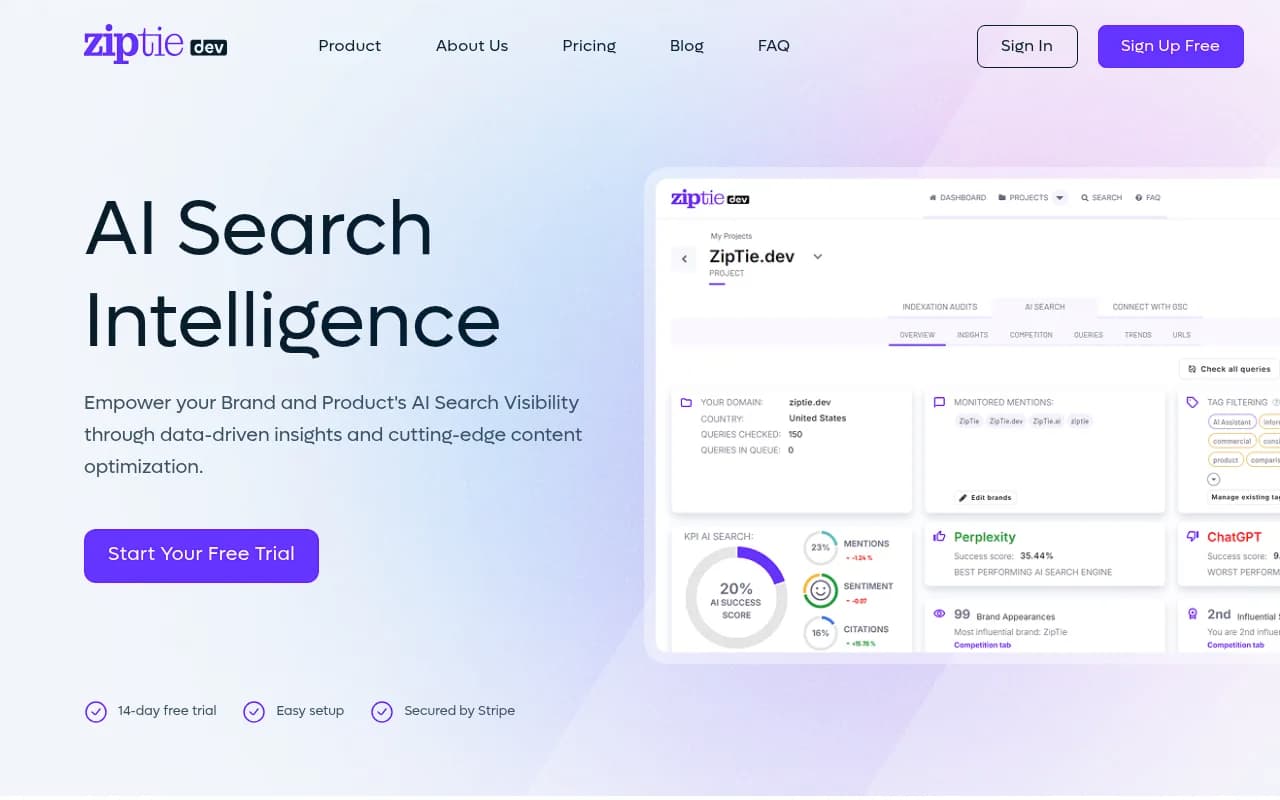
They fit when you only need to watch, but expect no crawler logs and little content help. ZipTie is usage-based and focused.
SEO suite add-ons
If your team already lives in a suite, Semrush and Ahrefs Brand Radar are the low-friction route, though prompt sets are fixed and AI-specific depth is shallower.

Enterprise peers
AthenaHQ, Scrunch, and Brandlight sit nearer Profound on the enterprise end.



For a wider shortlist, the GEO software directory at bestgeosoftware.com lists dozens more.
A few negotiation notes
If you do renew, use the leverage you have. Vendors in a crowded category would rather keep a second-year customer than relist the seat.
- Ask for a multi-year price cap in exchange for annual prepay.
- Ask for overage terms to be written as a rate, not "we'll help you explore expansion options."
- Ask for a data export clause that survives termination.
- Ask for a named contact, and the SLA in the order form.
- Bring a competing quote. It changes the conversation.
And if you plan to switch, export your history first. Run both tools in parallel for 30 days on the same prompts so you can compare outputs and see whether a difference is the tool or the world.
Final word
The honest answer to "why do teams leave Profound after a year" is that it depends on whether they turned insight into shipped work and whether the pricing stayed predictable. The evidence is thin, and the incentives of most roundups are obvious, so run the checklist yourself. Pull twelve months of data, count the actions that came out of it, get the credit and overage terms in writing, and then decide. If the count is low, the tool isn't the only thing to fix, but it's a good place to start asking.