Key takeaways
- Most AI visibility tools in this tier are monitoring dashboards -- they show you where you're invisible but don't help you fix it.
- Promptwatch is the only platform here with a full optimization loop: gap analysis, AI content generation, crawler logs, and traffic attribution in one place.
- Nightwatch is a solid rank tracker that has added AI search features, but it's still primarily a traditional SEO tool with AI monitoring bolted on.
- Omnia targets scaleups and does a good job connecting monitoring to recommended actions, though its content generation capabilities are limited compared to Promptwatch.
- "Gauge" is not a standalone AI visibility platform -- if you've seen it mentioned, it's likely a feature within another tool or a niche product without broad adoption.
- For growing teams that need to move from "we know we're invisible" to "we fixed it," Promptwatch is the most complete option at a mid-market price point.
The AI search monitoring space has exploded. There are now 20+ tools claiming to track your brand across ChatGPT, Perplexity, Gemini, and Google AI Overviews. For a growing team with a real budget but not an enterprise one, the choice is genuinely hard. You need something that does more than show you a dashboard -- you need to actually improve your visibility.
This guide compares four platforms that come up frequently for mid-market teams: Omnia, Promptwatch, Nightwatch, and Gauge. I'll be upfront about one thing: "Gauge" as a standalone AI visibility platform doesn't have a clear, established presence in the 2026 market the way the others do. I'll address that directly rather than pretend it's a like-for-like competitor.
Let's get into it.
What "mid-market AI visibility" actually means in 2026
Before comparing tools, it's worth being specific about what growing teams actually need. Enterprise teams (think Booking.com or a Fortune 500 brand) can afford $2,000+/month platforms with dedicated onboarding and custom data pipelines. Solopreneurs can get by with a $49/month tracker.
Mid-market teams -- typically 5 to 50 person marketing or SEO functions at companies doing $5M to $200M in revenue -- need something in between. Specifically:
- Tracking across multiple AI models (not just one or two)
- Competitor visibility comparisons, not just self-monitoring
- Some form of content optimization or gap analysis (because knowing you're invisible is useless without a path to fix it)
- Reasonable pricing (roughly $100 to $600/month)
- Enough data to justify the spend to a CMO or VP of Marketing
That's the lens I'm using for this comparison.
The platforms
Promptwatch
Promptwatch is the most complete platform in this comparison. It tracks visibility across 10 AI models -- ChatGPT, Perplexity, Claude, Gemini, Google AI Overviews, Google AI Mode, Meta/Llama, DeepSeek, Grok, Mistral, and Copilot -- and pairs that monitoring with tools to actually improve your rankings.
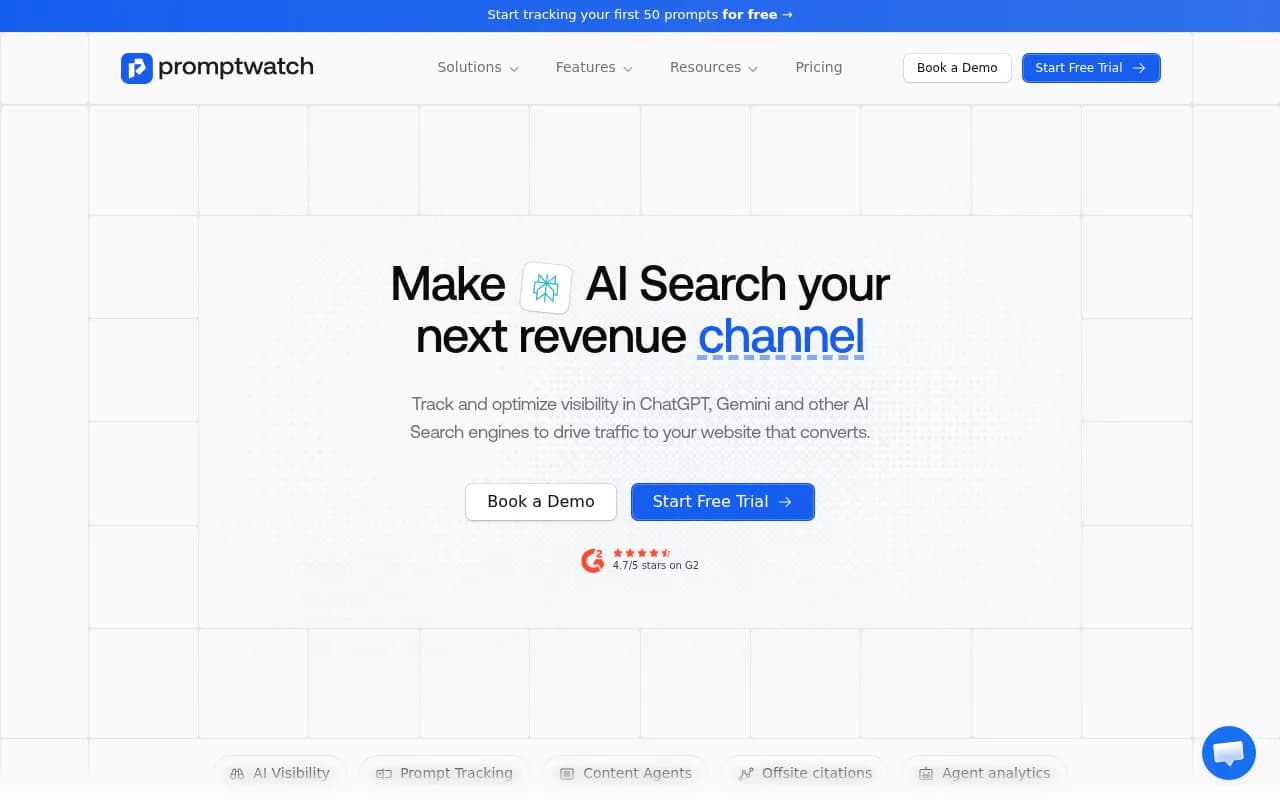
The core workflow is what separates it from the rest. Answer Gap Analysis shows you which prompts competitors are appearing for that you're not. Content Agents then generate articles, comparisons, and briefs built around those specific gaps -- not generic SEO content, but pages engineered to answer what AI models are already looking for. Then page-level tracking shows whether those new pages are getting crawled and cited.
The AI Crawler Logs feature is genuinely rare. You can see in real time which AI crawlers (ChatGPT, Claude, Perplexity) are hitting your site, which pages they're reading, and whether those pages are moving from "crawled" to "cited." Most competitors don't have this at all.
Other things worth knowing: Promptwatch tracks Reddit and YouTube as citation sources (both influence AI recommendations more than most teams realize), monitors ChatGPT Shopping appearances, and provides prompt volume estimates so you can prioritize high-traffic queries instead of guessing.
Pricing runs from $99/month (Essential: 1 site, 50 prompts) to $579/month (Business: 5 sites, 350 prompts, 30 articles/month). There's a free trial. For a growing team, the Professional plan at $249/month is probably the right starting point -- it adds crawler logs, city/state tracking, and 150 prompts.

Omnia
Omnia (useomnia.com) positions itself specifically for scaleups that need both monitoring and action. It's one of the more honest self-descriptions in this space -- the site explicitly says it's for teams that want "monitoring and actions," not just dashboards.
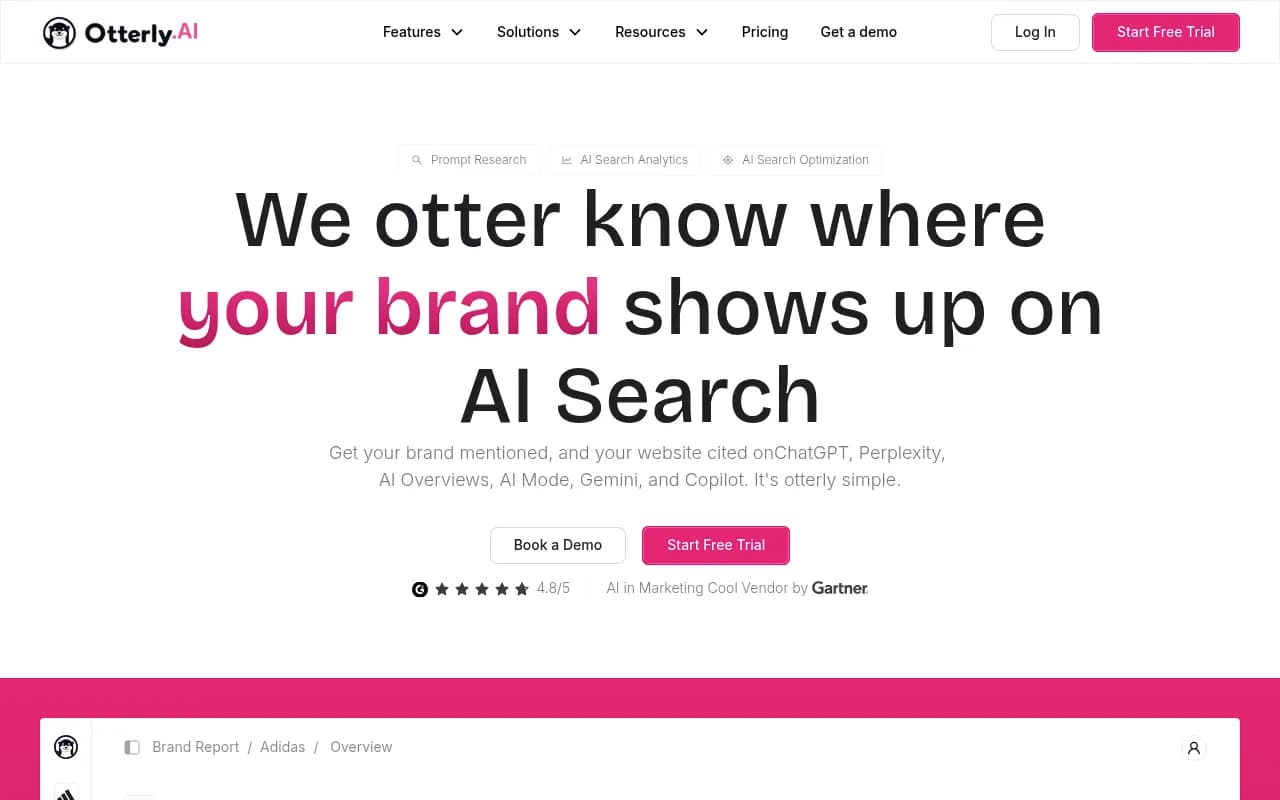
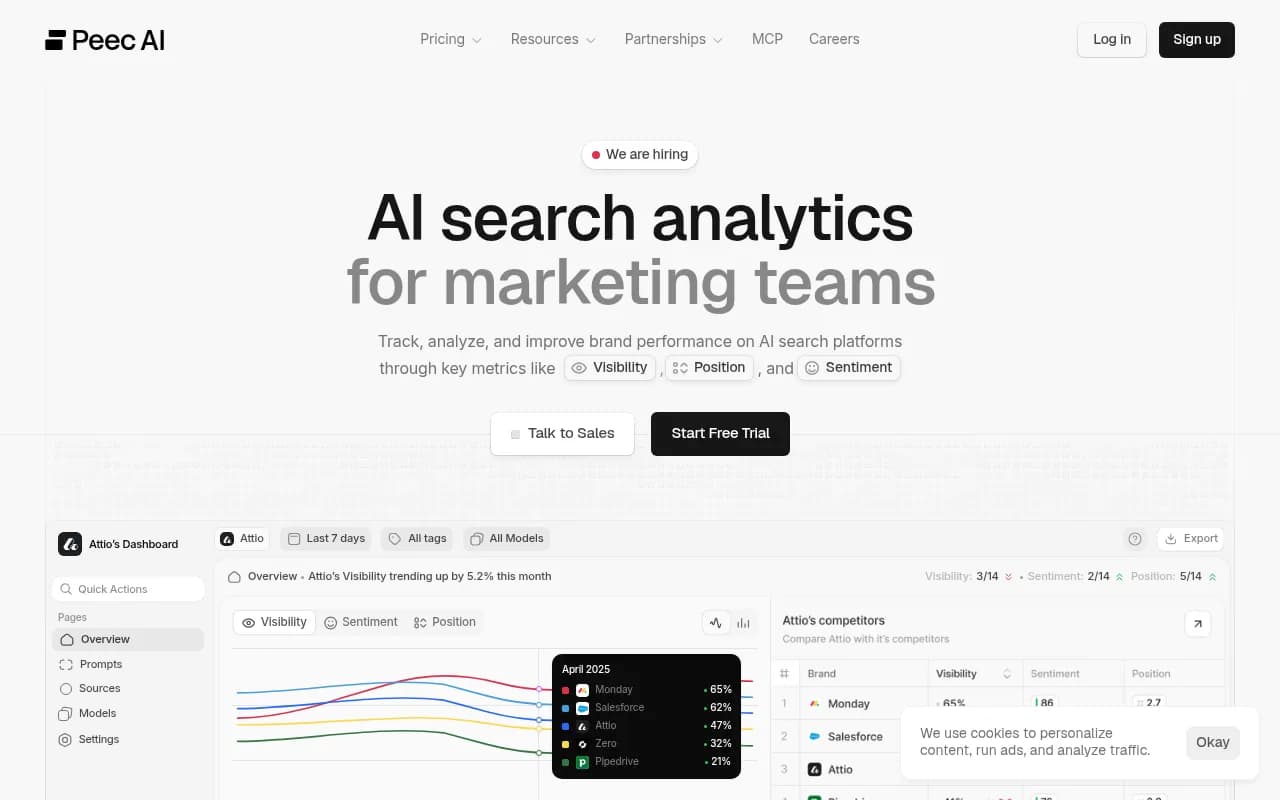
From what's publicly available, Omnia covers the major AI search engines, tracks brand mentions and citations, and provides some level of recommended next steps based on what it finds. It's a step above pure monitoring tools like Otterly.AI or Peec.ai in that it tries to connect data to decisions.
Where Omnia is weaker: it doesn't appear to have the depth of content generation that Promptwatch offers, and there's no public mention of AI crawler logs or page-level citation tracking. For a team that wants to understand why they're being cited (or not), that's a meaningful gap.
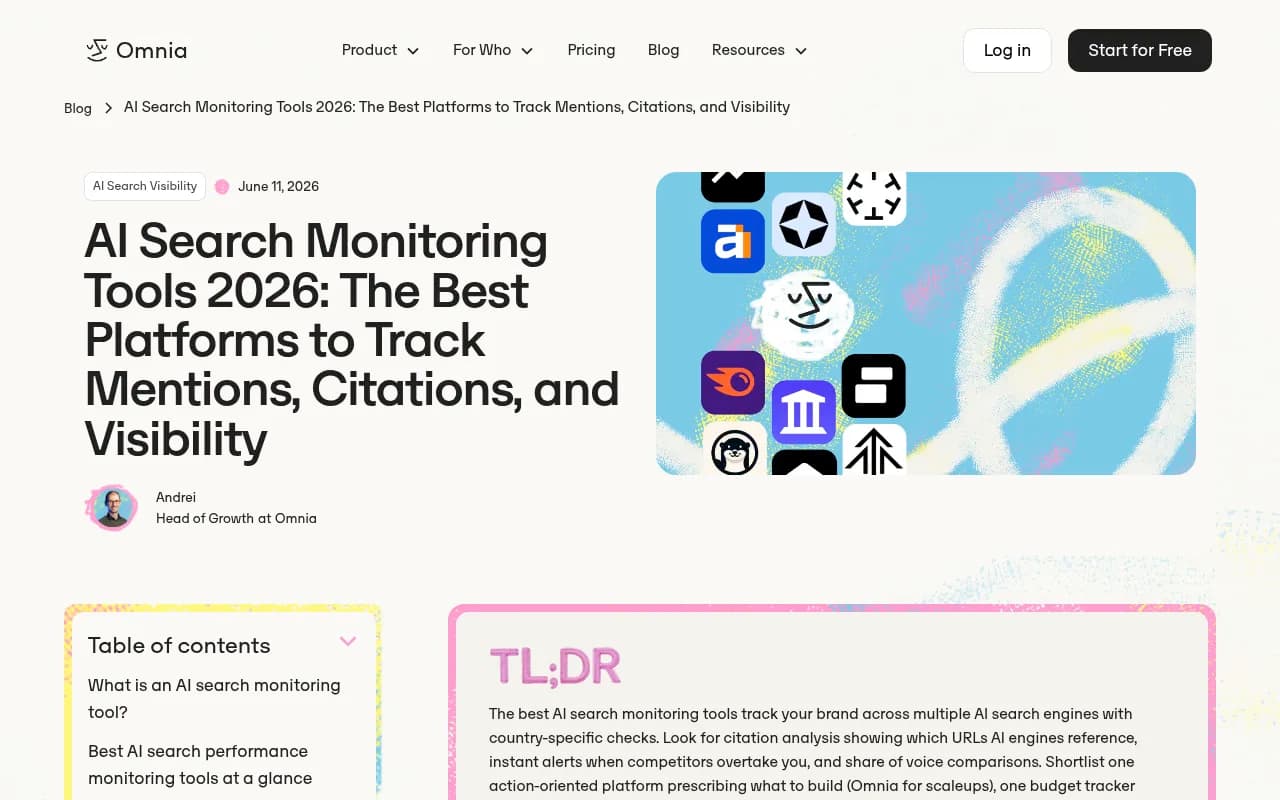
Omnia also ranks Promptwatch in its own comparison of AI search monitoring tools -- which is worth noting. When a competitor acknowledges another tool in its own blog post, it's usually because that tool is hard to ignore.
Nightwatch
Nightwatch (nightwatch.io) started as a rank tracker -- a good one, with a clean interface and solid SERP position monitoring. In 2026, it has added AI search monitoring features, which puts it in this conversation.
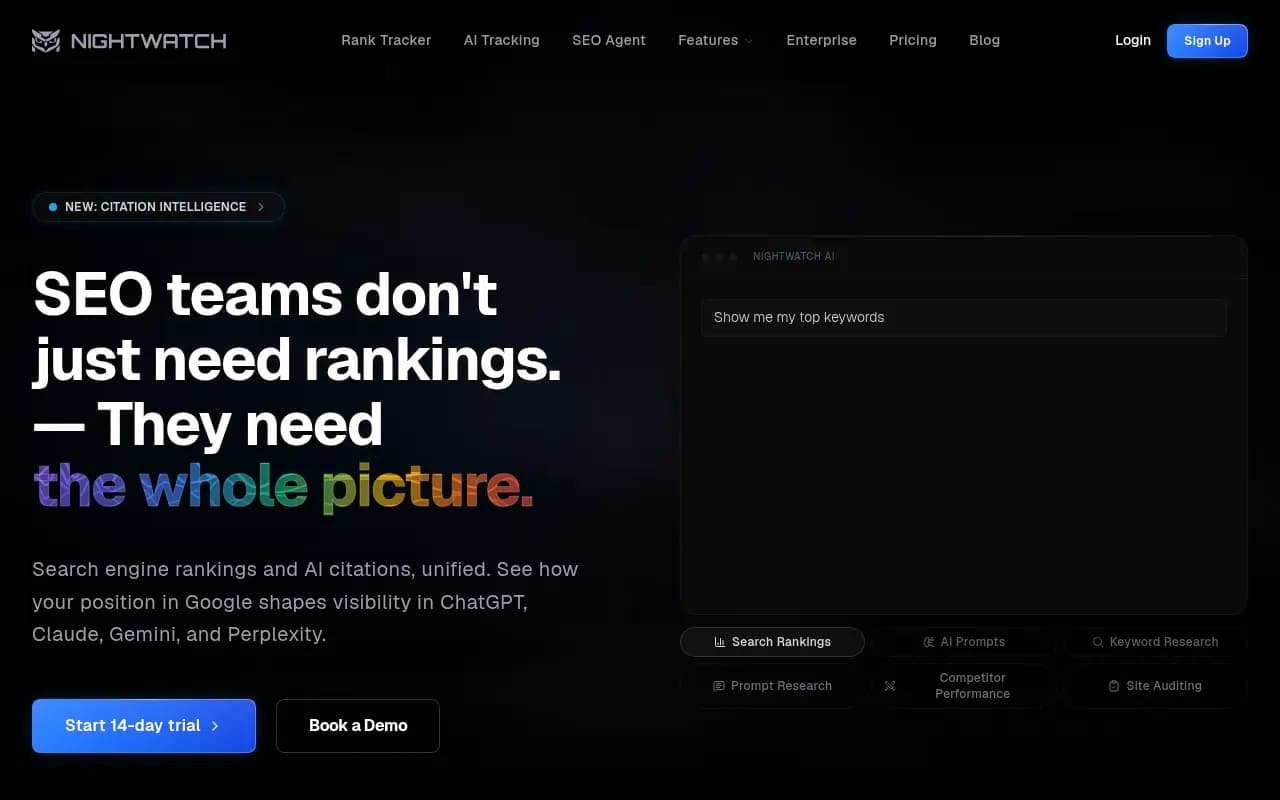
The honest assessment: Nightwatch is a traditional SEO tool that has extended into AI search, not a platform built from the ground up for AI visibility. That's not necessarily bad -- if your team already uses Nightwatch for rank tracking, having AI monitoring in the same place has obvious workflow benefits.
But the depth isn't the same. Nightwatch doesn't appear to offer content gap analysis, AI content generation, or crawler logs. It's a monitoring tool, and a good one, but it won't help you close the gaps it finds. For teams that already have a content workflow and just need visibility data piped into it, that might be fine. For teams that need the full loop, it falls short.
Pricing for Nightwatch is generally lower than Promptwatch, which makes it attractive for budget-conscious teams. If your primary need is "show me where I appear across AI models" and you'll handle content separately, Nightwatch is worth evaluating.
Gauge
Here's the honest part: "Gauge" doesn't appear as a distinct, established AI visibility platform in the 2026 market. There are tools with "gauge" in their name or as a feature label, but there's no platform called Gauge that competes directly with Omnia, Promptwatch, or Nightwatch in this category.
If you've seen "Gauge" referenced in a comparison or recommendation, it may be:
- A feature within another tool (several platforms use "gauge" as a UI element for visibility scores)
- A very new or niche product without significant market presence
- A confusion with another tool name
Rather than fabricate a comparison, I'd suggest treating this slot as an open one. If you're evaluating a specific tool called Gauge that I haven't covered, the framework in this guide still applies: does it monitor only, or does it help you optimize? Does it have crawler logs? Can it generate content? Those questions will tell you what you need to know.
Feature comparison
Here's how the three established platforms stack up across the features that matter most for growing teams:
| Feature | Promptwatch | Omnia | Nightwatch |
|---|---|---|---|
| AI models tracked | 10 (ChatGPT, Perplexity, Claude, Gemini, Grok, DeepSeek, Copilot, Meta AI, Google AIO, Google AI Mode) | Multiple (exact count not public) | Several (exact count not public) |
| Competitor visibility tracking | Yes | Yes | Yes |
| Answer gap analysis | Yes | Partial | No |
| AI content generation | Yes (Content Agents) | Limited | No |
| AI crawler logs | Yes | No | No |
| Page-level citation tracking | Yes | No | No |
| Reddit & YouTube insights | Yes | No | No |
| ChatGPT Shopping tracking | Yes | No | No |
| Prompt volume & difficulty | Yes | No | No |
| Traffic attribution to revenue | Yes | No | No |
| Starting price | $99/mo | Not public | Lower tier |
| Free trial | Yes | Yes | Yes |
| Best for | Full optimization loop | Scaleup monitoring + actions | Traditional SEO teams adding AI |
Which platform fits which team
You should use Promptwatch if...
Your team needs to move from visibility data to actual content improvements. If you're asking "why aren't we appearing in ChatGPT results for [X]?" and you want a tool that answers that question and helps you create the content to fix it, Promptwatch is the right choice. The crawler logs alone are worth the price for teams that are actively publishing content and want to know whether AI engines are reading it.
It's also the right call if you're tracking multiple sites (agencies or multi-brand companies), need city/state level tracking, or want to connect AI visibility to revenue rather than just impressions.
You should use Omnia if...
You're a scaleup that wants a clean, action-oriented monitoring experience and you're comfortable handling content production separately. Omnia seems to do a good job of surfacing recommendations without overwhelming teams with raw data. If you're earlier in your AI search journey and want to understand the landscape before investing in a full optimization platform, Omnia is a reasonable starting point.
You should use Nightwatch if...
You already use Nightwatch for traditional rank tracking and want to add AI search monitoring without switching tools. The workflow consolidation is real value. If your team is primarily SEO-focused and AI search is a secondary concern right now, Nightwatch's lower price point and familiar interface make sense. Just know that you'll need other tools to actually optimize your AI visibility.
The monitoring-only trap
One thing worth saying directly: most teams that buy an AI visibility tool in 2026 will end up frustrated within three months if they buy a monitoring-only platform.
Here's why. You set up the tool, you see that competitors are appearing in ChatGPT for 40 prompts you're not. You have a dashboard. Now what? Most tools stop there. They show you the gap but give you no path to close it.
This is the core problem with monitoring-only tools. Knowing you're invisible is the easy part. Figuring out what content to create, writing it in a way that AI models will actually cite, and then verifying that AI crawlers are reading the new pages -- that's the hard part, and most tools don't touch it.
Promptwatch built its entire product around this problem. The Answer Gap Analysis tells you exactly which prompts to target. The Content Agents write the pages. The crawler logs confirm the pages are being read. The citation tracking shows when you start appearing. That loop -- find gap, create content, verify crawl, track citation -- is what actually moves the needle.
The other tools in this comparison are useful, but they're mostly step one of a four-step process.
A note on pricing and value
For a growing team, the relevant question isn't "which tool is cheapest?" It's "which tool generates enough visibility improvement to justify its cost?"
A $99/month tool that shows you data but doesn't help you act on it is more expensive in practice than a $249/month tool that helps you create content that drives AI citations. If one new AI-visible page generates 500 additional monthly visitors from Perplexity and ChatGPT, the math on a $249/month subscription gets very easy very quickly.
That said, budget is real. If you're genuinely constrained, Nightwatch's lower price point for basic AI monitoring is defensible as a starting position. Just plan to graduate to something with optimization capabilities once you've validated that AI search is a meaningful traffic channel for your business.
Other tools worth knowing about
This comparison focused on four specific platforms, but the mid-market AI visibility space has several other tools worth a quick look depending on your needs:
If you want monitoring with a strong agency focus:
If you want affordable monitoring as a starting point:
If you want monitoring with smart suggestions built in:
If you want enterprise-grade depth at a higher price point:
If you want AI visibility data alongside traditional SEO in one platform:
Bottom line
The mid-market AI visibility space in 2026 has a clear split: tools that monitor and tools that optimize. For growing teams that want to actually improve their AI search presence -- not just measure it -- that distinction matters a lot.
Promptwatch is the most complete option for teams that need the full loop. Omnia is a reasonable choice for scaleups that want monitoring with some action guidance. Nightwatch works if you're already in their ecosystem and AI search is a secondary priority. And "Gauge" as a standalone platform doesn't have a clear presence in this market yet.
The best move for most teams: start a free trial with Promptwatch, run your first Answer Gap Analysis, and see how many prompts your competitors are winning that you're not. That number will tell you everything you need to know about how seriously to take AI search optimization.