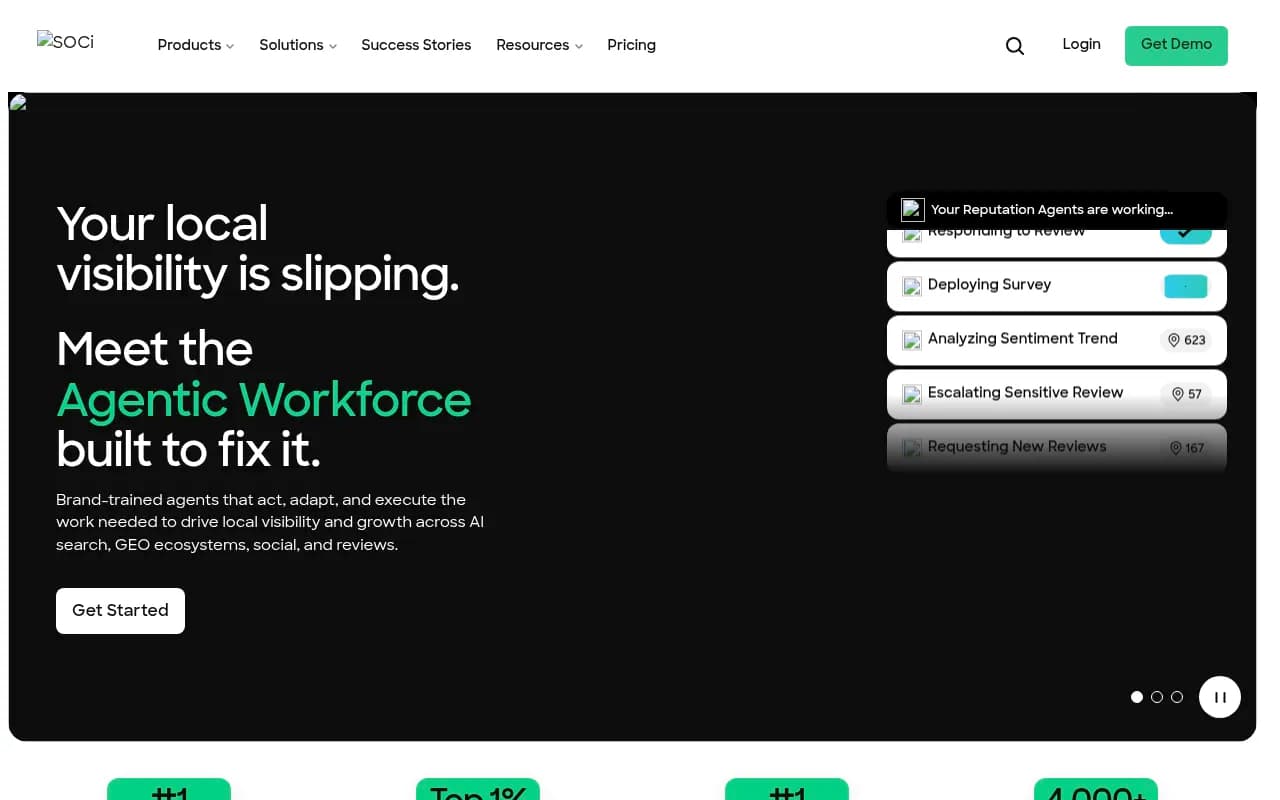
Search Party Review 2026
AI visibility monitoring platform built for digital agencies. Tracks client brand citations across LLMs and provides white-label reporting features.
Key takeaways
- Search Party is an agency-focused AI visibility monitoring platform that tracks brand citations across major LLMs, with white-label reporting as a core differentiator
- Lacks content generation, AI crawler logs, traffic attribution, Reddit/YouTube tracking, and prompt volume scoring that Promptwatch offers -- it's primarily a monitoring dashboard, not an optimization platform
- Emerged from stealth in October 2025 with $3.5 million in seed funding, so it's still early-stage
- Plans start at $95/month with a free tier available, making it accessible for smaller agencies
- Best suited for agencies that need client-facing reporting on AI visibility but don't need to act on the data themselves
Search Party is a relatively new entrant in the AI search visibility space, having emerged from stealth in October 2025 with $3.5 million in seed funding. The platform is built specifically around the needs of digital agencies -- the kind of shops managing AI visibility for multiple clients simultaneously and needing clean, presentable reports to show those clients what's happening. The core pitch is straightforward: as AI search engines like ChatGPT, Perplexity, and Gemini increasingly answer questions without sending users to websites, brands need to know whether they're being cited or ignored. Search Party tracks that.
The target audience is clearly agencies rather than in-house marketing teams. The white-label reporting angle, the multi-client structure, and the automated report generation all point to a product designed for account managers who need to show clients something tangible at monthly check-ins. That's a real and underserved need -- most AI visibility tools are built for single-brand use, and adapting them for agency workflows is clunky. Search Party recognized this gap early.
That said, the platform is young. Launched in late 2025, it's still building out its feature set, and the gap between what it monitors and what it helps you do about that monitoring is significant. More on that below.
Key features
Visibility and sentiment tracking
The core of Search Party is monitoring how brands appear in AI-generated responses. It tracks whether a brand is mentioned, how prominently, and with what sentiment -- positive, neutral, or negative. This goes slightly beyond simple citation counting, which is useful. A brand being mentioned dismissively in an AI answer is meaningfully different from being cited as a top recommendation, and Search Party attempts to capture that distinction.
- Tracks citations across major LLMs including ChatGPT, Perplexity, and Gemini
- Sentiment classification on brand mentions
- Visibility scoring that aggregates citation frequency and prominence
White-label reporting
This is arguably Search Party's most differentiated feature for its target audience. Agencies can generate branded reports that carry their own logo and styling rather than Search Party's branding. For account managers presenting AI visibility data to clients, this matters -- it keeps the agency looking like the expert rather than a reseller of a third-party tool.
- Custom branding on exported reports
- Client-facing dashboards with agency branding
- Designed for monthly or quarterly client reporting cadences
Automated reports
Search Party can generate reports automatically on a schedule, reducing the manual work of pulling data and assembling presentations. For agencies managing 10, 20, or 50 clients, this kind of automation is the difference between a scalable service offering and a time sink.
- Scheduled report generation
- Automated delivery to clients or internal stakeholders
- Reduces manual reporting overhead for account managers
Multi-client management
The platform is structured to handle multiple brands or clients from a single account, which is table stakes for any agency-focused tool. Switching between client accounts, comparing visibility across clients, and managing prompts per client are all part of the workflow.
LLM coverage
Search Party monitors visibility across the major AI search engines. The exact list of models covered isn't fully documented in public-facing materials, but ChatGPT, Perplexity, and Gemini are confirmed. Coverage breadth matters because different AI models cite different sources, and a brand might be prominent in one and invisible in another.
Free tier and accessible pricing
Starting at $95/month with a free entry point, Search Party is priced to let smaller agencies experiment without a significant commitment. This is a deliberate positioning choice -- lower the barrier to entry, get agencies hooked on the data, then upsell as they grow their AI visibility service offerings.
Who is it for
Search Party's sweet spot is small to mid-sized digital agencies that are starting to offer AI visibility as a service to clients but don't yet have the internal infrastructure to build their own reporting. Think a 10-30 person SEO or digital marketing agency that's been asked by clients "are we showing up in ChatGPT?" and needs a tool that can answer that question across 15-30 client accounts without requiring a data analyst to pull everything together manually.
The white-label angle makes it particularly useful for agencies that want to present AI visibility monitoring as a proprietary service. If you're charging clients for "AI search optimization" as a retainer line item, having reports that carry your branding rather than a third-party tool's name helps maintain that positioning.
In-house marketing teams at single brands are less well-served here. The multi-client structure and white-label focus add complexity that solo brand teams don't need, and the monitoring-only approach means in-house teams who want to act on the data -- creating content, fixing gaps, tracking what's working -- will quickly hit the ceiling of what Search Party can do.
Enterprise brands with sophisticated AI visibility needs should also look elsewhere. The platform is early-stage, and the depth of features around prompt intelligence, content optimization, and traffic attribution that enterprise teams typically need isn't there yet.
Integrations and ecosystem
Search Party's integration story is limited at this stage, which is expected for a platform that launched in late 2025. There's no publicly documented API, no native connections to Google Search Console, Slack, or project management tools, and no browser extension.
The primary output mechanism is the white-label report, which can be exported and shared with clients. This works for the agency reporting use case but leaves gaps for teams that want to pipe AI visibility data into their existing analytics stack or automate workflows beyond scheduled reports.
As the platform matures, integration depth will be a key area to watch. The absence of a developer API in particular limits how agencies can build custom workflows or connect Search Party data to their own dashboards.
Pricing and value
Search Party's pricing starts at $95/month, with a free tier available to get started. The "Sonar" release (the platform's most recent major update as of 2026) appears to have solidified the core feature set around visibility tracking, sentiment analysis, and automated reporting.
Specific tier breakdowns beyond the $95/month starting point aren't fully detailed in public documentation, which is a minor frustration for anyone trying to evaluate the platform before signing up. The free tier is a genuine on-ramp rather than a crippled demo, which is the right call for an agency-focused product where the sales cycle involves getting account managers to see value before committing budget.
Compared to the broader competitive landscape:
- Promptwatch starts at $99/month for its Essential tier but includes content generation, AI crawler logs, and traffic attribution that Search Party doesn't offer
- Otterly.AI and Peec.ai are similarly priced monitoring tools without the agency-specific white-label features
- Profound and AthenaHQ sit at higher price points with more feature depth
For a pure monitoring and reporting use case at an agency, $95/month is reasonable. The question is whether monitoring alone is enough, or whether clients will eventually demand to know what to do about the data.
Strengths and limitations
What Search Party does well:
- Agency workflow design: The white-label reporting and multi-client structure are genuinely well-thought-out for the agency use case. Most AI visibility tools ignore this entirely.
- Accessible pricing: Starting at $95/month with a free tier makes it easy for smaller agencies to experiment without a significant budget commitment.
- Sentiment tracking: Going beyond citation counting to classify the tone of brand mentions adds a layer of nuance that pure citation trackers miss.
- Automated reporting: Scheduled report generation reduces the manual overhead that makes AI visibility monitoring impractical for agencies managing many clients.
Where it falls short:
- Monitoring only, no optimization: Search Party shows you where you're invisible but offers no tools to fix it. There's no content gap analysis, no AI content generation, no briefs, no recommendations for what to create. Platforms like Promptwatch close this loop with Answer Gap Analysis and Content Agents that generate articles grounded in real prompt data.
- No AI crawler logs: Understanding which pages AI crawlers are visiting, how often, and what errors they encounter is increasingly important for diagnosing why a brand isn't being cited. Search Party doesn't offer this. Promptwatch's crawler log feature gives page-level visibility into how AI engines discover and index content.
- No traffic attribution: Knowing you're cited in AI answers is useful; knowing whether those citations are driving actual traffic and revenue is essential. Search Party doesn't connect AI visibility to web analytics or revenue data.
- No Reddit or YouTube tracking: A significant portion of AI citations come from Reddit threads, YouTube videos, and third-party content. Search Party focuses on brand mentions in AI responses but doesn't surface the offsite content driving those mentions.
- No prompt volume or difficulty scoring: Without knowing which prompts are high-volume or winnable, agencies can't prioritize where to focus client efforts. This is a meaningful gap for any team trying to build a strategic AI visibility program rather than just report on the current state.
- Limited model coverage documentation: It's not entirely clear how many LLMs Search Party monitors or how comprehensively. Promptwatch explicitly covers 10+ models including DeepSeek, Grok, Mistral, and Meta AI alongside the major players.
- Early-stage platform: Launched in late 2025, the platform is still maturing. Feature gaps that are acceptable in a v1 product become frustrating as client expectations grow.
Bottom line
Search Party fills a real gap for digital agencies that need a clean, white-labeled way to show clients their AI search visibility. If your agency is selling AI visibility monitoring as a service and needs automated, branded reports across multiple client accounts, it's worth evaluating -- especially given the accessible entry price.
The honest limitation is that it stops at monitoring. Agencies whose clients will eventually ask "okay, so how do we improve this?" will need to look beyond Search Party. For teams that want to move from tracking to actually fixing AI visibility gaps, Promptwatch offers the full loop: gap analysis, content generation, crawler logs, and traffic attribution in one platform. Search Party is a good starting point; it's not where you end up when AI visibility becomes a serious priority.
Best use case: A digital agency managing 10-30 client accounts that needs white-labeled AI visibility reports to include in monthly client deliverables.
Frequently asked questions
What is Search Party?
How much does Search Party cost?
Does Search Party help you improve AI visibility, or just monitor it?
Who is Search Party best suited for?
Does Search Party offer white-label reporting?
How does Search Party compare to Promptwatch?
Similar and alternative tools to Search Party