Orchly Review 2026
SEO and content optimization platform offering AI-assisted writing, content briefs, and visibility tracking for teams looking to scale organic growth.
Key takeaways
- Orchly combines AI visibility tracking (ChatGPT, Perplexity, Claude, Gemini, Grok, Google AI Overviews) with autonomous agents that actually execute SEO and AEO tasks — not just surface them
- Compared to Promptwatch, Orchly lacks prompt volume and difficulty scoring, query fan-out analysis, deep citation analytics across 4.5B+ data points, and the mature multi-model coverage that comes from a platform processing data at that scale
- Strong value proposition for small teams and agencies who want to replace a stack of 6-8 tools with one platform starting at $49/month
- The "you approve every move" model is a smart design choice — agents propose, humans decide, which keeps quality control in the team's hands
- Still a relatively young platform (350+ brands vs competitors with thousands), and some features appear to be in active development
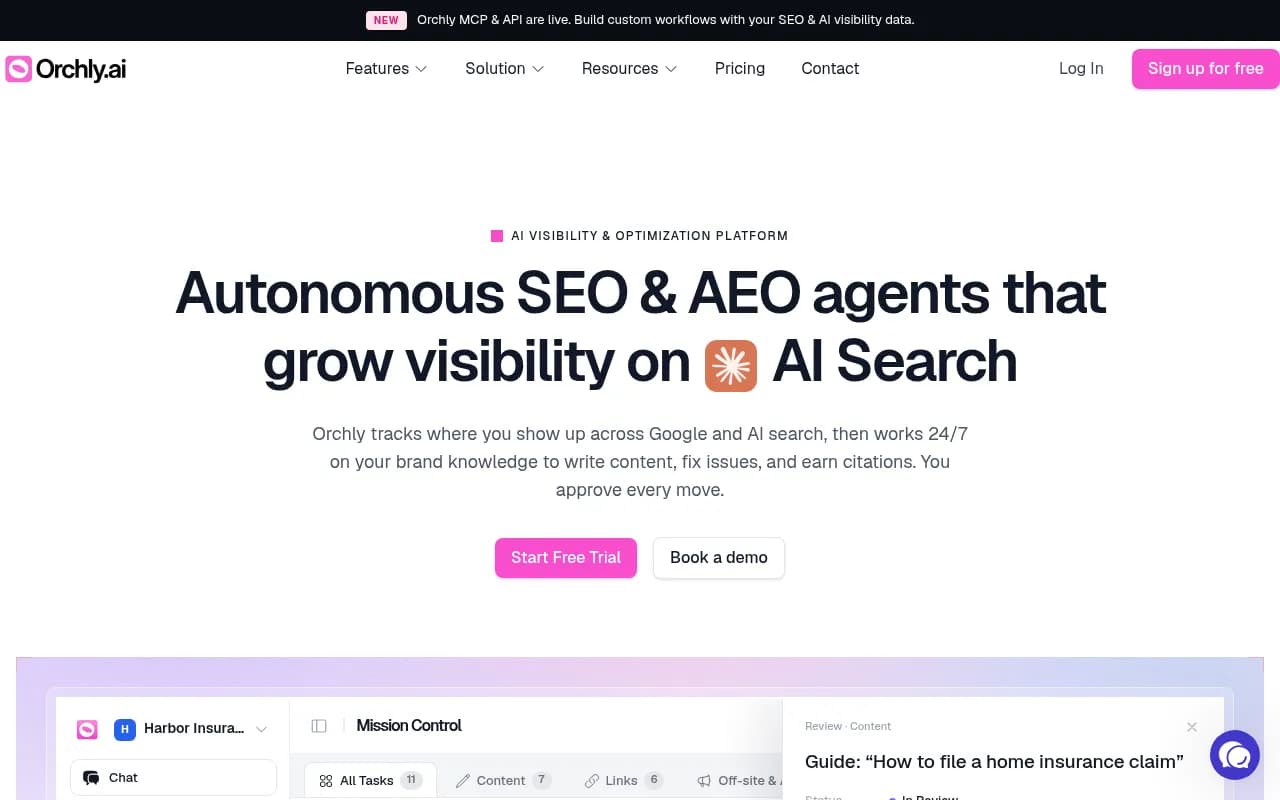
Orchly is an autonomous SEO and AEO (Answer Engine Optimization) platform that deploys a fleet of specialized AI agents to grow your visibility across both Google and AI search engines. Rather than just showing you a dashboard of metrics, it tries to close the loop: agents find opportunities, draft content, fix technical issues, build links, and monitor Reddit mentions, then hand everything to you for approval before anything ships.
The target audience is marketing teams and SEO professionals who are tired of juggling Ahrefs for rank tracking, Jasper for content, Screaming Frog for audits, Brand24 for mentions, and AgencyAnalytics for reporting. Orchly's pitch is that one platform, starting at $49/month, can replace most of that stack. Whether that's fully true depends on how deep you need to go in each category, but the breadth is genuinely impressive for the price point.
The platform appears to be a relatively new entrant, with 350+ brands and agencies listed as customers. That's a meaningful early customer base, though it's worth noting this is a competitive space where more established players have significantly larger datasets and longer track records.
Key features
Mission Control dashboard
The central interface is a Kanban-style task board called Mission Control. It shows all active agent tasks across five categories: Content, Links, Off-site & Authority, and Site Health. Each task has a status (Queued, In Progress, Review, Done), a priority level, and an assigned agent. The "you approve every move" philosophy is built directly into the UI — tasks that need human sign-off show an "Approve" button rather than auto-running. This is a genuinely useful design choice for teams that can't afford to have AI publishing content or making site changes without review.
Specialized AI agents
Orchly runs a roster of purpose-built agents rather than one general-purpose AI:
- Article Writer: drafts new content based on gap analysis and competitor research
- Content Refresh: identifies and updates stale pages
- Link Agent: finds internal linking opportunities, fixes broken links, cleans redirect chains
- Reddit Agent: monitors relevant subreddit threads and drafts replies or flags brand mentions
- Outreach Agent: identifies backlink opportunities (e.g. getting featured in roundups like NerdWallet guides) and drafts pitches
- Technical SEO: detects and fixes issues like missing schema, slow LCP, missing meta descriptions, and sitemap gaps
- AI Citation Monitor: tracks which AI engines are citing your pages and which competitors they're citing instead
Each agent runs on its own schedule — some continuously, some daily, some weekly. The Article Writer, for example, shows its reasoning process in the UI: it scans competitor pages, maps content gaps, pulls cost data from your brand knowledge base, and outlines for AI citation patterns before writing a word.
AI visibility tracking
Orchly monitors brand and page citations across ChatGPT, Claude, Perplexity, Gemini, Grok, and Google AI Overviews. The platform scrapes responses directly from the ChatGPT and Perplexity UIs (not just APIs), which matters because user-facing answers can differ from API outputs. Visibility scores are shown per model with trend data, so you can see that you're at 87% on ChatGPT but only 61% on Gemini and prioritize accordingly.
Google rank tracking
Daily keyword rank tracking for organic Google results is built in, not bolted on. The interface shows position, daily delta, and trend. At 25 keywords on Essential and 50 on Pro, the limits are modest compared to dedicated rank trackers like Ahrefs or Semrush, but for teams that don't need to track hundreds of keywords, it's enough.
AI traffic analytics
This is one of the more interesting features. Orchly connects to your hosting provider (WordPress, Cloudflare, Vercel, Netlify) and separates AI bot crawls from human visits. The dashboard shows how many human visits came from ChatGPT, Perplexity, Gemini, and Claude, alongside the raw bot crawl counts. Seeing that ChatGPT sent 1,840 human visits in a week while Claude sent 250 is the kind of data that helps you prioritize which AI engines to optimize for. This feature is available on the Pro plan and above.
Brand knowledgebase
You can upload PDFs, DOCX files, and CSVs (brand guidelines, tone-of-voice docs, product catalogs, case studies) and Orchly uses them to ground every agent output in your actual brand context. This is a meaningful differentiator from generic AI writing tools — the Article Writer pulls pricing data, product specifics, and brand voice from your uploaded files rather than hallucinating details.
SEO & GEO optimizer
Each piece of content gets scored on both SEO (78/100) and GEO (60/100) dimensions separately. The GEO score specifically evaluates how well the content is structured for AI citation — things like FAQ blocks, self-contained passages, entity coverage, and schema markup. Recommendations are shown inline: "Add FAQ schema," "Cover 3 entities," "Add 2 internal links." This dual-scoring approach is a smart acknowledgment that optimizing for Google and optimizing for AI answers require different techniques.
Source citation analysis
The platform surfaces which external sources (Zapier, Reddit threads, G2, TechCrunch, Forbes, HubSpot) AI engines are citing when answering queries in your space, and whether your brand is present in those sources. This helps you identify where to publish or get mentioned to improve AI visibility — a genuinely useful offsite strategy feature.
Agency tools
White-label reports, pitch-ready audits for prospects, and MCP/API access are available on Pro and Enterprise. The pitch audit feature is clever: generate an instant AI visibility audit for any prospect domain and use it to win the meeting. The MCP integration connects Orchly to Claude, Cursor, and n8n for custom workflows.
Reddit monitoring
Real-time monitoring of brand mentions and relevant discussions across subreddits, with the Reddit Agent drafting replies or flagging opportunities. This is a channel that many SEO tools ignore, and it's increasingly relevant since Reddit threads are heavily cited by AI engines.
ChatGPT Shopping tracking
Orchly tracks product appearances in ChatGPT's shopping recommendations and carousels. This is a niche but growing channel, especially for e-commerce brands.
Who is it for
Orchly fits best for marketing teams at small to mid-sized companies who are trying to compete in both traditional and AI search without hiring a full SEO team. Think a 5-10 person marketing team at a SaaS company or an insurance brand that needs to produce content consistently, fix technical issues, and monitor AI citations — but doesn't have a dedicated SEO specialist for each of those tasks. The autonomous agent model means one person can oversee work that would normally require three or four specialists.
Digital agencies managing 3-15 client sites will find the Pro plan ($125/month for 3 sites, 5 users) genuinely competitive. The white-label reporting and pitch audit features are built specifically for agency workflows. An agency that currently pays separately for rank tracking, AI visibility monitoring, content tools, and reporting could consolidate meaningfully here.
Solo consultants and freelancers can start on the Essential plan at $49/month. The limits (25 AI prompts, 20 articles, 1 site) are tight but workable for someone managing a single client or their own site.
Who should probably look elsewhere: large enterprise SEO teams that need to track thousands of keywords, run deep technical crawls across massive sites, or require the kind of data depth and historical dataset that comes from platforms processing billions of data points. Similarly, teams that need granular prompt volume and difficulty scoring, query fan-out analysis, or attribution tied to revenue at scale will find Orchly's current feature set less mature than alternatives.
Integrations and ecosystem
Orchly connects to a solid range of tools for a platform at this price point:
- Analytics: Google Analytics 4, Google Search Console
- CMS: WordPress, Webflow, Framer
- Hosting/CDN: Cloudflare, Vercel, Netlify (for AI traffic analytics)
- Communication: Slack, Gmail
- Workflow: MCP protocol (connects to Claude, Cursor, n8n)
- API: Full API access on Enterprise; MCP & API described as "live" for custom workflows
The MCP integration is worth noting — it's a relatively new protocol that lets AI assistants like Claude interact directly with Orchly's data, which opens up interesting custom workflow possibilities for technical teams.
Import/export capabilities aren't detailed prominently on the site, but the Brand Knowledgebase accepts PDF, DOCX, and CSV uploads. White-label reports can be shared via a live link.
Pricing and value
Orchly's pricing is straightforward:
Essential: $49/month ($37/month annual)
- 1 website, 1 user
- 25 AI prompts (daily refresh)
- 20 articles (create or refresh)
- 100 pages audited and tracked
- 25 organic keywords tracked
- ChatGPT, Google AI Overview, Perplexity included; Gemini, AI Mode, Grok, Claude as paid add-ons
- Chat/email support
Pro: $125/month ($93/month annual)
- 3 websites, 5 users
- 100 AI prompts (daily refresh)
- 50 articles
- 300 pages audited
- 50 organic keywords
- AI traffic analytics
- White-label reports
- 5 agency pitch audits
Enterprise: Custom pricing
- Unlimited prompts, pages, domains, users
- Custom AI agents
- Full API access
- Dedicated CSM
A 7-day free trial is available on all plans (the pricing search results mention 14 days in one snippet, so it's worth confirming at signup).
The value story is compelling on paper. Orchly claims to replace tools that would collectively cost $1,192/month. That's a real comparison if you're paying for Ahrefs, a dedicated AI visibility tool, Jasper, Surfer, Screaming Frog, Brand24, AgencyAnalytics, and a content calendar tool separately. In practice, most teams aren't paying for all eight, but even replacing three or four tools with Orchly at $125/month is a strong deal.
Compared to dedicated AI visibility platforms, Orchly's Pro plan at $125/month is significantly cheaper than most standalone GEO tools, which typically start at $99-$249/month for monitoring alone.
Strengths and limitations
Where Orchly does well:
- The autonomous agent model is genuinely differentiated. Most SEO tools show you what's wrong; Orchly's agents actually do the work (with your approval). The Mission Control board makes it easy to see what's happening across content, links, technical SEO, and outreach simultaneously.
- The price-to-feature ratio is hard to argue with. Getting AI visibility tracking, content generation, technical SEO monitoring, Reddit monitoring, and white-label reporting in one tool at $125/month is a strong offer.
- The Brand Knowledgebase is a thoughtful feature. Grounding AI-generated content in your actual brand docs, pricing data, and tone-of-voice guidelines produces better output than generic AI writers.
- The dual SEO/GEO scoring on content is a smart acknowledgment that the two optimization targets require different approaches.
- Reddit Agent and ChatGPT Shopping tracking are features that many competitors skip entirely.
Honest limitations:
- Orchly lacks the prompt volume and difficulty scoring, query fan-out analysis, and deep citation analytics that more mature platforms like Promptwatch offer. If you need to understand which prompts are high-volume and winnable, or how a single query branches into sub-queries across AI engines, Orchly doesn't surface that data.
- The AI model coverage has some gaps at the base tier. Gemini, AI Mode, Grok, and Claude are paid add-ons on Essential and Pro, which means the headline "monitors 6 AI platforms" requires extra spend to fully realize. Promptwatch includes broader multi-model coverage in its base plans.
- With 350+ customers, Orchly is early-stage relative to competitors. Some features are noted as "in beta" in user sentiment shown on the site itself. The dataset depth — citations analyzed, historical data — is naturally smaller than platforms that have been running longer.
- Prompt tracking limits (25 on Essential, 100 on Pro) are tight for teams trying to monitor a broad topic area. Brands in competitive verticals may hit the ceiling quickly.
Bottom line
Orchly is a genuinely interesting platform for small marketing teams and agencies that want autonomous SEO and AEO execution without building a tool stack. The agent-based approach, combined with human approval gates, is a smart design for teams that need to move fast but can't afford to let AI run unchecked. At $49-$125/month, it's priced to compete on value.
Teams that need deeper prompt intelligence, mature citation analytics across billions of data points, or more granular AI traffic attribution should evaluate Promptwatch, which offers query fan-out analysis, prompt volume scoring, and a larger dataset built specifically around the optimization loop. But for a team that wants one tool to replace their SEO, content, and AI visibility stack without a five-figure annual commitment, Orchly is worth a serious look.
Best for: Small to mid-sized marketing teams and digital agencies that want autonomous SEO and AEO execution across Google and AI search from a single, affordable platform.
Frequently asked questions
What is Orchly?
How much does Orchly cost?
Which AI search engines does Orchly monitor?
Is Orchly suitable for agencies?
How does Orchly differ from tools like Ahrefs or Semrush?
Does Orchly generate content automatically?
Similar and alternative tools to Orchly