Vizup Review 2026
Specializes in answer engine optimization (AEO), helping brands track and improve visibility in AI-generated answers. Focuses on structured content strategies for LLM discovery.
Key takeaways
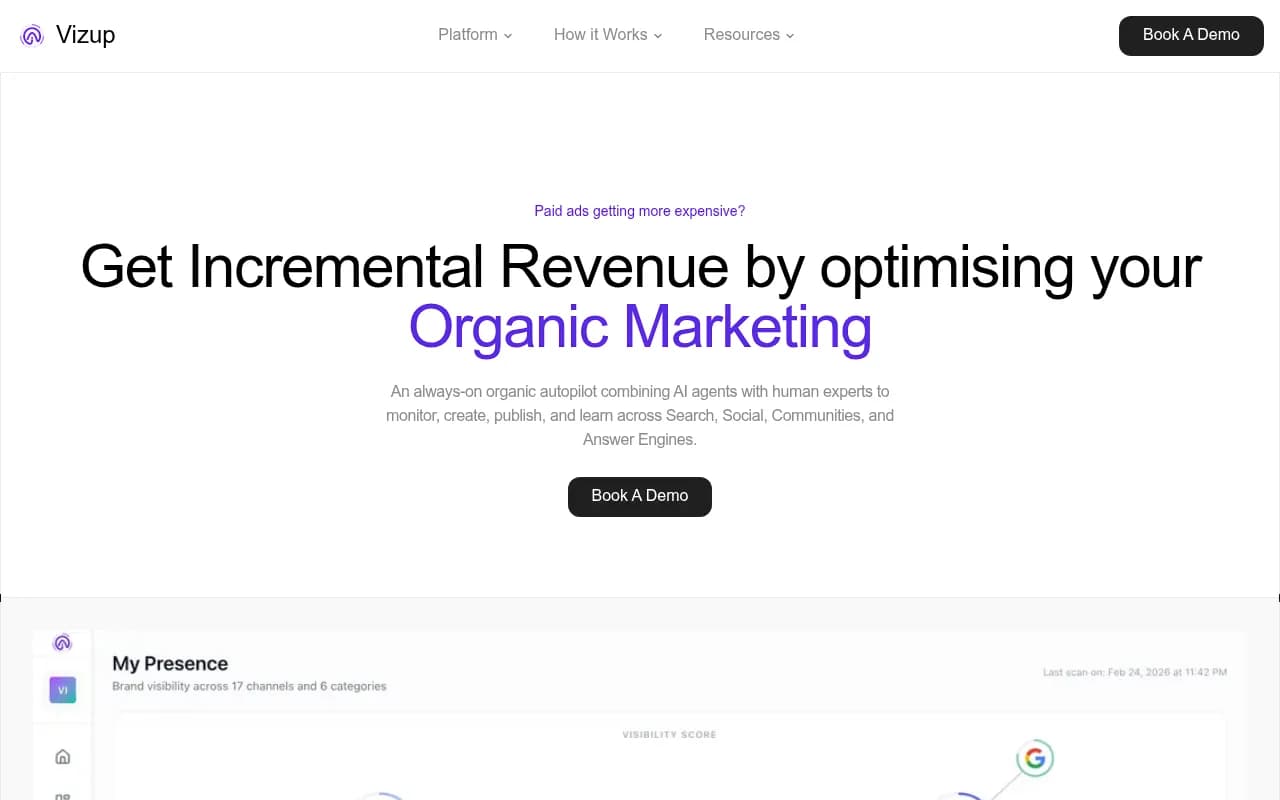
- Vizup positions itself as an "always-on organic autopilot" that combines AI agents with human experts to monitor, create, and publish content across search, answer engines, and social platforms.
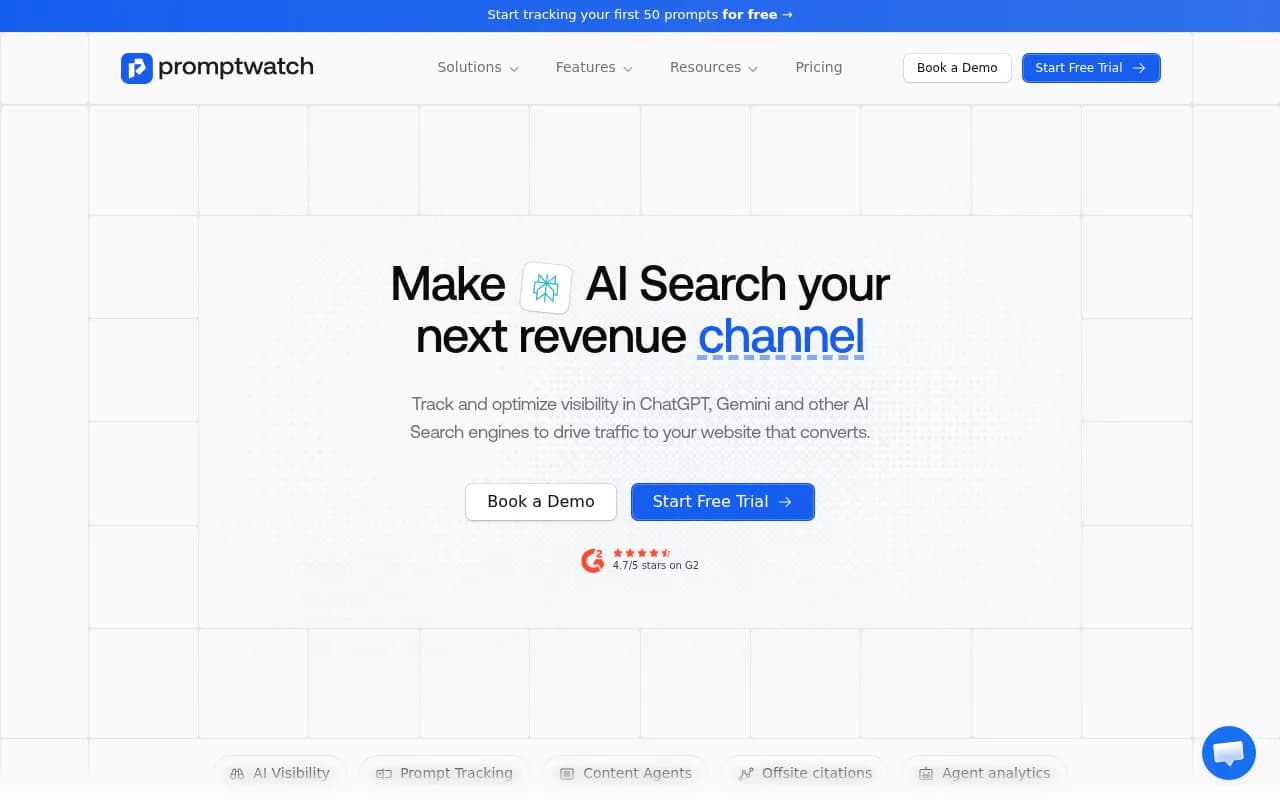
- Competes directly with Promptwatch in AI visibility monitoring -- but lacks Promptwatch's AI crawler logs, prompt volume/difficulty scoring, query fan-outs, ChatGPT Shopping tracking, page-level citation tracking, and traffic attribution tied to actual revenue.
- Strongest differentiator is its agentic execution layer: Vizup doesn't just surface insights, it claims to act on them by publishing content, fixing schema, and posting to communities.
- Pricing is not publicly listed; requires a demo booking, which makes it harder to evaluate for self-serve buyers.
- Best suited for growth-stage SaaS companies and digital brands that want a managed, done-for-you organic marketing system rather than a pure analytics dashboard.
Vizup is a relatively new entrant in the organic marketing automation space, built around the idea that most marketing teams are drowning in data but starved for execution. The platform describes itself as an "agentic AI" system -- meaning it uses AI agents that don't just report on what's happening but actually take action: publishing pages, fixing technical issues, posting to Reddit, and updating content. That's a bigger promise than most tools in this category make, and it's worth examining carefully.
The target audience is growth-focused marketing teams at SaaS companies and digital brands that are feeling the squeeze from rising paid ad costs and want to build durable organic channels. Vizup covers three main areas: traditional SEO, answer engine optimization (AEO) for AI models like ChatGPT and Gemini, and social/community presence on platforms like Reddit and LinkedIn. The combination is genuinely interesting -- most tools pick one lane and stay there.
The company appears to be early-stage, with a customer list that includes brands like Ceat, WanderOn, Scale.Jobs, and Smallest.ai. These are mostly growth-stage companies rather than enterprise names, which tells you something about where Vizup is in its own maturity curve. There's no public pricing, no listed funding, and the primary call to action is a demo booking -- all signs of a company still finding its go-to-market footing.
Key features
Watcher Agent -- cross-platform visibility monitoring The Watcher Agent continuously tracks brand visibility across Google Search, ChatGPT, Gemini, Perplexity, Claude, Reddit, and other platforms. It assigns visibility scores per channel, so you can see at a glance that your brand scores 8.5 on ChatGPT but only 4.2 on Google Search. This kind of cross-channel view is genuinely useful for teams that have historically optimized for Google alone and are now trying to understand their AI search footprint. The monitoring covers both traditional search rankings and AI-generated answers, which puts it in the same category as dedicated AEO tools.
Strategist Agent -- gap and opportunity analysis Once the Watcher Agent has collected data, the Strategist Agent processes it into actionable insights. The demo UI shows outputs like "Create new landing page for /pricing," "Add FAQ Schema for /product," and "Post a comment on r/OpenAI." This is the layer that turns raw visibility data into a prioritized to-do list. Whether the prioritization logic is sophisticated enough to consistently surface the highest-ROI actions is hard to verify without extended use, but the concept is sound.
Operator Agent -- execution and publishing This is where Vizup gets ambitious. The Operator Agent claims to act on the Strategist's recommendations by actually publishing content, fixing indexing issues, updating internal links, and posting to community platforms. The activity feed shown on the site includes entries like "Published page: Notion vs ClickUp," "Fixed indexing issue on /pricing," "Published comment on r/OpenAI," and "Earned backlink from AI tools blog." If this works as advertised, it's a meaningful step beyond what pure monitoring tools offer. The caveat is that automated community posting (Reddit, LinkedIn) carries real risks around authenticity and platform policy compliance.
Answer Engine Monitoring Vizup tracks brand mentions inside AI-generated responses across ChatGPT, Claude, Gemini, and Perplexity. The interface shows position rankings and mention percentages per model -- for example, "ChatGPT: Pos#1, 94%" and "Gemini: Not mentioned." This query-level tracking is the core of what makes Vizup relevant to the AEO space. However, based on the available information, it doesn't appear to include prompt volume or difficulty scoring, query fan-outs, or AI crawler log data -- capabilities that matter a lot for prioritizing which gaps to close first.
Content Engine (Programmatic SEO) Vizup generates comparison pages, FAQ content, long-tail articles, and other high-intent content at scale. The platform shows an SEO score of 92 for generated content and tracks word count and keyword density. The programmatic angle -- "Page 847 of 1,200" in the demo -- suggests it's built for teams that need to produce large volumes of structured content rather than one-off blog posts. This is a real capability gap that many monitoring-only tools don't address at all.
Brand Visibility Graph Vizup's proprietary model maps the connections between queries, platforms, content assets, and competitors into a single visibility system. The idea is to show not just where you rank but how visibility flows -- where it's created, where it's lost, and where competitors are capturing it. This is a more holistic framing than keyword-by-keyword tracking, though the actual depth of the graph model isn't fully verifiable from public materials.
Website Optimizer Identifies technical issues affecting search and AI visibility, including crawlability problems, missing or malformed schema markup, and AEO readiness gaps. The Operator Agent then claims to fix these issues automatically -- adding FAQ schema, fixing indexing errors, and updating page structure. This is a useful complement to the content generation side.
Digital Presence Monitoring Tracks brand mentions across social platforms, forums, blogs, and communities. Reddit appears to be a first-class channel here, which is smart given how heavily AI models like ChatGPT and Perplexity draw from Reddit discussions when forming answers.
Who is it for
Vizup's sweet spot is growth-stage SaaS companies and digital-first brands with small-to-mid-size marketing teams (roughly 2-10 people) that want to scale organic marketing without scaling headcount. Think a Series A SaaS company with one or two marketers who are responsible for SEO, content, and social simultaneously -- Vizup's "always-on autopilot" pitch speaks directly to that resource constraint. The customer logos on the site (Scale.Jobs, Smallest.ai, Bitscale) reinforce this profile.
It's also potentially interesting for founders who are doing their own marketing and need a system that can execute without constant supervision. The agentic framing -- agents that monitor, strategize, and act -- is appealing to anyone who's tried to maintain a consistent content and SEO operation while also running a product.
Industries where Vizup seems to fit well include SaaS, e-commerce (FloMattress, Amrutam are on the customer list), and travel/lifestyle brands. The content engine's focus on comparison pages and FAQ clusters maps well to high-consideration purchase categories where buyers research extensively before converting.
Who should probably look elsewhere: large enterprise marketing teams with complex governance requirements will find the automated publishing and community posting features risky without more control. Pure SEO agencies managing dozens of client sites will likely want more granular reporting and white-label capabilities than Vizup appears to offer. And teams that primarily need deep AI visibility analytics -- prompt-level data, crawler logs, traffic attribution -- will find Vizup's monitoring layer thinner than dedicated platforms built specifically for that use case.
Integrations and ecosystem
Vizup connects with Google Search Console and Google Analytics, which are the baseline integrations any SEO tool needs. The Brand Visibility Graph visualization shows these alongside Gemini and Reddit as data sources. Beyond that, the site mentions "Custom Integrations" to connect with your CMS and marketing stack, but doesn't name specific tools.
There's no mention of a public API, which limits how much you can build on top of Vizup's data or pipe it into custom reporting workflows. For teams that rely heavily on Looker Studio dashboards or custom data pipelines, this is worth asking about before committing.
The free tools section (Schema Builder, Sitemap Checker, AI Humanizer, AI Content Checker, Prompt Library) is a nice addition -- these are genuinely useful standalone utilities that also serve as a top-of-funnel entry point for the platform.
Social presence is primarily on LinkedIn. No Twitter/X profile was found in the research, which is a bit unusual for a marketing technology company.
Pricing and value
Vizup doesn't publish pricing publicly. The only path to pricing information is booking a demo, which is a friction point for self-serve buyers who want to evaluate cost before investing time in a sales conversation. Third-party coverage suggests "tiered plans that are reachable for mid-market teams," but no specific numbers are available.
This opacity makes direct price comparisons difficult. For reference, dedicated AEO monitoring tools in this space range from around $99/month at the entry level to $500+/month for more comprehensive platforms. If Vizup is positioning as a full-stack organic marketing system (monitoring + content generation + execution), it would need to justify a higher price point than pure monitoring tools -- but without public pricing, it's impossible to assess value objectively.
The free tools (Schema Builder, Sitemap Checker, etc.) provide a no-commitment way to experience part of the Vizup ecosystem, which is a reasonable approach for a company still building brand awareness.
Strengths and limitations
What Vizup does well:
- The agentic execution layer is genuinely differentiated. Most tools in this space stop at "here's what's wrong." Vizup claims to fix it, which is a meaningful step forward if it works reliably.
- Cross-channel coverage (SEO + AEO + social/community) in a single platform reduces the tool sprawl that plagues marketing teams juggling multiple point solutions.
- The programmatic content engine for comparison pages and FAQ clusters addresses a real need that monitoring-only tools ignore entirely.
- Reddit as a first-class channel is smart -- it's one of the most influential sources for AI-generated answers, and most tools treat it as an afterthought.
Honest limitations:
- Missing depth vs. dedicated AEO platforms: Compared to Promptwatch, Vizup appears to lack AI crawler logs (which show exactly when and how AI bots crawl your pages), prompt volume and difficulty scoring, query fan-outs, ChatGPT Shopping tracking, page-level citation tracking, and traffic attribution that connects AI visibility to actual revenue. These aren't minor gaps -- they're the difference between knowing you're visible and knowing why, and being able to prove the ROI.
- No public pricing makes it hard to evaluate without a sales conversation, which filters out a lot of self-serve buyers who are the natural audience for a tool like this.
- Automated community posting carries risk. Posting to Reddit and LinkedIn on behalf of a brand via AI agents is a genuinely tricky area -- Reddit in particular has strong community norms around authenticity, and automated posts can backfire badly if they read as spam.
- Early-stage customer base means there's limited independent evidence of the platform's effectiveness at scale. The customer logos are real companies, but they're not the kind of names that signal enterprise-grade reliability.
- No API or Looker Studio integration (at least not publicly documented) limits extensibility for data-driven teams.
Bottom line
Vizup is an interesting bet for growth-stage SaaS and e-commerce brands that want a single system to handle SEO, AEO, and social visibility without building a large in-house team. The agentic execution angle -- actually publishing content and fixing issues, not just flagging them -- is the most compelling part of the pitch, and if it delivers consistently, it addresses a real gap in the market.
That said, teams whose primary need is deep AI search visibility analytics -- understanding exactly which prompts drive citations, how AI crawlers interact with their site, and how to attribute organic revenue to AI channels -- will find Vizup's monitoring layer less comprehensive than purpose-built platforms. Promptwatch covers that ground more thoroughly, with AI crawler logs, prompt volume scoring, query fan-outs, ChatGPT Shopping tracking, and traffic attribution that Vizup doesn't appear to offer.
Best use case: A 3-5 person marketing team at a growth-stage SaaS company that wants an always-on system to monitor AI and search visibility, generate comparison and FAQ content at scale, and execute fixes without hiring more people.
Tags:
Frequently asked questions
What is Vizup?
Who is Vizup built for?
How much does Vizup cost?
How does Vizup compare to Promptwatch for AI visibility?
Which AI models does Vizup monitor?
Does Vizup have a free plan or free tools?
Similar and alternative tools to Vizup