Key takeaways
- Promptwatch is an AI search visibility specialist -- every feature exists to help you rank in ChatGPT, Perplexity, Gemini, and similar platforms. Orchly is a broader SEO + AEO platform that covers traditional Google SEO alongside AI search.
- Orchly starts at $49/mo vs Promptwatch's $99/mo, so if budget is tight and you need general SEO coverage too, Orchly is the cheaper entry point.
- Promptwatch tracks 10 AI models with real user-interface data (not just API outputs), AI crawler logs, ChatGPT Shopping, and prompt volume/difficulty scoring -- none of which Orchly matches in depth.
- Orchly's autonomous agent system is genuinely different: it runs tasks like writing articles, fixing broken links, doing Reddit outreach, and scheduling content refreshes -- all in a kanban-style workflow. Promptwatch's content generation is more focused but less autonomous.
- If your primary goal is understanding and improving how AI models cite your brand, Promptwatch is the more specialized and data-rich choice. If you want one tool to handle SEO, AEO, content, and technical fixes together, Orchly is worth a serious look.
- Both tools offer free trials, so you can test them before committing.
Overview
Promptwatch
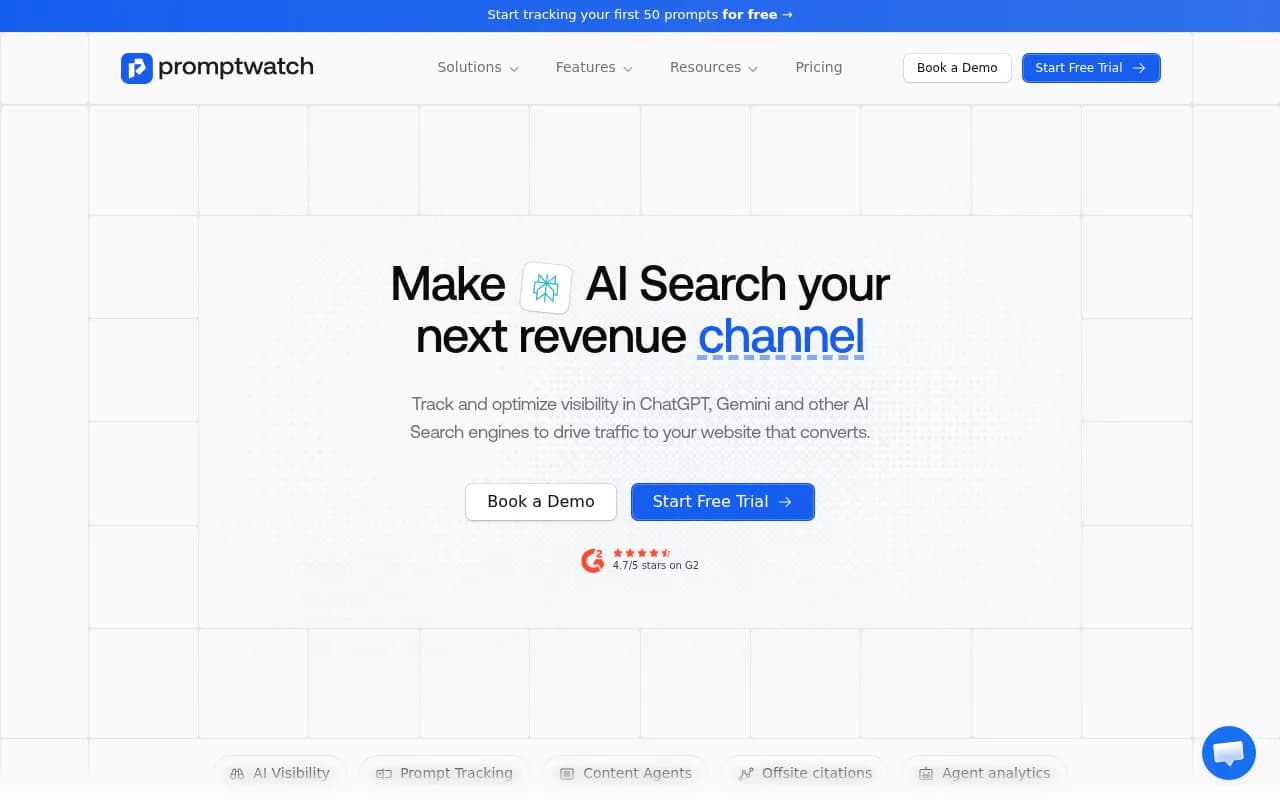
Promptwatch is an end-to-end GEO (Generative Engine Optimization) platform built specifically around AI search visibility. The core idea is a three-step loop: find the prompts where competitors are visible but you're not, generate content that fills those gaps, then track whether AI models start citing your new pages. It monitors 10 AI engines -- ChatGPT, Perplexity, Gemini, Claude, Google AI Overviews, Google AI Mode, Grok, DeepSeek, Copilot, and Meta AI -- using real user-interface data rather than just API calls. That distinction matters because what AI models show in their actual interfaces often differs from what the API returns.
The platform is used by 1,480+ brands and agencies including Booking.com, Duolingo, Typeform, and Yelp, and has processed over 4.5 billion citations and prompts. It holds a 4.7/5 rating on G2.
Orchly
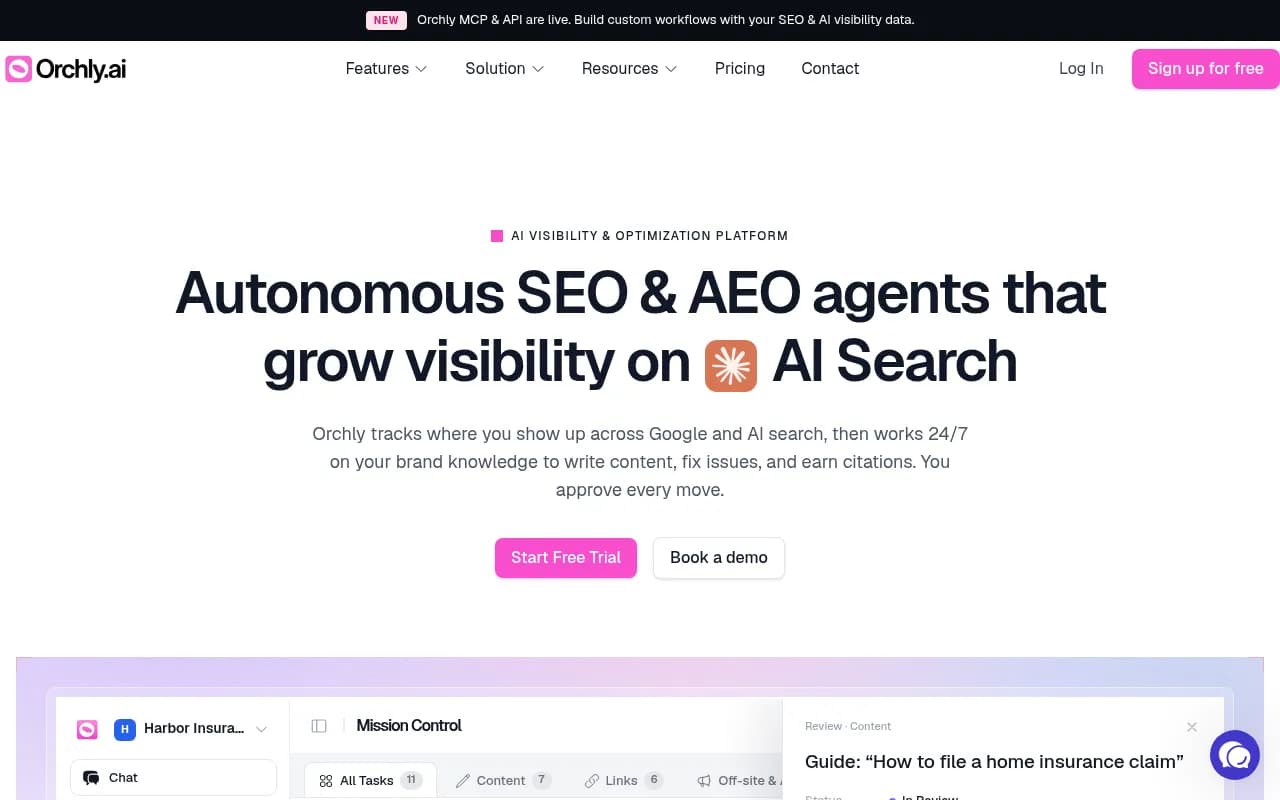
Orchly takes a different angle. It's an autonomous SEO and AEO agent platform -- the headline feature is a "Mission Control" dashboard where AI agents run 24/7 on tasks like writing articles, fixing broken links, doing Reddit outreach, building backlinks, and refreshing old content. You approve every move before it goes live, but the agents surface the opportunities and do the legwork.
Orchly covers both traditional Google SEO and AI search visibility, which makes it a broader tool. It recently launched an MCP and API, letting teams build custom workflows on top of its SEO and AI visibility data. Pricing starts at $49/mo with a 7-day free trial.
Side-by-side comparison
| Feature | Promptwatch | Orchly |
|---|---|---|
| Primary focus | AI search visibility (GEO) | SEO + AEO (broader) |
| AI models tracked | 10 (ChatGPT, Perplexity, Gemini, Claude, Grok, DeepSeek, Copilot, Meta AI, Google AI Overviews, Google AI Mode) | AI search + Google (specific models not fully documented) |
| Free tier / trial | Free trial (50 prompts) | 7-day free trial |
| Starting price | $99/mo | $49/mo |
| Content generation | Yes -- AI Content Agents grounded in citation/prompt data | Yes -- autonomous Article Writer agent |
| Autonomous agents | No (human-directed workflow) | Yes -- runs 24/7, you approve tasks |
| AI crawler logs | Yes -- real-time logs per page | Not documented |
| Prompt volume & difficulty | Yes | Not documented |
| Query fan-outs | Yes | Not documented |
| Technical SEO fixes | No | Yes -- Technical SEO agent |
| Link building / outreach | No | Yes -- Outreach Agent, Link Agent |
| Reddit tracking/outreach | Monitoring only | Active Reddit Agent (replies, monitors threads) |
| ChatGPT Shopping tracking | Yes | Not documented |
| Offsite citation analysis | Yes | Not documented |
| Multi-language / multi-region | Yes | Not documented |
| API / integrations | Yes -- Looker Studio, GSC, Cloudflare, Fastly, Vercel | Yes -- MCP & API |
| Agency tier | Yes -- custom pricing | Not explicitly documented |
| G2 rating | 4.7/5 | Not listed |
Head-to-head feature deep-dive
AI model coverage
Promptwatch tracks 10 AI models and does so using real user-interface data -- meaning it simulates how actual users interact with ChatGPT, Perplexity, etc., rather than just hitting the API. This matters because AI models sometimes give different answers in their consumer interfaces than through the API, especially for shopping recommendations and local results.
Orchly tracks AI search visibility but the specific model coverage isn't as clearly documented. Based on the platform's positioning, it covers the major AI search engines, but the depth of per-model breakdowns and the methodology (UI vs API) isn't as transparent.
Verdict: Promptwatch wins on AI model depth and data methodology transparency.
Autonomous agents vs directed workflow
This is the biggest philosophical difference between the two tools.
Orchly's Mission Control is genuinely interesting. You get a kanban board of tasks generated by autonomous agents -- an Article Writer, Link Agent, Reddit Agent, Technical SEO agent, Content Refresh agent, and Outreach Agent. The agents identify opportunities (31 in the demo screenshot), prioritize them, and queue up work. You review and approve before anything goes live. It's closer to having an AI-powered SEO team running in the background.
Promptwatch's workflow is more human-directed. You set up prompts to track, review the Answer Gap Analysis to see where competitors are visible and you're not, then use Content Agents to generate articles targeting those gaps. It's deliberate and data-driven, but you're driving the process rather than approving a queue.
Neither approach is objectively better -- it depends on your team. If you want to stay in control and make strategic decisions based on data, Promptwatch's model fits. If you want the tool to surface and execute opportunities with minimal input, Orchly's agent system is genuinely useful.
Verdict: Tie -- depends on your workflow preference. Orchly for autonomous execution, Promptwatch for strategic control.
Content generation
| Dimension | Promptwatch | Orchly |
|---|---|---|
| Content types | Articles, listicles, comparisons, briefs | Articles, guides, comparisons, content refreshes |
| Data grounding | Prompt data, citation data, competitor analysis, screenshots, brand guidance | Brand knowledge base, SEO data, AI visibility data |
| Scheduling | Manual | Autonomous scheduling with approval |
| Technical SEO content | No | Yes (content refresh agent) |
| Reddit content | No | Yes (Reddit Agent writes replies) |
Promptwatch's Content Agents are specifically engineered to fill AI citation gaps -- the content is grounded in real prompt data, which pages competitors are getting cited for, and what questions AI models are already answering. The output is targeted at winning AI search citations, not just ranking on Google.
Orchly's content generation is broader. The Article Writer agent handles standard SEO content, but it also has a Content Refresh agent for updating old pages and a Reddit Agent that can draft replies to relevant threads -- a channel that genuinely influences AI recommendations and that most tools ignore.
Verdict: Promptwatch for AI-citation-targeted content. Orchly for volume and variety of content tasks.
Prompt intelligence and gap analysis
Promptwatch's Answer Gap Analysis is one of its strongest features. It shows you the specific prompts where competitors are getting cited but your site isn't -- not just "you're missing coverage on topic X" but the exact questions AI models are answering with competitor content. Each prompt comes with volume estimates and difficulty scores, so you can prioritize the gaps that are actually worth filling.
Query fan-outs extend this further: one prompt branches into sub-queries, and Promptwatch maps that tree so you understand the full scope of a topic before you create content.
Orchly identifies content opportunities too, but the intelligence layer is less documented. The platform surfaces "31 opportunities" in its demo, but the methodology for how those are scored and prioritized isn't as transparent as Promptwatch's prompt volume and difficulty data.
Verdict: Promptwatch is clearly ahead on prompt intelligence and gap analysis depth.
Technical SEO and link building
This is where Orchly has a real advantage. Promptwatch doesn't do technical SEO at all -- no broken link detection, no page speed analysis, no backlink outreach. It's purely focused on AI visibility.
Orchly's Technical SEO agent handles things like fixing broken links, identifying slow LCP pages, and flagging site health issues. The Link Agent manages internal linking. The Outreach Agent targets backlink opportunities on sites like NerdWallet. These are real SEO tasks that Promptwatch simply doesn't cover.
If you're running a site that needs both traditional SEO maintenance and AI visibility work, Orchly covers more ground in a single tool.
Verdict: Orchly wins clearly -- Promptwatch doesn't compete here.
AI crawler logs and attribution
Promptwatch's AI Crawler Logs are a feature most competitors don't have at all. You get real-time logs of AI crawlers (ChatGPT, Claude, Perplexity, etc.) hitting your website -- which pages they read, errors they encounter, how often they return, and the timeline from crawl to citation. You can connect via Cloudflare, Fastly, Vercel, server logs, Google Search Console, or a tracking snippet.
This is genuinely useful for diagnosing why certain pages aren't getting cited. If an AI crawler is hitting your page but it's not showing up in citations, you can see exactly what happened.
Orchly doesn't document equivalent crawler log functionality.
Verdict: Promptwatch wins -- crawler logs are a meaningful differentiator.
Pricing
| Plan | Promptwatch | Orchly |
|---|---|---|
| Free / trial | Free trial (50 prompts) | 7-day free trial |
| Essential | $99/mo | $49/mo |
| Professional / Pro | $249/mo | $125/mo |
| Business | $579/mo | -- |
| Enterprise | Custom | Custom |
Orchly is roughly half the price of Promptwatch at each tier. For teams on a tight budget who need both SEO and AI visibility coverage, that's a meaningful difference. Promptwatch's higher price reflects its specialization -- you're paying for deeper AI-specific data, crawler logs, prompt intelligence, and 10-model coverage.
Annual billing discounts are available on both platforms.
Pros and cons
Promptwatch
Pros:
- Deepest AI search visibility coverage available -- 10 models, real UI data, not just API
- AI Crawler Logs show exactly how AI engines discover and cite your content
- Prompt volume and difficulty scoring helps prioritize what to work on
- Content Agents generate content specifically engineered to fill AI citation gaps
- Offsite citation analysis, ChatGPT Shopping tracking, Reddit/YouTube insights
- Strong agency tier with multi-site, multi-language, multi-region support
- 4.7/5 on G2, used by recognizable brands
Cons:
- More expensive than Orchly at every tier
- No traditional SEO features (technical audits, link building, backlinks)
- Workflow is human-directed -- no autonomous agent execution
- Overkill if you primarily need Google SEO and only want basic AI tracking
Orchly
Pros:
- Autonomous agents run 24/7 and surface prioritized opportunities
- Covers both Google SEO and AI search in one tool
- Technical SEO agent handles broken links, page speed, site health
- Reddit Agent actively monitors and drafts replies to relevant threads
- Outreach Agent targets backlink opportunities
- Cheaper entry point ($49/mo vs $99/mo)
- MCP and API for custom workflow integrations
Cons:
- AI model coverage depth and methodology less transparent than Promptwatch
- No documented AI crawler logs
- No prompt volume/difficulty scoring or query fan-outs
- No ChatGPT Shopping tracking
- Autonomous agent model means less direct control over prioritization
- Newer platform with less documented track record and customer base
Who should pick which tool
Pick Promptwatch if:
- AI search visibility is your primary goal and you want the most detailed data available
- You need to understand exactly which prompts competitors are winning and why
- Crawler logs and citation attribution matter to your reporting
- You're an agency managing multiple brands' AI visibility
- You want content generation grounded specifically in AI citation data
- You're tracking ChatGPT Shopping, entity mentions, or offsite citations
Pick Orchly if:
- You want one tool to handle both traditional SEO and AI search visibility
- You like the idea of autonomous agents surfacing and executing tasks
- Budget is a constraint and $49/mo is more workable than $99/mo
- You need technical SEO fixes alongside content and visibility work
- Reddit outreach and link building are part of your strategy
- You want an MCP/API to build custom workflows on top of SEO data
Consider both if:
- You have a larger team where one person owns AI visibility (Promptwatch) and another owns SEO execution (Orchly)
- You want Promptwatch's depth for AI citation intelligence and Orchly's agents for content production and technical maintenance
Final verdict
These two tools are less direct competitors than they first appear. Promptwatch is the more specialized and data-rich choice for teams whose primary concern is AI search visibility -- it goes deeper on every AI-specific dimension and the crawler logs alone are worth the price difference for serious GEO work. Orchly is the better pick if you want a single autonomous platform that handles the full SEO and AEO stack, including the technical and outreach work that Promptwatch doesn't touch.
If AI citations, prompt tracking, and GEO optimization are the core of your strategy, Promptwatch is the stronger tool. If you're building out a broader content and SEO operation and want AI visibility as one piece of it, Orchly's agent-driven workflow at a lower price point makes a compelling case.