Rankability Review 2026
Content optimization platform built for agencies, with AI-assisted content briefs, on-page SEO scoring, and competitor content analysis.
Key takeaways
- Rankability targets digital agencies managing multiple clients who need to track and report AI search visibility alongside traditional SEO rankings.
- Compared to Promptwatch, Rankability lacks AI crawler logs, answer gap analysis, AI traffic attribution, Reddit/YouTube tracking, ChatGPT Shopping tracking, prompt volume/difficulty scoring, and query fan-outs -- it's primarily a monitoring and content optimization tool without the deep optimization action loop.
- Pricing starts at $99/month with unlimited clients and users on every plan, which is genuinely agency-friendly.
- Content optimization features (briefs, on-page scoring, AI writing) are a real differentiator for agencies that want to combine visibility tracking with content production.
- Local rank tracking is included, which is useful for agencies serving brick-and-mortar or service-area businesses.
- Reporting is designed to be client-facing, which saves agencies time on deliverables.
Rankability is a web-based platform built specifically for digital marketing agencies that need to manage SEO and AI search visibility across multiple client accounts. The pitch is straightforward: as more of your clients' customers turn to ChatGPT, Perplexity, and Google AI Overviews instead of traditional search, agencies need a way to track that visibility, optimize content for it, and report on it in a way clients actually understand. Rankability tries to be the single platform that covers all three.
The company has been positioning itself in the agency market for a few years, originally as an SEO content optimization tool (think Surfer SEO or Clearscope territory), and has since expanded into AI search monitoring. That heritage shows in the product -- the content brief and on-page optimization features feel mature and polished, while the AI search tracking side is newer but functional. Agencies like Timmermann Group, iFrog Marketing Solutions, and Kickstart Digital Marketing are listed as customers, which gives a sense of the typical buyer: mid-size agencies with anywhere from a handful to dozens of active SEO clients.
The target audience is pretty specific. This isn't a tool for solo consultants running a few sites, and it's not enterprise software either. It's for agencies that have a content team, sell SEO as a service, and are starting to get questions from clients about AI search. The unlimited clients and unlimited users model on every plan is a deliberate choice to fit that use case -- you're not paying per seat or per client, just per credit volume.
Key features
AI search visibility tracking
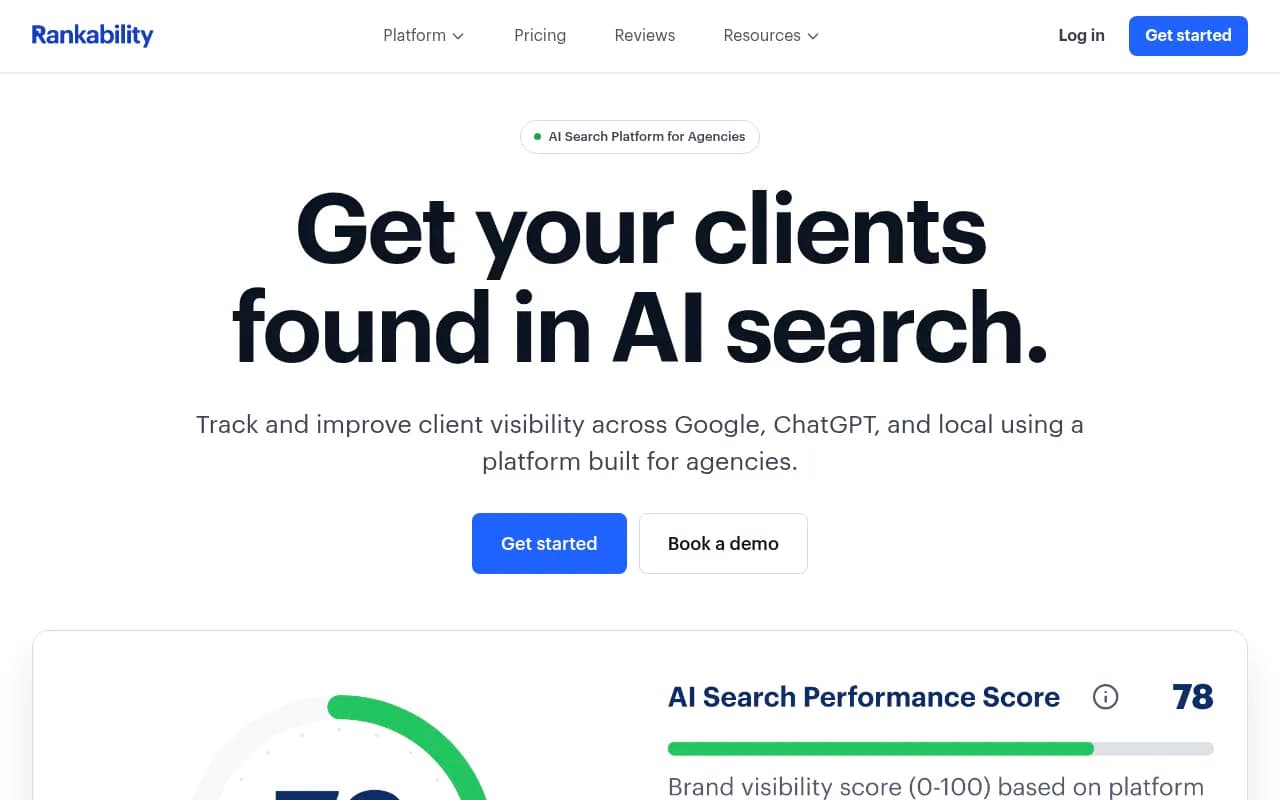
Rankability monitors brand mentions, citations, and rankings across ChatGPT, Perplexity, Google AI Mode, Gemini, Claude, Copilot, and Grok. You set up prompts relevant to each client, and the platform tracks whether and how that client appears in AI-generated answers. The dashboard shows a "Search Performance Index" (SPI) score that aggregates visibility across platforms, which gives clients a single number to point to rather than a wall of data. Competitor tracking is included, so you can show clients where they're winning or losing against named competitors in AI answers.
Local rank tracking
This is one of the more distinctive features for an AI search tool. Rankability tracks local map pack rankings alongside AI visibility, which matters a lot for agencies serving restaurants, dental practices, law firms, and other location-based businesses. Being able to show a client their Google Maps position and their ChatGPT mention rate in the same report is genuinely useful -- most AI visibility tools ignore local entirely.
Content optimization and briefs
The content side of Rankability is where the product has the most depth. You can generate content briefs based on competitor analysis and on-page SEO signals, then score content against those briefs before publishing. The scoring covers crawling and indexing signals, on-page structure, content quality, UX and performance indicators, trust and authority factors, and what Rankability calls "agentic search readiness" -- a newer category that tries to assess how well a page is structured for AI answer engines. Users on G2 and Capterra consistently mention this as faster and easier than Surfer SEO, which is a reasonable comparison point.
AI content writing
Rankability includes an AI writing tool that works within the brief and optimization workflow. You configure a brief, then use the AI writer to produce or improve content that's already aligned with the SEO targets. This isn't a standalone AI writer -- it's integrated into the optimization loop, which is the right approach. The output is meant to be SEO-ready rather than generic.
Client reporting
Reports are designed to be handed directly to clients without heavy editing. The SPI score, competitor rankings over time, ranking changes, and platform-by-platform breakdowns are all included in a format that non-technical clients can read. This is a real time-saver for agencies that currently spend hours building custom reports in Google Slides or Data Studio.
Multi-client workspace
Every plan supports unlimited clients and unlimited users, which is the right model for agencies. You can run campaigns for 5 clients or 50 from one workspace, with accounts, campaigns, competitors, and reports organized per client. This is a meaningful difference from tools priced per seat or per domain.
Academy and onboarding resources
Rankability includes an "Academy" -- training content and playbooks for agencies that want to sell AI search visibility as a service. This is more than just documentation; it's positioned as a way to help agencies build a new service line. Whether this is genuinely useful depends on how much content is actually there, but the intent is to reduce the ramp-up time for agencies new to AI search.
Prompt tracking and share of voice
You can track specific prompts relevant to each client and monitor share of voice across those prompts over time. This gives agencies a way to show progress -- if a client's share of voice in AI answers for their key prompts goes from 20% to 40% over a quarter, that's a reportable win. The depth of prompt analytics (volume estimates, difficulty scoring, query fan-outs) is more limited than dedicated GEO platforms, but it covers the basics.
Who is it for
The clearest fit is a digital marketing agency with 5 to 50 active SEO clients that's starting to field questions about AI search from clients. If you're already selling content optimization and traditional SEO, Rankability lets you add AI visibility tracking to the same workflow without switching platforms. The unlimited-client model means you're not penalized for growing your client roster.
Agencies serving local businesses -- dental practices, law firms, home services, restaurants -- will find the local rank tracking particularly useful. Being able to combine local map pack data with AI mention tracking in one client report is something most competitors don't offer. An agency managing 20 local service businesses can show each client a unified picture of their search presence without stitching together data from multiple tools.
The content team angle is also real. Agencies that have writers producing SEO content regularly will get value from the brief generation and on-page scoring features. If your writers are currently using Surfer SEO or Clearscope, Rankability is a credible alternative that also covers AI visibility -- consolidating two tool costs into one.
Who should probably look elsewhere: enterprise brands managing their own AI visibility in-house, solo consultants who don't need multi-client infrastructure, and teams that need deep prompt analytics (volume data, difficulty scoring, query fan-outs) or AI crawler log analysis. If you need to understand why AI models are or aren't citing your content at a technical level, Rankability's monitoring is surface-level compared to more specialized platforms.
Integrations and ecosystem
Rankability is a web-based platform with no mobile app. The FAQ confirms it's browser-only, which is standard for this category. There's no public API mentioned in the available documentation, which limits custom reporting or workflow automation for agencies with more technical needs.
The platform doesn't appear to have native integrations with Google Search Console, Google Analytics, or major CRM tools based on available information. For agencies that want to pull GSC data alongside AI visibility metrics, this is a gap -- you'd need to manage those data sources separately.
There's no mention of Zapier, Make, or other automation platform integrations, which means agencies can't easily pipe Rankability data into their existing reporting stacks without manual export. The built-in client reporting is designed to compensate for this, but it's a limitation for agencies with custom reporting workflows.
Pricing and value
Rankability's pricing is structured around credit volume, with every plan including unlimited clients and unlimited users. Based on available information:
- Starter: $99/month -- entry-level credit volume, full platform access
- Higher tiers are available with more monthly credits
The exact credit volumes and higher-tier prices aren't fully detailed in the scraped content, but the pricing page lists all options. All plans can be canceled anytime, and there's no mention of a free trial -- you go straight to a paid plan or book a demo.
The unlimited-clients-and-users model is genuinely good value for agencies. Most competitors charge per seat or per domain, which gets expensive fast when you're managing 20+ clients. At $99/month for a starter plan with no per-client fees, the math works for small agencies. The main question is whether the credit limits on the starter plan are sufficient for real agency workloads -- content briefs and AI tracking queries both consume credits, so high-volume agencies will likely need a higher tier.
Compared to Surfer SEO (which starts around $89/month but charges per article and per user) or Clearscope (which starts at $170/month), Rankability's pricing model is more agency-friendly. Compared to dedicated AI visibility platforms, it's competitive at the entry level.
Strengths and limitations
What Rankability does well:
- The unlimited clients and users model is genuinely agency-friendly and removes a common pain point with per-seat pricing
- Content brief and on-page optimization features are mature and well-reviewed by actual users -- faster and easier than Surfer SEO according to multiple G2 reviews
- Local rank tracking alongside AI visibility is a real differentiator for agencies serving location-based businesses
- Client-facing reporting is designed to be handed over without editing, which saves agencies meaningful time
- The combined content optimization + AI tracking workflow reduces tool sprawl for agencies that currently use separate tools for each
Honest limitations:
- No AI crawler logs -- you can't see which AI crawlers are hitting client sites, which pages they're reading, or what errors they're encountering. This is a significant gap for agencies that want to understand why a client isn't being cited.
- No answer gap analysis or content gap identification at the prompt level -- Rankability shows you where you stand but doesn't systematically surface which prompts competitors rank for that you don't. Platforms like Promptwatch have dedicated Answer Gap Analysis that identifies specific content gaps and then generates content to fill them.
- No AI traffic attribution -- you can't connect AI visibility to actual website traffic or revenue, which limits the ROI story you can tell clients.
- No Reddit or YouTube tracking -- AI models frequently cite Reddit threads and YouTube videos in their answers, and Rankability doesn't surface these as optimization opportunities.
- No ChatGPT Shopping tracking -- for e-commerce clients, this is a growing blind spot.
- Prompt analytics are basic -- no volume estimates, difficulty scoring, or query fan-outs to help agencies prioritize which prompts to target first.
- No public API or major third-party integrations, which limits agencies with custom reporting needs.
Bottom line
Rankability is a solid choice for digital marketing agencies that want to add AI search visibility tracking to an existing SEO and content workflow without switching platforms or paying per client. The content optimization features are genuinely good, the local tracking is a real differentiator, and the pricing model fits how agencies actually operate.
That said, it's primarily a monitoring and content optimization tool. If your agency needs to go deeper -- understanding why clients aren't being cited, identifying specific content gaps from prompt data, generating content engineered to fill those gaps, or connecting AI visibility to traffic and revenue -- you'll hit the ceiling quickly. For that level of optimization, Promptwatch covers the full action loop from gap identification through content generation to result tracking, which Rankability doesn't.
Best for: Mid-size digital agencies (5-50 clients) that want a single platform for content optimization, local rank tracking, and AI search visibility reporting without per-client fees.
Frequently asked questions
What is Rankability?
How much does Rankability cost?
Is there a free trial for Rankability?
Who is Rankability best for?
How does Rankability compare to Surfer SEO?
Does Rankability track local SEO rankings?
Similar and alternative tools to Rankability