Atomic AGI Review 2026
Platform for automating content workflows and scaling production using AI agents, positioned as a simpler alternative for teams that find AirOps complex.
Key takeaways
- Atomic AGI combines traditional Google SEO analytics with AI search visibility tracking across 10 LLMs, making it one of the more comprehensive all-in-one options for teams that want both in a single dashboard
- Lacks key optimization capabilities compared to Promptwatch: no Answer Gap Analysis, no AI content generation agents, no AI crawler logs, no prompt volume/difficulty scoring, and no query fan-out data -- Atomic is primarily a monitoring and analytics platform, not an optimization engine
- Strong technical SEO suite (site audits, LLM audit, URL indexing, interlinking analysis) that most pure-play GEO tools skip entirely
- AI agents and workflow automation are available but appear to be in early stages, with some features still marked "coming soon"
- Rated 4.8-4.9 on G2 with a small but enthusiastic user base; customers include Booking.com, Accenture, Loom, and Samsung employees
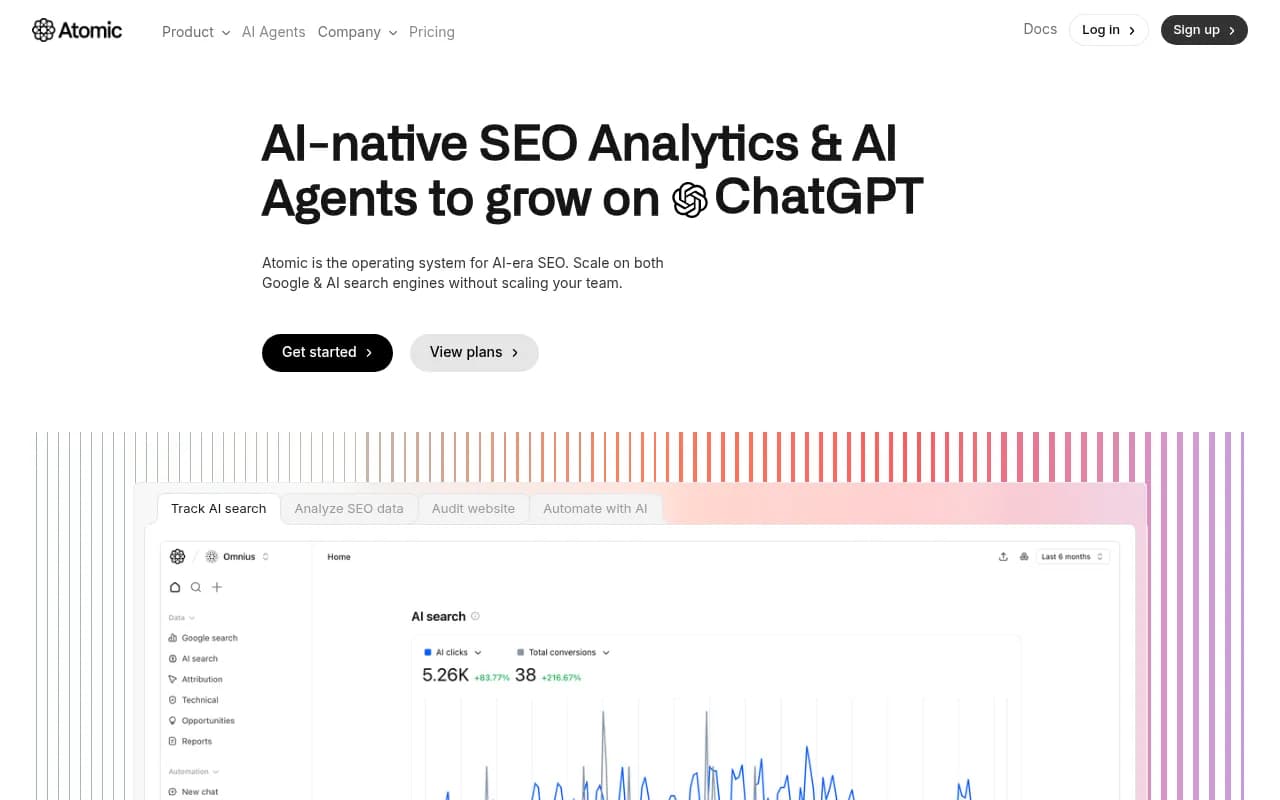
Atomic AGI positions itself as the "operating system for AI-era SEO" -- a single platform where you can track Google rankings, monitor brand visibility across AI search engines, audit your site's technical health, and automate repetitive SEO tasks with AI agents. It's a genuinely ambitious scope. Most tools in this space pick one lane: either traditional SEO analytics or AI search monitoring. Atomic is trying to do both, plus add automation on top.
The company appears to be a relatively young startup, with the product still actively evolving. Some features are labeled "coming soon" on the homepage, and the YouTube channel has fewer than 25 subscribers as of mid-2026. That said, the customer logos on the site -- Booking.com, Accenture, Loom, Payoneer, Samsung, MIT -- suggest real enterprise traction, even if the brand itself is still building awareness.
The target audience is SEO teams and marketing managers who are tired of stitching together Google Search Console, a separate AI visibility tracker, a technical audit tool, and a reporting dashboard. Atomic's pitch is that fragmented tools create fragile workflows, and that unifying everything in one place lets smaller teams punch above their weight.
Key features
AI search tracking across 10 engines
Atomic monitors brand visibility across ChatGPT, Perplexity, Google Gemini, Claude, DeepSeek, Copilot, xAI Grok, Meta Llama, Qwen, and Mistral. For each engine, it tracks visibility percentage, average position in AI responses, citation share, and actual click-through to your website. The platform also captures "recent chat examples" -- real AI conversation snippets where your brand appears -- which is useful for understanding how models actually describe you, not just whether they mention you.
Prompt tracking and visibility scoring
You can monitor specific prompts and queries that trigger mentions of your brand in AI responses. The system categorizes prompts by intent stage (Awareness, Consideration, Decision) and shows which AI engines return your brand for each query. This is useful for prioritizing optimization efforts. However, unlike some competitors, Atomic doesn't appear to offer prompt volume estimates or difficulty scoring -- you can see your visibility for a prompt, but not how many people are actually searching that prompt across AI engines.
AI search sentiment analysis
Atomic analyzes the tone and context of AI-generated answers that mention your brand, classifying sentiment as positive or negative and grouping responses into recurring themes. Each sentiment signal is linked to the source the AI model relied on. This is a genuinely useful feature for brand managers who want to know not just whether AI mentions them, but whether those mentions are favorable.
Citation tracking and source analysis
The citations feature shows which specific pages and domains AI engines cite when responding to your tracked prompts. It categorizes citations by type: your brand, competitors, user-generated content, corporate sites, and reference sources. You can see citation share by domain over time and identify which external sources AI models consider authoritative for your industry. This helps answer the question "where should I publish to earn more citations?" -- though Atomic stops short of actually helping you create that content.
Google SEO analytics (GSC + GA4 integration)
On the traditional SEO side, Atomic connects to Google Search Console and Google Analytics 4 to pull keyword rankings, landing page performance, conversion attribution, referring domains, geographic data, and device breakdowns. The attribution feature is particularly useful: it shows which traffic sources (including AI platforms like ChatGPT and Perplexity) drive actual conversions, not just visits. This cross-channel attribution in a single view is something most standalone GEO tools don't offer.
Technical SEO audit
Atomic runs automated site crawls that check for indexability issues, meta tag problems, missing alt text, sitemap errors, and more. The site health score tracks improvements over time. What's interesting is the separate LLM Audit, which evaluates your site specifically from an AI crawler's perspective -- checking crawlability, trust signals, content structure, HTML readability, and organic backlinks as they relate to AI citation potential. Most traditional SEO audit tools don't have this.
URL indexing management
You can track the indexing status of every URL on your site, bulk-load URLs from your sitemap, and request indexing for specific pages directly through the Atomic interface. This is a practical time-saver for teams managing large sites where indexing gaps are common.
Internal linking analysis
The interlinking feature maps your site's internal link structure, showing incoming and outgoing link counts for every page and calculating a score based on link profile strength. It identifies pages that lack internal links and could benefit from additional connections -- a frequently overlooked SEO lever.
AI agents and workflow automation
Atomic offers AI agents that can analyze data, identify opportunities, and execute tasks. Described use cases include content refresh workflows (pulling GSC data, auditing decaying pages, performing SERP analysis, and refreshing content with AI), keyword decay monitoring, backlink opportunity discovery, and site crawlability diagnostics. The workflow builder supports multi-step automations with email and Slack notifications. This is the most differentiated part of Atomic's pitch, though based on the website, some agent capabilities are still rolling out.
Custom reporting
Users can build custom reports using any data available in Atomic, add explanations and commentary, and share them with team members or external stakeholders. Reports go beyond clicks and impressions to include AI visibility data, conversion attribution, and technical health metrics.
Who is it for
Atomic fits best for in-house SEO teams at growth-stage companies who are managing both traditional search and AI search visibility and don't want to pay for three or four separate tools. Think a 2-5 person marketing team at a B2B SaaS company with 50-500 employees, where the SEO manager is also responsible for reporting to leadership and doesn't have engineering resources to build custom dashboards. The all-in-one angle is genuinely appealing in that context.
Digital agencies managing multiple client sites could also find value here, particularly if clients are asking about AI search visibility alongside traditional rankings. The custom reporting feature and multi-engine tracking make it easier to show clients a complete picture. That said, the pricing structure (per-project, with limited historical data on lower tiers) may create friction for agencies managing large client rosters.
The platform is less suited for teams that need deep GEO optimization capabilities -- specifically, teams that want to identify content gaps, generate AI-optimized content, and track the impact of that content on AI citations over time. Atomic tells you where you stand; it doesn't have a robust system for helping you improve. Enterprise teams with dedicated content operations will likely find the automation features too lightweight for their needs.
Integrations and ecosystem
Atomic's core integrations are Google Search Console and Google Analytics 4, which handle the traditional SEO data layer. These connect in minutes without coding, according to the site.
On the AI search side, Atomic tracks data from ChatGPT, Perplexity, Gemini, Claude, DeepSeek, Copilot, Grok, Meta Llama, Qwen, and Mistral -- 10 engines in total, which is competitive coverage.
The workflow automation layer supports Slack and email notifications for agent-triggered alerts. There's no mention of a public API, Zapier integration, or webhook support in the scraped content, which is a gap for teams that want to pipe Atomic's data into their own systems or BI tools.
No browser extension or mobile app is mentioned. The platform is web-based, hosted on EU infrastructure (Germany), and claims GDPR compliance with no cookie collection.
Pricing and value
Atomic offers a free tier with limited features -- specifically 7 days of historical data and 1 user. Paid plans are structured per project (per website), with pricing details not fully disclosed in the scraped content. The pricing page references monthly billing with per-project pricing.
From the comparison page content found in search results, Atomic's paid plans appear to start at a lower price point than some GEO-focused competitors. One comparison page references competitor pricing starting at $249/month for AI search features, implying Atomic positions itself as more accessible.
The free plan is genuinely usable for initial exploration -- you can run site audits and see basic AI search data -- but the 7-day historical limit makes it hard to spot trends. Paid plans unlock attribution data, prompt tracking, competitor analysis, citations, sentiment, and the full technical audit suite.
For teams currently paying separately for a GSC analytics tool, a GEO monitoring tool, and a technical audit tool, Atomic's consolidation argument has real financial merit. Whether the individual modules are deep enough to replace specialized tools depends on how sophisticated your needs are.
Strengths and limitations
What Atomic does well:
- The combination of Google SEO analytics and AI search monitoring in one platform is genuinely rare. Most tools pick one or the other.
- The LLM Audit is a standout feature -- evaluating your site specifically for AI crawler accessibility is something most SEO audit tools haven't built yet.
- Cross-channel conversion attribution that includes AI search engines (ChatGPT, Perplexity) alongside Google and direct traffic gives a more complete picture of what's actually driving business results.
- The sentiment analysis feature adds qualitative context that pure visibility metrics miss.
- EU hosting, GDPR compliance, and a clean no-cookie policy are meaningful for European customers and privacy-conscious teams.
Where Atomic falls short:
- No Answer Gap Analysis or content gap identification. Atomic shows you where your visibility is weak, but doesn't map those gaps to specific content you're missing. Platforms like Promptwatch go further by showing you exactly which prompts competitors rank for that you don't, and what content you need to create to close those gaps.
- No AI content generation. Atomic's agents can refresh existing content, but there's no built-in system for generating new articles, listicles, or briefs grounded in prompt data and citation analysis. Promptwatch's Content Agents do this natively.
- No AI crawler logs. Atomic doesn't show you real-time logs of AI bots (GPTBot, ClaudeBot, PerplexityBot) hitting your site -- which pages they read, errors they encounter, or how often they return. This data is essential for diagnosing why certain pages aren't being cited. Promptwatch's Agent Analytics feature covers this; Atomic doesn't.
- No prompt volume or difficulty scoring. You can track prompts, but Atomic doesn't tell you how many people are actually entering those prompts into AI engines or how competitive they are. Without that, prioritization is guesswork.
- No query fan-out data showing how one prompt branches into sub-queries across AI engines.
- The automation and agent features, while promising, appear to still be maturing. Some capabilities are marked "coming soon."
Bottom line
Atomic AGI is a solid choice for SEO teams that want a single platform covering Google analytics, AI search monitoring, and technical audits without needing to stitch together multiple tools. The LLM Audit, cross-channel attribution, and 10-engine AI tracking are genuine differentiators in the traditional SEO tool space.
But if your primary goal is improving your AI search visibility -- not just measuring it -- Atomic's monitoring-first approach will leave you wanting more. It shows you the problem without giving you the full toolkit to fix it. For teams that need content gap analysis, AI content generation, crawler log diagnostics, and prompt-level prioritization, Promptwatch is the stronger platform.
Best for: Growth-stage marketing teams that want unified Google + AI search analytics and basic technical SEO in one dashboard, without the complexity of enterprise GEO platforms.
Tags:
Frequently asked questions
What is Atomic AGI?
Which AI search engines does Atomic AGI track?
Is there a free plan?
How does Atomic AGI compare to dedicated GEO platforms like Promptwatch?
What makes Atomic AGI different from traditional SEO tools?
Who is Atomic AGI best for?
Similar and alternative tools to Atomic AGI