MarketMuse Review 2026
Content intelligence platform that uses AI to identify topical authority gaps, prioritize content opportunities, and generate detailed content briefs.
Key takeaways
- MarketMuse is a well-established AI content intelligence platform focused on topical authority, content planning, and SEO optimization -- not a general-purpose writing tool
- Its patented topic modeling technology sets it apart from basic TF-IDF or keyword correlation tools, offering genuinely personalized difficulty scores based on your existing content inventory
- Lacks any meaningful AI search visibility monitoring (no LLM citation tracking, no GEO/AEO features) -- if you need to track how your brand appears in ChatGPT, Perplexity, or Google AI Overviews, you'll need a dedicated platform like Promptwatch
- Pricing has a free tier, but serious functionality requires paid plans; the platform is best suited to mid-size content teams and agencies rather than solo bloggers
- Strong on content planning and brief generation; weaker on real-time competitive intelligence and AI search channel coverage
MarketMuse has been around since 2013, which makes it one of the older players in the AI content optimization space. The company was founded by Jeff Coyle and a team of SEO practitioners who were frustrated with keyword-by-keyword research workflows and the endless spreadsheet juggling that came with them. The core idea was straightforward: instead of analyzing individual keywords in isolation, build a system that understands topical authority at a site-wide level and tells you exactly where you're strong, where you're weak, and what to do about it.
The platform has since built a loyal following among content teams at B2B SaaS companies, publishers, and digital agencies. Customers like Sumo Logic and Orbit Media Studios have cited significant traffic gains from using MarketMuse's optimization workflow. The tool sits in a crowded market alongside Clearscope, Surfer SEO, and Frase, but its differentiation has always been the site-level inventory analysis rather than single-page optimization. That's a meaningful distinction, and it's one that holds up in practice.
The target audience is content strategists, SEO managers, and editorial teams who are producing content at scale and need a systematic way to prioritize what to create or update next. It's less useful for someone writing one or two blog posts a month and more valuable for teams managing hundreds of URLs across a competitive domain.
Key features
Topic authority analysis
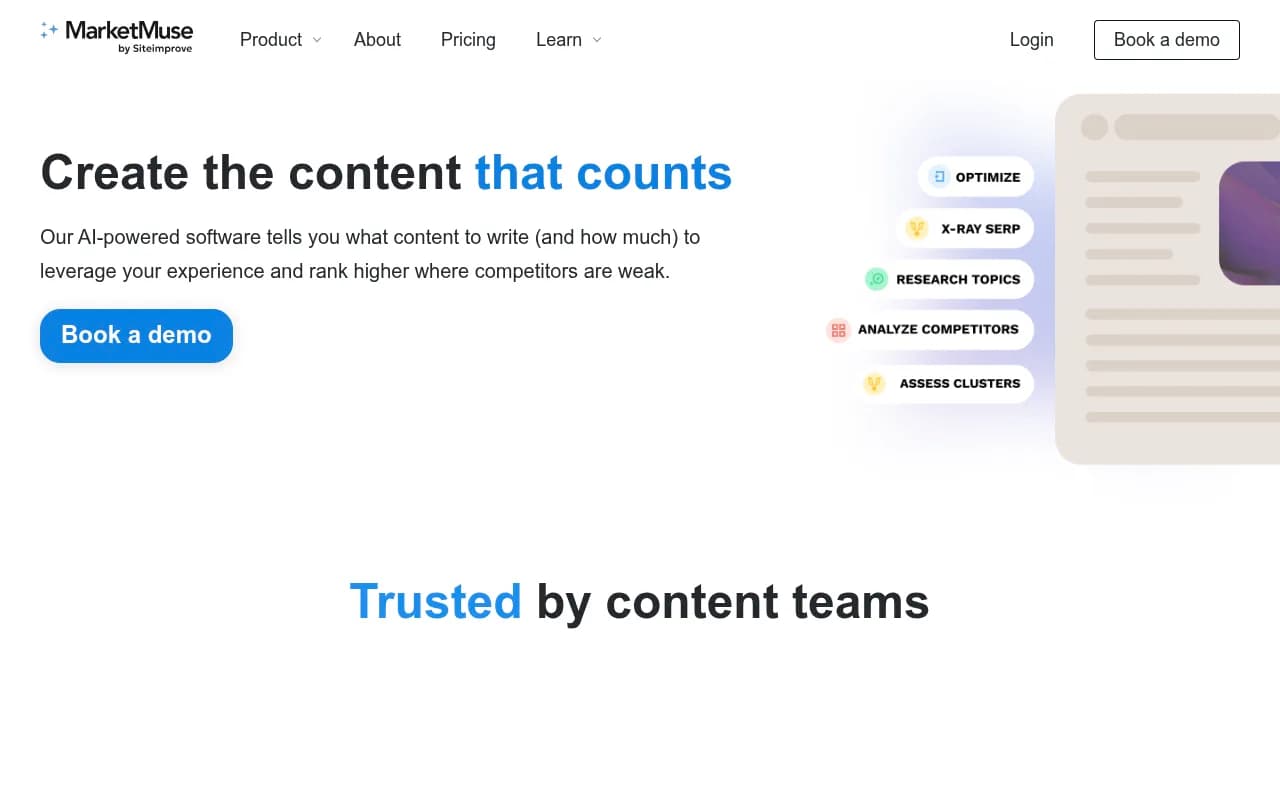
This is the core of what MarketMuse does. The platform ingests your entire content inventory and runs it through its proprietary AI to map out where you have established topical authority and where you don't. The output is a cluster view that shows which topic areas you own, which are contested, and which are wide open. This is genuinely more useful than a standard keyword gap report because it accounts for the depth and breadth of your existing content, not just individual rankings.
- Automatically crawls and categorizes your content inventory
- Groups pages into topic clusters based on semantic relationships
- Identifies "quick wins" -- topics where you have partial authority and can consolidate with minimal new content
Personalized difficulty scores
One of MarketMuse's most cited differentiators is that its difficulty scores are personalized to your domain. A topic that's hard for a new site might be easy for an established authority in that space. The platform calculates this by comparing your existing content depth against what's required to compete for a given topic. In practice, this means you're not chasing the same generic difficulty numbers that every other tool shows -- you're seeing your actual competitive position.
Competitor gap analysis
MarketMuse maps competitor content inventories and surfaces topics they've covered that you haven't, and vice versa. The competitive analysis goes beyond simple keyword overlap to look at topical depth -- whether a competitor has covered a subject comprehensively or just touched on it. This helps you find angles where you can genuinely outperform rather than just publish another thin piece on a crowded topic.
Content planning and roadmapping
The platform generates a prioritized content plan based on your authority data, competitor gaps, and personalized difficulty scores. This is one of the more practical outputs -- instead of a raw data dump, you get a ranked list of what to create or update, with reasoning attached. Teams can use this to build editorial calendars without spending hours in spreadsheets.
- Generates plans in minutes rather than requiring manual research
- Distinguishes between net-new content and content that should be updated or consolidated
- Accounts for existing page performance when making recommendations
Content briefs
MarketMuse's brief generation is detailed. Each brief includes recommended topics to cover, questions to answer, related entities to mention, suggested word count, and internal linking recommendations. The briefs are grounded in the platform's topic model rather than just keyword frequency, which tends to produce more coherent guidance for writers.
- Structure recommendations based on what top-performing content includes
- Expertise and editorial integrity signals built into brief scoring
- Writers can use briefs without needing to understand the underlying SEO logic
Content optimization (Optimize application)
The Optimize module is where you take a draft and score it against the topic model. It shows you which subtopics you've covered, which you've missed, and how your content depth compares to what's needed to compete. There's a generative AI component that can help fill gaps faster, though MarketMuse is clear that it's not a ghostwriting service -- the AI assists rather than replaces the writer.
Quality analysis
Beyond keyword coverage, MarketMuse evaluates content quality signals including structure, comprehensiveness, and differentiation from competitor content. This is a useful check before publishing, particularly for teams that produce high volumes of content and need a systematic quality gate.
Link recommendations
The platform suggests internal linking opportunities based on your content cluster structure. This is practical for large sites where manually identifying every relevant internal link would take significant time. The recommendations are cluster-aware, meaning they're designed to reinforce topical authority rather than just connect random related pages.
Who is it for
MarketMuse fits best with content teams that are already producing at scale and need a more systematic approach to prioritization. The clearest use case is a B2B SaaS company with a content team of three to ten people, a domain with hundreds of existing pages, and a need to figure out which of those pages to update versus which new topics to pursue. The personalized difficulty scoring is particularly valuable here because it lets the team focus effort on winnable opportunities rather than chasing high-volume keywords that are out of reach.
Digital agencies managing multiple client accounts also get real value from the platform, particularly the content planning and brief generation features. Being able to produce a prioritized content roadmap and a set of detailed briefs quickly is a genuine time saver when you're managing ten or fifteen clients simultaneously. The competitive gap analysis also gives agencies something concrete to show clients during strategy presentations.
Publishers and media companies with large content inventories are another strong fit. MarketMuse's inventory analysis is well-suited to sites with thousands of URLs where understanding topical coverage at a macro level is more important than optimizing individual pages one at a time.
Who should probably look elsewhere: solo bloggers or very small teams who don't have enough existing content to make the inventory analysis meaningful. The platform's value compounds with content volume -- if you have 20 pages, the authority mapping isn't going to tell you much. Similarly, teams whose primary concern is tracking brand visibility in AI search engines (ChatGPT, Perplexity, Google AI Overviews) will find MarketMuse doesn't address that channel at all. It's a traditional SEO content tool, not a GEO or AI visibility platform.
Integrations and ecosystem
MarketMuse's integration footprint is relatively modest compared to some competitors. The platform connects with Google Search Console, which allows it to pull in performance data and factor actual rankings into its recommendations. This is a meaningful integration because it grounds the authority analysis in real-world data rather than purely modeled estimates.
There's no native Slack integration or project management connector listed prominently, though the platform's content briefs can be exported and shared through standard workflows. The Optimize application works as a web editor, so writers work directly in the platform rather than in their existing CMS.
The platform doesn't appear to offer a public API for custom integrations, which is a limitation for teams that want to pull MarketMuse data into their own reporting or workflow tools. Export options exist for content plans and briefs, but the ecosystem is more self-contained than tools like Semrush or Ahrefs that have broader integration networks.
There's no dedicated mobile app -- MarketMuse is a web-based platform designed for desktop use, which is standard for this category.
Pricing and value
MarketMuse has four pricing tiers, including a free plan:
- Free: Limited access, good for testing the interface and running a small number of analyses. Not sufficient for ongoing content strategy work.
- Standard: Paid tier aimed at individual practitioners and small teams. Includes content inventory analysis, brief generation, and optimization features with a monthly query limit.
- Team: Higher query limits, more users, and additional features for collaborative content teams.
- Premium: Enterprise-level access with custom limits, dedicated support, and additional customization options.
Specific pricing numbers aren't published transparently on the main site -- you need to visit the pricing page or book a demo to get current figures, which is a minor friction point. Based on available information, paid plans start in the range of a few hundred dollars per month, putting MarketMuse in the mid-to-high range for content optimization tools. Clearscope and Surfer SEO are generally cheaper at entry level, while Semrush's content tools are bundled into a broader platform subscription.
For teams that use it consistently, the ROI case is straightforward: if the platform saves 260 hours per month in planning and optimization time (as MarketMuse's own calculator suggests), the cost is easy to justify. The question is whether your team has the volume and workflow to actually capture those savings.
A free trial is available, which is the right way to evaluate whether the inventory analysis is meaningful for your specific domain.
Strengths and limitations
Where MarketMuse genuinely excels:
- The personalized difficulty scoring is one of the most practically useful features in the content optimization space. Generic difficulty scores from tools like Ahrefs or Semrush don't account for your existing authority, which means they're often misleading. MarketMuse's approach is more honest about what's actually achievable for your specific domain.
- Site-level inventory analysis is a real differentiator. Most competitors focus on page-by-page optimization; MarketMuse's ability to map your entire content footprint and identify cluster-level opportunities is genuinely useful for strategic planning.
- Content brief quality is consistently cited by users as a strength. The briefs are detailed enough to hand directly to a writer without additional research, which saves meaningful time in the editorial workflow.
- The platform has over a decade of development behind it, and the topic modeling is mature. This isn't a tool that was thrown together to capitalize on the AI content wave -- the underlying technology has been refined over years.
Honest limitations:
- No AI search visibility features whatsoever. MarketMuse is built entirely around traditional search engine optimization. It doesn't track how your brand or content appears in ChatGPT, Perplexity, Claude, Google AI Overviews, or any other AI search interface. As AI search becomes a larger share of how people find information, this is a growing gap. Platforms like Promptwatch are built specifically for this channel and offer citation tracking, answer gap analysis, and AI crawler logs that MarketMuse simply doesn't have.
- The integration ecosystem is limited. Teams that want to connect MarketMuse data to their existing reporting stack, CMS, or project management tools will find the options thin. No API, limited native integrations.
- Pricing transparency could be better. Having to book a demo or navigate to a separate pricing page to understand costs adds unnecessary friction for teams doing initial vendor evaluation.
- The generative AI writing features are secondary to the platform's core strengths. If you're looking for a tool that writes content for you, MarketMuse is upfront that this isn't its focus -- but teams expecting a full AI writing workflow may be disappointed.
Bottom line
MarketMuse is a solid, mature content intelligence platform for SEO teams and content strategists who need a systematic way to understand topical authority, prioritize content opportunities, and produce detailed briefs at scale. It's particularly well-suited to B2B content teams and agencies managing large content inventories where the site-level analysis and personalized difficulty scoring provide real strategic value.
That said, it's a traditional SEO tool in a world where AI search is becoming increasingly important. If your team needs to understand and improve how your brand appears in ChatGPT, Perplexity, or Google AI Overviews, MarketMuse won't help you -- you'll need a dedicated GEO platform like Promptwatch for that. Best use case: a content team of three to ten people at a B2B company with an established domain who want to stop guessing about what to write next and start making data-driven decisions about content prioritization.
Tags:
Frequently asked questions
What is MarketMuse?
Who is MarketMuse best suited for?
How much does MarketMuse cost?
How does MarketMuse differ from tools like Clearscope or Surfer SEO?
Does MarketMuse track AI search visibility or LLM citations?
Is there a free version of MarketMuse?
Similar and alternative tools to MarketMuse