Key takeaways
- Brand narrative tracking breaks AI answers into individual claims ("affordable for small teams", "weak mobile app") instead of giving you one mention count or sentiment number.
- Claims come from two places: what a model learned in training and what it fetches live. You need to know which one you're dealing with before you try to fix anything.
- The workflow is simple: collect responses, extract claims, group repeats, mark each one accurate or inaccurate, trace the source page, then fix the page.
- Tools differ a lot. Some stop at a checklist of claims, others link the claim to the page that taught it and help you rewrite that page.
- Re-measure after every fix. A claim that doesn't change in a few weeks usually has a source you haven't found yet.
Why mentions and scores aren't enough
Most AI visibility dashboards answer one question: was my brand mentioned? Useful, but thin. Say ChatGPT mentions you in 60% of tracked prompts. Is it saying you're the cheap option? The outdated one? The one with no support team? A score can't tell you, and those are exactly the things that decide whether a buyer clicks.
I think of this as the difference between knowing someone talked about you at a party and knowing what they said. Brand narrative tracking is the second thing.
The unit of analysis changes. Instead of a response, the unit is a claim: one statement about your brand that can be true or false. "Offers a free plan." "Integrates with Salesforce." "Best for enterprise." "Customer support is slow." Once you have claims as discrete objects, you can count them, group them, compare them to competitors, and check them against reality.
What a brand narrative actually is
A brand narrative, in the AI search sense, is the set of claims that models repeat about you across many prompts, models, countries, and personas. No single answer is the narrative. It's the pattern that shows up when you ask 200 different questions and notice that 40 of them say your pricing is confusing.
Two things make this harder than it sounds.
First, AI answers are not stable. The same prompt on the same model can produce different claims on different days. You need volume to separate a real pattern from noise.
Second, a claim can be repeated because the model believes it or because the model just retrieved it. Neurorank's write-up on brand narrative drift makes a similar point: the narrative can drift from reality, and you need to see it before you can correct it. Waikay's Topic Reports split exactly this, testing training data and grounded (retrieved) data separately, so "the model believes X" is a different finding from "the model found X".
How AI builds claims about your brand
Understanding the mechanism tells you where to intervene.
Training data claims
When a model answers without searching, it relies on what it absorbed during training. Old press, outdated pricing pages, a 2022 review, a Wikipedia entry. You can't edit this directly. You can only outweigh it over time by publishing clearer, more widely referenced information, and by waiting for model updates.
Retrieved claims
When a model searches the web, it builds the answer from pages it fetches. This is the part you can influence quickly. And the retrieval is more fragmented than people assume. Promptwatch Data on ChatGPT query fanouts shows ChatGPT averaging about 1.84 searches per response in early March 2026, down from 2.15 in December 2025, with a single prompt sometimes triggering 3 to 8 or more. Average query length also fell, from about 117 characters to the high 80s by February and March. So the claims ChatGPT makes about you are assembled from short, keyword-like sub-queries (pricing, alternatives, reviews), not just from the question the user typed.
That has a practical consequence. If nobody has a clean, current page that answers "[your brand] pricing", the model will use whatever else it finds.
There's a newer wrinkle too. Promptwatch Data on the site: operator shows ChatGPT Search began using site: queries at scale on August 8, 2026, jumping from roughly 0.4% to about 17% of fanout queries. Where the model is searching inside specific domains, your own pages and the review sites it already trusts carry more weight in the claims it produces.
How many sources feed an answer
The number of sources differs by engine. In Promptwatch's sources-per-response report (September 2025 data), ChatGPT cited about 5 sources per web-search answer, Google AI Overviews about 10, and Perplexity almost exactly 10 each day. More sources means each individual claim has more places it could have come from, which makes tracing harder and makes the mix of third-party pages matter more.
The claim-level workflow
Here's the process I'd run, whichever tool you use.
- Build a prompt set that reflects how buyers actually ask: category questions, comparisons, pricing, alternatives, and brand-specific queries.
- Run it across the models and countries you care about, ideally from the real interfaces, since user-facing answers can differ from API outputs.
- Extract the claims from every response.
- Group duplicates so "cheap", "budget-friendly" and "low cost" count as one claim.
- Mark each claim accurate or inaccurate.
- For inaccurate or damaging claims, find the page that is teaching the model.
- Fix or replace that page, publish, then re-measure.
Steps 3 to 6 are where tools differ. Doing them by hand across hundreds of responses is possible for a pilot and miserable after that.
Tools that surface individual claims
Coverage of the claim layer is uneven. Many trackers report sentiment and stop. Here is what the research I pulled shows, and where I couldn't verify things, I say so.
Waikay
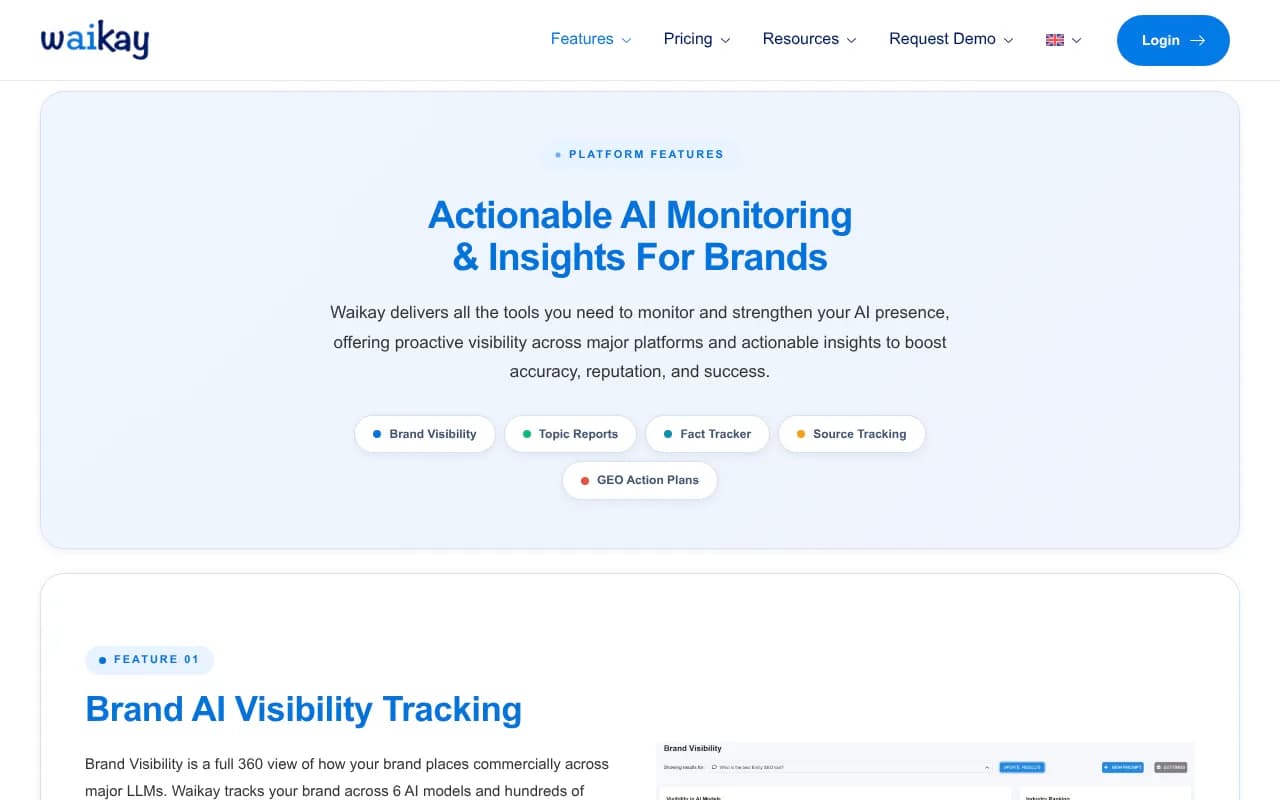
Waikay is built around this idea. Its Fact Tracker lists every AI-generated claim about your brand as a checklist, and you work through them one at a time, marking each correct or flagging it as inaccurate or misleading. It tracks 6 AI models and hundreds of prompts per brand, and its Source Tracking splits citations into knowledge sources (pages that shape the model's understanding) and commercial sources (pages cited on competitive prompts). It also generates GEO action plans and checks whether models pick up the changes. I didn't find pricing on the page I reviewed.

Promptwatch
Promptwatch has a feature called Brand Narrative on every plan. It pulls the individual claims AI makes about you and your competitors out of every tracked response (for example "affordable for small teams" or "its mobile app lacks features"), groups repeated claims, shows how often and which models say each one, and files them under themes like Pricing, Features, Support, or Reputation with a 0 to 100 score per theme that you can compare against competitors.
The part I find most useful is what comes after. Fact Check (Business, Agency Scale, and Enterprise plans, using Agent Credits) lets you mark a claim Accurate or Inaccurate, then reads the pages crawled from your site to find the ones that state the claim or its opposite, with quotes and a recommended next step. That answers the question that usually stalls this work: which of my pages is the model learning the wrong thing from? From there, the Content Agent and Content Refresh can rewrite and publish the fix, and Page Tracker plus crawler logs show whether the updated page gets crawled and cited. Data comes from the real interfaces of ChatGPT, Gemini, Perplexity, Google AI Overviews, AI Mode, Copilot and others, by country and language.
Pricing starts at $95/month for Essential, and Business is $579/month; confirm current numbers at promptwatch.com/pricing. There is also a 7-day free trial on monthly plans and a free AI visibility report.

Profound
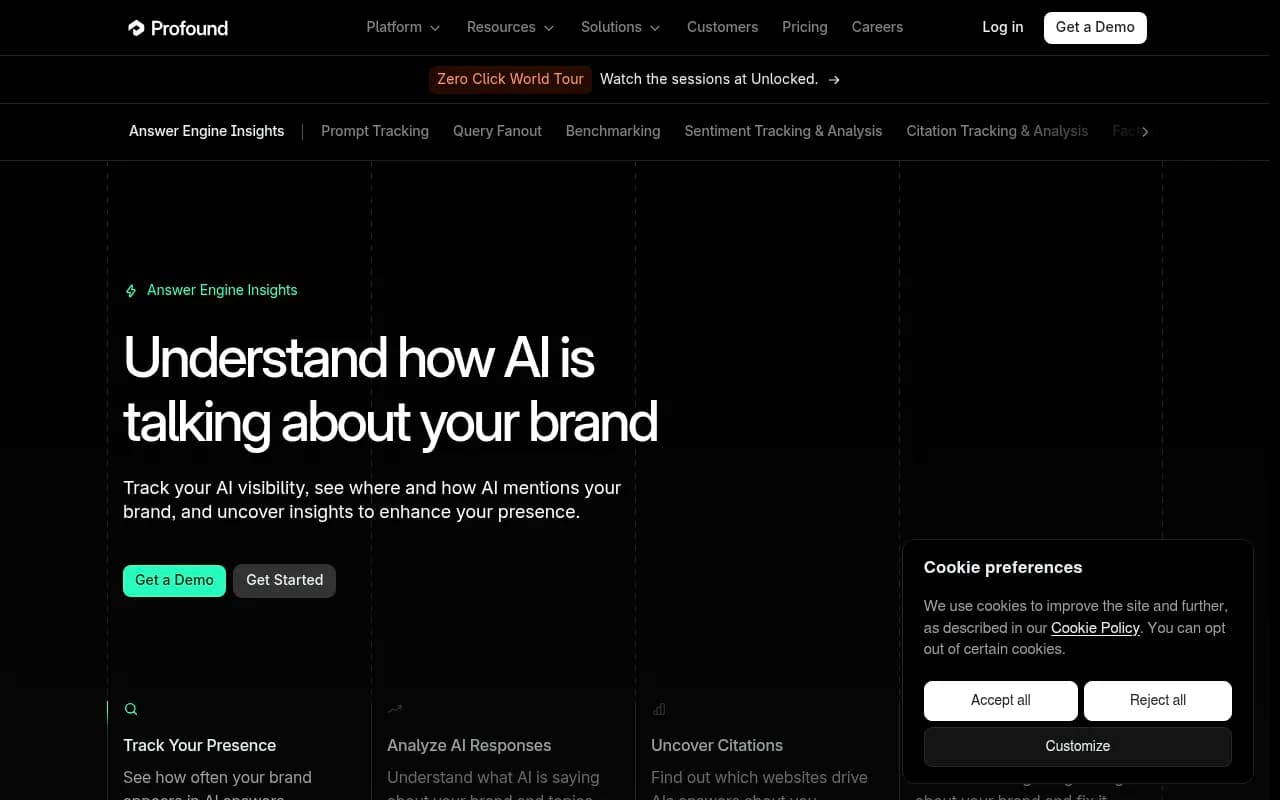
Profound says you can track visibility scores, share of voice, brand sentiment and keyword themes, citation sources and their authority, and competitor rankings, across time, regions, topics, and personas. Keyword themes are a step toward narrative, but I couldn't verify whether it extracts and lets you verify individual claims, so check that in a demo.

Otterly.AI and others
Otterly publishes a guide to tracking brand sentiment in AI search, so sentiment is covered. I didn't verify claim-level extraction there. The same caveat applies to most of the long tail of trackers in the catalog.

Comparison
| Tool | Extracts individual claims | Mark accurate or inaccurate | Traces claim to your page | Helps fix it |
|---|---|---|---|---|
| Promptwatch | Yes (Brand Narrative, grouped by theme) | Yes (Fact Check, higher plans) | Yes, with quotes from crawled pages | Content Agent, Content Refresh, Page Tracker |
| Waikay | Yes (Fact Tracker checklist) | Yes (verify or flag) | Source Tracking by source type | GEO Action Plans |
| Profound | Themes and sentiment; claim-level not verified | Not verified | Citation sources | Not verified |
| Otterly.AI | Sentiment; claim-level not verified | Not verified | Not verified | Not verified |
Treat the "not verified" cells as questions for your demo, not as negatives.
Reading the narrative once you have it
A pile of claims is still a pile. Some ways to make it useful.
Rank by frequency, then by damage
A claim repeated across five models and twenty prompts matters more than a one-off. But a rare claim like "has had data breaches" can matter more than a common, mild one. Sort on both.
Split by model
If only one model repeats a claim, the cause is likely that model's training data or a source it favors. If every model repeats it, look at a source they all share, often a review site, a comparison article, or your own page.
Split by persona and country
Your narrative to a CFO may differ from your narrative to a developer. Promptwatch's personas show visibility, position, and sentiment per persona against the general audience. Waikay and Profound also break results out by dimensions like topic and region. If one segment sees a worse story, the content that serves that segment is where to look.
Compare against competitors
Seeing that AI calls you "expensive" means more when it calls your closest competitor "premium". Same fact, different framing. Narrative scores per theme compared against competitors make that gap visible.
Tracing a bad claim to its source
This is where most people give up, because the claim and the source don't match word for word. A few things I'd check, in order.
- Your own site. Old pricing pages, a blog post from 2023, a help doc that says "not supported". Models read these.
- Comparison and listicle pages that name you. Third parties often have outdated details, and models treat them as neutral.
- Review sites and directories such as G2 or Capterra, where outdated listings are common.
- Reddit, YouTube and LinkedIn threads, if the engine cites them. This varies a lot by engine. Promptwatch Data found ChatGPT drew only 0.46% of its citations from social platforms from Sep 28 to Oct 4, 2026, while Google AI Overviews drew 12.2%. So a claim that originates in a forum thread is much more likely to show up in AI Overviews than in ChatGPT.
- Whether the AI crawler can even read your corrected page. If bots hit errors on it, the old claim persists. IP-verified crawler logs (Promptwatch's Agent Analytics is one option) separate a crawl problem from a content problem.
Fixing the narrative
Fixing is mostly boring and mostly content.
Correct your own pages first
Update the specific page, state the fact plainly and early, and keep it consistent across your site. Models pick up clear, quotable statements. A pricing page with "Plans start at $X per month" in plain text beats one where the number is in an image.
Fill the gaps
If no page answers "does [brand] integrate with X", the model will guess. Publish the page. Gap analysis that maps your pages against the prompts AI answers helps find these, and Promptwatch's content gap approach is documented in its Academy.
Go after third-party sources
Ask the owner of the outdated comparison page to correct it, update your G2 profile, and answer the Reddit thread with facts and your real affiliation. Slow, and sometimes it fails. Do it anyway, since these sources are often cited more than you are.
Pick your battles by content type
Not all content lasts equally. Promptwatch Data on content half-life tracked pages ChatGPT cited on July 6, 2026 for 90 days: landing pages and docs stayed cited longest, while news lost half its pages within 36 days. A fix on a landing or docs page is likely to stick longer than a fix that depends on a news piece.
Measuring whether the fix worked
After publishing, wait for the pages to be recrawled, then check three things: did the bot read it, is the page now cited for the relevant prompts, and did the claim frequency drop. Give it a few weeks. Training-data claims can take far longer, and some won't move until a model update.
Keep an eye on the other side of the ledger too. Referral traffic from AI engines, tracked separately, tells you whether a better narrative turns into visits. A Reddit thread in r/content_marketing makes the same suggestion: monitor sentiment for story accuracy, then look at AI referral traffic separately. Note that ChatGPT stopped sending a referrer on October 8, 2026, so tools that count UTM-tagged visits (utm_source=chatgpt.com) are now necessary to see it.
Limits you should know about
Tracking has limits. As Searchable's guide to AI visibility tracking notes, tracking can't show prompt volumes, individual views, or an engine's reasons, so pair it with referral analytics and source reading. Some platforms do add estimated prompt volumes and query fan-outs, but treat them as estimates.
Two more cautions. A claim classifier can get a claim wrong, so spot-check groups before acting. And a verified-inaccurate claim from one model on one day is a data point, not a crisis.
A starter checklist
- Write 30 to 50 prompts across category, comparison, pricing, and brand queries.
- Run them on at least ChatGPT, Gemini, Perplexity, and Google AI Overviews.
- Extract and group claims, then list the top ten by frequency.
- Mark each accurate or inaccurate, with a source link for your decision.
- For each inaccurate claim, name the page responsible.
- Fix the five highest-damage claims first.
- Re-run in two to four weeks and compare.
If you'd rather see the tools side by side, the GEO software directory at bestgeosoftware.com lists many of them.
Start with whichever tool lets you see claims in your own data this week. A free report or a trial is enough to find out whether the story AI tells about you matches the one you'd tell yourself.