Key takeaways
- A cited page has three measurable phases: ramp-up (first citation to peak), peak (its highest citation share), and decay (how fast it falls afterwards, summarised as a half-life).
- Profound's study of seven engines found a median half-life of 11 days, but 78% of page and engine pairings fall to half their peak within two weeks. That is mostly burst-and-fade, not a real loss.
- Half-life figures from different vendors measure different things. Profound measures page share from peak. Promptwatch measures whether a page is still cited at all. Scrunch and Stacker measure cohort persistence. Don't put them side by side.
- Content type matters. In Promptwatch Data, landing pages and docs stay cited longest, while news loses half its pages within 36 days.
- Before calling a drop "decay", compare the page against similar pages on the same platform. A platform-wide shift is not a page problem.
What citation trends actually show
If you track AI visibility, you probably look at mentions and citations as a count. This many this week, that many last week. Citation trends add a time axis to each individual URL. Instead of asking "how often was my brand cited?", you ask "when did this page start getting cited, when did it top out, and how quickly did it fade?"
That shift matters because the answer changes what you do. A page that ramps slowly and holds for months deserves protection. A page that spikes and vanishes in ten days is a different kind of asset, and trying to "fix" it may be wasted effort.
Three numbers describe the lifecycle of any cited page:
- Ramp-up: the days from first citation to peak.
- Peak: the day the page's smoothed citation share is at its maximum.
- Half-life: the days from peak until the share falls to half its peak value and stays there.
These terms are borrowed from science. Rutherford noticed radioactive samples took the same time to decay by half, and the idea spread to drug dosing, marketing campaigns and academic papers. In bibliometrics, the Journal Citation Reports use a "cited half-life" to describe how old the articles are that a journal receives citations for. Same word, different mechanics. Keep that in mind, because AI citation half-life is measured forward in days from a peak, not backward in publication years.

Reading the ramp-up
Ramp-up is the least discussed phase and, I think, the most useful for planning.
Profound's analysis of about 883,000 pages (1.19 million page and engine lifecycles) puts the median rise for burst pages at roughly 20 days. Sustained pages take longer: a median of 36 to 46 days from first citation to peak, depending on the engine.
The breadth of citation matters too. In the same study:
| Engines citing the page | Pages | Median rise | Still above half-peak at day 56 |
|---|---|---|---|
| 1 | 679,077 | 19 days | 1.2% |
| 2 | 275,530 | 31 days | 2.0% |
| 3-4 | 190,439 | 33 days | 3.5% |
| 5 or more | 43,770 | 46 days | 6.8% |
Pages cited by five or more engines took more than twice as long to peak as single-engine pages, and were 5.5 times as likely to still carry half their peak share after eight weeks. The pattern is that slow builds tend to last. A page that gets a quick pop from one engine usually doesn't.
What to do with this: don't judge a new page after two weeks. If it has been cited by two or three engines and the curve is still rising, it may be on the slower, more durable path.
Reading the peak
The peak is where the page's smoothed share of citations is highest. "Share" here is the page's citations divided by all citations the engine issued that day within the page's category, so it controls for the engine simply running more prompts.
Two cautions about peaks:
- A peak is only meaningful with enough volume behind it. Profound requires at least 5 citations in the 14-day window at the smoothed peak, and the page must be at least 28 days old, before it scores a page at all.
- The peak is computed on a smoothed line (a rolling two-week average), so it can lag the actual busiest day.
A high peak with a short half-life is a news-style page. A modest peak with a long half-life is a reference page. For most brands the second kind is worth more, because it keeps working without constant upkeep.
Reading decay and half-life
Half-life is the number of days from the peak until the smoothed share drops to half and stays there for 14 consecutive days. If it never does within the window, the page is classed as still holding.
The 11-day number needs context
Profound's headline is that the median cited page loses half its share within 11 days of peaking. The detail matters more than the headline:
- 78% of page and engine pairings have a half-life of 14 days or less.
- The other 22% have a median half-life of 27 to 29 days.
- Because share is averaged over two weeks, a page cited once cannot have a half-life longer than 14 days. Many land right at that ceiling.
So the 11-day median describes a population dominated by one-off citations. It is not a statement that your carefully built guide will vanish in 11 days. The sustained 22% is the group worth studying, and its median is closer to a month.
Engines diverge
Median half-life varies little by engine, but the tails differ. Among sustained pages, a Claude citation is 2.8 times as likely as a ChatGPT citation to still carry half its peak share two months out. The explanation in the data is citation style. Perplexity and Claude return to a page repeatedly, spreading citations across weeks (62% and 63% of sustained pages). ChatGPT, Google AI Mode and Gemini tend to cite intensively for a few days and then stop.
Also, decay on one engine tells you almost nothing about another. Cross-engine correlations in half-life run between 0.03 and 0.09 (0.12 to 0.17 among Google's three surfaces). So report decay per engine, never as one blended line.
Page purpose matters
Profound found that reporting pages, the ones tied to a date or event, fade first on all seven engines. Other page families hold at 1.4 to 1.6 times their rate. Reporting pages also peak faster (a 34-day median rise against 41 to 43 for the rest). They arrive fast and leave fast.
A different yardstick: survival of cited pages in ChatGPT
Promptwatch Data takes another approach in its content half-life in ChatGPT report. It took every classified page ChatGPT cited on July 6, 2026 and followed that cohort for 90 days, tracking the share still cited on or after each day.
| Content type | Still cited at 30 days | Still cited at 60 days | Half-life notes |
|---|---|---|---|
| Landing pages | 78% | 69% | Likely near or beyond 90 days |
| Docs | 76% | 67% | 93% cited again after day 0 |
| Comparisons | 72% | 63% | Likely near or beyond 90 days |
| Listicles | n/a | 60% | Crosses 50% only in the final week |
| Product pages, reviews, how-tos | n/a | about 55% | 74 to 77 days |
| News | n/a | 41% | Half gone by day 36 |
Almost a quarter of news pages were never cited again after day 0, against 7% of docs. The report flags a window-end artifact: lines drop faster in the last week because there are fewer days left for a page to be cited again, so true half-lives for the longest-lived types are probably longer than the chart shows.
The practical read from that report is straightforward. Treat landing pages, docs and pricing pages as long-term citation assets and keep them accurate. Don't assume product pages stay cited on their own; keep specs, availability and prices current. Comparisons and listicles keep more than 60% of citations after two months. Use news and press coverage for short bursts.
This lines up with what gets cited in the first place. In Promptwatch's ChatGPT citation share by content type data (Sep 28 to Oct 4, 2026), product pages hold 22.4% of classified citations and landing pages 16.8%. Share and durability are separate measures: news is 5.7% of citations but decays fastest.
Why the numbers look so different (and why you shouldn't compare them)
This is the part most write-ups skip. Three published "half-lives" exist, and they measure different things.
| Source | What it measures | Headline figure |
|---|---|---|
| Profound | A page's share of citations, from its peak, smoothed over 14 days, seven engines | 11 days median |
| Scrunch and Stacker | Persistence of a weekly source cohort, 3.5M citation events | About 4.5 weeks (3.4 on ChatGPT, 5.8 on Perplexity) |
| Promptwatch Data | Whether a day-0 cohort of cited pages is still cited at all, ChatGPT only | 36 days (news) to 77+ days |
Profound asks "how fast does this page's share fall?" Promptwatch asks "is this page cited again at all?" A page can lose most of its share and still show up occasionally, which counts as surviving in one method and as decay in the other. Neither is wrong. If someone quotes you a half-life, ask which question it answers.
Decay is not the same as rotation
The Rhinegold Compendium entry on AI citation decay makes a point I agree with: a missing citation is not decay, and a decline is not yet a diagnosis. Answer engines rotate sources constantly. In Rhinegold's summary of the SISTRIX study, AI Mode citations outside the stable core changed by 89% per week. A single missing run proves little.
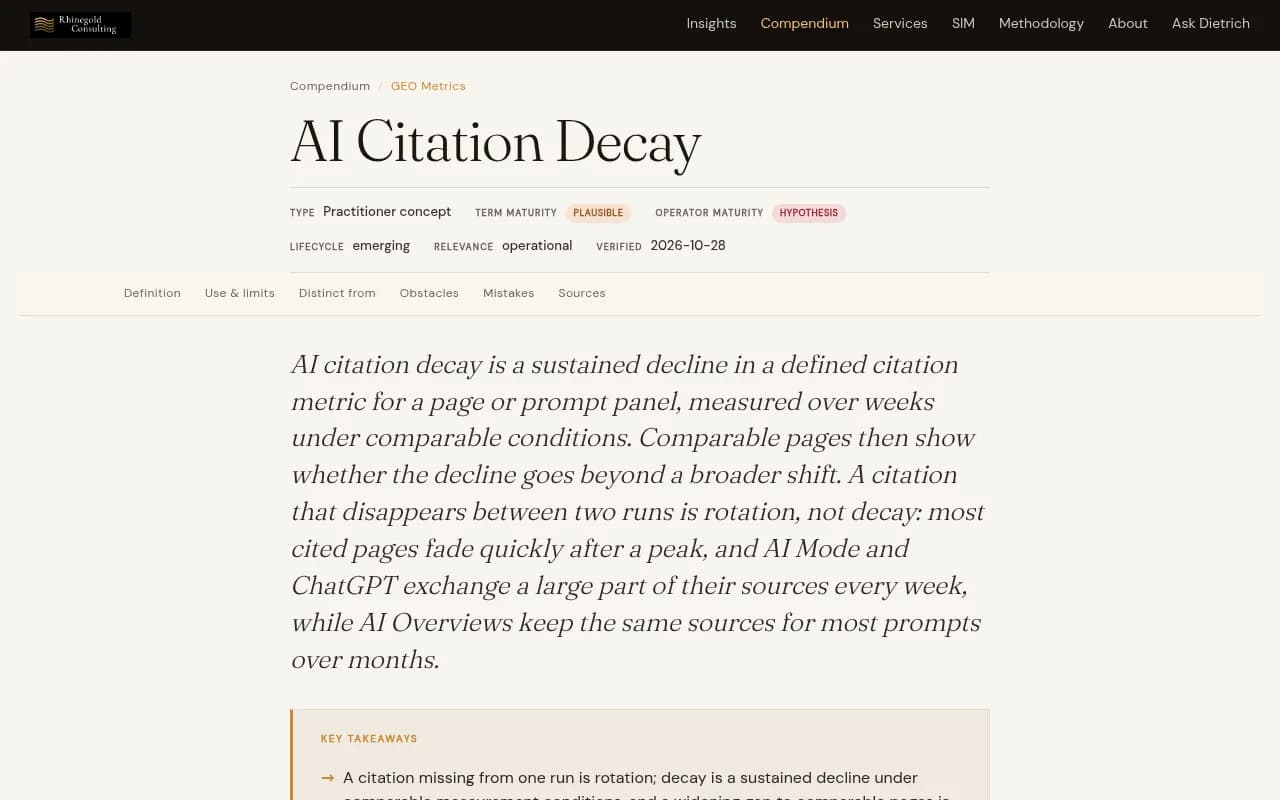
Their suggested procedure is a good template for anyone building a monitoring routine:
- Choose comparable pages before the series starts: same page type, similar topic, similar starting level, same platform and prompt panel.
- Count citations per page (or per fixed prompt panel) in weekly windows.
- Treat the page as worth investigating only when the gap to its comparison pages widens beyond a noise band in three consecutive windows.
- Report per platform, never pooled.
- Don't change the prompt panel mid-series, or you'll turn a change in the sample into an apparent trend.
Two limits are worth stating plainly. Comparison pages are not fully independent when you use a share metric, because shares sum to 100%. And citation data shows that a page lost standing, not why. A competitor's new page, an edit to your own, or a model change can all look identical in the chart.
A practical routine for reading your own pages
Here is how I would work through it for a typical content library.
Step 1: Sort pages by type before judging them
Separate news, reporting and campaign pages from landing pages, docs, comparisons and listicles. Expect the first group to decay quickly and don't treat that as failure. Set expectations per type, using the ChatGPT survival table above as a rough benchmark.
Step 2: Look at ramp-up before you panic
A page under about 28 days old has no reliable half-life. A page still rising after four to six weeks, cited by multiple engines, is behaving like the durable minority.
Step 3: Flag only sustained, page-specific gaps
When a page that was a stable performer slides while its comparison set holds, check freshness first. Rhinegold cites a finding that half of the content answer engines cite is less than 13 weeks old. Then check whether the page changed, whether crawlers can still reach it, and whether a competitor published something newer.
Step 4: Split by engine
If the drop is only on ChatGPT and Claude is steady, you are probably seeing the "intense burst" behaviour of some engines, not a content problem.
Step 5: Refresh with intent
Refresh pages that are slipping against peers. Leave burst pages alone, and put your effort into building more of the types that last.
Tools that surface citation trends
Not every AI visibility tracker shows per-page lifecycles. Many stop at brand-level mentions. Some options worth knowing:
Profound has a Citation Decay view that shows rise, peak and half-life for each URL an answer engine cites.

Promptwatch classifies every citation into content types and source types, and its Citation Trends show first cited date, ramp-up, peak and decay half-life for each cited page. It also ties those curves to IP-verified AI crawler logs and AI-referred traffic, so you can see whether a fading page was still being crawled, which is useful when you're trying to tell decay from a crawlability problem. Its Action Board then turns underperforming pages into tasks.

The broader field is crowded. Peec AI, Otterly.AI and AthenaHQ cover prompt tracking, with differing depth on page-level history, so check whether a tool stores first-cited dates before you commit.



If you want to compare more options, the GEO software directory at bestgeosoftware.com lists many of them.
| Capability | Why it matters for citation trends |
|---|---|
| Per-URL first cited date | Needed to compute ramp-up |
| Per-engine breakdown | Half-lives don't transfer across engines |
| Fixed prompt panel | Keeps the series comparable over time |
| Content-type classification | Lets you benchmark against type-level survival |
| Crawler logs or traffic data | Separates decay from access problems |
Common mistakes
- Calling a citation that's missing from one run "decay". Single runs can't separate decay from rotation.
- Comparing Profound's 11 days with Scrunch and Stacker's 4.5 weeks as if they were the same metric.
- Pooling engines into one series, so a shift in engine mix creates or hides a trend.
- Reading a decline with no comparison pages, so a model update gets blamed on your page.
- Alerting on any fall from peak. With 78% of pairings halving inside two weeks, that alert fires on most cited pages and sends your team to refresh content that was never stable.
- Treating a short half-life on a news page as a content failure.
What we still don't know
There's no shared definition of half-life across vendors. Similarweb's quoted recovery time of 6 to 12 weeks has no published method, and nobody in the sources I reviewed has measured whether citation decay leads traffic loss. Treat every figure here as a benchmark for reasoning, not a promise about your own site.
The cleanest position is this: measure from a stable baseline instead of the peak, compare against similar pages, split by engine and content type, and refresh pages only when a gap to peers persists. Everything else is mostly the normal churn of a very wide source pool.