Key takeaways
- In August 2026, Pulse articles (30.41%) and posts (27.75%) made up about 58% of LinkedIn citations across ChatGPT, AI Mode, AI Overviews and Perplexity, down from roughly 70% in May-June. Company pages rose from 13.35% to 18.05%.
- The mix differs sharply by engine. ChatGPT leans on company pages (33.68%), Perplexity is the only engine where posts beat Pulse articles (37.32%), and the two Google surfaces favor Pulse articles.
- These are shares of LinkedIn citations only. LinkedIn is a small slice of each engine's total citations, so don't read "posts 27.75%" as a share of all AI citations.
- Third-party reports such as Meltwater's put LinkedIn third overall with 100.2K citations. The numbers differ because the engine mixes and prompt sets differ.
- Track page types per engine, not as one blended LinkedIn number.
Why LinkedIn citations deserve their own tracking
Most AI citation reports treat LinkedIn as one row in a table of domains. That hides the useful part. LinkedIn is a bundle of very different page types: long-form Pulse articles, short posts, company pages, job listings, help articles, showcase pages, Learning courses. An AI engine can love one and ignore another.
Promptwatch Data published a LinkedIn citation page types report for August 2026 that splits LinkedIn citations by page type and by engine. It covers Aug 1-31, 2026, across ChatGPT, Google AI Mode, Google AI Overviews and Perplexity, and compares against a May 18 to June 17 window. (Note that baseline: it is not a month-over-month comparison with July.) There is also an earlier edition, LinkedIn citation page types in AI search, if you want the longer-run picture.
What the August 2026 page-type data shows
All engines combined
Pulse articles are 30.41% of LinkedIn citations and posts are 27.75%. That is about 58% together, down from roughly 70% in May-June, when Pulse articles alone were 37.67%. Company pages climbed from 13.35% to 18.05% and gained on every engine, most of all on ChatGPT and Perplexity.
Some page types barely register. Showcase pages are 0.4%, product pages 0.44% and LinkedIn Learning 0.37%. Promptwatch's own advice is to skip these for GEO work. I'd agree: nobody gets a visibility win from polishing a showcase page.
Engine by engine
| Page type | ChatGPT | AI Mode | AI Overviews | Perplexity |
|---|---|---|---|---|
| Pulse articles | 3.65% (was 8.77%) | 34.66% (was 44.85%) | 34.51% (was 42.25%) | 26.01% (was 32.46%) |
| Posts | 26.45% (was 12.09%) | 24.39% | 23.06% (was 27.72%) | 37.32% (was 41.88%) |
| Company pages | 33.68% (was 23.84%) | 13.53% (was 10.71%) | 14.46% (was 12.86%) | 22.03% (was 13.09%) |
| Top-content pages | n/a | 4.22% (was 6.62%) | 5.15% (was 8.14%) | n/a |
All figures are shares of that engine's LinkedIn citations, with the May-June value in brackets where the report gives it.
ChatGPT. Company pages jumped to 33.68%. Job listings (6.51%) and help articles (5.97%) add to that, and together with company pages they make up close to half of ChatGPT's LinkedIn citations. Posts more than doubled from 12.09% to 26.45% and are now the second-largest format, while Pulse articles collapsed to 3.65%. The practical read: ChatGPT is pulling LinkedIn as a source of facts about organizations, not as a reading list of thought leadership.
Google AI Mode and AI Overviews. Both still favor Pulse articles (34.66% and 34.51%), though both are down from earlier. Posts sit around 23-24%. AI Overviews now almost mirrors AI Mode. Top-content pages have the highest share on AI Overviews at 5.15%; those pages go to accounts LinkedIn ranks as leading voices on a topic, which is not something you can fake in a week.
Perplexity. Posts lead at 37.32%, making it the only engine where posts beat Pulse articles. Company pages had the biggest gain of any page type on Perplexity, from 13.09% to 22.03%.
How big is LinkedIn overall? Keep the denominator straight
This is the part that trips people up. The page-type numbers above are shares of LinkedIn citations. They say nothing about how much of an engine's total output comes from LinkedIn.
Promptwatch's Social Media Citations by AI Model report for October 2026 (Sep 28 to Oct 4, 2026) puts that in proportion:
| Engine | Social platforms combined | LinkedIn share of citations |
|---|---|---|
| ChatGPT | 0.46% | 0.3% (its most cited social platform) |
| Google AI Overviews | 12.2% | 1.55% |
| Perplexity | 2.7% | 0.86% (tied with Reddit) |
Across the three engines, the average share was YouTube 1.70%, Reddit 1.03%, LinkedIn 0.90%, Facebook 0.81%, Instagram 0.56%, TikTok 0.07% and X 0.04%. ChatGPT's social share dropped from 5.8% in the earlier report as Reddit fell from 5.19% to 0.09%, which fits the wider pattern in Promptwatch's data on Reddit citations dropping in ChatGPT.
So LinkedIn matters, but as a fraction of a percent to a couple of percent of citations on any given engine. That is still real volume when you multiply by billions of responses, and the report's advice for Perplexity is to publish on LinkedIn as well as Reddit.
Why Meltwater's numbers look so different
Meltwater's AI Search Visibility Report for August 2026 says LinkedIn grew 24.8% month over month to 100.2K citations, moving from fifth to third place behind YouTube and Reddit. Perplexity alone produced 69,302 of those, roughly 69% of LinkedIn's total in the sample. Other engines: AI Mode 13,855, AI Overviews 8,232, Copilot 3,941, Grok 3,540, Claude 699.
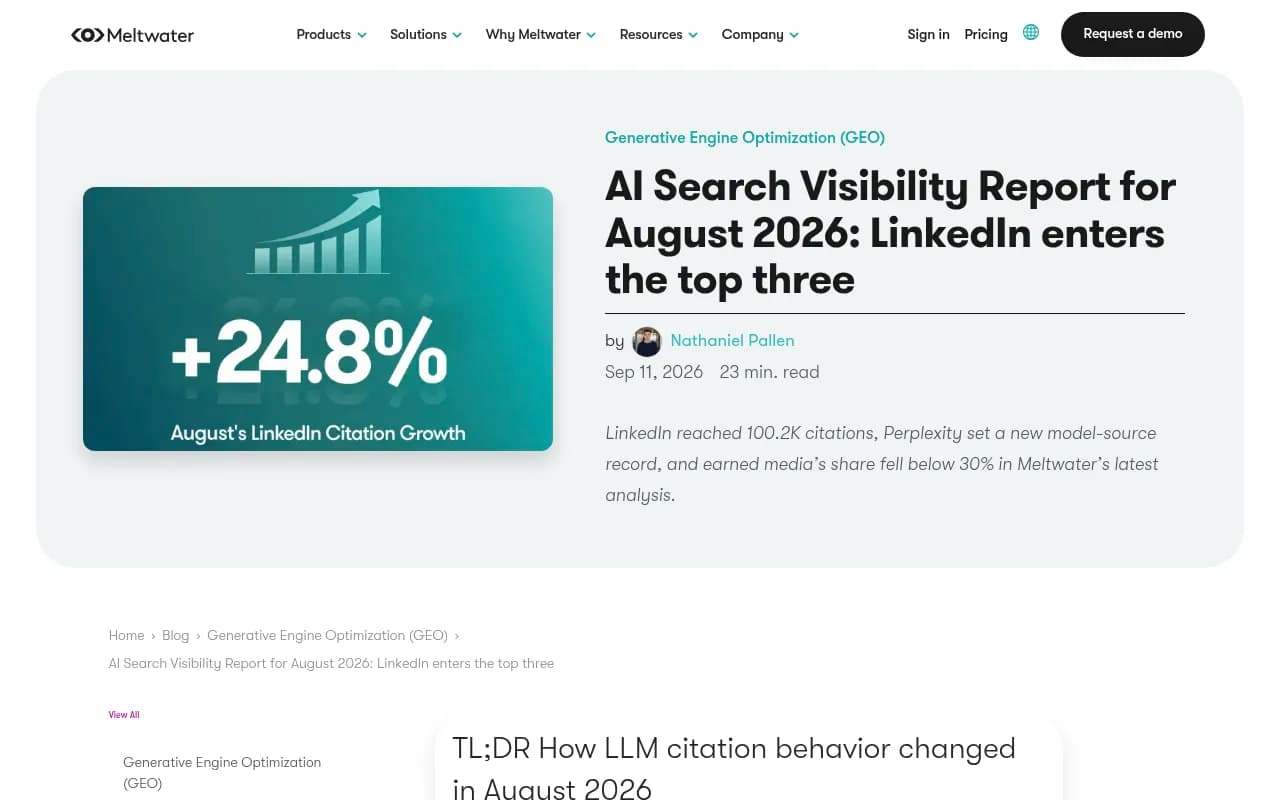
That looks like a conflict with the idea that LinkedIn is a minor share of ChatGPT's citations. It isn't, quite. Meltwater covers eight engines and uses consumer-category prompts (retail banking, automotive, streaming). Promptwatch tracks real interfaces across its own prompt sets and reports shares within each engine. Different engines, different prompts, different counting. Note also that Meltwater's own report says preferences vary by prompt, category and timing.
There is one point where the two datasets line up: Perplexity is where LinkedIn posts do best. Meltwater's biggest single model-source pairing is Perplexity and LinkedIn, and Promptwatch has posts as the largest page type on Perplexity.
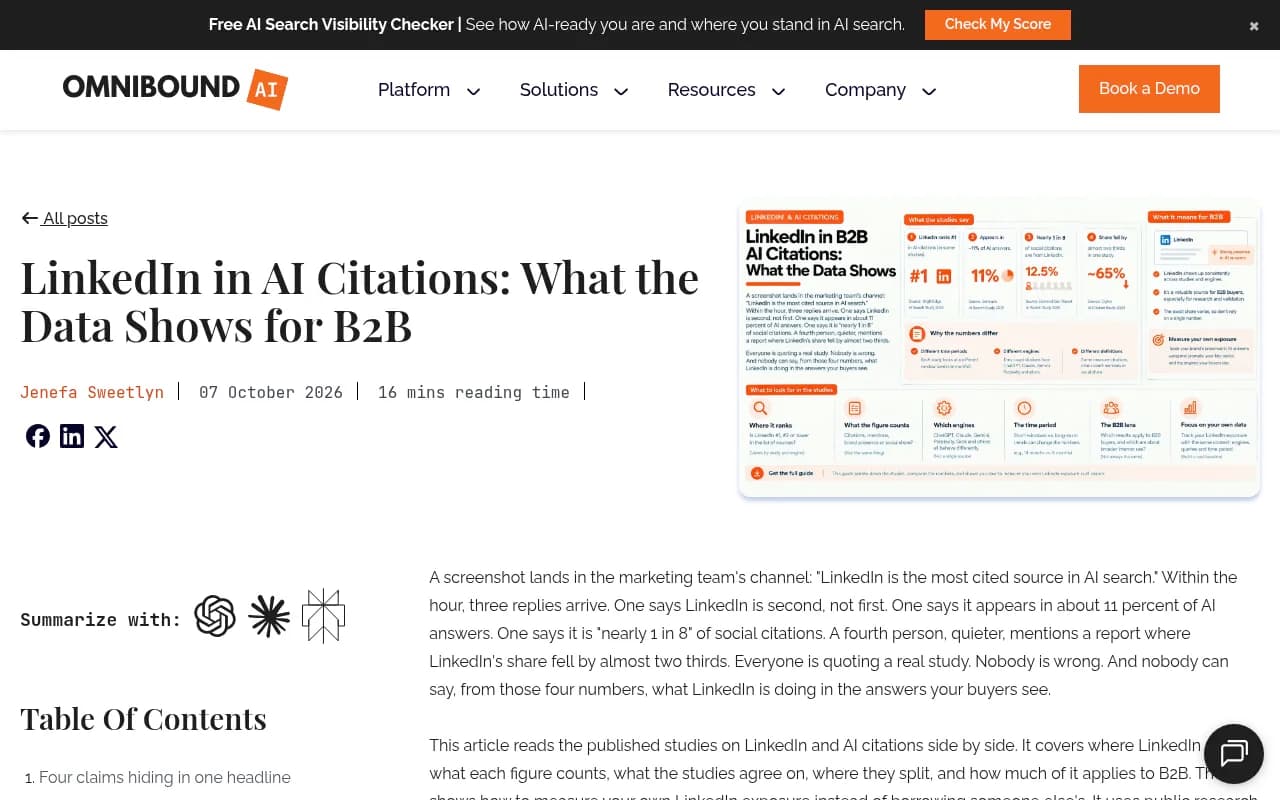
Omnibound's roundup of LinkedIn citation studies is worth a read for the methodology comparison. It relays Meltwater's figure that individual member profiles produce about 75 percent of LinkedIn citations, and notes Otterly found likes, comments, emojis and hashtags correlated near zero with citations. It also stresses that these studies are correlational, not tests of what causes citation. I'd hold that caveat close: nobody has shown that a post gets cited because of a specific tactic.
Other numbers floating around: a DSMN8 piece cites Semrush's analysis of 89,000 LinkedIn URLs across ChatGPT Search, AI Mode and Perplexity, finding reshares account for just 5% of citations and articles of 500 to 2,000 words attract the most citations. Those are third-party figures I haven't verified, so treat them as directional.
What to do with this
If ChatGPT visibility is the goal
Finish the company page. About section, offerings, size, locations. Company pages are a third of ChatGPT's LinkedIn citations, and job listings and help articles are another chunk. Post from both the company page and leaders' profiles, since posts are now the second-largest format. Skip Pulse articles if ChatGPT is your only target; at 3.65% they barely register there.
If Perplexity is the goal
Write posts that stand alone as answers: a clear claim in the first lines, supporting numbers, no teaser that makes the reader click through for the point. Keep the company page current too, since it gained the most there.
If Google AI Mode and AI Overviews matter
Pulse articles still carry about a third of LinkedIn citations on both. Long-form, well-structured pieces from named experts are the play. Top-content pages are a small slice but the largest on AI Overviews, and they depend on LinkedIn recognizing the author as a leading voice.
Treat LinkedIn as one source among several
LinkedIn sits next to review sites, community threads and independent coverage in every study. For ChatGPT, the social media report shows social is almost irrelevant overall, so your owned pages and third-party editorial still do most of the work.
How to track LinkedIn as a citation source
The method matters more than the tool. A workable setup:
- Build a monitor of prompts your buyers actually ask, in the countries and languages you care about, and run it daily across ChatGPT, AI Mode, AI Overviews and Perplexity.
- Filter citations to linkedin.com and classify each URL by page type: post, Pulse article, company page, job, help article.
- Split the results by engine. A blended LinkedIn number will mislead you, as the table above shows.
- Separate your own LinkedIn URLs (company page, executives' profiles) from other people's LinkedIn content that mentions you.
- Watch changes over weeks, not days. Shares moved a lot between the May-June and August windows.
Promptwatch does this with real-interface prompt tracking, dedicated LinkedIn citation reporting (including a "my channels" filter for your own accounts) and Citation Trends that classify sources by type.

Other trackers cover parts of the job. Profound and Peec AI are common picks for citation monitoring; Omnibound ties B2B AI visibility to pipeline.


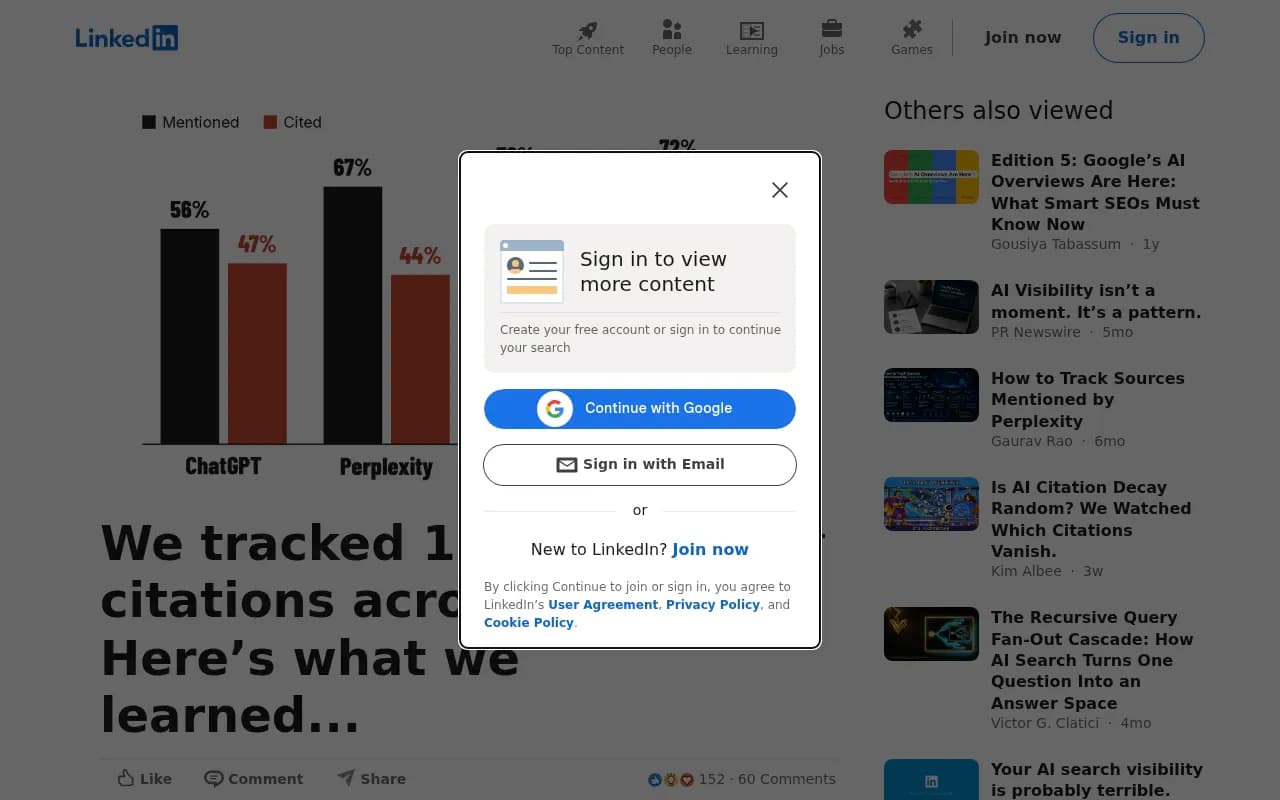
Pick one that shows citation URLs and lets you break them out per engine; domain-level only is not enough. One limit to know about: Gemini sometimes reveals only the domain it cited, not the exact page, which makes page-type analysis impossible for those responses. Andy Crestodina's LinkedIn write-up of 13,184 tracked citations across four LLMs flags the same issue, and also separates mentions from citations.
If you're comparing options, the directory at bestgeosoftware.com lists GEO software side by side.
Common mistakes
- Quoting page-type shares as if they were shares of all citations.
- Comparing the August report against July. The baseline is May 18 to June 17.
- Mixing Meltwater-style and Promptwatch-style numbers in one chart. Different engines, prompts and counting.
- Chasing likes and comments. Otterly found them near zero correlated with citations.
- Publishing Pulse articles to win ChatGPT, where they are 3.65% of LinkedIn citations.
The short version
LinkedIn is not one source, it is several, and each engine picks different ones. ChatGPT wants your company page and short posts. Perplexity wants standalone posts. Google's AI surfaces still lean on Pulse articles. Measure each separately, keep the denominator straight, and expect the mix to keep moving.