Key takeaways
- On August 8, 2026, the share of ChatGPT fanout queries using
site:went from 0.37% to 16.8% in a single day, according to Promptwatch Data. - Average fanouts per response rose from about 1.08 to about 1.83 the same day, so site:-scoped searches look additive, not a replacement for generic searches.
- Your domain is now a retrieval surface. Indexing gaps, thin category pages, and weak internal structure cost you AI answers as well as rankings.
- The data covers tracked prompts only, and OpenAI has not documented the behavior. Verify before you rewrite anything.
- Re-run fanout analysis on your tracked prompts. Keyword mappings built before August 8 are stale.
What actually happened on August 8
ChatGPT changed how it searches the web overnight. Promptwatch's data shows fanout queries containing the site: operator, meaning searches scoped to one domain, rose from 0.37% to 16.8% of all fanout queries. That is roughly a 46x jump in a day.
For weeks before, the share sat between 0.3% and 0.5%, about 1 in 280 fanouts. It dipped to 0.15% on August 3 to 5, which Promptwatch says is consistent with a staged rollout or a pre-launch experiment. Since August 8 it has run at 16 to 17%, about 1 in 6.
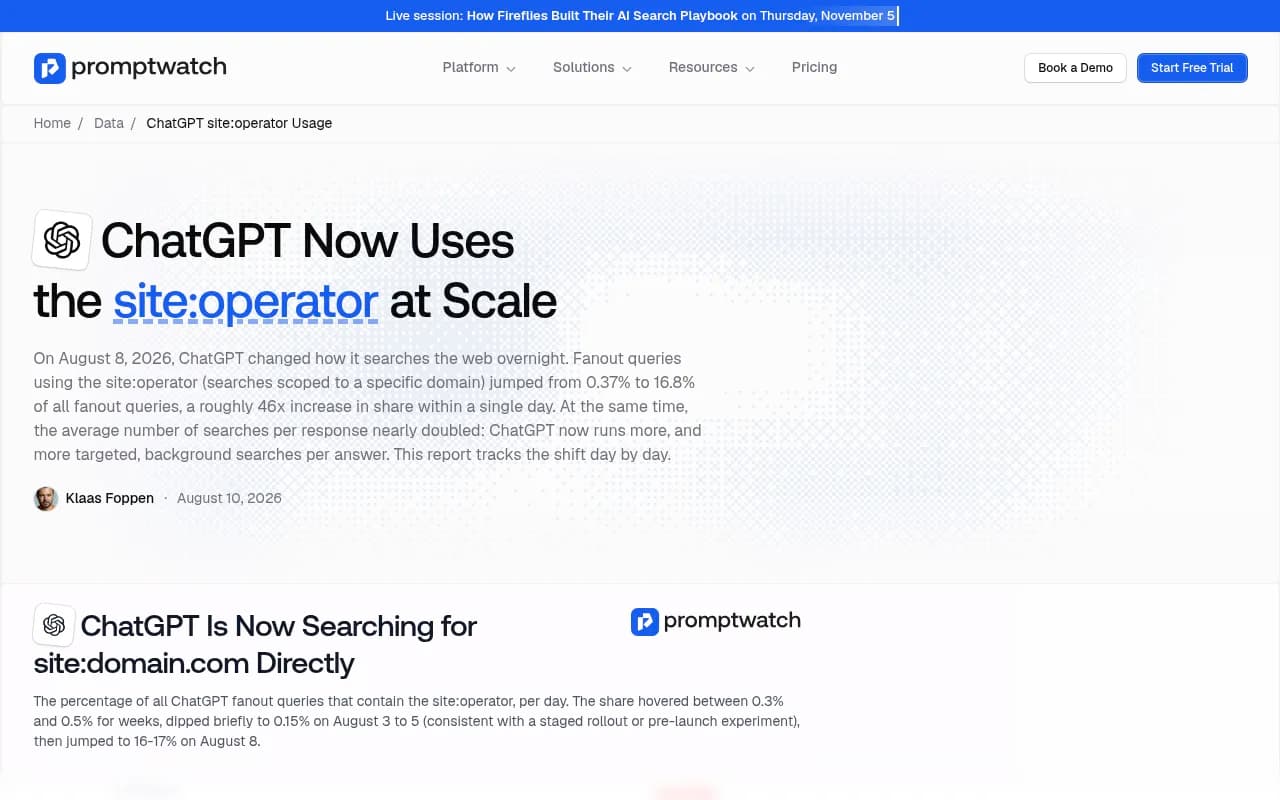
A one-day shift like this points to a model or system-prompt rollout on OpenAI's side. No individual site caused it, and no individual site can take credit or blame for it. That matters because the first instinct of a lot of teams is to go rewrite things. Don't, at least not yet.
What is a fanout query, quickly
When you ask ChatGPT a question, it often runs one or more background web searches before answering. Those are fanout queries. They are the actual retrieval steps that decide which pages end up as sources. If you want the longer background, Promptwatch's ChatGPT query fanouts report tracks volume and query length over time.
The second number: searches per response
The less-discussed half of the story is that the average number of fanouts per response went from about 1.08 to about 1.83 on August 8, and stayed there.
This timing matters. If ChatGPT had swapped generic queries for site: queries, the average would have stayed flat. It didn't. So the domain-scoped searches look like they were layered on top of the generic ones. Your existing chances of being found through ordinary searches are intact, and there is a new retrieval path alongside them.
Some context so you don't over-read this. Promptwatch's own baseline shows the average falling from 2.15 in early December 2025 to about 1.84 in early March 2026, then sitting at exactly 1.0 in April. So the August figure of 1.83 is closer to a partial return to the winter level than a brand new high. Also, the intro of that report mentions a single prompt triggering "3-8+" searches, which doesn't match the 1.0 to 2.15 averages on the same page. Treat that as a ceiling on heavy prompts, not a typical response.
What we do not know
This is where I'd slow down. A few honest caveats:
- The figures only reflect prompts Promptwatch tracks. Simon Willison made the same point in his write-up.
- OpenAI has not documented any of this. Its August 6 announcement only says GPT-5.6 Sol in Chat was updated "to be more reliable with facts and provide more focused answers" for Plus and Pro users.
- Willison suspects the underlying search tool looks like
search(query, recency, domains), so what shows up assite:may be a domain filter, not a literal operator. That is his inference from poking at ChatGPT, and system prompts are not public. - Nobody has published which sites get targeted. I haven't seen a breakdown, and I'd be wary of anyone who claims one.
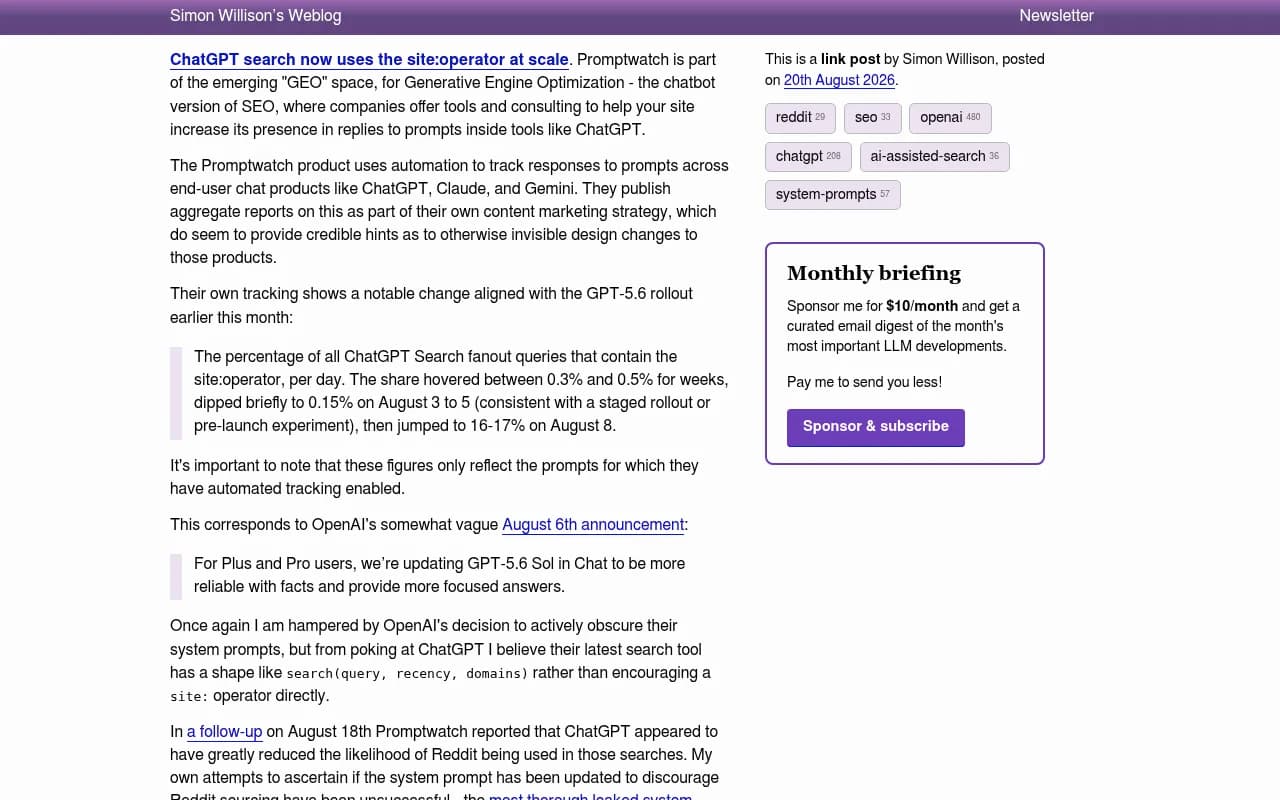
So the confident reading is: something changed on August 8, it is large in tracked data, and domain-level retrieval is now a bigger part of how ChatGPT builds answers. The speculative reading is everything about why.
A related shift: Reddit
A few days later, on August 14, Promptwatch recorded reddit.com's share of ChatGPT citations falling from about 4% to 0.5%. Both Google surfaces declined more gradually. See the Reddit citations report. Willison couldn't confirm any system-prompt change behind it. Whether the two events are connected is unproven, but they point the same direction: ChatGPT is being more selective about where it pulls from. For the wider picture of who gets cited, the social media citations by AI model report shows ChatGPT drawing only 0.46% of citations from social platforms from Sep 28 to Oct 4, 2026, versus 12.2% for Google AI Overviews.
What it means for your content strategy
Treat your domain as a retrieval surface
When ChatGPT runs something like site:yourdomain.com topic, it is effectively searching your site through a search engine. Thin category pages, weak internal linking, and content that was never indexed now cost you answers, not only rankings.
Check indexing before anything else
A site:-scoped query can only surface what search engines have indexed from your domain. Run through the basics:
- Confirm key pages are indexed in Google and Bing using Search Console and Bing Webmaster Tools.
- Find orphaned pages and pages missing from your sitemap.
- Fix soft 404s, accidental noindex tags, and canonicals pointing somewhere odd.
- Check robots.txt and CDN rules for AI crawlers. Being indexed is one thing, being readable by AI crawlers is another.
Cover more angles per topic
With about 1.8 retrievals per answer instead of about 1.1, each response draws on more distinct searches. Comparisons, pricing, alternatives, and domain-scoped lookups are all separate chances to be found. If you have one page per topic, you have one shot. A cluster of focused pages gives you several.
Write headings like queries
Promptwatch's fanout data shows average query length dropping from about 117 characters in December 2025 to about 53 from April 2026. Short queries reward headings that read like keyword searches, with the entity and category up front, for example "Best CRM for small agencies 2026". Prefer a cluster of focused pages to one mega-page.
Pick formats that stay cited
Content type still matters. In Promptwatch's content half-life data, landing pages and docs stayed cited longest among pages ChatGPT cited on July 6, 2026, while news lost half its pages within 36 days. And product pages are the most cited type at 22.4% of citations from Sep 28 to Oct 4, 2026. If your site is mostly blog posts and your product and docs pages are thin, that is the first thing I'd fix.
Don't panic-rewrite
This was a platform-wide rollout, not a verdict on your content. Check your own data first. Did your citations or AI referral traffic move after August 8? If not, you may not need to change anything beyond hygiene.
A practical checklist
| Step | What to do | Why |
|---|---|---|
| 1 | Audit indexation in Google and Bing | site:-scoped searches only find indexed pages |
| 2 | Verify AI crawler access in server or CDN logs | Indexed is not the same as readable |
| 3 | Strengthen category and hub pages | Domain-scoped lookups land here first |
| 4 | Build multi-angle clusters: comparison, pricing, alternatives | More retrievals per answer means more chances |
| 5 | Re-run fanout analysis on tracked prompts | Pre-August 8 mappings are stale |
| 6 | Compare citations and AI traffic before and after Aug 8 | Confirms whether you were affected |
| 7 | Monitor weekly | Behavior changed in a day and can again |
Tools that help you monitor this
The real lesson of August 8 is that platform behavior changes overnight and a one-off audit won't catch it. You need continuous tracking of prompts, fanouts, citations, and crawler activity.
Promptwatch is where this data comes from, and it tracks fanouts, citations, and IP-verified AI crawler logs from real ChatGPT and other AI interfaces, then connects them to content gaps and actions you can publish against.

Other tools in the category worth a look, depending on budget and needs:




Aiso advertises prompt and fan-out tracking, which is the part most relevant here. Profound is the enterprise option, while Peec AI and Otterly.AI lean toward lighter monitoring. For classic indexing and search data, Semrush and Ahrefs still cover the Google side.
| Tool | Focus | Fanout or crawler visibility |
|---|---|---|
| Promptwatch | Monitoring plus content action | Fanouts and IP-verified crawler logs |
| Profound | Enterprise AI visibility | Monitoring-focused |
| Peec AI | Prompt tracking | Basic tracking |
| Otterly.AI | Affordable monitoring | Basic tracking |
| Aiso | Prompt and fan-out tracking | Fan-out tracking advertised |
| Semrush / Ahrefs | Traditional SEO plus AI add-ons | Google and index-side data |
For a broader list, the GEO software directory is a good place to compare more options.
How I'd think about this
I find the 46x number striking, but the 1.08 to 1.83 number more useful. It tells you ChatGPT is doing more work per answer, not just different work. More retrievals means more doors into your content, and also more competition for each slot in the final answer.
The unsettling part is how fast it moved. One day. No announcement that says what it is. If your content strategy depends on a fixed picture of how ChatGPT retrieves, it is already out of date. Fix indexing, widen topic coverage, and watch the data weekly. That is most of the work.
For more first-party research on how AI answers are built, browse the Promptwatch Data hub.