Key takeaways
- Financial services is one of the hardest YMYL categories for GEO -- AI models apply extra scrutiny to money-related content, which means E-E-A-T signals matter more here than almost anywhere else.
- Roughly 82% of AI citations in financial queries go to earned media and established outlets, so third-party authority (not just your own website) is the primary lever.
- Brands like Chime, Ally, SoFi, Chase, and Bank of America dominate AI recommendations today -- but smaller institutions can close the gap by targeting specific, answerable prompts competitors are ignoring.
- Compliance is a GEO constraint, not just a legal one: a hallucinated rate or fee in an AI answer is a regulatory problem, so financial brands need content that is precise, verifiable, and regularly updated.
- Tools like Promptwatch can show you exactly which prompts your competitors are being cited for -- and which gaps you can realistically win.
When someone asks ChatGPT "what's the best high-yield savings account right now" or "how does term life insurance work," they're not getting a list of blue links. They're getting a synthesized answer, maybe two or three citations, and a recommendation. That's it. If your brand isn't in that answer, you're invisible -- and the user moves on without ever visiting your website.
This is the new reality for financial services marketing in 2026. AI search has created what Conductor's 2026 AEO benchmarks call "a parallel surface of visibility" -- an invisible layer that determines which brands get seen before anyone clicks. And in financial services, where trust is everything and the stakes of a wrong answer are genuinely high, winning that layer is both harder and more important than in most other industries.
This guide covers what makes financial services GEO different, what's actually working in 2026, and how banks, fintechs, and insurers can build a strategy that earns citations without creating compliance headaches.

Why YMYL makes financial GEO harder than most categories
YMYL -- "Your Money or Your Life" -- is Google's framework for content where inaccurate information could cause real harm. AI models have internalized the same logic. When someone asks about mortgage rates, investment strategies, or insurance coverage, the AI is more cautious about which sources it cites. It's not going to pull from a random blog post.
The practical consequence: financial brands face a higher bar for AI citations than, say, a SaaS company or a travel brand. AI models want to see:
- Demonstrated expertise (credentials, authorship, institutional affiliation)
- Factual accuracy that can be verified against primary sources
- Content that's been cited or referenced by other authoritative sources
- Regular updates -- rates change, regulations change, products change
This is why the Conductor benchmarks show that broad YMYL queries about investing, credit, and financial advice are dominated by high-authority educational publishers and comparison sites. NerdWallet, Investopedia, Bankrate -- these aren't winning because they have better marketing. They're winning because they've built the kind of deep, verified, regularly updated content that AI models trust.
The good news: that same logic creates a real opportunity for financial brands willing to do the work.
The citation landscape in financial services right now
According to data from Conductor's 2026 AEO benchmarks, AI referral traffic currently represents just over 1% of total web visits across industries, growing at roughly 1% per month. That number sounds small, but the framing matters: AI visibility isn't primarily a traffic channel yet. It's a credibility channel. Being cited in an AI answer signals to the model -- and to the user -- that your brand is a trusted source.
In banking specifically, the brands dominating AI recommendations are the ones that have invested heavily in educational content: Ally's savings calculators and explainers, Chime's guides to building credit, SoFi's financial literacy content. Chase and Bank of America benefit from sheer domain authority and media coverage volume.
For fintechs, the picture is more interesting. Fintechs tend to move faster on content, which gives them an early-mover advantage on specific prompts. A fintech that publishes a genuinely useful, accurate guide to BNPL regulations or crypto tax reporting can earn citations that a slower-moving bank hasn't captured yet.
For insurers, the challenge is slightly different. Insurance queries tend to be highly local and highly specific ("best homeowners insurance in Texas," "what does term life insurance cover"). AI models often cite comparison sites for these queries rather than the insurers themselves -- which means insurers need to think about both their own content and their presence on third-party platforms.

The compliance problem -- and how to work around it
Here's the tension that makes financial GEO genuinely hard: the content that earns AI citations tends to be specific, direct, and opinionated. "The best high-yield savings account is X because it offers Y% APY with no minimum balance." But financial brands are often constrained by compliance teams who want every claim qualified, every rate disclaimed, and every recommendation hedged.
That tension is real, and there's no magic solution. But there are ways to navigate it:
Write for verifiability, not vagueness. Compliance teams often push for vague language because specific claims can go stale or create liability. But AI models don't cite vague content -- they cite content that answers the question. The fix is to write specific content that's tied to verifiable, current data, and to build a process for updating it regularly. A page that says "our current APY is X% (updated monthly)" is both specific and defensible.
Separate educational content from promotional content. Your compliance team is right to be cautious about promotional claims. But educational content -- how does a HELOC work, what's the difference between term and whole life insurance, how do I dispute a credit card charge -- carries much lower compliance risk and is exactly what AI models cite. Build a content library that's primarily educational, and let your promotional content live separately.
Use third-party citations strategically. Since 82% of AI citations in financial queries go to earned media, getting your brand mentioned in NerdWallet, Forbes Advisor, or Bankrate is often more valuable for AI visibility than publishing on your own site. This is a PR and outreach play, not just a content play.
Document your content review process. AI models can't see your internal compliance review, but they can see signals of trustworthiness: author credentials, publication dates, update timestamps, citations to primary sources (FDIC, CFPB, IRS). Make these visible on every page.
What financial brands should actually optimize for
The mistake most financial brands make with GEO is trying to optimize for broad, competitive queries where they have no realistic chance of winning. "Best savings account" is dominated by Bankrate and NerdWallet. You're not going to displace them.
The better approach is to find the specific, answerable prompts where you can realistically compete -- and where winning actually matters for your business.
Prompt types that work for financial brands
Product-specific questions your brand can definitively answer. "Does [your bank] offer joint checking accounts?" "What's the minimum balance for [your fintech's] premium tier?" These are queries where you are the authoritative source. AI models should be citing you, and if they're not, that's a fixable problem.
Comparison queries in your specific niche. Instead of "best credit card," target "best credit card for freelancers with irregular income" or "best business checking account for LLCs under $500k revenue." These are specific enough that AI models need to find a source that actually addresses the nuance -- and that's where well-targeted content wins.
Regulatory and compliance explainers. "What is FDIC insurance and how does it protect my savings?" "How does the CFPB complaint process work?" These queries are high-trust, high-value, and often underserved by the big comparison sites. A bank or credit union that publishes genuinely clear explanations of these topics can earn citations that drive real credibility.
Local and regional queries. "Best credit union in [city]" or "SBA loan options in [state]" are queries where national comparison sites are often weak. Local institutions have a real advantage here if they create content that's specific to their geography.
Building the content that earns citations
The brands winning AI citations in financial services treat their content as reference material, not marketing copy. That's the framing that matters.
Reference material has a few defining characteristics:
It's comprehensive on the specific topic it covers. Not "here's a brief overview of HELOCs" but "here's everything you need to know to decide whether a HELOC is right for your situation, including current rate ranges, qualification requirements, tax implications, and alternatives."
It cites primary sources. Link to the CFPB, the IRS, the FDIC. Show your work. AI models are more likely to cite content that itself cites authoritative sources.
It's written by someone with demonstrable expertise. Author bios matter. A certified financial planner or a licensed insurance agent writing content carries more weight than "Staff Writer." If you don't have credentialed authors in-house, consider working with them as contributors.
It's updated regularly. Rates change. Regulations change. A guide to Roth IRA contribution limits that hasn't been updated since 2024 is a liability, not an asset. Build a content calendar that includes regular reviews of your most important pages.
It answers the question directly. AI models are extracting answers, not summarizing brand messaging. If your content buries the answer in three paragraphs of brand voice, the AI will either skip it or get it wrong. Lead with the answer, then provide context.
Tracking your AI visibility in financial services
You can't improve what you can't measure. The challenge with AI search is that traditional analytics tools don't capture it -- a user who gets their answer from ChatGPT and never clicks through to your site is invisible in Google Analytics.
This is where purpose-built GEO platforms become important. Promptwatch tracks how AI models respond to specific prompts across ChatGPT, Perplexity, Gemini, Claude, and others -- including which sources they cite. For financial brands, this means you can see exactly which prompts your competitors are being cited for, which prompts you're winning, and which gaps represent realistic opportunities.

The answer gap analysis is particularly useful for financial brands: it shows you the specific questions AI models are answering where your competitors appear but you don't. That's your content roadmap.
For broader tracking and content optimization, a few other tools are worth knowing:
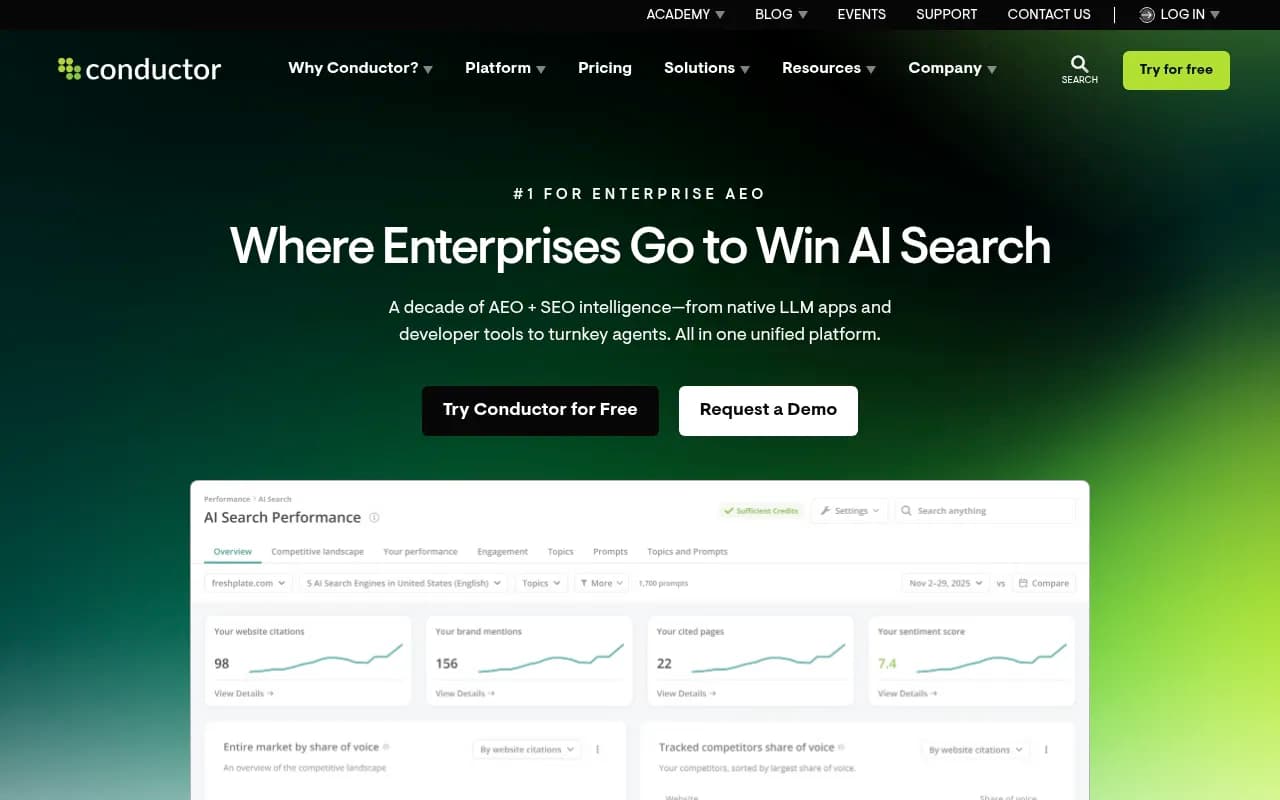
Conductor's 2026 AEO benchmarks are one of the most detailed public datasets on AI visibility in financial services -- useful for understanding the competitive landscape before you build your strategy.
BrightEdge offers enterprise-grade AI search intelligence, which suits larger banks and financial institutions with complex content operations.
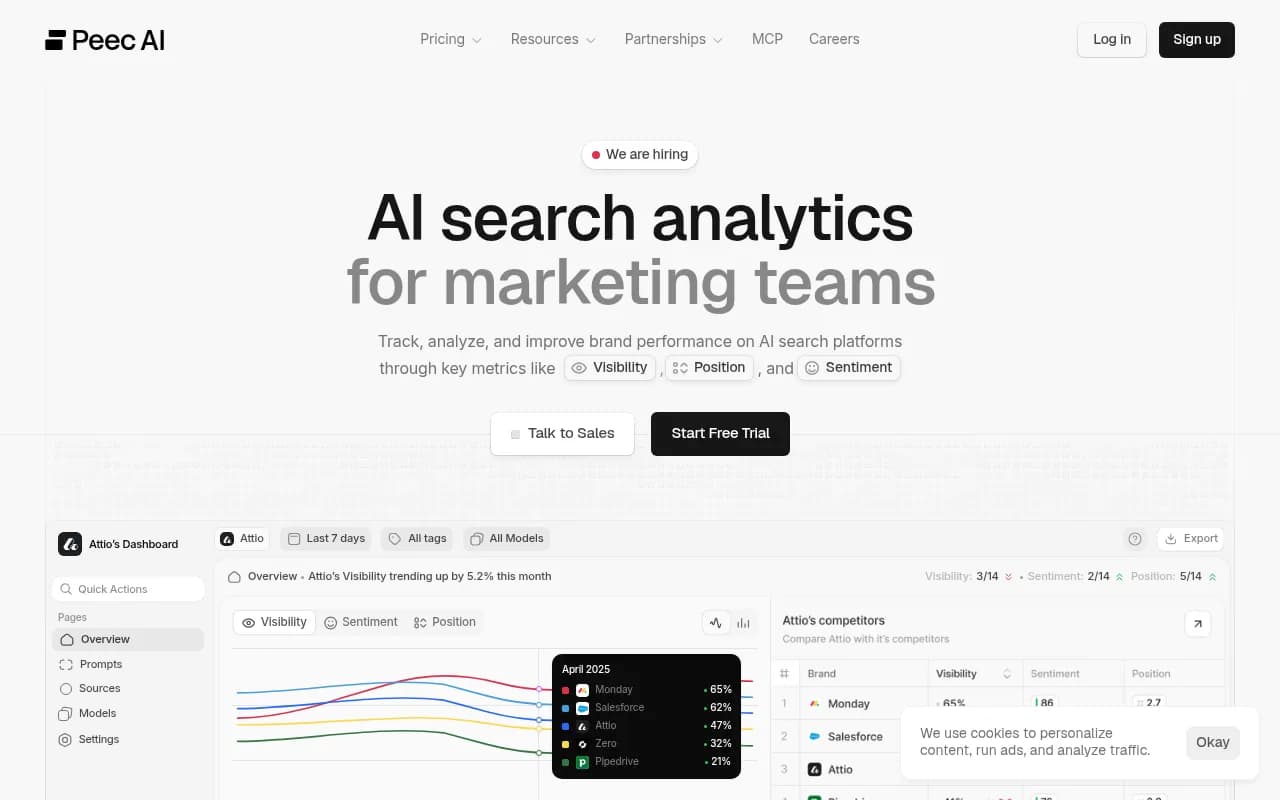
Peec AI provides AI visibility tracking with suggestions for improvement -- a good option for fintechs that want monitoring without a full enterprise contract.

Scrunch AI is worth considering for financial brands that want to monitor AI search across multiple models simultaneously.
Comparison: GEO tools for financial services brands
| Tool | AI models tracked | Content generation | Crawler logs | Best for |
|---|---|---|---|---|
| Promptwatch | 10+ (ChatGPT, Perplexity, Gemini, Claude, Grok, etc.) | Yes (Content Agents) | Yes | Full-cycle GEO: find gaps, create content, track results |
| Conductor | Google AI Overviews, others | No | No | Enterprise brands needing benchmark data |
| BrightEdge | Multiple | Limited | No | Large enterprise SEO + AI search |
| Peec AI | Multiple | No | No | Monitoring-focused fintechs |
| Scrunch AI | Multiple | No | No | Brand and agency monitoring |
| AthenaHQ | Multiple | No | No | Monitoring-focused teams |
The key distinction for financial brands: monitoring tells you where you stand. Optimization tells you what to do about it. Most tools stop at monitoring. Promptwatch's content agents generate articles and briefs grounded in real prompt data -- which matters when your compliance team needs to review every piece before it goes live, because you're starting from content that's already structured around what AI models actually want.
A practical GEO roadmap for financial brands
If you're starting from scratch or trying to prioritize, here's a sequence that makes sense for most financial brands:
Month 1: Audit your current AI visibility. Run your brand name and your core product queries through ChatGPT, Perplexity, and Gemini. Are you being cited? Are competitors? What sources are appearing? This baseline tells you where you actually stand.
Month 2: Identify your winnable prompts. Use a GEO platform to find prompts where competitors are visible but you're not -- specifically prompts that are relevant to your products and where you could plausibly be the authoritative source. Prioritize by prompt volume and difficulty.
Month 3: Build your reference content library. Start with the prompts where you have the clearest right to win: product-specific questions, local queries, regulatory explainers in your area. Get compliance review processes in place before you scale.
Month 4+: Earn third-party citations. Reach out to comparison sites, financial publications, and relevant media with your expertise and data. Guest contributions, expert quotes, and data studies are all effective. A mention in a NerdWallet article or a Forbes Advisor roundup can do more for your AI visibility than a dozen pages on your own site.
Ongoing: Track, update, repeat. Monitor your citation share across AI models monthly. Update your highest-value pages when rates, regulations, or products change. Watch for new prompt types emerging in your category.
The trust equation
There's a reason this is hard for financial brands: trust is the product. A bank that gets cited in an AI answer for "best savings account" is implicitly being endorsed by the AI model. That's valuable. But it also means the AI model is applying real scrutiny to whether your content deserves that citation.
The brands that win in financial services GEO aren't the ones with the biggest marketing budgets or the most aggressive content calendars. They're the ones that have built genuine expertise into their content, maintained accuracy over time, and earned the kind of third-party validation that AI models use as a proxy for trustworthiness.
That's a longer game than most marketing teams are used to playing. But in a category where a wrong answer can cost someone their retirement savings or their home, it's the only game worth playing.
The brands that treat GEO as a credibility investment -- not a traffic hack -- are the ones that will still be winning citations two years from now.