Key takeaways
- Google AI Overviews now appear on a significant share of high-intent queries, making AI visibility tracking a core part of any SEO strategy in 2026.
- Semrush, SE Ranking, and Ahrefs all track AI Overviews to some degree, but they're fundamentally traditional SEO tools with AI features bolted on.
- Promptwatch is purpose-built for AI search visibility and goes further than monitoring -- it helps you identify content gaps and generate content engineered to get cited.
- If your primary goal is ranking in Google AI Overviews (and other AI engines like ChatGPT and Perplexity), the tool you choose matters more than most teams realize.
- For teams already deep in Semrush or Ahrefs, layering a dedicated GEO platform on top is often the most practical path.
Google AI Overviews didn't just add a new box to the search results page. They changed who gets traffic. A page that ranks #3 organically might get zero clicks if the AI Overview answers the question completely -- and cites three other sources instead.
That's the problem most SEO teams are now trying to solve. And the tool question is genuinely complicated, because the four platforms most people reach for -- Promptwatch, Semrush, SE Ranking, and Ahrefs -- were built with very different philosophies.
This guide breaks down exactly what each tool does for Google AI Overviews specifically, where each one falls short, and which makes the most sense depending on what you're actually trying to accomplish.
Why Google AI Overviews require a different approach
Traditional SEO tools track rankings. You put in a keyword, you see your position, you watch it move. That model worked fine when position #1 meant the most visible result on the page.
AI Overviews break that model. Your ranking position no longer predicts whether you get cited. A page at position #7 can appear as a source in an AI Overview while the #1 result gets ignored. The AI is selecting sources based on content quality, topical authority, and how well a page directly answers the question -- not just link equity and on-page optimization signals.
This means you need to track different things:
- Which prompts and questions trigger AI Overviews in your niche
- Whether your pages are being cited as sources in those overviews
- Which competitors are getting cited instead of you
- What content gaps exist between your site and the pages that are getting cited
Most traditional SEO tools were not built to answer these questions. Some have started adding features that get partway there. Let's look at each one honestly.
Semrush: the broadest SEO suite, with AI Overviews tracking added
Semrush is the most feature-complete traditional SEO platform on the market. Its AI Visibility Toolkit, added in 2025, lets you track brand mentions and citations across several AI engines including Google AI Overviews and AI Mode.
Promptwatch aside, Semrush is probably the most capable option here for teams that want everything in one place.
What Semrush does well for AI Overviews:
- Tracks both Google AI Overviews and Google AI Mode
- Integrates AI visibility data alongside your existing keyword rankings, backlink data, and site audit
- Useful for teams that don't want to manage multiple tools
The limitations are real, though. Semrush's AI tracking uses fixed prompts rather than dynamic prompt discovery. That means you're monitoring the prompts you already know about, not uncovering the ones where competitors are beating you. There's no prompt volume data, no difficulty scoring, and no content gap analysis that maps your existing pages against what AI engines are actually citing.
For a team that wants to understand why they're not appearing in AI Overviews and what to do about it, Semrush gets you partway there and then stops.
Pricing: AI Visibility Toolkit is bundled with Semrush plans, which start at $139.95/month for Pro. The toolkit itself is an add-on within the platform.
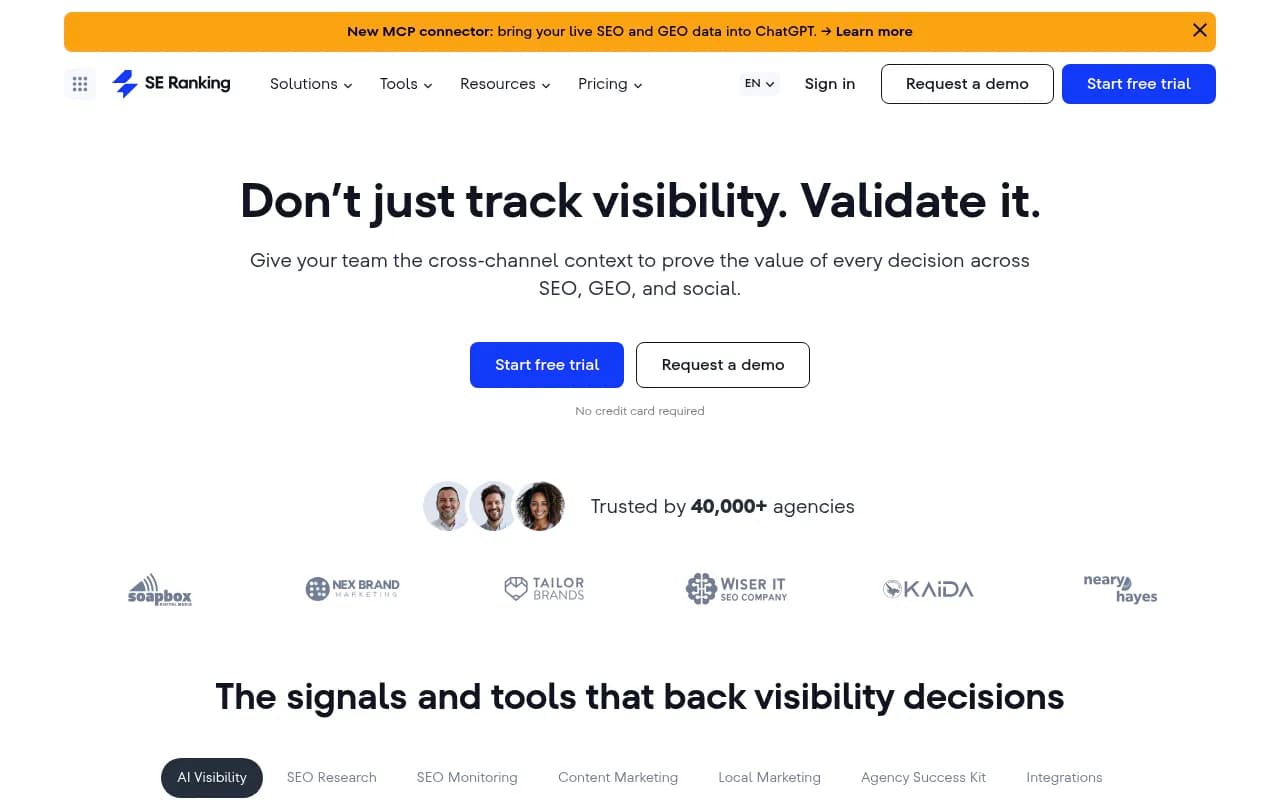
SE Ranking: the mid-market option with a dedicated AI visibility product
SE Ranking has taken an interesting approach: rather than just adding AI features to its core SEO platform, it built a separate product called SE Ranking Visible specifically for AI search monitoring.
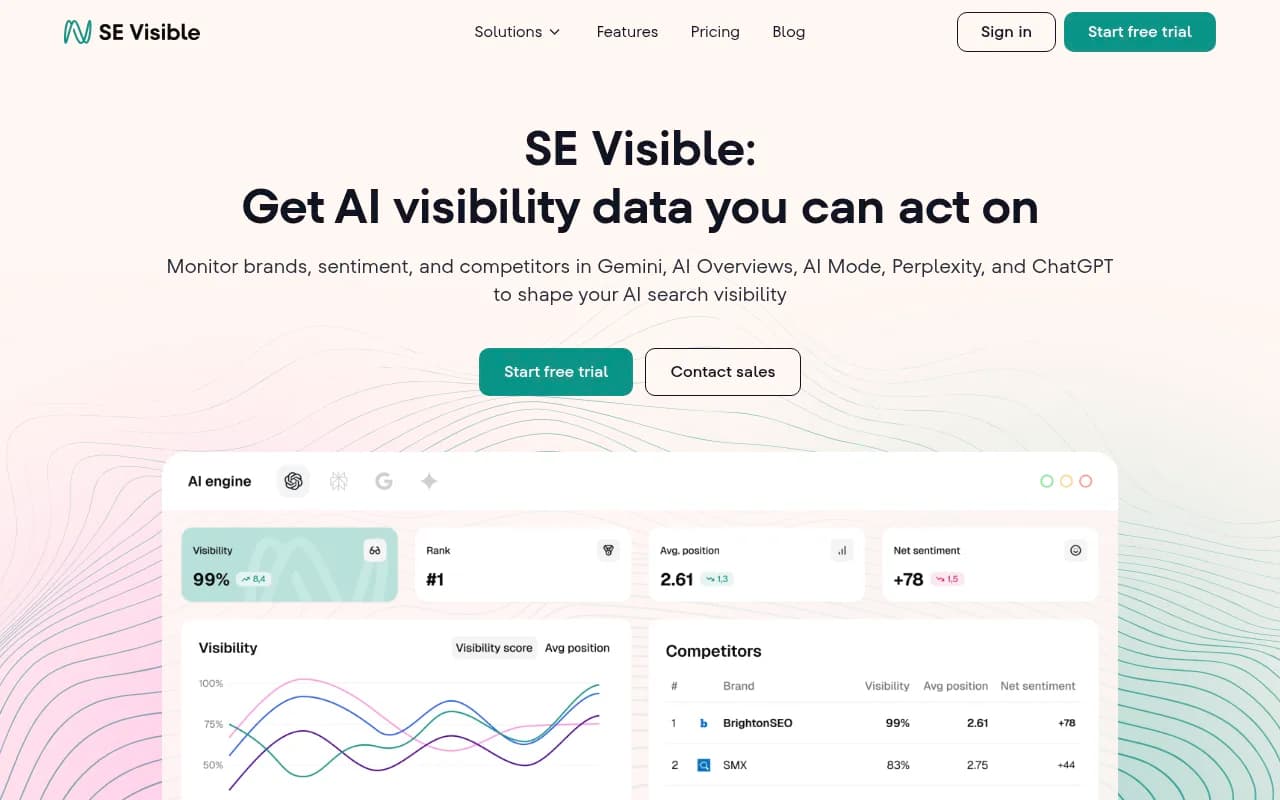
Visible tracks five AI engines and gives you share-of-voice metrics, citation tracking, and competitive comparisons. It's priced at $99/month as a standalone, which makes it one of the more accessible dedicated options.
What works well: SE Ranking's core platform is strong for traditional SEO, and Visible adds a reasonable layer of AI visibility on top. Multi-brand and multi-country support is there, which matters for agencies managing multiple clients.
The gap: Like most monitoring-focused tools, Visible tells you where you stand but doesn't help you improve. There's no content generation, no answer gap analysis, and no crawler log data showing how AI engines are actually interacting with your site. You see the score; you don't get a path to change it.
Ahrefs: strong SEO foundation, limited AI Overviews depth
Ahrefs added Brand Radar in 2025, which tracks brand mentions across AI engines. It's a useful addition to an already excellent backlink and keyword research platform.
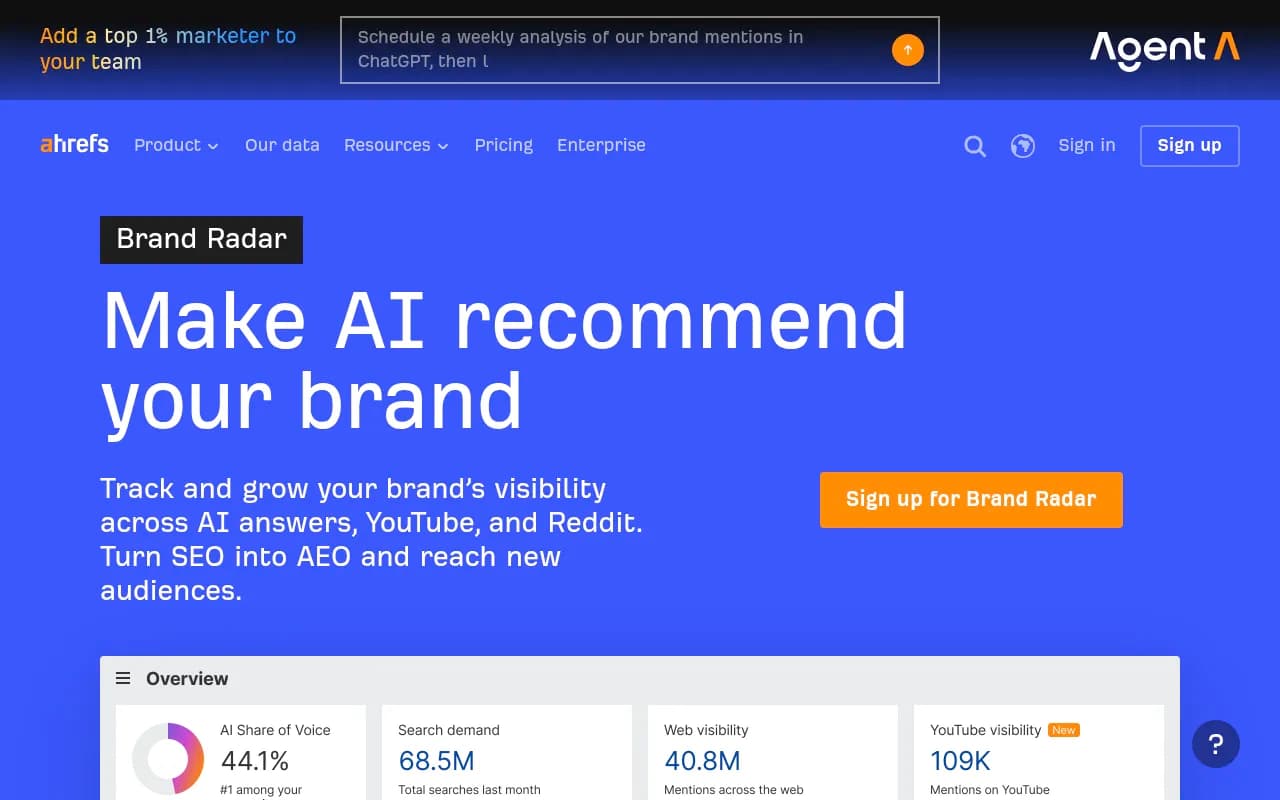
The honest assessment: Ahrefs Brand Radar uses fixed prompts, similar to Semrush. There's no AI traffic attribution -- you can't connect AI visibility to actual site traffic or revenue. The feature set is narrower than what dedicated GEO platforms offer, and there's no content optimization workflow built around AI citation data.
Ahrefs remains the best tool on the market for backlink analysis and technical SEO research. If you're trying to understand your link profile or do deep keyword research, nothing beats it. But for Google AI Overviews specifically, it's a monitoring layer, not an optimization system.
Promptwatch: built specifically for AI search visibility and optimization
Promptwatch is the outlier in this comparison. Where Semrush, SE Ranking, and Ahrefs are traditional SEO tools that added AI visibility features, Promptwatch was built from the ground up to solve the AI search problem.
The core difference is what happens after you see the data. Most tools show you that you're not appearing in AI Overviews for certain prompts. Promptwatch shows you that -- and then helps you fix it.
The workflow works in three stages:
Finding the gaps: Answer Gap Analysis identifies the specific prompts where competitors are getting cited but you're not. You see the exact questions and topics your site isn't answering well enough for AI engines to cite you. This isn't guesswork -- it's based on real prompt data from actual user queries, not a fixed list of keywords you already know.
Creating content that gets cited: Content Agents generate articles, comparisons, and briefs grounded in that prompt data. The output is calibrated to answer the specific gaps AI engines are exposing, not generic SEO content. Each brief includes prompt volumes, difficulty scores, competitor analysis, and brand guidance.
Tracking what changes: Page-level tracking shows which of your pages are being cited, by which AI engines, and how often. Agent Analytics logs show when AI crawlers hit your site, which pages they read, and the timeline from crawl to citation. This is the feedback loop that tells you whether your content changes are actually working.
On Google AI Overviews specifically: Promptwatch monitors all major AI engines including Google AI Overviews and Google AI Mode, with real user-interface tracking rather than API-only queries. This matters because what Google shows in AI Overviews to actual users can differ from what the API returns.
Pricing: $99/month (Essential, 1 site, 50 prompts), $249/month (Professional, 2 sites, 150 prompts, crawler logs), $579/month (Business, 5 sites, 350 prompts). Free trial available.
Head-to-head comparison
| Feature | Promptwatch | Semrush | SE Ranking Visible | Ahrefs Brand Radar |
|---|---|---|---|---|
| Google AI Overviews tracking | Yes | Yes | Yes | Yes |
| Google AI Mode tracking | Yes | Yes | No | No |
| ChatGPT / Perplexity / Claude | Yes (10 models) | 5 models | 5 models | Limited |
| Dynamic prompt discovery | Yes | No (fixed prompts) | No (fixed prompts) | No (fixed prompts) |
| Prompt volume & difficulty scores | Yes | No | No | No |
| Answer gap analysis | Yes | No | No | No |
| AI content generation | Yes | No | No | No |
| AI crawler logs | Yes | No | No | No |
| Page-level citation tracking | Yes | Limited | Limited | No |
| AI traffic attribution | Yes | No | No | No |
| Reddit / YouTube tracking | Yes | No | No | No |
| ChatGPT Shopping tracking | Yes | No | No | No |
| Traditional SEO features | No | Yes (full suite) | Yes (full suite) | Yes (full suite) |
| Starting price | $99/mo | $139.95/mo (bundled) | $99/mo | Bundled with Ahrefs |
The table tells the story pretty clearly. For pure AI Overviews optimization -- finding gaps, creating content, tracking results -- Promptwatch covers ground that the other three don't touch. For traditional SEO work (backlinks, keyword research, technical audits), Semrush and Ahrefs are still the right tools.
Which tool should you actually use?
The answer depends on what problem you're trying to solve right now.
If you're starting from zero on AI visibility: Promptwatch is the most direct path. You'll get prompt discovery, gap analysis, content generation, and tracking in one place. The $99/month entry tier is reasonable for a single site.
If you're already a Semrush power user: The AI Visibility Toolkit is worth exploring as a starting point. But if you find yourself wanting to understand why you're not being cited and what content to create, you'll hit the ceiling quickly. Many teams run Semrush for traditional SEO and Promptwatch for GEO.
If you're primarily an Ahrefs user: Same logic. Ahrefs Brand Radar is a useful addition but thin on its own. For Google AI Overviews specifically, you'll want a dedicated tool alongside it.
If you're an agency managing multiple clients: SE Ranking Visible's multi-brand support is worth noting, but Promptwatch's agency and enterprise tiers cover this too -- with the added benefit of content generation and crawler logs that clients can actually see value in.
If budget is the primary constraint: SE Ranking Visible at $99/month is the most accessible dedicated option. Otterly.AI starts at $29/month if you need something even lighter.
The broader AI visibility tool landscape
These four tools aren't the only options. The dedicated GEO platform space has grown significantly in 2026, with tools like Profound, Peec AI, and others targeting specific segments.
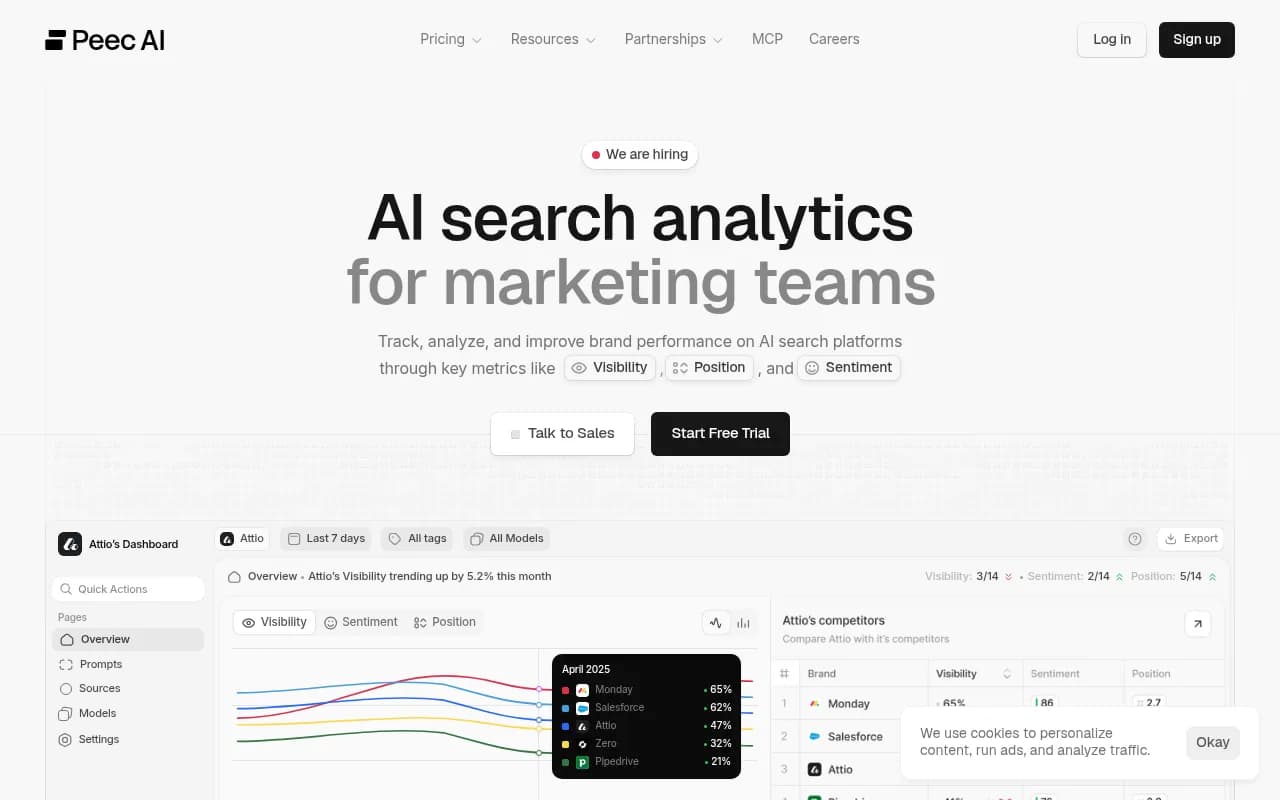
The pattern across the dedicated platforms is similar: most are strong on monitoring and weaker on optimization. Profound has solid enterprise prompt research. Peec AI offers flexible model selection. Neither has the full action loop that Promptwatch built around content gap analysis and generation.
For teams serious about Google AI Overviews, the practical recommendation is a two-tool stack: your existing SEO platform (Semrush or Ahrefs) for traditional search, plus a dedicated GEO platform for AI visibility. That combination covers both surfaces without requiring you to abandon tools your team already knows.
What actually moves the needle in Google AI Overviews
Tracking is only useful if you know what to do with the data. Based on how Google AI Overviews select sources, a few things consistently matter:
Direct answers win citations. Pages that answer a specific question clearly and early in the content get cited more often than pages that bury the answer. AI Overviews are looking for the most direct, accurate response to the query.
Topical depth matters more than keyword density. A page that covers a topic comprehensively -- including related questions, edge cases, and nuances -- tends to get cited across multiple related prompts. Thin pages that target a single keyword rarely appear.
Structured content helps. Headers, lists, and tables make it easier for AI engines to extract specific answers. This isn't new SEO advice, but it's more important than ever when the AI is parsing your page to pull a citation.
Freshness signals. Google AI Overviews tend to favor recently updated content for time-sensitive topics. Regular content refreshes matter.
E-E-A-T signals still apply. Author credentials, citations, and authoritative sources all feed into whether Google trusts your content enough to cite it in an AI Overview.
The gap analysis that tools like Promptwatch surface is essentially a map of where your content fails on these dimensions relative to competitors who are already getting cited.
Bottom line
Semrush, SE Ranking, and Ahrefs are all adding AI visibility features, and for teams already invested in those platforms, those features are worth using. But they're monitoring layers. They tell you where you stand.
Ranking in Google AI Overviews in 2026 requires knowing which prompts you're missing, understanding why competitors are getting cited instead of you, creating content that directly addresses those gaps, and tracking whether it's working. That's an optimization workflow, not just a dashboard.
Promptwatch is the only tool in this comparison built around that full cycle. For teams where AI search visibility is a priority -- not just a metric to report -- that distinction matters.