Ahrefs Review 2026
Comprehensive SEO platform including Ahrefs Brand Radar, which monitors brand visibility in AI-generated search answers alongside its core backlink and keyword tools.
Key takeaways
- Ahrefs is one of the most established SEO platforms available, with genuinely best-in-class backlink data, keyword research, and site auditing tools trusted by major brands like eBay, LinkedIn, and Shopify.
- Brand Radar, its AI search monitoring feature, tracks brand mentions and citations across AI chatbots -- but it uses fixed prompts and lacks AI traffic attribution, making it a monitoring dashboard rather than an optimization tool.
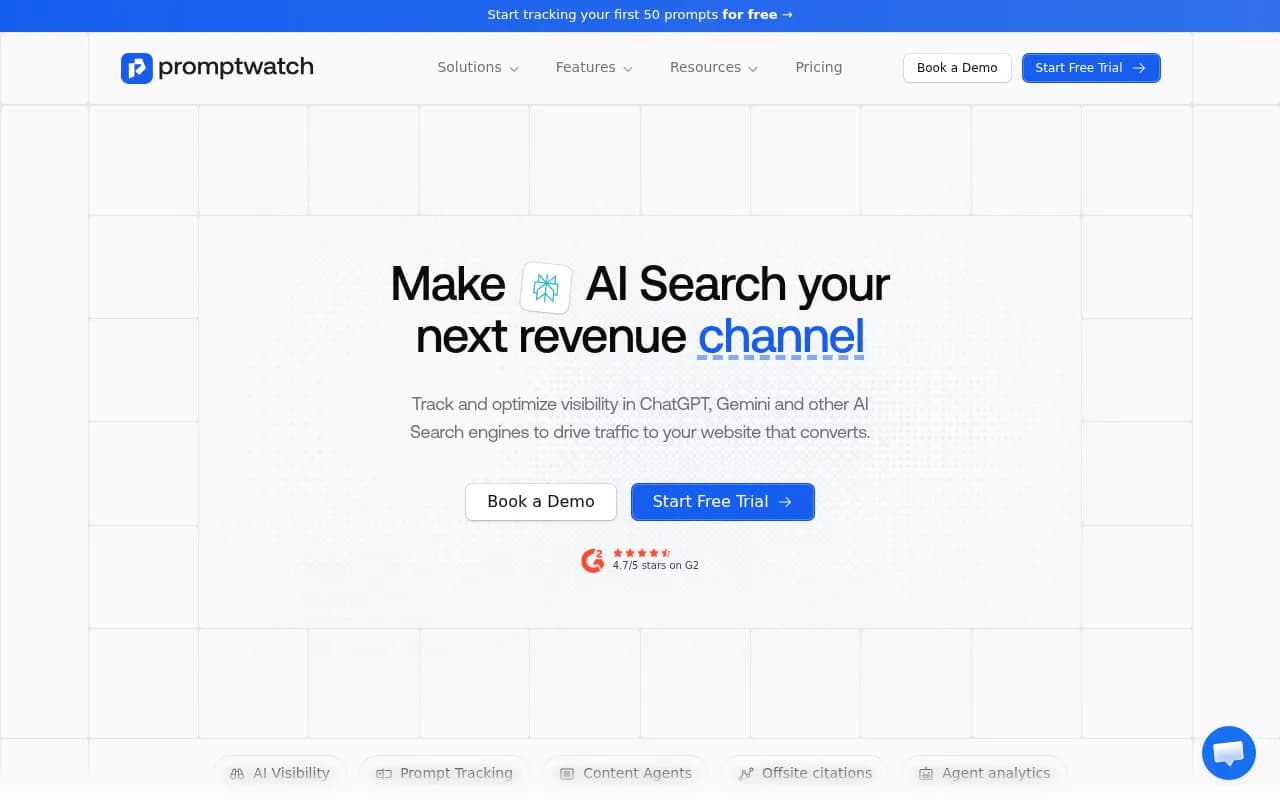
- Compared to dedicated GEO platforms like Promptwatch, Ahrefs Brand Radar has no content gap analysis, no AI content generation, no crawler logs, and no prompt volume or difficulty scoring -- it shows you where you appear but doesn't help you fix where you don't.
- Best suited for SEO teams and agencies who want a single platform for traditional SEO plus basic AI visibility monitoring, rather than teams whose primary goal is winning AI search.
- Pricing starts at $29/month for a Starter plan, with full-featured plans from $129/month.
Ahrefs has been a fixture in the SEO industry since its launch around 2011, built initially around what became one of the web's most comprehensive backlink indexes. Over the years it expanded into keyword research, content analysis, rank tracking, and site auditing, eventually becoming the go-to all-in-one SEO suite for agencies and in-house teams alike. The company is bootstrapped and Singapore-based, which is somewhat unusual for a tool at this scale, and it's been vocal about staying independent.
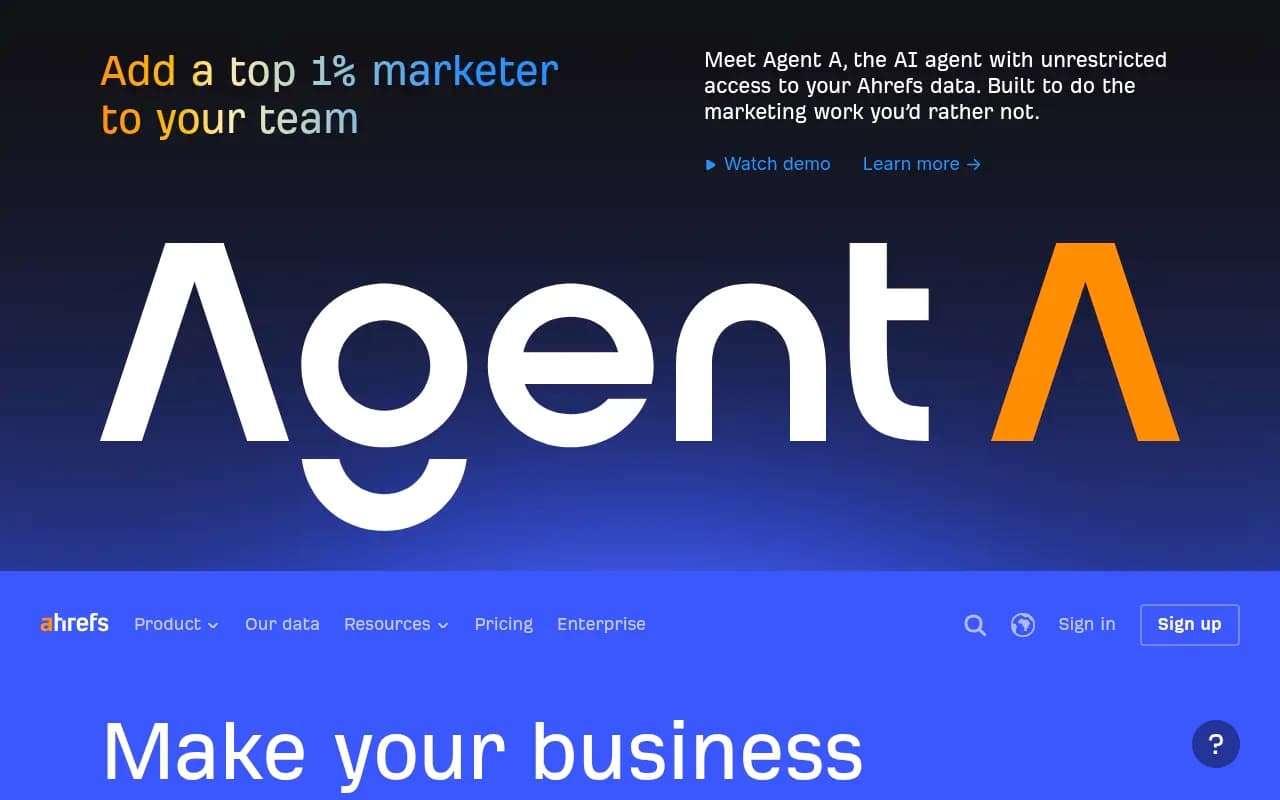
In 2025 and into 2026, Ahrefs made a significant push to reposition itself as an "AI Marketing Platform," adding Brand Radar for AI search monitoring, an AI Content Helper, Bot Analytics, and most recently Agent A, an AI marketing agent with full access to Ahrefs data. The homepage now leads with AI search visibility alongside traditional SEO. Whether that repositioning holds up in practice is worth examining closely, because the core SEO toolset and the newer AI features are at very different levels of maturity.
The target audience is broad: content marketers, SEO specialists, PPC teams, agencies, and now AEO (Answer Engine Optimization) specialists. Marketers at 44% of Fortune 500 companies reportedly use Ahrefs, and the platform claims 22,894 new users joined in a single week. Those numbers suggest it's genuinely mainstream, not niche.
Key features
Site Explorer is still the heart of Ahrefs and the reason most people sign up. It gives you a full backlink profile for any domain or URL -- referring domains, anchor text distribution, link growth over time, and broken links. The index is updated frequently and is widely considered one of the two or three most complete backlink databases available. You can drill into competitor backlink profiles, find link-building opportunities, and track your own link acquisition. In practice, it's fast and the data is reliable enough that most SEO professionals treat it as a source of truth.
Keywords Explorer covers keyword research across Google, Bing, YouTube, Amazon, and several other search engines. It shows search volume, keyword difficulty, click-through rate estimates, and SERP analysis. The "Traffic Potential" metric is particularly useful -- it estimates total traffic a page could get by ranking for a keyword and all its variants, not just the exact match. Compared to Semrush's keyword tool, Ahrefs tends to be more conservative with volume estimates, which many practitioners actually prefer because it avoids chasing inflated numbers.
Rank Tracker monitors keyword rankings over time across desktop and mobile, with support for 217+ countries and local tracking down to city level. It also includes SERP feature tracking, so you can see if you're winning featured snippets, image packs, or People Also Ask boxes. The AI search visibility component here is limited -- it tracks traditional SERP positions, not AI answer appearances.
Brand Radar is Ahrefs' answer to the growing demand for AI search monitoring. It tracks your brand's mentions, citations, and sentiment across AI chatbots including ChatGPT, Perplexity, and others. You can see which prompts surface your brand, how often you're cited, and how competitors compare. The limitation worth knowing: Brand Radar uses fixed prompts rather than letting you define custom prompt sets, and there's no traffic attribution connecting AI citations to actual website visits. It's a visibility dashboard, not an optimization loop. You can see the data, but the platform doesn't tell you what content to create to improve your position.
Site Audit crawls your website and surfaces technical SEO issues -- broken links, slow pages, missing meta tags, duplicate content, redirect chains, and more. The "AI Tech SEO" feature and "Patches" tool are newer additions that let you deploy technical fixes without developer involvement, which is genuinely useful for marketing teams without engineering resources. Bot Analytics is also here, showing which bots are crawling your site, though it's less detailed than dedicated crawler log analysis tools.
Content Explorer lets you search a database of billions of web pages to find high-performing content in any niche. Filter by traffic, backlinks, social shares, and publication date. It's useful for content ideation, finding link prospects, and understanding what's resonating in a given topic area. The AI Content Helper and AI Content Grader sit alongside this, helping you write and optimize content for both search and AI answers.
Agent A is the newest and most ambitious feature. It's an AI marketing agent with full access to your Ahrefs data -- not a filtered API, but the full dataset. You can switch between Claude, Gemini, and other underlying models depending on the task. In theory, it can run keyword research, analyze competitors, and surface insights without you manually pulling reports. It's early-stage but the concept is sound, and having unrestricted data access is a real differentiator compared to generic AI assistants.
Social Media Manager is a newer addition that lets you create, schedule, and publish social posts, monitor brand mentions, and identify influencer partnerships. It's not the primary reason anyone buys Ahrefs, but it rounds out the platform for teams who want fewer tools in their stack.
Reporting and dashboards include a Report Builder, Portfolios for managing multiple sites, and Looker Studio integration. Enterprise customers get 100+ API endpoints for custom dashboards and integrations with ChatGPT, Claude, or Copilot as marketing analysts.
Who is it for
Ahrefs is best suited for SEO-first teams who want one platform that handles the full traditional SEO workflow -- backlinks, keywords, technical audits, rank tracking -- and are starting to think about AI search visibility as a secondary concern. A typical power user is an in-house SEO manager at a mid-size company tracking 200-500 keywords, or an agency managing 10-30 client sites who needs reliable data across all of them. The depth of the backlink and keyword data makes it hard to replace for these use cases.
Content marketing teams at SaaS companies and ecommerce brands also get a lot of value from Content Explorer and Keywords Explorer together. Finding content gaps, identifying what competitors rank for, and building topic clusters is genuinely faster in Ahrefs than in most alternatives. The AI Content Helper adds a layer of optimization that's useful for teams publishing at volume.
Enterprise teams at Fortune 500 companies use Ahrefs for competitive intelligence -- tracking competitor organic strategies, monitoring market share in search, and feeding data into custom dashboards via the API. The ISO27001 certification and SSO support make it viable for larger organizations with security requirements.
Who should probably look elsewhere: teams whose primary goal is winning AI search visibility. If you're an AEO specialist or a brand that's specifically trying to improve how ChatGPT, Perplexity, or Claude recommends you, Ahrefs Brand Radar gives you monitoring but not optimization. You'll see the problem but won't get much help solving it. Similarly, small businesses or solo operators who only need basic SEO might find the pricing and complexity more than they need.
Integrations and ecosystem
Ahrefs integrates with Google Search Console for organic traffic data, and the Enterprise tier connects to ChatGPT, Claude, and Copilot for AI-assisted analysis. The API has 100+ endpoints, making it viable for custom reporting pipelines and internal tooling.
There's a Looker Studio integration for custom dashboards, and the platform supports data export in CSV format across most reports. The newer Patches feature integrates directly with your website for deploying technical SEO fixes without code changes.
Ahrefs Academy, certification programs, a blog with detailed guides, webinars, and a YouTube channel with tutorial content make up a substantial learning ecosystem. The private Facebook community (Ahrefs Insider) is active. Customer support runs 5 days a week with a 91.2% satisfaction rating and a median first response time under 6 minutes, which is notably fast for a platform at this scale.
There's no native Slack integration or project management tool connection, which can be a friction point for agencies who want to pipe alerts into team workflows.
Pricing and value
- Free / Ahrefs Webmaster Tools: Free access to Site Audit and Site Explorer for your own verified domains. Genuinely useful for small sites and a good way to evaluate the data quality before committing.
- Starter: $29/month. Aimed at SEO beginners going beyond the basics. Limited credits and features.
- Lite: $129/month. Core tools with limits on tracked keywords, crawl credits, and historical data. Suitable for freelancers and small agencies.
- Standard: $249/month. More keywords, more crawl credits, more historical data. The most popular tier for growing teams.
- Advanced: $449/month. Adds more seats, higher limits, and advanced features like Portfolios.
- Enterprise: Custom pricing. Full API access, SSO, higher limits, dedicated support.
Annual billing saves 20% across all plans. Compared to Semrush, which starts at $139.95/month for its Pro plan, Ahrefs is slightly cheaper at equivalent tiers. Compared to dedicated GEO platforms, Ahrefs is more expensive if AI search monitoring is your primary need -- Promptwatch starts at $99/month and goes deeper on AI visibility specifically.
The value proposition is strongest if you're using the full SEO suite. If you're paying $249/month primarily for Brand Radar, you're overpaying for what you get relative to purpose-built AI monitoring tools.
Strengths and limitations
What Ahrefs does well:
- The backlink index is genuinely one of the best available. Ahrefs claims the #1 SEO crawler ranking per Cloudflare Radar, and the data quality reflects that.
- Keywords Explorer is thorough and the Traffic Potential metric is more useful than raw search volume for content planning.
- Site Audit is reliable and the new Patches feature for no-code technical fixes is a real time-saver for marketing teams.
- The learning resources (Academy, blog, YouTube) are among the best in the SEO industry. New users can get productive quickly.
- Agent A is an interesting bet on AI-assisted marketing workflows, and having full data access rather than a filtered API is the right architectural choice.
Where it falls short:
- Brand Radar uses fixed prompts, which means you can't track the specific questions your customers are actually asking AI tools. You're monitoring a preset list, not your real competitive landscape.
- There's no AI traffic attribution. You can see that an AI model cited you, but you can't connect that citation to actual website visits or revenue. This is a significant gap for teams trying to justify GEO investment.
- No content gap analysis for AI search. Ahrefs can show you content gaps in traditional SEO, but it doesn't tell you which prompts competitors are winning in AI answers that you're missing. That's the core of what dedicated GEO platforms do.
- No AI crawler logs in the depth that specialized tools provide. Bot Analytics shows crawler activity, but it doesn't give you the page-level detail of which AI agents read which pages, how often they return, or when a crawled page becomes a citation.
- The platform is large and can feel overwhelming. Teams who only need AI visibility monitoring are paying for a lot of SEO infrastructure they may not use.
Bottom line
Ahrefs remains the strongest all-in-one SEO platform for teams who live in traditional search -- backlinks, keywords, technical audits, rank tracking. If that's your core workflow and you want to add basic AI search monitoring on top, Brand Radar is a reasonable addition without switching tools.
But if AI search visibility is your primary concern, Ahrefs is not the right tool. Brand Radar is a monitoring dashboard with fixed prompts and no optimization capabilities. Teams that need to understand why they're not being cited by ChatGPT or Perplexity, identify content gaps, generate content to fill those gaps, and track the results need a dedicated GEO platform. Promptwatch covers that full loop -- from gap analysis to content generation to citation tracking -- in a way Ahrefs currently doesn't.
Best use case: SEO agencies and in-house teams managing organic search who want one platform for the full traditional SEO workflow, with AI monitoring as a secondary capability.
Tags:
Frequently asked questions
What is Ahrefs?
How much does Ahrefs cost?
Does Ahrefs track AI search visibility?
How does Ahrefs compare to dedicated GEO platforms like Promptwatch?
Is there a free version of Ahrefs?
What is Agent A in Ahrefs?
Similar and alternative tools to Ahrefs