SE Ranking Review 2026
All-in-one SEO and AI search visibility tool tested for both traditional SEO and generative engine optimization, with keyword tracking and AI answer monitoring.
Key takeaways
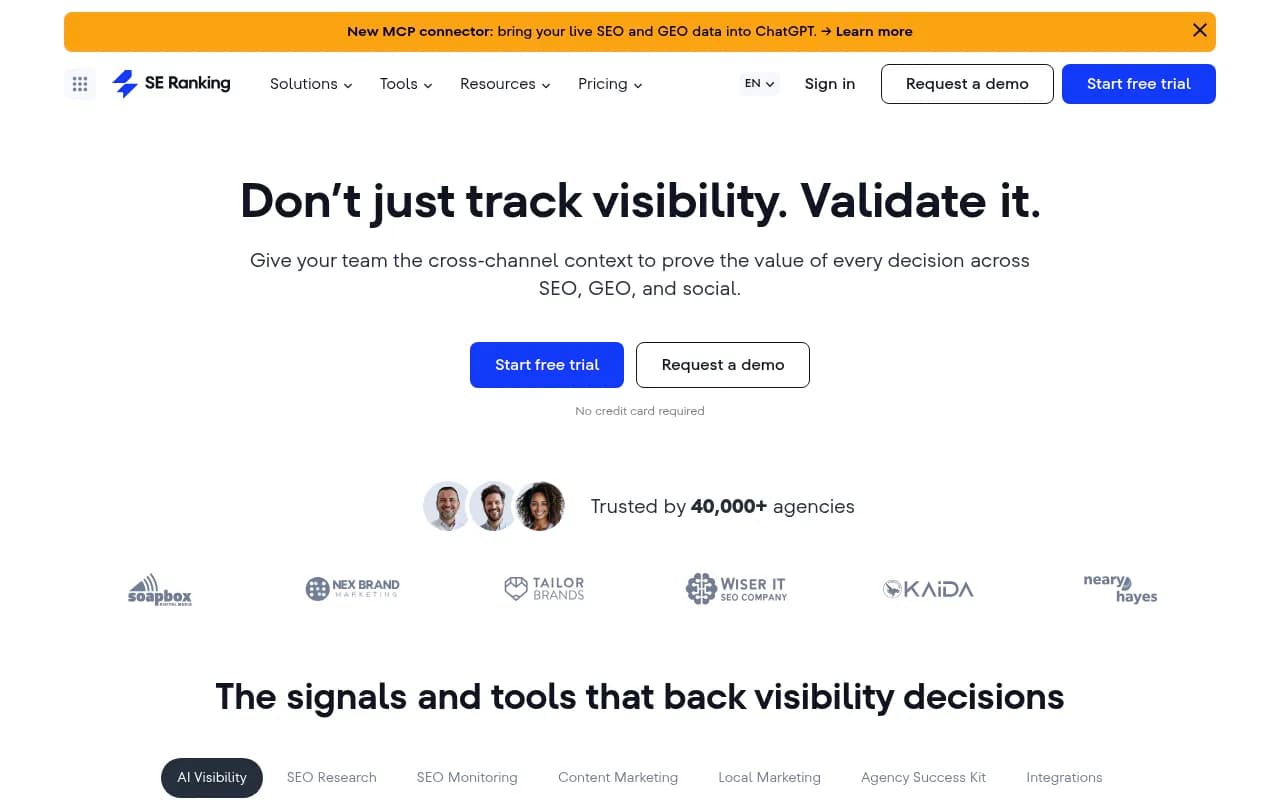
- SE Ranking is a mature, full-featured SEO platform that has expanded into AI visibility monitoring (GEO) through its SE Visible product, covering ChatGPT, Gemini, Perplexity, Google AI Overviews, and Google AI Mode.
- Monitoring-focused on the GEO side: the AI visibility features track where your brand appears in AI answers but lack the content gap analysis, AI content generation, AI crawler logs, and traffic attribution that Promptwatch provides -- making SE Ranking a tracker rather than an optimizer for GEO.
- Strong value for agencies: white-label reporting, client seats, a lead generator, and an agency catalog make it one of the more complete agency toolkits in the SEO space.
- Pricing starts at $103.20/mo for the Core plan, with AI Search features available as a paid add-on from $71.20/mo -- meaning GEO monitoring costs extra on top of the base subscription.
- Best suited for SEO-first teams that want one platform for traditional search and want to dip a toe into AI visibility, rather than teams whose primary goal is GEO optimization.
SE Ranking has been around since 2013, built initially as a rank tracker and gradually expanding into a full SEO suite. By 2026 it serves over 40,000 agencies across 150+ countries, which is a real number -- not a rounding-up-to-the-nearest-ten-thousand situation. The platform has grown to cover keyword research, competitive analysis, backlink monitoring, site audits, content tools, local SEO, and now AI visibility through a companion product called SE Visible. That last addition is the most interesting development in recent years, as the company has clearly recognized that traditional SERP rankings are no longer the only game in town.
The target audience is primarily SEO agencies and in-house SEO teams at small to mid-sized companies. The pricing, the white-label features, the client seat system, and the agency catalog all point to a product built around the agency workflow. That said, solo consultants and in-house marketers at growth-stage companies use it too -- the interface is clean enough that you don't need a dedicated SEO analyst to get value from it.
Key features
Rank tracker is the historical core of SE Ranking and still one of its strongest modules. You can track keyword positions across Google, Bing, Yahoo, and YouTube, with daily or on-demand updates. The tracker supports local rank tracking down to city level, which matters for agencies running local SEO campaigns. Historical data goes back to the start of your project, and you can segment keywords by tags, groups, or landing pages. Compared to Semrush's rank tracker, SE Ranking's is slightly less granular on SERP feature tracking but significantly cheaper at equivalent keyword volumes.
AI Visibility Tracker (SE Visible) is SE Ranking's answer to the GEO monitoring wave. Through the SE Visible product, you can monitor how your brand appears in responses from ChatGPT, Gemini, Perplexity, Google AI Overviews, and Google AI Mode. The tracker shows mention frequency, sentiment, and which competitors appear alongside you. There are dedicated sub-trackers for ChatGPT specifically and for AI Overviews, which is useful given how differently those two surfaces behave. The limitation here is that this is monitoring, not optimization -- you can see that you're not being cited, but SE Ranking doesn't tell you why or what content to create to fix it.
Keyword research and competitive analysis covers a database of 5.4 billion keywords across 188 country databases. The keyword suggestion tool surfaces related terms, questions, and long-tail variants. The competitive research module lets you analyze any domain's estimated traffic, top keywords, and traffic value -- useful for prospecting and for benchmarking client performance. The data quality is generally solid, though volume estimates for lower-traffic keywords can be imprecise (this is an industry-wide issue, not unique to SE Ranking).
Backlink checker and monitor gives you a view of any domain's backlink profile, including referring domains, anchor text distribution, and domain authority scores. The backlink monitor alerts you when new links are gained or lost, which is genuinely useful for link-building campaigns. The database is smaller than Ahrefs' or Majestic's, but for most agency use cases it's sufficient.
Website audit crawls your site and surfaces technical SEO issues across categories like crawlability, page speed signals, structured data, and Core Web Vitals. The audit produces a prioritized list of issues with explanations and fix recommendations. It's not as deep as Screaming Frog for technical audits, but it's more than adequate for routine site health checks and client reporting.
Content marketing tools include a Content Editor that scores your content against top-ranking pages for a given keyword, an AI Writer for generating drafts, and a Content Marketing platform for managing content workflows. The Content Editor is the most useful of these -- it pulls NLP terms from top-ranking pages and shows you which ones your draft is missing. The AI Writer produces generic output and is more useful as a starting point than a finished product.
Local marketing covers local rank tracking (down to specific zip codes or neighborhoods), Google Business Profile monitoring, and local citation management. For agencies running local SEO for restaurants, clinics, or retail chains, this is a meaningful differentiator over tools that treat local as an afterthought.
Agency Success Kit bundles white-label reporting, client seats, a lead generator widget you can embed on your own website, and a listing in SE Ranking's agency catalog. The white-label option lets you present the platform under your own brand and domain, which is a real selling point for agencies that want to look like they've built proprietary tooling. The lead generator is a nice touch -- it's a free SEO audit widget you can embed on your site to capture prospect emails.
API and integrations include connections to Google Analytics 4, Google Search Console, Google Data Studio (Looker Studio), Whatagraph, Agency Analytics, Make.com, n8n, Zapier, and Matomo. There's also an MCP connector that lets you query SE Ranking data inside Claude, ChatGPT, or other AI assistants by describing what you need in plain language. The API provides access to rankings, keywords, backlinks, and AI visibility data, with credit-based pricing that varies by plan.
Who is it for
SE Ranking fits best for SEO agencies managing 5-50 client projects who need a single platform that covers the full SEO workflow without paying Semrush or Ahrefs prices. The agency-specific features -- white label, client seats, lead generator, agency catalog -- are clearly designed for this audience, and the pricing scales reasonably as you add projects. An agency running 20 client sites with regular reporting needs will find the Growth plan ($223.20/mo) covers most of what they need.
In-house SEO teams at SMBs are the second major audience. If you're the sole SEO at a company with a modest budget, SE Ranking gives you rank tracking, keyword research, backlink monitoring, and site audits in one place at a price that's hard to argue with. The interface is clean enough that non-specialists can navigate it, which matters when you're presenting data to a marketing director who doesn't live in SEO tools.
Teams exploring AI visibility will find SE Ranking's GEO features useful as a starting point. If you're already using SE Ranking for traditional SEO and want to add basic AI mention monitoring without switching platforms, the AI Search add-on makes sense. But if AI visibility is your primary concern -- if you're trying to actively improve how AI models describe and cite your brand -- SE Ranking's monitoring-only approach will leave you wanting more.
Who should look elsewhere: enterprise SEO teams that need deep technical crawl capabilities (Screaming Frog or Botify are better fits), teams whose primary goal is GEO optimization rather than monitoring (the content gap analysis and content generation tools aren't there), and anyone who needs Reddit or YouTube citation tracking to understand what's driving AI recommendations.
Integrations and ecosystem
SE Ranking connects to the tools most SEO agencies already use:
- Google ecosystem: GA4, Google Search Console, Google Data Studio (Looker Studio)
- Reporting platforms: Whatagraph, Agency Analytics
- Automation: Make.com, n8n, Zapier
- Analytics: Matomo
- AI assistants: Claude, ChatGPT (via MCP connector)
- Social: Planable (SE Ranking's sister product for social media management)
The MCP integration is worth calling out specifically. Being able to ask "what are my top 10 ranking keywords for this client this month?" inside Claude and get a structured answer from SE Ranking's data is genuinely useful for agencies that are building AI-assisted workflows. It's one of the more forward-thinking integrations in the SEO tool space right now.
The API is credit-based. Core plan users get 25,000 credits/month, Growth and Enterprise users get 100,000 credits/month, and additional API credits are available as an add-on from $149/mo. There's a GitHub presence (github.com/seranking) for developer resources.
No native mobile app was found, but the web interface is responsive enough for basic monitoring on mobile.
Pricing and value
SE Ranking uses a tiered subscription model with optional add-ons:
- Core plan: from $103.20/mo -- covers rank tracking, keyword research, backlink analysis, site audit, content tools, and basic reporting. Suitable for solo consultants or small agencies.
- Growth plan: from $223.20/mo -- adds project lifetime historical data, API access (300k credits), and multi-client workflow features. This is the sweet spot for most agencies.
- Enterprise: custom pricing for larger teams.
Add-ons are priced separately:
- Agency Pack: from $69/mo -- white label, lead generator, client seats, agency catalog listing.
- AI Search (SE Visible): from $71.20/mo -- the GEO monitoring features for ChatGPT, Gemini, Perplexity, AI Overviews, and AI Mode.
- API: from $149/mo for additional API credits beyond what's included in your plan.
So a Growth plan agency that wants AI visibility monitoring and the Agency Pack is looking at roughly $363/mo before any API add-ons. That's competitive with Semrush's agency-tier pricing, and SE Ranking generally offers more features per dollar for the core SEO workflow.
A 14-day free trial is available with no credit card required, which is full access to the platform -- not a stripped-down demo.
Compared to Semrush ($139.95-$499.95/mo) and Ahrefs ($129-$449/mo), SE Ranking is meaningfully cheaper for comparable core SEO features. The GEO monitoring add-on is priced similarly to standalone tools like Otterly.AI, but with less depth on the AI visibility side.
Strengths and limitations
What SE Ranking does well:
- The breadth of the core SEO toolkit is impressive for the price. Rank tracking, keyword research, backlink monitoring, site audit, content tools, and local SEO in one platform at under $200/mo is genuinely good value.
- The agency workflow features are among the best in the mid-market SEO tool space. White label, client seats, lead generator, and the agency catalog together form a real business development toolkit.
- The MCP integration and API flexibility show that SE Ranking is thinking about how agencies actually work in 2026, not just how they worked in 2019.
- The 14-day full-access trial with no credit card is a low-friction way to evaluate the platform properly.
Where it falls short:
- The GEO/AI visibility features are monitoring-only. SE Ranking can tell you that your brand appeared in 23% of ChatGPT responses for a given prompt set, but it can't tell you which content gaps are causing you to miss the other 77%, generate content to fill those gaps, or show you AI crawler logs to understand how AI engines are reading your site. For teams that want to actively improve AI visibility rather than just track it, this is a significant gap compared to dedicated GEO platforms like Promptwatch.
- No Reddit or YouTube citation tracking. A meaningful share of AI recommendations are influenced by Reddit discussions and YouTube content, and SE Ranking doesn't surface this data at all.
- No AI traffic attribution. You can see that your brand is mentioned in AI answers, but SE Ranking doesn't connect those mentions to actual website traffic or revenue. Knowing you're cited is useful; knowing it drove 400 visits last month is actionable.
- No prompt volume or difficulty scoring for GEO. You can't prioritize which prompts to target based on how often real users ask them or how competitive they are in AI search.
- No AI crawler logs. You can't see which pages AI crawlers are reading, how often they return, or whether they're encountering errors -- which means you're flying blind on the technical side of AI indexing.
Bottom line
SE Ranking is a well-built, fairly priced SEO platform that makes a lot of sense for agencies and in-house SEO teams who want comprehensive traditional search coverage without paying enterprise prices. The recent addition of AI visibility monitoring through SE Visible is a genuine step forward, and the agency toolkit (white label, lead gen, client seats) is one of the better implementations in the mid-market.
The honest caveat: if AI search visibility is your primary concern in 2026, SE Ranking's GEO features are a starting point, not a destination. The monitoring is there, but the optimization layer -- content gap analysis, AI content generation, crawler logs, traffic attribution -- isn't. For teams that need to move from "we can see we're invisible" to "here's what we're doing about it," Promptwatch is the more complete solution.
Best use case: SEO agencies managing multiple client projects who want one platform for traditional SEO with basic AI visibility monitoring layered on top.
Frequently asked questions
What is SE Ranking?
Does SE Ranking track AI search visibility?
How much does SE Ranking cost?
Is there a free trial for SE Ranking?
Who is SE Ranking best for?
How does SE Ranking compare to Semrush and Ahrefs?
Similar and alternative tools to SE Ranking