Omnibound Review 2026
Tracks buyer prompts and citation visibility across ChatGPT, Perplexity, Gemini, Claude, and Google AI Mode for B2B growth teams.
Key takeaways
- Omnibound is built for B2B teams that want AI search visibility tied to CRM pipeline, not just a mention dashboard. Its main idea is generating prompts from real buyer conversations (sales calls, CRM notes, support tickets) instead of keyword guesses.
- Compared with Promptwatch, it lacks IP-verified AI crawler logs, prompt volume and difficulty scoring, query fan-outs, Reddit/YouTube/LinkedIn citation reports, AI Shopping and Ads Radar, Search Console and Bing overlays, and an agentic Content Agent with direct CMS publishing.
- Coverage is five engines (ChatGPT, Perplexity, Gemini, Claude, Google AI Mode). That is mid-table, and Omnibound has no tracking of Copilot, Alexa, Grok, DeepSeek or coding agents.
- No public pricing, no pricing page (it returns a 404), and no independent user reviews. Capterra shows 0 reviews. Expect a sales call before you learn the cost.
- Best for mid-market and enterprise B2B marketing teams that already report pipeline in Salesforce or HubSpot. Poor fit for anyone who wants a self-serve tracker with listed prices.
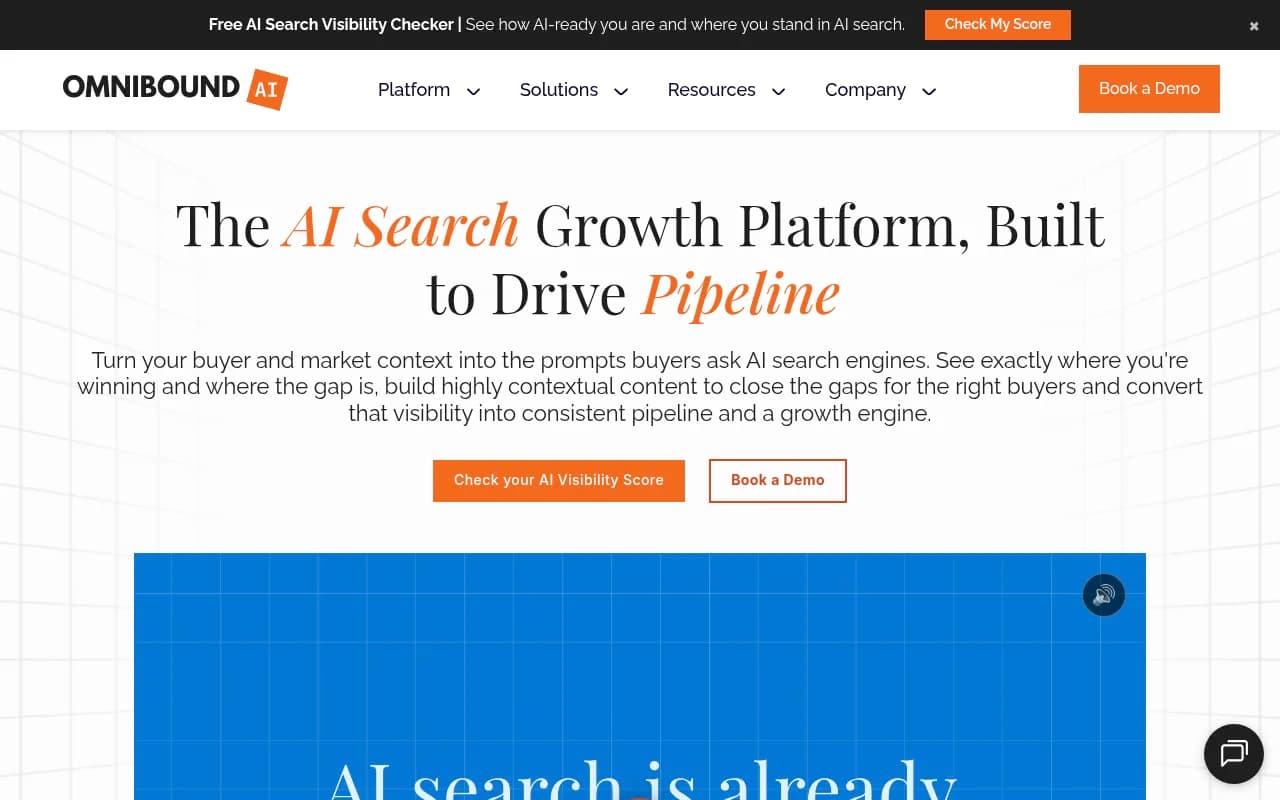
Omnibound is a B2B-focused AI search visibility and growth platform that pitches itself as more than a tracker. The company's argument is simple: most tools in this category guess at buyer prompts from keywords, produce generic content, and never explain whether AI visibility leads to revenue. Omnibound tries to cover the whole chain, from collecting buyer context to tracking citations to producing content to connecting results with Google Analytics and a CRM.
It is aimed at B2B marketing and revenue teams, particularly SaaS and services companies with a long sales cycle and a CRM full of call recordings and notes. The product sits in the AEO and GEO space, and Capterra lists it under AI Search Visibility and Marketing Automation. It has also published its own roundup of 22 AEO tools, where it places itself first, so read that comparison with the obvious bias in mind.
There is very little independent evidence about it. I found no user reviews on Capterra, G2 or Reddit, so most of what follows rests on Omnibound's own materials and one third-party review from SaaSInsight. I flag vendor claims as claims.
Key features
Marketing context layer. This is the part that makes Omnibound different on paper. It ingests customer and market signals: sales and customer calls, CRM notes, support tickets, reviews, competitor sites and industry trends. It then verifies and unifies them into a single source of intelligence that drives everything else.
- Call and meeting sources include Gong, Clari Copilot, Zoom, Google Meet, Microsoft Teams, Fireflies, Fathom, Apollo, Sybill and RingCentral.
- Support sources include Zendesk, Zoho Desk, Intercom and HubSpot tickets.
- Document stores include Google Drive, Notion, Box, Dropbox and OneDrive.
- Review sites include G2, Capterra and TrustRadius.
The idea is sound. Real sales conversations contain the language buyers actually use. Whether the extracted prompts are better than well-built synthetic ones is a vendor claim that nobody has independently tested.
AI search intelligence. Omnibound tracks citation visibility per prompt and per engine across ChatGPT, Perplexity, Gemini, Claude and Google AI Mode. You see where you appear, where competitors appear instead, and where you are missing. Promptwatch tracks 15+ engines through real user interfaces, with country and language targeting, so Omnibound's five-engine coverage is narrower.
Scored content opportunities. The platform combines buyer context (conversations and pain points) with prompt gaps and competitor citations to surface scored opportunities. It then generates structured content for blog posts, articles and social posts, for each buying stage. This resembles Promptwatch's content gap analysis, though the scoring methods are not documented publicly.
Content audit and refresh grid. Omnibound audits existing pages against the prompts your buyers ask and shows which pages earn citations. The Content Refresh Grid analyzes the whole site against content and engagement signals to flag pages needing work. There is also a pre-publication audit that estimates whether a piece is strong enough to earn a citation. Promptwatch offers Content Refresh with git-diff-style updates and weekly 21-check site audits, plus page-level crawl-to-citation tracking that Omnibound does not describe.
AI authority building and offsite opportunities. The platform surfaces third-party articles, blogs and roundups that AI cites most in your category, then lets you approve outreach targets. It also finds citations in reviews, community threads and YouTube. This is useful, though Promptwatch has dedicated Reddit, YouTube and LinkedIn citation reports and Offsite Mentions that catch brand names inside cited pages even without a link.
Pipeline measurement. Omnibound connects citation and sentiment data to Google Analytics, your CRM and marketing automation. It says each AI-referred session is tagged by engine and prompt and then followed into the CRM. SaaSInsight did not validate that workflow, so ask for a live demo of it. This is the feature that most separates Omnibound from pure monitors, and it is where I would focus any evaluation.
AI content workflows and multi-language. You can build whole content campaigns, manage localized brand voices and translate content for different regions. A human-feedback AI Training feature lets you tune the output step by step.
Key Alerts. You get notifications when a competitor gains citation ground on a prompt that matters, or when an opportunity opens that you can claim first.
Free AI Search Visibility Checker. A no-account scan of how AI-ready your site is. It is a handy way to try the product's framing before talking to sales.
Who is it for
The sweet spot is a B2B SaaS or services company with a demand-gen team of roughly 5 to 30 people, a CRM such as Salesforce or HubSpot that holds real pipeline data, and a library of Gong or Zoom recordings nobody is mining. A VP of marketing who must justify spend on AI search to a CFO will like the CRM linkage. A content lead who is tired of publishing generic articles will like the buyer-context approach.
Enterprise buyers get SOC 2 Type II compliance, a published SLA with 99.5% monthly uptime, and a statement that customer data never trains shared models. Those are real boxes ticked for procurement.
Who should skip it? Anyone who shortlists on published price, since there is none. Teams that only need mention tracking will be paying for a platform they do not use. Engineering-led evaluations will hit a wall because the Open API and Zapier support are claimed but there is no public developer documentation. Agencies managing many clients also get little visible white-label or multi-client tooling compared with Promptwatch's agency plans.
Integrations and ecosystem
The integration list is broad on the input side. According to Omnibound's platform directory, as summarized by SaaSInsight:
- CRM: Salesforce, HubSpot, Zoho CRM, Microsoft Dynamics 365
- Communication: Slack, Microsoft Teams, Outlook, Gmail
- Analytics: Google Analytics
- Marketing automation connections for pipeline attribution
The weak spot is depth and developer access. SaaSInsight could not verify how deep the integrations go, and no API endpoints, authentication scheme or rate limits are documented publicly. There is no mention of CMS publishing to WordPress, Webflow or Framer, and no MCP server, Looker Studio connector or CDN-level crawler log integrations. Promptwatch has all of those, including a hosted MCP server with 110+ tools and REST API v2.
Support is a gray area. The SLA names three severity levels and caps scheduled maintenance at 8 hours per quarter with 48 hours' notice. Service credits are extensions to the subscription term rather than refunds. Your own team is first-line support, Omnibound is second-line, and no channel, hours or response times are published.
Pricing and value
Omnibound publishes no pricing. The /pricing URL returns a 404, and its own AEO roundup lists pricing as "Custom pricing". Paid plans go through a demo. Sources conflict on a free trial: SaaSInsight says one needs no card, while Capterra says a free trial is not available. I would treat it as demo-led and custom, and ask about a pilot.
SaaSInsight flags a few watchouts:
- Service credits follow the Master Services Agreement.
- Setup work (tagging, analytics configuration, CRM field mapping) is a real cost.
- Without tiers, you cannot tell which capabilities are entry-level and which are enterprise.
For context, Otterly.AI starts at $29 and publishes every tier. Promptwatch lists a free Explore tier, Essential at $95/mo, Professional at $245/mo and Business at $579/mo, with agency plans from $199/mo, and gives a 7-day free trial on monthly plans (confirm at promptwatch.com/pricing). Omnibound is probably priced above those because it bundles content production and CRM work, but without numbers that is a guess. Value depends on whether the buyer-context prompts and pipeline attribution actually deliver in your stack.
Strengths and limitations
Strengths
- The buyer-context idea is a real differentiator. Pulling prompts from sales calls and support tickets is more grounded than keyword expansion, if it works as described.
- CRM and Google Analytics linkage speaks directly to the question marketing leaders get asked: what revenue did this produce?
- A wide input integration list covers the major call-recording and support tools.
- SOC 2 Type II compliance and a published SLA make procurement easier.
- Content audit, refresh and offsite outreach in one place means fewer tools to stitch together.
Limitations
- Five engines is mid-table. Scrunch covers seven and Profound nine on its top plan, and Promptwatch covers 15+ engines through real UI monitoring.
- No pricing transparency and no independent reviews. The claims are largely unverified.
- No developer docs for the API, and unknown sampling frequency for prompt runs.
What it lacks compared with Promptwatch
- IP-verified AI crawler logs (GPTBot, ClaudeBot, PerplexityBot and others) and crawl-to-citation paths
- Prompt volumes, difficulty scores and query fan-outs
- Dedicated Reddit, YouTube and LinkedIn citation tracking
- AI Shopping tracking (ChatGPT, Amazon Alexa) and Ads Radar
- Google Search Console and Bing Webmaster data overlaid on AI data
- A Content Agent that publishes on a schedule to WordPress, Webflow or Framer, plus an Action Board and Agent Chat
- Coding agent visibility (Codex, Claude Code, OpenCode)
- Public pricing and a free tier
Bottom line
Omnibound suits B2B marketing teams with a CRM-driven reporting culture and a pile of untouched sales conversations, who are willing to go through a demo to see whether the pipeline attribution holds up. Ask to see the engine-and-prompt tagging inside a real CRM before signing, because that is the claim the whole product rests on.
If you want optimization and not only monitoring, with crawler logs, visitor analytics, content gap analysis and a Content Agent that publishes and then tracks results, Promptwatch is the stronger option, and its pricing is public. For more options, the GEO software directory at bestgeosoftware.com is a good place to compare. Best use case in one sentence: a mid-market B2B SaaS team that wants buyer-call-derived prompts tied to Salesforce or HubSpot pipeline.
Tags:
Frequently asked questions
What is Omnibound?
How much does Omnibound cost?
Does Omnibound have a free trial or free tool?
Which AI engines does Omnibound track?
How does Omnibound compare to Promptwatch?
Is Omnibound enterprise-ready?
Similar and alternative tools to Omnibound