Key takeaways
- Citations.io tracks four engines (ChatGPT, Perplexity, Gemini, Claude) on a monthly-by-default scan cycle, missing Copilot, Grok, DeepSeek, and Google's AI Mode as a distinct surface.
- It measures answers and citations, not whether AI crawlers like GPTBot, ClaudeBot, or Meta-WebIndexer can even reach your site, so a robots.txt mistake could be silently tanking your visibility scores.
- Citation behavior shifts fast: ChatGPT's average citations per response dropped roughly 27% after the GPT-5.3 rollout in March 2026, and Reddit's share of ChatGPT citations collapsed from about 3.8% to 0.5% in a single week in August. A monthly snapshot catches this weeks late, if at all.
- Ads, shopping cards, Reddit/YouTube breakdowns, and query fanout data don't appear anywhere in Citations.io's metric set, which is limited to Visibility Score, Recommendation Rate, Share of Answer, Source Influence, and hallucination alerts.
- Closing these gaps usually means pairing a citation tracker with crawler-log analytics and more frequent monitoring, something platforms like Promptwatch are built around.
Why this matters right now
Most teams that adopt an AI visibility tool assume it's watching everything that matters. It isn't, and that's true of almost every tool in this category, not just Citations.io. But Citations.io is a popular entry point for marketers moving off manual ChatGPT prompt-checking, and its pricing page and comparison content are pretty upfront about what it does and doesn't do, if you read past the marketing copy.
A Semrush survey of 481 marketers found only 22% have fully integrated AI search and SEO into one workflow, and measurement is where the gap is widest: 40% still manually type prompts into AI tools to check for mentions, 38% lean on a traditional SEO platform that bolted AI tracking on top, and 13% have no consistent approach at all. Scrunch's 2026 survey of 600+ marketing and PR professionals found something similar: 73% have invested in AI-visibility tooling, but only 41% can turn the data into action, and just 33% look at AI bot traffic in server logs at all.
So the tooling gap isn't really about which specific vendor you picked. It's that most tools, Citations.io included, cover the easy 60% (are we cited, how often) and skip the harder 40% (why, and what's changing under us right now).
What Citations.io actually tracks
Citations.io's pricing page and its own AEO learning content lay out the feature set clearly. Four plans:
| Plan | Price | Tracked prompts | Analysed answers/mo | Competitors | Notes |
|---|---|---|---|---|---|
| Starter | $39/mo | 25 | 1,000 | 5 | 5-day trial for $5 |
| Growth | $69/mo | 75 | 3,000 | 10 | Slack alerts |
| Pro | $99/mo | 150 (+150 benchmark) | 6,000 | 25 | API/webhooks, hallucination alerts |
| Agency | Custom | Custom | Custom | Custom | White-label |
Every standard plan includes one monthly AI visibility scan by default. Extra scans burn through your remaining answer credits. And this is where the first gap shows up: Citations.io's own AEO guide recommends checking "monthly / weekly while actively fixing a gap," which is a quiet admission that monthly is the floor, not the ideal cadence.
The engine list is also narrower than it looks at first glance: ChatGPT, Perplexity, Gemini (including AI Overviews), and Claude. No Copilot. No Grok. No DeepSeek. No separate tracking of Google's AI Mode as distinct from AI Overviews. If your buyers live on Copilot inside Microsoft 365, or you're watching how Grok handles brand comparisons, Citations.io simply has no line item for that.
The metrics themselves are Visibility Score (0-100), Recommendation Rate, Share of Answer, Source Influence, and Competitor Visibility Index, plus hallucination and misattribution alerts on the Pro plan. That's a reasonable starting kit. It's also, by Citations.io's own comparison page, positioned below Profound and AthenaHQ for "enterprise programs with deep prompt sets." The vendor is telling you, in its own marketing content, that it's a mid-market tool.
Gap one: no crawler logs, so you can't see the "why"
This is the biggest blind spot, and it's structural, not a missing checkbox. Citations.io queries AI interfaces and reports what comes back. It has no mechanism for reading your own server or CDN logs to see whether GPTBot, ClaudeBot, PerplexityBot, or Meta-WebIndexer are actually reaching your pages.
That distinction matters more than it sounds. Citations.io's own AEO guide flags that "a surprising number of teams block the [AI] crawler and then wonder why they are never cited," which is a real, common failure mode. But the product itself can't tell you if that's happening to you. You'd have to go dig through log files separately, then manually connect "we're invisible in ChatGPT" to "our WAF has been blocking GPTBot since March."
And crawler mix is moving fast enough that this blind spot compounds. Promptwatch's data shows OpenAI's share of verified AI crawler requests fell from 94.8% in early June 2026 to 79.8% by early September, while Meta-WebIndexer surged from about 2% to nearly 38% of all tracked AI crawler requests between mid-July and early August, coinciding with reports Meta is building its own search index. If your robots.txt was written a year ago with only OpenAI and Google in mind, you could be quietly locking out the crawler that ends up mattering most by the end of the year, and a citation-only tool would never tell you.
Gap two: monthly scans miss shifts that happen overnight
Citation behavior in 2026 isn't stable enough for a once-a-month check to be reliable. A few examples from Promptwatch's tracking:
- Around the GPT-5.3 rollout on March 4, 2026, average citations per ChatGPT response dropped about 27%, from roughly 6.4 to 4.7-4.9 sources, across every ChatGPT model simultaneously, with no recovery a month later. A brand running a monthly scan would see its citation count fall and, without other context, might assume its content got worse. It didn't. The whole platform changed.
- On August 8, 2026, ChatGPT Search started using the site: operator at scale, jumping from about 0.4% to 17% of all fanout queries overnight, a roughly 46x increase, while average searches per response nearly doubled. That's ChatGPT deliberately deep-crawling specific domains, which means your own site structure and internal linking now gate citations more directly than before. Miss that shift for a month and you're optimizing against last quarter's rules.
- Reddit's share of ChatGPT Search citations held steady around 3.8% from mid-July into early August 2026, then collapsed to about 0.5% on August 14 and stayed there, an 86% relative drop. Google AI Overviews and AI Mode only declined gradually over the same window. A blended, monthly "visibility score" would flatten these two very different engine-level stories into one number.
None of this is a knock on Citations.io specifically; most monthly-cadence tools have this problem. But it's worth knowing that the tool's own recommended fix, checking weekly while you're actively working a gap, isn't the default behavior you're paying for.
Gap three: no ads, shopping, or content-type breakdowns
Citations.io's metric set stops at citation presence and share. It doesn't touch monetization or content-format signals, both of which are becoming material in 2026.
ChatGPT ads went from appearing in 0% of responses before May 27, 2026, to a 90-day average of 20.1%, with the most recent 7-day average at 32.4% and peaks near 44%. Most of those ad-bearing responses (73.3%) come from organic prompts, not brand or competitor searches, which means ads are showing up in the exact answers you're trying to win citations in. If you're only measuring citation share, you're missing whether a competitor bought the placement sitting right above (or instead of) your citation.
Shopping features follow a similar pattern: ChatGPT's product-card usage roughly doubled overnight in late May 2026 before falling back, and it concentrates heavily on transactional prompts. For ecommerce brands, checking citation share alone tells you nothing about whether you're losing the shopping card to a competitor.
Citations.io also doesn't classify citations by content type (listicle, product page, how-to, news, etc.), and content type matters. ChatGPT's July 2026 citation mix had product pages leading at roughly a third of all citations, with listicles the fastest-growing format. If you don't know which format is winning, you don't know what to publish next.
Gap four: flattened social and video citation data
Reddit, YouTube, and LinkedIn behave very differently across AI engines, and a single "social visibility" score hides that. Promptwatch's YouTube citation data shows Perplexity cites YouTube in about 2.74% of citations and AI Overviews around 2.25%, but ChatGPT cites YouTube just 0.05% of the time, 60x less than its own Reddit citation rate of 2.96%. Meanwhile social media citation share by engine shows ChatGPT is essentially a Reddit specialist, AI Overviews and Grok lean on YouTube instead, and Grok is the only engine giving Facebook and Instagram meaningful share. X never clears 0.25% anywhere.
If your visibility tool reports one blended "mentions across social" number, you can't tell whether you should be investing in a Reddit thread strategy for ChatGPT or a YouTube strategy for AI Overviews. Those are opposite plays.
How the rest of the market stacks up
Citations.io isn't unique in having gaps, but the shape of its gaps is worth comparing to a few peers.
| Tool | Engines tracked | Crawler log analytics | Ads/shopping tracking | Cadence |
|---|---|---|---|---|
| Citations.io | 4 (ChatGPT, Perplexity, Gemini, Claude) | No | No | Monthly default |
| KIME | 9 (adds AI Mode, Copilot, Grok, DeepSeek) | Limited | Yes (KIME Ads) | Varies by plan |
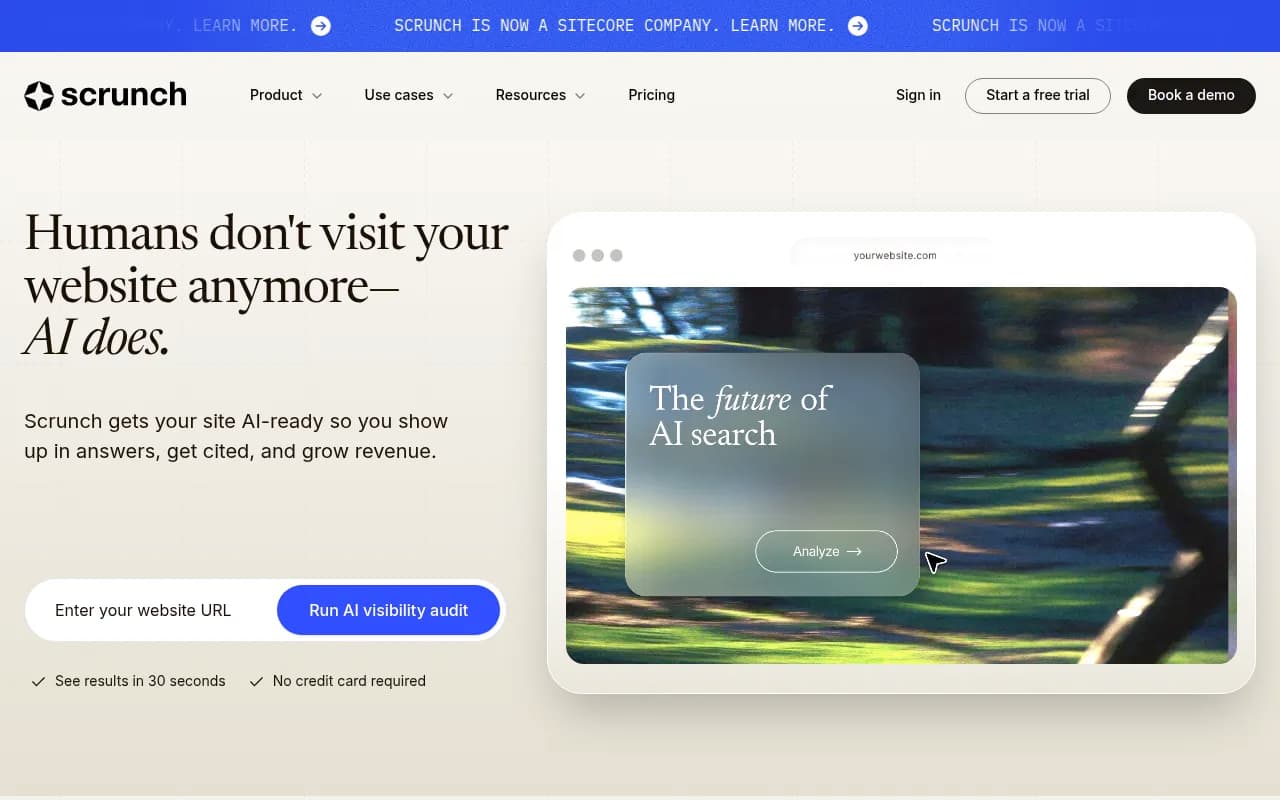
| Scrunch AI | Multiple + Agent Traffic | Yes (Agent Traffic/Site Diagnostics) | No | Continuous |
| Waikay | 5 | No | No | Continuous |
| Promptwatch | 12+ including AI Mode, Copilot, DeepSeek, Mistral, coding assistants | Yes, 400+ crawlers logged | Yes, plus ChatGPT Ads Radar | Continuous |
KIME's own comparison content notes it covers nine engines against Citations.io's four, and adds sentiment tracking and competitor ad monitoring. Scrunch AI positions itself around an "Agent Traffic" layer, effectively crawler analytics for the pages AI bots actually touch, something citation-only tools skip entirely. Waikay leans specifically into hallucination detection. None of these fully close every gap on its own, which is part of the problem: marketers end up stitching two or three tools together anyway.
Where a platform like Promptwatch fits
The pattern across all four gaps above (crawler visibility, monitoring cadence, monetization layers, and platform-specific content behavior) is the same: Citations.io answers "were we mentioned?" but not "why weren't we, and what do we do about it?" That second question is what Promptwatch is built around.
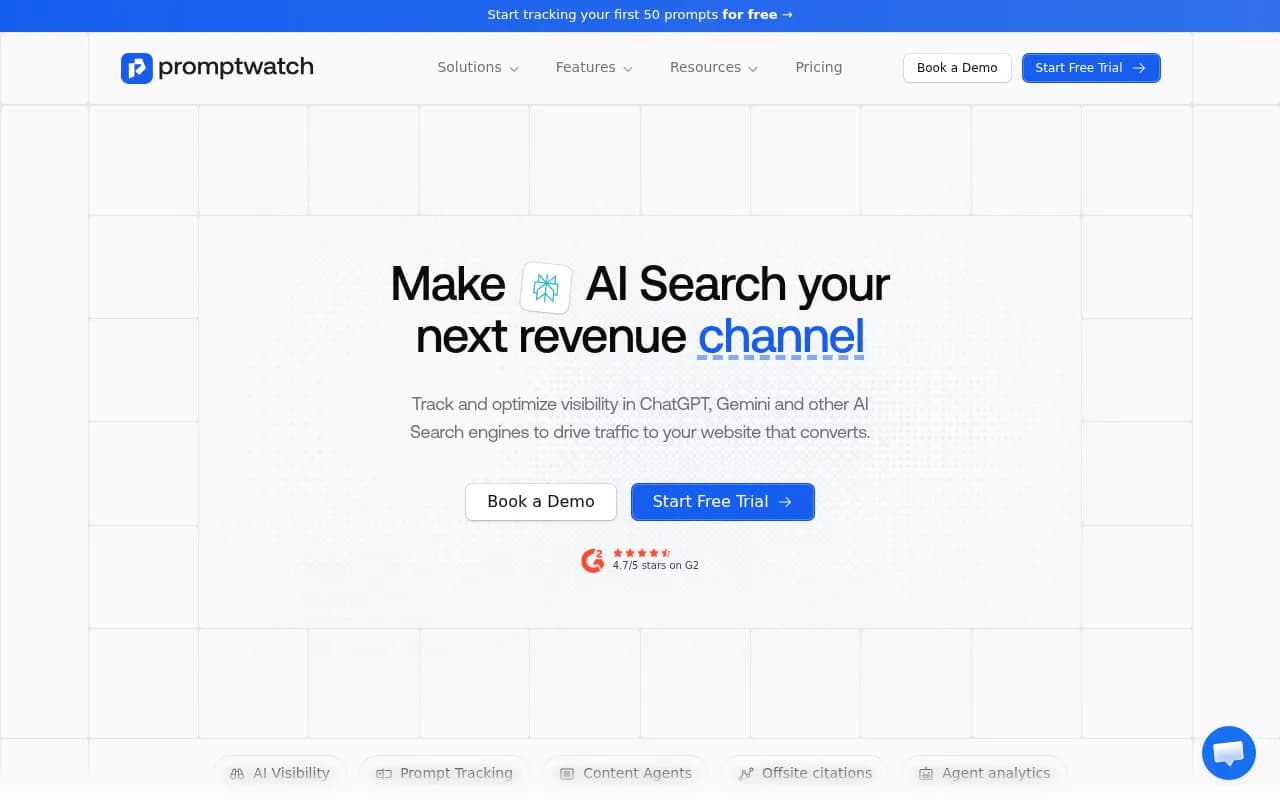
Promptwatch tracks ChatGPT, Gemini, Claude, Perplexity, Grok, DeepSeek, Mistral, Microsoft Copilot, Google AI Overviews, Google AI Mode, and AI coding assistants like Claude Code, well past Citations.io's four-engine coverage. It logs 400+ AI crawlers hitting your site in real time, so you can see exactly when GPTBot or ClaudeBot visits a page, whether it hit an error, and the crawl-to-citation path, closing the exact blind spot described above. It also tracks ChatGPT Shopping placements and an Ads Radar for competitor ad spend inside AI answers, Reddit and YouTube citation reports broken out by platform, and query fanout data showing how a single prompt splits into sub-queries.
The bigger difference, though, is what happens after you spot a gap. Citations.io stops at alerting you to a problem. Promptwatch's Content Agents can draft and publish GEO-optimized content straight to Webflow, Framer, or WordPress, and Unified Actions turns your visibility, citation, and crawler data into a prioritized to-do list rather than a dashboard you have to interpret yourself. Crisp, one of Promptwatch's customers, used this to scale to 5-10 published articles a day and saw 2x higher conversion rates from AI traffic than from traditional channels.
A few other tools worth knowing about
Depending on what you're missing most, a few others are worth a look. Profound and AthenaHQ (named by Citations.io's own comparison page as the enterprise leaders) go deeper on prompt volume for large multi-market catalogs.
Scrunch AI is worth a look specifically for its Agent Traffic layer if crawler visibility is your biggest gap and you're not ready to switch platforms entirely.
If you want a broader look at the category before committing, the GEO software directory at bestgeosoftware.com rounds up more options across price points, and agenticseotools.com is a good place to compare tools that go beyond monitoring into automated content execution.
The practical takeaway
Don't ditch a tool like Citations.io just because it has gaps; every tool in this category does, and it's a reasonable starting point for teams new to AI visibility tracking. But go in with clear eyes about what it can't see: crawler-level access issues, overnight platform shifts, ad and shopping placements, and the very different ways engines use Reddit, YouTube, and LinkedIn. If those gaps matter to your business, and for most brands running real revenue through organic and AI channels they will, pair it with crawler-log analytics or move to a platform built to cover the full stack from monitoring through to fixing the problem it finds.
If you're trying to figure out where your own AI search program stands, and whether you need an agency to help close these gaps rather than another tool, 1001 SEO Media works on exactly this kind of AI Search and GEO strategy alongside traditional technical SEO.