SEOmonitor Review 2026
Agency-focused SEO platform offering rank tracking, traffic forecasting, and visibility metrics, with growing support for AI search monitoring use cases.
Key takeaways
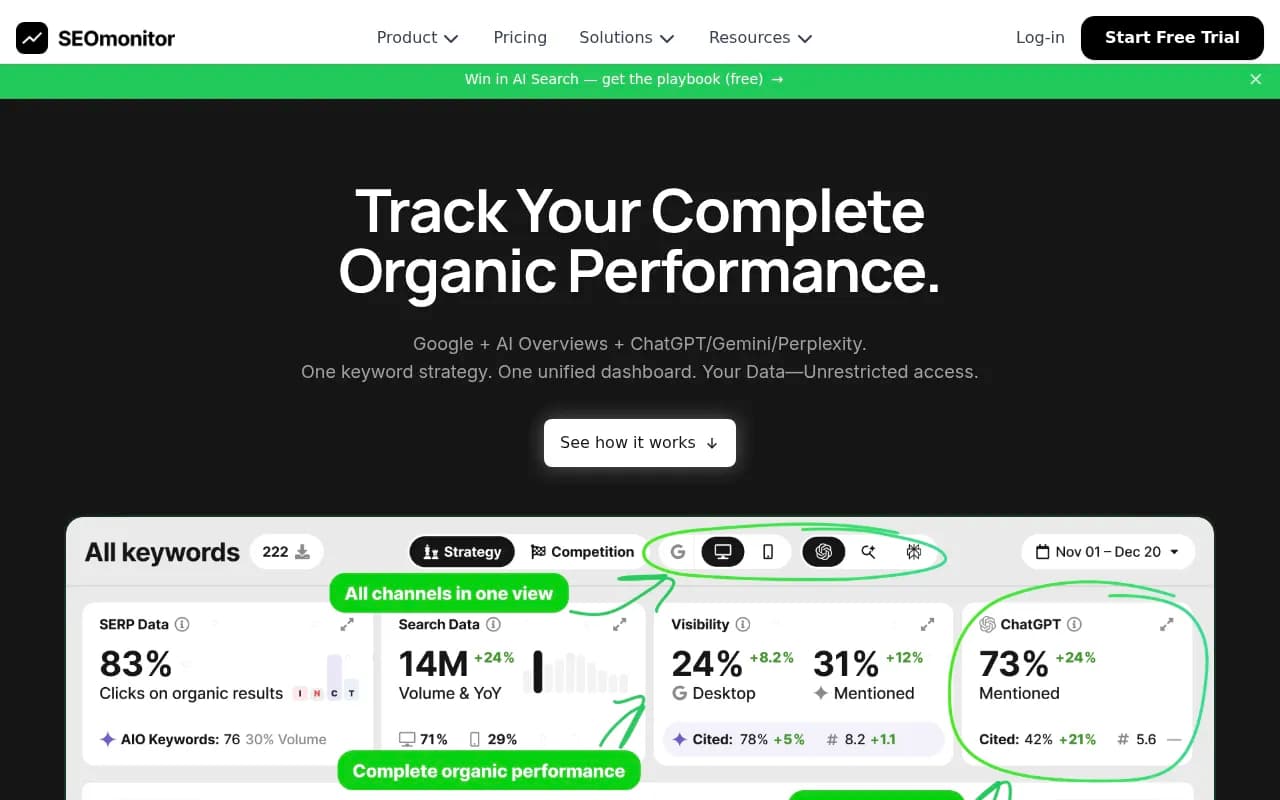
- SEOmonitor is a mature, agency-focused SEO platform that has expanded into AI search monitoring, tracking Google rankings alongside AI Overviews, ChatGPT, Gemini, and Perplexity in a single dashboard
- Its keyword-based methodology (rather than prompt-based) is a genuine differentiator -- one keyword maps to thousands of long-tail prompts, giving broader coverage with less setup overhead
- Compared to dedicated GEO platforms like Promptwatch, SEOmonitor lacks AI crawler logs, content gap analysis tied to AI responses, ChatGPT Shopping tracking, Reddit/YouTube citation tracking, and traffic attribution from AI search -- it monitors AI visibility but doesn't help you systematically fix it
- Best suited to SEO agencies managing multiple client campaigns who want one tool for traditional SEO and basic AI search monitoring, rather than teams whose primary goal is GEO optimization
- Rated 4.7/5 on G2 with clients including Vodafone, Gymshark, Marks & Spencer, and Publicis
SEOmonitor has been around long enough to earn a reputation as one of the more thoughtful rank trackers built specifically for agencies. Where most rank trackers are essentially data pipes with a dashboard bolted on, SEOmonitor was designed around the agency workflow: pitch a client, win the campaign, execute the work, prove the results. That four-step loop is baked into the product's structure, and it shows.
The platform's recent expansion into AI search monitoring is the most interesting development in its history. As Google AI Overviews, ChatGPT, Gemini, and Perplexity have started eating into traditional organic traffic, SEOmonitor made a deliberate architectural choice: don't build a separate AI tracker. Instead, extend the existing keyword strategy across all channels. The argument is that keywords have verified search volume, prompts don't -- so weighting AI visibility by keyword demand gives you metrics that actually mean something for business cases.
That's a reasonable position, and it separates SEOmonitor from tools that ask you to manually enter hundreds of prompts and then give you coverage data with no demand signal attached. Whether it's the right approach depends on what you're trying to do. For agencies that want to show clients a unified organic performance number, it works well. For teams doing deep GEO work -- trying to understand exactly why a competitor is getting cited and how to fix it -- it starts to show its limits.
Key features
Unified organic dashboard
The headline feature in 2026 is the unified dashboard that shows Google rankings, AI Overview appearances, and AI search citations (ChatGPT, Gemini, Perplexity) side by side, all keyed to the same keyword list. You're not switching between tools or reconciling different methodologies. If you track "running shoes," you see your rank on Google, whether you appear in AI Overviews for that term, and whether you're cited in ChatGPT/Gemini/Perplexity responses related to that intent. The competitive view is particularly useful -- you can see, for a given keyword group, which competitors are winning in each channel and how that's trending over time.
Keyword-based AI tracking methodology
SEOmonitor's approach to AI search tracking is worth understanding in detail. Rather than asking users to define specific prompts (e.g., "What are the best running shoes right now?"), the platform maps each tracked keyword to the range of prompts that keyword intent covers. This means:
- One keyword covers dozens or hundreds of long-tail prompt variations automatically
- AI visibility is weighted by actual Google search volume, so high-volume keywords matter more to your overall score
- The same keyword list drives reporting across all channels, making cross-channel comparison meaningful
The tradeoff is that you lose granularity at the prompt level. If you want to know exactly which phrasing of a question your brand appears in, or which specific prompts competitors are winning that you're not, the keyword-level view doesn't give you that.
Dynamic Depth Crawling rank tracker
SEOmonitor's rank tracker uses what it calls Dynamic Depth Crawling -- daily tracking of the full top 100 results for every keyword, on every plan. Most rank trackers either charge extra for daily tracking or limit depth. SEOmonitor includes both by default. They published a study covering 898 keyword portfolios to validate the methodology, which is the kind of transparency that builds trust with technical buyers. Tracking is available across Google, with AI Overviews detection layered on top.
Traffic forecasting and business case builder
This is arguably where SEOmonitor has the strongest reputation. The forecasting engine takes your keyword portfolio, applies CTR models (including adjustments for AI Overview zero-click impact), accounts for seasonality, and generates month-by-month traffic projections. The output is designed to be pitch-ready -- you can export a business case document that shows a client what they'll get from an SEO campaign in revenue terms. The fact that competitors have reportedly copied the methodology is a reasonable signal that it's credible. The 2026 CTR model explicitly accounts for AI Overview cannibalization, which is a meaningful update given how much AIO has changed click behavior.
AI Content Writer
SEOmonitor's content tool goes beyond a simple AI writing assistant. It handles topic discovery (finding keywords your site can realistically rank for given your authority), editorial planning, article writing, fact-checking, CMS publishing, and post-publish performance tracking. The workflow is:
- Discover topics with ranking potential
- Plan an editorial calendar with briefs
- Write articles in your brand voice
- Fact-check before publishing
- Publish directly to your CMS
- Track performance across Google, AIO, and AI search
The case study data they cite (657 published articles, 80% ranking within 30 days, 52% cited in AIO, 43% cited in AI search) is specific enough to be useful, though it comes from a single agency case study (AimUP) so treat it as directional rather than a guarantee.
SEO forecasting with AI Overview CTR impact
The forecasting module now includes a specific adjustment for AI Overview impact on CTR. When a keyword triggers AI Overviews, the expected click-through rate drops -- SEOmonitor models this as a negative CTR adjustment (the example shown is -15% for zero-click scenarios). This is important for agencies trying to set realistic traffic expectations with clients in a world where Google is increasingly answering queries directly.
Keyword research and clustering
The platform includes AI-powered keyword research that starts from a URL and generates a full keyword strategy with automatic clustering, intent detection, and filtering of irrelevant terms. This is useful for onboarding new clients quickly -- you're not starting from a blank spreadsheet. The Keyword Vault feature lets you track unlimited keywords with monthly updates (rather than daily tracking) for keywords you want to monitor but don't need real-time data on.
Content audit and cannibalization detection
The content audit tool automatically identifies pages competing for the same keywords, intent mismatches, and content gaps. This is a standard feature in mature SEO platforms but SEOmonitor's implementation is tightly integrated with the rank tracker, so you can see cannibalization issues alongside actual ranking data rather than in a separate audit silo.
Reporting and client dashboards
Agencies get white-label client dashboards and unified reporting that covers all channels. The pricing model is notable here: unlimited users on every plan, no per-seat fees, and full API access included. For agencies with large teams or multiple stakeholders per client, this is a meaningful cost advantage over tools that charge per seat.
Who is it for
SEOmonitor's primary audience is SEO agencies managing multiple client campaigns simultaneously. The pitch-to-prove workflow, the business case builder, the client dashboards, and the unlimited user model all point at this persona. Specifically, it fits agencies that are:
- Running 5-50+ client campaigns and need a single platform for rank tracking, reporting, and client communication
- Transitioning from pure Google SEO to multi-channel organic strategy and want to show clients AI search visibility alongside traditional rankings
- Billing on performance and need credible traffic forecasting to set expectations and prove results
In-house SEO teams at mid-to-large brands (the Vodafone and Gymshark logos on the homepage suggest this audience exists) can also use it effectively, particularly if they're managing large keyword portfolios and need the forecasting and content tools. The unlimited user model means you can give access to stakeholders across marketing, content, and leadership without worrying about seat costs.
Who should probably look elsewhere: teams whose primary goal is deep GEO optimization rather than traditional SEO with AI monitoring layered on. If you're trying to understand why competitors are getting cited in ChatGPT, which specific content gaps are causing you to lose AI visibility, how AI crawlers are indexing your site, or how to attribute revenue to AI search traffic, SEOmonitor's current feature set doesn't go that deep. It tells you where you stand; it doesn't give you the diagnostic tools to systematically fix AI visibility gaps.
Small freelance SEOs or solo consultants managing a handful of clients may also find the platform more than they need -- the pricing is structured around keyword volume, and the full feature set is designed for team workflows.
Integrations and ecosystem
SEOmonitor connects to Google Analytics and Google Search Console, which are the two integrations that matter most for proving SEO ROI. The GSC integration lets you see actual clicks and impressions alongside rank data; the GA integration connects rankings to revenue.
The platform offers full API access on all plans, which is useful for agencies that want to pull data into custom dashboards or automate reporting. The content writer integrates directly with CMS platforms for publishing, though the specific CMS integrations supported aren't detailed in the public documentation.
There's no mention of Zapier, Slack, or other workflow tool integrations in the available information, which is a gap compared to some competitors. The platform appears to be primarily web-based with no dedicated mobile app.
Pricing and value
SEOmonitor's pricing is keyword-volume-based rather than per-seat, which is the right model for agencies. The Pro Plan prices tracked keywords at approximately €47 per 1,000 keywords per month. A 14-day free trial is available with no credit card required.
The "5x more data for the same budget" claim refers to the fact that competitors often charge per user or restrict API access, while SEOmonitor includes both. For an agency with 10 team members tracking 5,000 keywords across 10 clients, the math can genuinely work out favorably compared to per-seat tools.
The free trial includes automatic keyword research and a full SEO strategy setup, which is a useful way to evaluate the platform without manual configuration.
Compared to dedicated AI search monitoring tools, SEOmonitor sits in a different category -- it's primarily an SEO platform with AI monitoring added, not an AI monitoring platform with SEO features. The pricing reflects this: you're paying for keyword tracking at scale, and AI search monitoring comes along for the ride.
Strengths and limitations
What it does well:
- The keyword-based unified methodology is genuinely smart. Tracking AI visibility by keyword demand rather than arbitrary prompts gives you metrics that connect to business outcomes.
- The forecasting and business case builder is the strongest in its category for agencies. The AI Overview CTR impact modeling is a meaningful update that competitors haven't all caught up to.
- Unlimited users and full API access on all plans is a real differentiator for agencies with large teams. The economics are built around data volume, not headcount.
- The AI Content Writer's end-to-end workflow (discover, plan, write, check, publish, track) is more complete than most SEO content tools, which stop at generation.
- The client roster (Vodafone, Gymshark, Marks & Spencer, Publicis, TUI) suggests the platform handles enterprise-scale keyword portfolios reliably.
Honest limitations:
- AI search monitoring is relatively shallow compared to dedicated GEO platforms. There are no AI crawler logs showing which pages AI engines are reading and how often, no content gap analysis that maps your content against AI responses to show specific missing topics, no ChatGPT Shopping tracking, and no Reddit or YouTube citation tracking. You can see that you're not being cited; you can't easily diagnose why or get a prioritized list of what to fix.
- Traffic attribution from AI search is not a feature. You can see AI visibility metrics, but connecting AI citations to actual website traffic and revenue requires a separate tool. Platforms like Promptwatch offer this through website integrations (Cloudflare, Vercel, server logs, GSC) that SEOmonitor doesn't replicate.
- Prompt-level granularity is sacrificed for the keyword-based approach. If a competitor is dominating a specific question format that's driving AI traffic, the keyword-level view may not surface that clearly enough to act on.
- The social/community presence is limited based on available information -- no Discord community, limited public GitHub presence.
Bottom line
SEOmonitor is a well-built, agency-focused SEO platform that has made a thoughtful move into AI search monitoring. For agencies that want one tool to handle traditional SEO and show clients a unified organic performance picture that includes AI channels, it's a strong choice -- particularly given the forecasting capabilities and the unlimited-user pricing model.
For teams whose primary need is GEO optimization -- understanding and improving AI search visibility specifically -- the platform's AI monitoring features are a starting point, not a complete solution. Dedicated platforms like Promptwatch go considerably further with AI crawler logs, content gap analysis, ChatGPT Shopping tracking, Reddit/YouTube citation tracking, and traffic attribution that connects AI visibility to actual revenue. SEOmonitor shows you the score; Promptwatch helps you change it.
Best use case: SEO agencies managing 10+ client campaigns who want a single platform for rank tracking, traffic forecasting, client reporting, and basic AI search visibility -- without needing deep GEO diagnostic capabilities.
Tags:
Frequently asked questions
What is SEOmonitor?
How does SEOmonitor track AI search visibility?
How much does SEOmonitor cost?
Is SEOmonitor good for GEO (Generative Engine Optimization)?
Who is SEOmonitor best for?
Does SEOmonitor have a free trial?
Similar and alternative tools to SEOmonitor