Key takeaways
- Promptwatch is a purpose-built GEO platform that covers the full cycle: track AI visibility, find content gaps, generate optimized content, measure results. SEOmonitor is a traditional SEO rank tracker that has bolted on AI search monitoring as an additional layer.
- SEOmonitor's AI tracking is keyword-based -- one keyword maps to many prompts automatically. Promptwatch tracks at the prompt level, which gives more granular data but requires more setup.
- Promptwatch monitors 10+ AI models including DeepSeek, Grok, Mistral, and Meta AI. SEOmonitor covers Google AI Overviews, ChatGPT, Gemini, and Perplexity -- solid coverage but a shorter list.
- Promptwatch includes AI crawler logs, Reddit/YouTube citation tracking, ChatGPT Shopping monitoring, and content generation. None of those exist in SEOmonitor.
- SEOmonitor is the stronger pick for traditional Google SEO workflows: rank tracking, traffic forecasting, and agency reporting. Promptwatch wins on anything AI-search-specific.
- Pricing models differ significantly: Promptwatch charges per site and prompt volume, SEOmonitor charges per keyword count. For large keyword sets, SEOmonitor can get expensive fast.
Overview
Promptwatch
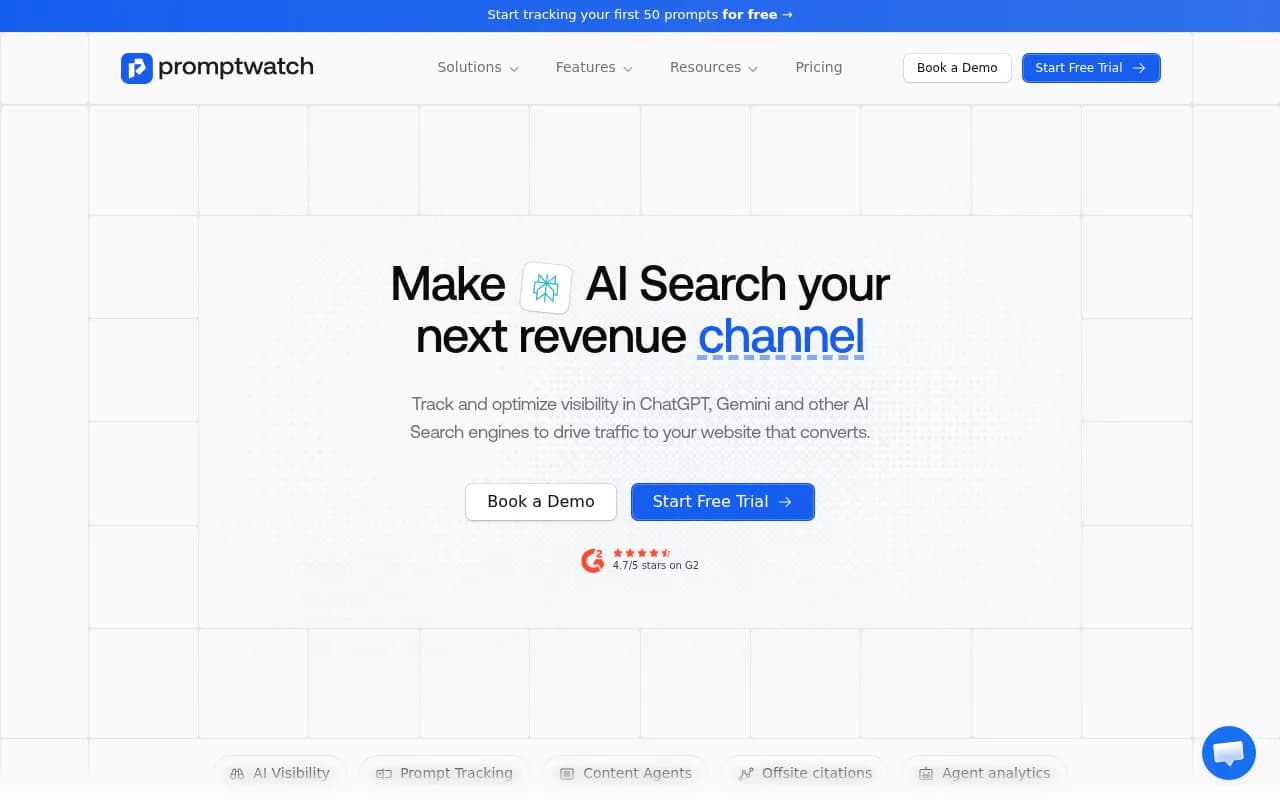
Promptwatch launched as a dedicated AI search visibility platform and has grown to serve 1,480+ brands and agencies. The core idea is that monitoring alone isn't enough -- you need to know what content gaps are costing you visibility, create content that fills those gaps, and then track whether it worked. That loop (find gaps, generate content, track results) is what separates it from most competitors. It monitors ChatGPT, Perplexity, Gemini, Claude, Google AI Overviews, Google AI Mode, Grok, DeepSeek, Mistral, Meta AI, and Copilot. Rated 4.7/5 on G2.
SEOmonitor
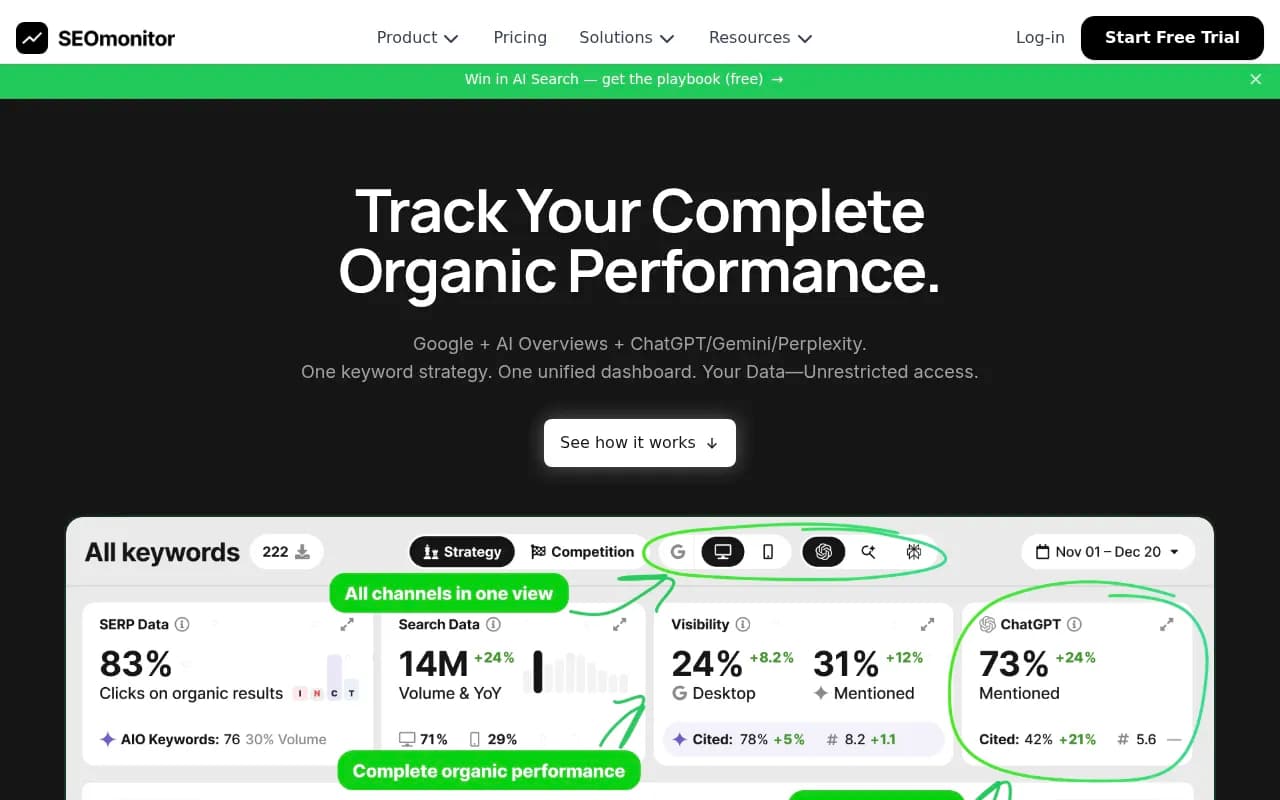
SEOmonitor has been an agency-focused SEO platform for years, built around rank tracking, traffic forecasting, and client reporting. In 2025-2026 it expanded into AI search monitoring, adding coverage for Google AI Overviews, ChatGPT, Gemini, and Perplexity. Its positioning is "one keyword strategy across all channels" -- the idea being that you shouldn't need separate tools and separate methodologies for Google and AI search. Also rated 4.7/5 on G2, with clients like Vodafone, Gymshark, Publicis, and TUI.
Side-by-side comparison
| Feature | Promptwatch | SEOmonitor |
|---|---|---|
| Primary focus | AI visibility & GEO optimization | Traditional SEO + AI monitoring add-on |
| AI models tracked | 10+ (ChatGPT, Gemini, Claude, Perplexity, Grok, DeepSeek, Mistral, Meta AI, Copilot, Google AIO) | 4 (Google AIO, ChatGPT, Gemini, Perplexity) |
| Tracking methodology | Prompt-level tracking | Keyword-based (maps to prompts automatically) |
| Content generation | Yes (AI Content Agents) | No |
| Content gap analysis | Yes (Answer Gap Analysis) | No |
| AI crawler logs | Yes | No |
| Reddit/YouTube citation tracking | Yes | No |
| ChatGPT Shopping tracking | Yes | No |
| Traffic attribution | Yes | Yes (forecasting-focused) |
| Competitor heatmaps | Yes | Partial (competitor rank tracking) |
| Rank tracking (Google) | No | Yes (core feature) |
| Traffic forecasting | No | Yes (core feature) |
| Agency white-labeling | Yes (agency tier) | Yes |
| Free trial | Yes | Yes (14 days) |
| Pricing model | Per site + prompt volume | Per keyword volume |
| Starting price | $99/mo | ~€47/mo (1,000 keywords) |
| G2 rating | 4.7/5 | 4.7/5 |
Head-to-head feature deep-dive
AI search coverage
Promptwatch tracks 10 AI platforms by running real queries in user-facing interfaces, not just API calls. That distinction matters because the answers users actually see can differ from API outputs -- especially for shopping recommendations and local results. The list includes models most competitors skip entirely: Grok, DeepSeek, Mistral, Meta AI, and Copilot alongside the obvious ones.
SEOmonitor covers four: Google AI Overviews, ChatGPT, Gemini, and Perplexity. That's the core set most brands care about, and for many teams it's enough. But if you're tracking a brand in markets where DeepSeek or Grok have meaningful share, you'll hit a wall.
Verdict: Promptwatch wins on breadth. SEOmonitor covers the essentials but nothing beyond.
Tracking methodology: prompts vs keywords
This is the most interesting philosophical difference between the two tools.
SEOmonitor argues that tracking individual prompts is impractical -- there are infinite variations of any question, so you'd need thousands of prompts to get meaningful coverage. Their approach: track keywords, and let the system automatically map those keywords to the AI prompts that contain them. One keyword like "running shoes" captures every AI response that mentions running shoes, regardless of how the user phrased it.
Promptwatch tracks at the prompt level. You define specific questions ("What are the best project management tools for remote teams?") and track exactly how AI models answer those questions over time. This is more granular -- you can see the exact response, the exact citation, the exact change -- but it requires more deliberate setup and you need to know which prompts matter.
Neither approach is objectively better. Keyword-based tracking is faster to set up and scales well for large SEO programs. Prompt-level tracking gives you the specificity needed for GEO optimization -- you can't do Answer Gap Analysis without knowing the exact prompt.
Verdict: Depends on your workflow. Keyword-based suits traditional SEO teams. Prompt-level suits GEO-focused teams.
Content optimization and generation
This is where the gap between the two tools is widest.
Promptwatch has a full content action loop. Answer Gap Analysis shows you which prompts competitors appear in but you don't -- and crucially, it shows you the specific content your site is missing. Content Agents then generate articles, listicles, comparison pages, and briefs grounded in real prompt data, citation patterns, and competitor analysis. Agent Analytics tracks the timeline from publish to AI crawl to first citation.
SEOmonitor has no content generation features. It's a tracking and forecasting tool. You can see where you're losing visibility, but the tool doesn't help you do anything about it. You'd need a separate content workflow.
Verdict: Promptwatch wins outright. SEOmonitor doesn't compete here.
AI crawler logs and technical insights
Promptwatch's crawler log feature is one of the more unusual things in this space. It shows you in real time which AI crawlers (ChatGPT, Claude, Perplexity, etc.) are hitting your website, which pages they're reading, what errors they're encountering, and how often they return. When a page moves from "crawled" to "cited," you can see that transition. This is genuinely useful for diagnosing why certain pages aren't getting cited despite good content.
SEOmonitor has no equivalent. It tracks whether you appear in AI responses, but not the crawl-side mechanics that determine whether you get there.
Verdict: Promptwatch wins. SEOmonitor doesn't offer this at all.
Traditional SEO features
This is SEOmonitor's home turf. It has mature, well-built rank tracking for Google, traffic forecasting that connects keyword movements to revenue projections, and a reporting layer designed for agency client presentations. The forecasting model is particularly strong -- it can project the traffic impact of ranking changes before you make them, which is useful for pitching SEO work to clients.
Promptwatch doesn't do traditional Google rank tracking. It's not trying to. If you need to track 10,000 keywords across Google and report on organic traffic trends, Promptwatch isn't the tool.
Verdict: SEOmonitor wins clearly. This is its core competency.
Agency and reporting features
Both tools have agency tiers. SEOmonitor's agency workflow is more mature -- white-labeled reports, client dashboards, and forecasting tools that make it easy to demonstrate ROI to clients. It's clearly been built with agency account managers in mind.
Promptwatch's agency tier supports multiple sites, Looker Studio integration, and an API for custom workflows. It's functional but the reporting layer is less polished than SEOmonitor's. Where Promptwatch shines for agencies is the ability to show clients concrete AI visibility data and content gap analysis -- things SEOmonitor can't provide.
Verdict: SEOmonitor has the more complete agency reporting workflow. Promptwatch is better for agencies whose clients specifically want AI visibility work.
Reddit, YouTube, and offsite citations
Promptwatch tracks which Reddit threads, YouTube videos, and third-party pages AI models are citing in their responses. This matters because AI models frequently pull from Reddit discussions and YouTube content -- if a Reddit thread is driving negative sentiment about your brand in AI responses, you want to know.
SEOmonitor doesn't track offsite citations or social platform content.
Verdict: Promptwatch wins. SEOmonitor doesn't cover this.
Pricing comparison
| Plan | Promptwatch | SEOmonitor |
|---|---|---|
| Free/trial | Free trial (50 prompts) | 14-day free trial |
| Entry | $99/mo (1 site, 50 prompts, 5 articles) | ~€47/mo (1,000 keywords) |
| Mid-tier | $249/mo (2 sites, 150 prompts, 15 articles, crawler logs) | ~€97/mo (2,000 keywords, est.) |
| Business | $579/mo (5 sites, 350 prompts, 30 articles) | Scales with keyword volume |
| Agency/Enterprise | Custom pricing | Custom pricing |
| Annual discount | Yes | Yes |
A few things worth noting on pricing. Promptwatch's model is predictable -- you know what you're paying based on sites and prompt volume. SEOmonitor's keyword-based pricing scales with your tracked keyword count, which can get expensive quickly for large programs. An agency tracking 50,000 keywords across multiple clients will pay significantly more than the entry price suggests.
Promptwatch's entry tier at $99/mo is genuinely usable -- 50 prompts is enough to get meaningful data for a focused brand. SEOmonitor's entry tier is similarly accessible but the AI monitoring features may be limited at lower tiers.
Pros and cons
Promptwatch
Pros:
- Full action loop: track, find gaps, generate content, measure results
- Widest AI model coverage (10+ platforms)
- AI crawler logs show the technical side of how AI discovers your content
- Reddit and YouTube citation tracking
- ChatGPT Shopping and entity tracking
- Prompt-level granularity for precise GEO work
- Multi-language and multi-region support
Cons:
- No traditional Google rank tracking
- Prompt-level setup requires more deliberate work than keyword-based tools
- Content generation quality depends on how well you configure brand guidance
- Newer platform -- some features still maturing
SEOmonitor
Pros:
- Mature, well-built rank tracking for Google
- Traffic forecasting is genuinely useful for agency pitches
- Keyword-based AI tracking is fast to set up
- Strong agency reporting and white-labeling
- Unified dashboard for Google + AI channels
- Established platform with a long track record
Cons:
- AI monitoring is an add-on, not the core product
- Only covers 4 AI platforms
- No content generation or gap analysis
- No crawler logs or technical AI indexing insights
- No Reddit/YouTube citation tracking
- Keyword methodology limits prompt-level granularity
Who should pick which tool
Pick Promptwatch if:
- AI search visibility is a primary concern, not a secondary one
- You want to actually improve your AI visibility, not just monitor it
- You need to track niche AI platforms (Grok, DeepSeek, Mistral, Meta AI)
- You want to understand why AI crawlers are or aren't citing your pages
- Your team produces content and wants data-driven briefs grounded in real prompt gaps
- You're an agency that sells GEO/AI visibility services to clients
Pick SEOmonitor if:
- Traditional Google SEO is your main focus and AI monitoring is a nice-to-have
- You need traffic forecasting to justify SEO investments to clients
- You manage large keyword sets (thousands of keywords) and want unified tracking
- You're an agency that needs polished client reporting and white-labeled dashboards
- You want a single tool for Google rank tracking and basic AI monitoring
Use both if:
- You're a larger agency or in-house team that needs serious Google SEO tracking AND serious AI visibility work. They don't overlap much, so running both is a legitimate setup rather than redundancy.
Final verdict
These two tools are solving different problems. SEOmonitor is a traditional SEO platform that added AI monitoring -- it's the right choice if Google rank tracking and forecasting are central to your workflow and you want AI visibility as a bonus layer. Promptwatch is built from the ground up for AI search, and it goes further than any traditional SEO tool can: crawler logs, content gap analysis, AI content generation, Reddit/YouTube tracking, and coverage of 10+ AI models.
If AI search visibility is genuinely important to your business in 2026 -- not just a metric to report but something you're actively trying to improve -- Promptwatch is the more complete tool. SEOmonitor is the better pick if you're primarily an SEO shop that wants to add AI monitoring without switching platforms.