GetMint Review 2026
Content strategy platform that combines AI writing tools with SEO guidance to help teams produce optimized content at scale without heavy workflow setup.
Key takeaways
- GetMint is a Generative Engine Optimization (GEO) platform that monitors brand visibility across major AI models including ChatGPT, Claude, Gemini, Perplexity, and Grok
- Lacks several capabilities that Promptwatch offers, including AI crawler logs, traffic attribution, ChatGPT Shopping tracking, Reddit/YouTube tracking, prompt volume and difficulty scoring, and query fan-outs -- making it a monitoring-focused tool with limited optimization depth
- Differentiates itself with a 150,000+ partner media outlet distribution network, which lets brands publish content that directly influences AI source pools
- Trusted by 200+ brands and agencies, with a free trial available; pricing starts at €99/month (or €79/month billed annually)
- Best suited for marketing teams and agencies in French-speaking markets or those wanting a straightforward AI visibility dashboard with content distribution built in
GetMint is a GEO platform built around a simple premise: if AI search engines are the new gatekeepers of discovery, brands need to know where they stand in those answers and have a way to act on that information. The platform monitors how brands appear across major AI models, surfaces content gaps, and -- this is the part that sets it apart from most monitoring tools -- offers a distribution channel through a network of 150,000+ partner media outlets to get content in front of the sources AI models actually cite.
The company appears to be French in origin, with several of its testimonials coming from French startup founders and agencies. It launched publicly in late 2025 and has grown to 200+ brand and agency customers. The product positions itself as an "end-to-end" GEO platform, covering the monitor-improve-distribute loop, though the depth of each stage varies considerably compared to more mature competitors.
The target audience is marketing teams, SEO managers, and digital agencies that want to understand and improve their AI search presence without building a complex internal workflow. It's particularly well-suited for teams that are just getting started with GEO and want a guided, structured approach rather than a raw data firehose.
Key features
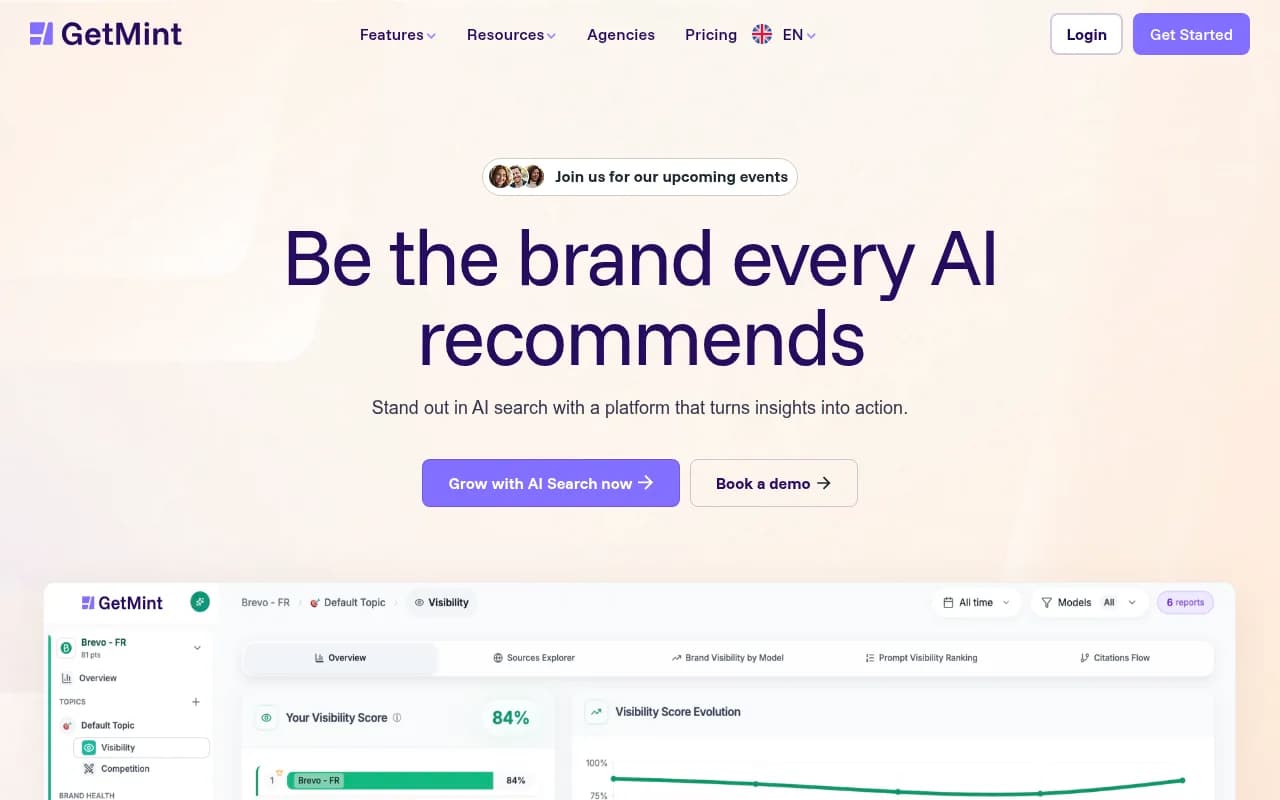
AI visibility monitoring across major LLMs GetMint tracks how your brand appears in responses from ChatGPT, Claude, Gemini, Perplexity, Grok, and Google AI Overviews. You can monitor by market, product line, and persona, which is useful for brands that sell to different buyer types or operate in multiple regions. The dashboard shows visibility scores and lets you compare your position against competitors. The monitoring covers real AI answer outputs, not just API-level queries, which matters because user-facing answers can differ from what you'd get hitting an API directly.
Prompt and topic setup (the "Define" phase) Before monitoring starts, GetMint walks you through defining your core topics and the specific prompts you want to track. This setup phase is more guided than some competitors, which is a genuine advantage for teams that don't have a GEO specialist on staff. Getting the prompt set right determines the quality of everything downstream, and GetMint's structured onboarding helps avoid the common mistake of tracking irrelevant or too-broad queries.
Content gap detection Once monitoring is running, GetMint surfaces content gaps -- areas where competitors are appearing in AI answers but you're not. This is the core insight that drives the "Improve" phase. The platform shows you which topics and questions your content isn't covering, giving you a prioritized list of what to create or refresh. This is a meaningful feature, though the depth of gap analysis (prompt volume data, difficulty scoring, query fan-outs) appears more limited than what more data-heavy platforms provide.
Content creation and optimization GetMint includes tools to create and optimize content based on the gaps it identifies. The platform helps produce "AI-ready assets" -- content structured to be cited by AI models. The specifics of the content generation workflow aren't fully detailed in public documentation, but the platform does offer content optimization credits as part of its plans, suggesting a credit-based generation model similar to other AI writing tools.
Content distribution via partner media network This is GetMint's most distinctive feature. The platform claims access to 150,000+ partner media outlets where you can publish content directly. The idea is that AI models pull from authoritative external sources when forming answers, so getting your content placed on those sources is a direct lever for improving AI visibility. This is a meaningful differentiator -- most GEO monitoring tools don't offer any distribution capability at all. Whether the quality and relevance of those 150K outlets holds up in practice is harder to verify from the outside, but the concept is sound.
Competitor benchmarking GetMint lets you compare your AI visibility against named competitors across the LLMs it tracks. You can see who's winning for specific prompts and in which markets. This competitive view is useful for prioritizing where to focus content efforts and for reporting to stakeholders who want to understand relative market position in AI search.
Multi-market and persona tracking The platform supports tracking visibility by country and by persona, which is important for brands that sell to different customer segments or operate internationally. This isn't unique to GetMint, but it's a necessary feature for any serious GEO tool and it's good that it's included even at lower plan tiers.
Reporting and dashboards GetMint's dashboards are described by users as "simple" and "reliable," which suggests the UX prioritizes clarity over raw data density. For teams that need to report AI visibility to non-technical stakeholders, this is a real advantage. The tradeoff is that power users who want to slice data in custom ways may find the reporting less flexible than they'd like.
Who is it for
GetMint fits best for marketing and SEO teams at mid-sized companies that are just beginning to take AI search seriously and want a structured, guided platform rather than a raw analytics tool. Think a 5-15 person marketing team at a B2B SaaS company or a consumer brand that's noticed traffic shifting away from Google and wants to understand what's happening in AI search. The platform's onboarding and guided setup make it accessible to people who aren't GEO specialists.
Digital agencies are another strong fit, particularly those serving clients who ask about AI visibility but don't yet have a clear framework for it. GetMint's multi-brand support and client-friendly dashboards make it workable for agency reporting. Several of the testimonials come from agency founders, which suggests the product has been shaped with agency workflows in mind.
The platform seems to have particular traction in France and French-speaking markets, based on the customer testimonials and the company's apparent origin. Brands in those markets may find localized support and community resources more accessible than with US-based competitors.
Who should probably look elsewhere: teams that need deep technical data (AI crawler logs, page-level citation tracking, traffic attribution from AI to revenue), brands running large-scale prompt monitoring across hundreds of queries, or organizations that need robust API access for custom reporting workflows. GetMint's feature set is solid for getting started, but it doesn't yet match the data depth of more established platforms.
Integrations and ecosystem
GetMint's integration story is relatively thin based on available information. The platform connects with major AI models for monitoring purposes, and the content distribution network (150K+ partner outlets) is the most notable external connection. There's no clear mention of native integrations with Google Search Console, Slack, Zapier, or major CMS platforms in the public documentation.
The platform does offer a free trial accessible directly from the website, and the app is hosted at app.getmint.ai. There's no public API documentation visible, which suggests API access may be limited or reserved for higher-tier plans.
For agencies, the multi-brand management capability is the main ecosystem feature -- being able to manage multiple client brands from a single account is table stakes for agency use, and GetMint supports this.
Pricing and value
Based on third-party pricing data (CheckThat.ai), GetMint's plans break down roughly as follows:
- Starter: €99/month (or €79/month billed annually, €948/year) -- 1 brand/URL, 50 monthly prompts, 1 country. Aimed at solo marketers testing AI visibility.
- Higher tiers add more brands, more monthly prompts, more countries, content optimization/creation credits, additional seats, and priority support.
A free trial is available directly from the site without requiring a sales call, which is a low-friction way to evaluate the platform.
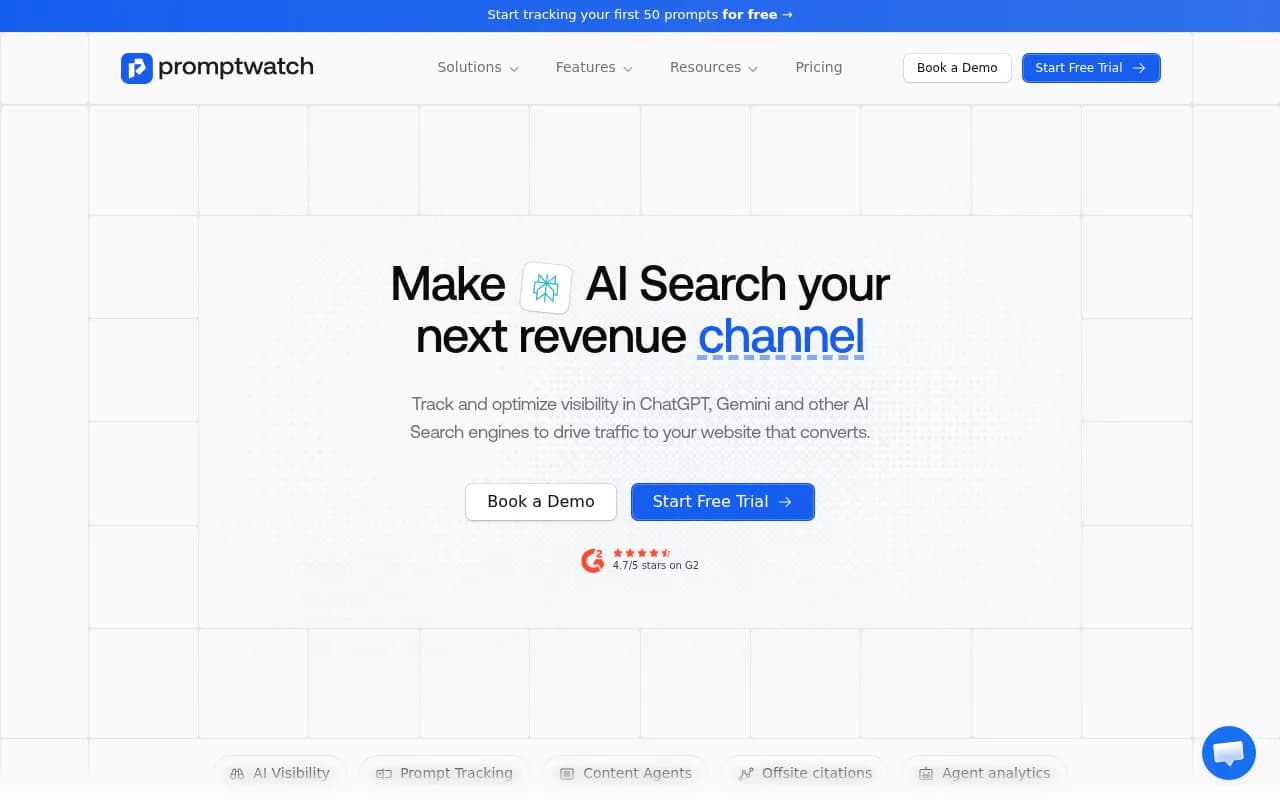
Compared to the broader GEO tool market, GetMint's pricing is in line with entry-level competitors. Promptwatch's Essential plan starts at $99/month (roughly €90-95) for similar prompt volumes, but includes features like AI crawler logs and traffic attribution that GetMint doesn't appear to offer. For teams that specifically want the content distribution network, GetMint's pricing may represent good value since that capability is genuinely uncommon in this space.
Strengths and limitations
What GetMint does well:
- The 150K+ partner media distribution network is a real differentiator. Most GEO tools stop at monitoring and leave you to figure out distribution yourself.
- The guided onboarding and structured "Define > Analyze > Improve" workflow makes the platform accessible to teams without dedicated GEO expertise.
- Multi-market and persona tracking is included, which is necessary for brands operating across regions or selling to multiple buyer types.
- User testimonials consistently mention dashboard simplicity and data reliability, which matters for teams that need to report to non-technical stakeholders.
- Free trial available without a mandatory sales call.
Where GetMint falls short:
- No AI crawler logs or agent analytics. You can't see which AI crawlers are hitting your site, which pages they're reading, or when a page moves from crawled to cited. Promptwatch offers this; GetMint doesn't appear to.
- No traffic attribution. There's no visible capability to connect AI visibility to actual website traffic or revenue. This is a significant gap for teams that need to justify GEO investment to leadership.
- Missing prompt intelligence depth. Features like prompt volume estimates, difficulty scoring, and query fan-outs -- which help you prioritize which prompts to target -- don't appear to be part of GetMint's offering. This makes prioritization more guesswork than data-driven.
- No Reddit or YouTube tracking. AI models frequently cite Reddit threads and YouTube videos. GetMint doesn't appear to surface these as influence channels, which leaves a meaningful blind spot in the citation picture.
- No ChatGPT Shopping tracking. For e-commerce brands, knowing when your products appear in ChatGPT's shopping recommendations is increasingly important. This capability isn't mentioned in GetMint's feature set.
- Model coverage appears narrower than some competitors. GetMint tracks ChatGPT, Claude, Gemini, Perplexity, Grok, and Google AI Overviews -- six models. Promptwatch monitors 10+ including DeepSeek, Meta/Llama, Mistral, and Copilot.
Bottom line
GetMint is a reasonable starting point for brands that want to understand their AI search visibility and have a structured way to act on it. The content distribution network through 150K+ partner outlets is genuinely useful and not something you'll find in most competing tools. For teams in French-speaking markets or agencies that need client-friendly dashboards, it's worth evaluating.
That said, teams that need deeper data -- crawler logs, traffic attribution, prompt volume scoring, Reddit/YouTube tracking, or ChatGPT Shopping monitoring -- will hit GetMint's ceiling fairly quickly. For that level of depth, Promptwatch is the stronger option, covering more AI models and offering the full loop from gap detection to content generation to traffic attribution.
Best for: Marketing teams and agencies that want a guided, accessible GEO platform with built-in content distribution, and don't yet need deep technical analytics.
Frequently asked questions
What is GetMint?
How much does GetMint cost?
Which AI models does GetMint track?
Does GetMint help with content creation, or just monitoring?
Who is GetMint best suited for?
How does GetMint compare to Promptwatch?
Similar and alternative tools to GetMint