RightBlogger Review 2026
A suite of AI tools for bloggers covering SEO content generation, custom voice profiles, and automated publishing.

Key takeaways
- RightBlogger has grown from a 75-tool AI writing suite into a genuine blog automation platform: autoblogging on a schedule, a Site Agent that maintains live posts, social auto-sharing, and white-label SEO reporting for agencies.
- Pricing is $59/mo (Solo, 1 site), $89/mo (Pro, 3 sites), and $299/mo (Agency, 10 sites) billed monthly, with meaningful discounts on annual billing and a 7-day free trial plus 30-day money-back guarantee.
- The bundled AI Brand Monitor covers basic AI visibility tracking across ChatGPT, Gemini, Perplexity, and Claude, but it's capped at 25 checks per site per month and lacks the depth of dedicated GEO platforms like Promptwatch — no AI crawler logs, no citation trend analysis, no Reddit/YouTube tracking, and no prompt volume or difficulty data.
- Automation limits are sensible but real: 30 queued posts, 5 posts per day per site, and one active automation per connected site regardless of tier.
- Best for solo bloggers, multi-site content marketers, and small agencies who want one subscription to replace a writing tool, social scheduler, and reporting dashboard — not for teams needing deep AI search visibility analytics.
What RightBlogger does
RightBlogger started life as a big pile of AI writing tools for bloggers. It still has 90+ of them, but the product has clearly matured into something more ambitious: a set-and-forget content engine. You connect your site, pick topics and a publishing cadence, and RightBlogger researches keywords, writes articles in your voice, publishes them to your CMS, shares them to social, and then keeps maintaining what's live.
That last part is what caught my attention. Most AI writing tools stop at the draft. RightBlogger's Site Agent runs weekly (or daily on Agency) audits of your live content and handles the unglamorous maintenance work: fixing broken links, refreshing stale titles, tightening weak meta descriptions on low-CTR pages, and adding internal links between related posts. Every change is one-click reversible within 30 days, which is the right design call. Anyone who has run a content site for a few years knows that broken-link cleanup and internal linking are exactly the tasks that never get done.
The founders are Ryan Robinson (of ryrob.com, a well-known blogging education site) and Andy Feliciotti. That origin shows. The product is built by people who actually run blogs, and the FAQ reads like it was written by someone who has answered these questions from real readers. The company claims 51,000+ users and 718,000+ articles written, which feels plausible given the price point and the niche.
The core workflow: autoblogging that doesn't feel spammy
The Autoblogging Content Planner is the centerpiece. You set topics, keywords, tone, and publishing days once, and articles get generated and scheduled individually rather than bulk-spammed. The planner demo on the homepage shows each queued post with a keyword difficulty score and search volume attached, which suggests real keyword research is feeding topic selection rather than the tool just making things up. A May 2026 update also added smarter topic selection to avoid keyword cannibalization across your queue, which is a genuinely thoughtful fix.
Limits keep it honest: 30 posts can sit in the queue at once, each site publishes at most 5 per day, and you get one active automation per connected site. If you're on Pro with 3 sites running daily automations, that's roughly 3 posts a day across your portfolio. That's a real content operation, not a content farm.
Features beyond writing
MyTone voice profiles. You can train custom writing styles (5 on Solo, 15 on Pro, 50 on Agency) so drafts come out sounding like you instead of like a language model. This matters more than most AI writing tools admit, because the number one complaint about AI content is that it all sounds the same.
Social automation. Each published post gets an AI-written caption and auto-shares to X, LinkedIn, Facebook, and Threads. Solo plans only get LinkedIn, which is an odd restriction, but Pro and Agency get all four. No Pinterest support, and at least one G2 reviewer asked for it.
Backlink Exchange. A matched network for earning links from verified sites in your niche without cold outreach. I'd treat any link exchange with some caution for SEO risk, but the verified-niche matching is a better implementation than most.
White-label SEO reports. Launched May 2026, these pull live data from Google Search Console, carry your agency's branding, support custom domains on higher tiers, and export to PDF. For a $299/mo agency tool replacing a separate reporting subscription, this is solid value.
Chat with model selection. You can pick between GPT, Claude (including Opus), Gemini, and Grok models, with web search and code execution. Premium chat credits are capped monthly (100 to 1,000 depending on tier).
Tool Studio. You can build custom AI tools and embed them on your own site, which is a quirky bonus feature that most competitors don't offer at all.
The AI Brand Monitor: a start, not a finish
This is where I have to be blunt. RightBlogger added an AI Brand Monitor that tracks brand mentions across ChatGPT, Gemini, Perplexity, and Claude, with a visibility score, competitor share of voice, sentiment, and cited sources. It's included on every plan at 25 checks per site per month.
As a free inclusion with a blogging tool, it's fine. It tells you whether AI assistants are mentioning you at all, which many bloggers have no way of knowing otherwise. The context for why this matters is stark: ChatGPT cites only about 5 sources per web-search answer on average, per Promptwatch's data on sources per response, so each citation slot is heavily contested. Google AI Overviews and Perplexity both average closer to 10 sources, making them somewhat easier surfaces to break into.
But as a serious AI visibility solution, it falls short. It covers four AI models versus the 10+ that dedicated GEO platforms track (missing Grok, DeepSeek, Copilot, Mistral, Meta AI, Google AI Mode, and others). There are no AI crawler logs to show whether ChatGPTBot or ClaudeBot are even visiting your pages, no Reddit or YouTube citation tracking despite those being meaningful citation sources, no prompt volume or difficulty scoring, no query fan-out analysis, and no content gap analysis tied to actual AI responses. It's a brand-mention checker bundled into a blogging tool, which is useful for awareness but not a workflow.
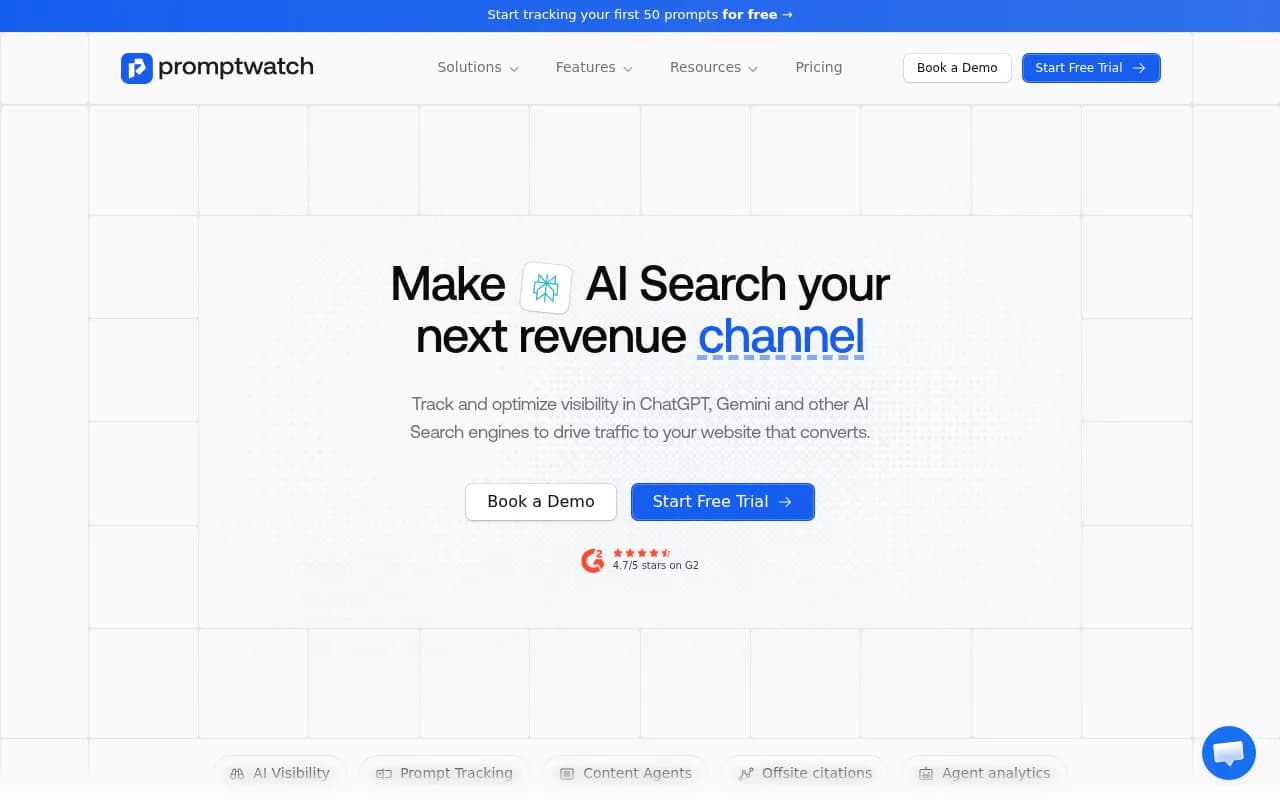
If AI-driven traffic and citations are a priority for your business, you'll outgrow this feature quickly. A dedicated platform like Promptwatch pairs visibility monitoring with the optimization side: crawler logs explaining why you are or aren't visible, citation trends by page, AI traffic attribution to your site, and automated content agents that close the gap. RightBlogger writes your posts; it doesn't tell you whether those posts are actually winning AI citations, or why.
Pricing and value
Solo is $59/mo monthly or $49/mo annually for 1 site. Pro is $89/mo monthly or $69/mo annually for 3 sites, 3 team seats, and all social integrations. Agency is $299/mo monthly or $199/mo annually for 10 sites, daily Site Agent audits, 5 seats, and white-label reporting. Extra sites cost $20/mo across tiers. There's a genuine free tier (2,000 words/month, no card required), a 7-day trial on paid plans, and a 30-day money-back guarantee.
For a solo blogger, $49/mo annual is reasonable if you're publishing multiple posts per week, since it replaces a writing tool, a social scheduler, and a rank tracker. For agencies, $199/mo for 10 sites with white-label reporting is competitive, though the 5 posts/day/site ceiling applies even at Agency tier, which some volume-focused shops will find restrictive.
One small thing I appreciate: they publish machine-readable pricing at rightblogger.com/pricing.md specifically for AI agents. That's a team paying attention to how people (and machines) actually research software in 2026.
Strengths and limitations
Strengths:
- End-to-end scope: research, writing, publishing, social sharing, maintenance, and reporting in one subscription
- Site Agent post-publish maintenance with one-click undo is genuinely differentiated
- Real keyword data (difficulty, volume) feeding topic selection, plus cannibalization avoidance
- Broad CMS coverage: WordPress, Shopify, Webflow, Ghost, Wix, Duda, Blogmaker, HighLevel, Notion, webhooks
- MyTone voice training and generous writing style limits
- Honest automation caps that prevent spam-scale publishing
- 139 languages supported in AI tools
Limitations:
- AI Brand Monitor is shallow: 4 models, 25 checks/site/month, no crawler logs, no citation analytics, no Reddit/YouTube tracking, no prompt intelligence, no content gap analysis, no AI traffic attribution. Dedicated GEO platforms cover all of this.
- No Pinterest scheduling despite user demand
- G2 reviews (4.5/5, small sample of 8) include tags for poor writing quality and inaccuracy, a reminder that AI drafts still need human editing
- Interface is English-only
- Site Agent works with WordPress, Ghost, and Webflow only, fewer than the full CMS publishing list
- Price has increased over time (older reviews reference $29.99), so long-time users should expect drift
Who it's for
A solo blogger or niche site owner who wants to go from 2 posts a month to 15 without hiring writers. A multi-site marketer running a small portfolio who is tired of stitching together four subscriptions. A small agency (under 10 client sites) that wants white-label reporting and daily content maintenance included. If you're a blogger who wants to know whether your posts are getting cited by ChatGPT and why, RightBlogger will tell you that you're mentioned, but for actual AI search optimization work, you'll want a dedicated visibility platform alongside it.
Bottom line
RightBlogger is one of the more complete blog automation packages at this price. The Site Agent alone solves a problem most competitors ignore, and the automation limits show restraint that protects users from themselves. The bundled AI Brand Monitor is a nice awareness feature but not a real GEO solution. If your goal is ranking in Google, RightBlogger covers the full loop. If your goal also includes winning the roughly 5 citation slots ChatGPT gives per answer, pair it with a platform built for that job, like Promptwatch.
Tags:
Frequently asked questions
How much does RightBlogger cost?
Does RightBlogger publish directly to my CMS?
What is the RightBlogger Site Agent?
Does RightBlogger track AI search visibility?
Is there a free plan or trial for RightBlogger?
Similar and alternative tools to RightBlogger