Gradial Review 2026
Enterprise marketing operations platform whose GEO Agent closes the loop from AI-visibility insight to actual content execution.
Key takeaways
- Gradial is an execution platform for enterprise marketing ops, not a lightweight AI writing tool. Agents take briefs and tickets and turn them into published pages, emails and assets inside your existing systems.
- Its strongest points are deep connections to enterprise stacks (AEM, Marketo, SFMC, Jira, Workfront, Figma) and governance baked into every workflow.
- Pricing is custom and enterprise-only, with no public tiers and no free plan. It is overkill for small teams.
- Gradial pitches a GEO Agent, but it is a feature of a marketing ops suite. It lacks the dedicated depth of Promptwatch: IP-verified AI crawler logs, prompt volumes and difficulty scoring, Reddit/YouTube/LinkedIn citation tracking, AI traffic attribution, and AI Shopping and Ads Radar.
- Best fit: large enterprises with a heavy AEM or similar stack and a campaign backlog that human teams cannot clear.
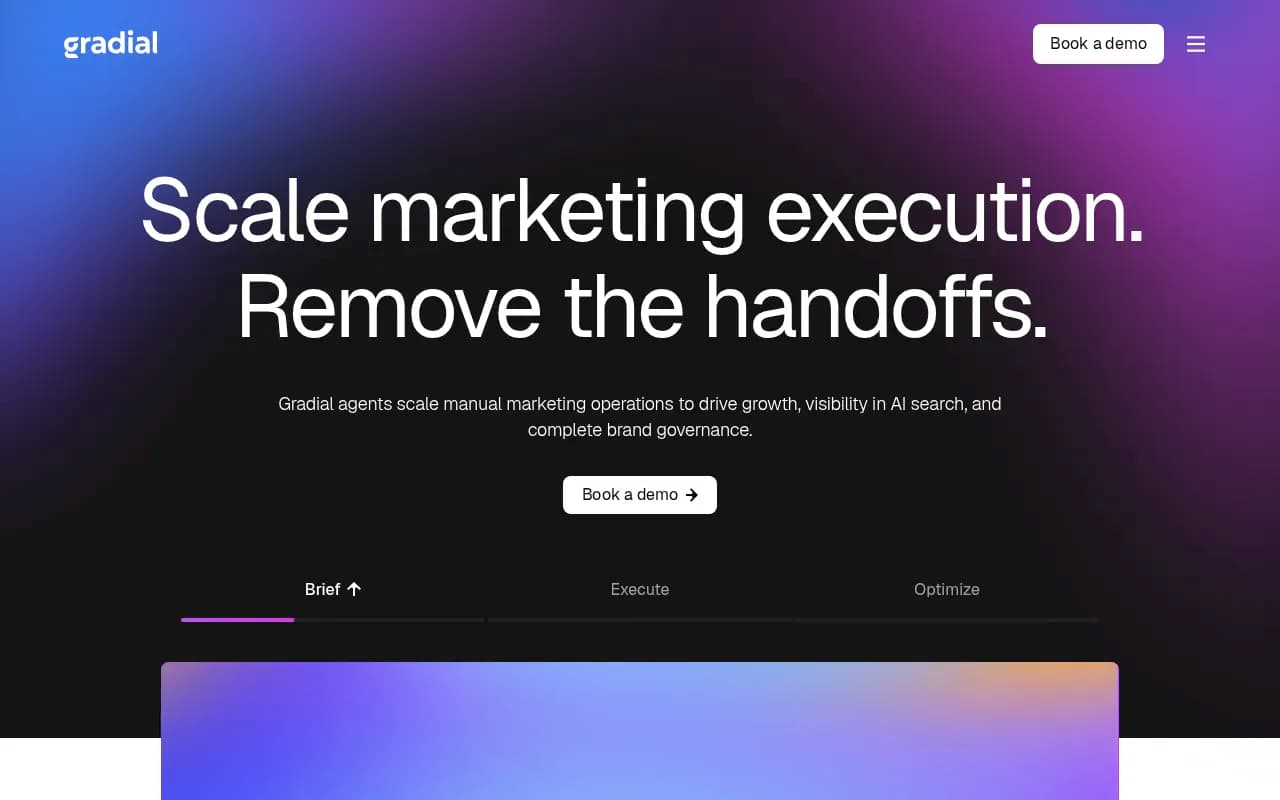
Gradial is a Seattle-based startup building AI agents for what it calls the execution layer of marketing: authoring, tagging, QA, localization, migrations and campaign assembly. The idea is simple. Marketers set direction, and agents do the grind that sits between a brief and a live page. The homepage tagline, "Scale marketing execution. Remove the handoffs," tells you where the company's head is.
The company has raised serious money. A $35M Series B led by VMG Partners (with Madrona and Pruven) was announced in December 2025, bringing total funding to $55M at that point. A $65M Series C led by Insight Partners followed, with VMG, Madrona and Pruven participating. Named customers include AWS, Prudential, T-Mobile, Vanguard, Kaiser Permanente and US Bank, and the homepage also shows Cisco, Intel, Wells Fargo, Lenovo and Micron logos.
The audience is enterprise marketing operations, web and DX teams, email teams and designers who are drowning in tickets. If you run a three-person marketing team, this is not for you. If you manage thousands of pages in AEM and a Jira queue that never empties, keep reading.
Key features
Campaign execution agents. Gradial orchestrates the jobs to be done across authoring, QA, tagging and assembly so landing pages, PDPs and emails go live faster. The pitch is brief to live in days rather than weeks. Customer stories back this up in concrete terms: Avalara turns Jira tickets into publish-ready pages, and T-Mobile uses it for high-volume campaign launches.
Backlog deletion. Lower-impact work like content updates, broken link fixes, migrations and asset metadata gets handed to agents. This is where I think most enterprises will see the quickest payback. Nobody wants to spend a Tuesday updating legal footers on 400 pages, and this is exactly that kind of work.
Asset operations. Agents upload, name, tag and activate assets, add metadata, and help teams find high-performing assets to reuse. It connects to DAMs such as AEM Assets and Bynder, so metadata work that normally lives in spreadsheets and ticket queues happens inside the workflow.
QA and brand governance. Brand, accessibility and compliance checks run automatically on every execution. That covers alt text completeness, accessibility audits run in parallel with production, regression detection before release, and tone, policy and design constraints. Reviewers get issues routed with context and recommendations. The marketing copy calls this "ending AI slop," which is a bit cheeky, but the underlying point is fair: in regulated industries like finance and healthcare, ungoverned AI output is a non-starter.
Personalization and experimentation. Agents build personalized landing pages and offers at scale, launch campaign variants, and connect performance back to execution. The site also mentions journey simulation. Prudential's story centers on personalization across digital touchpoints.
Organizational context and memory. Gradial builds a knowledge graph from your CMS, DAM, ticketing systems, design tools and CDPs. Agents reference it as long-term memory. A recent release post mentions feedback, memory, recommendations and HubSpot email operations, though I could not verify the details of that release.
Figma-to-page building. One workflow shows creating an ecommerce page from a Figma design. For designers, that cuts the markup-and-revision loop with developers.
GEO Agent. The directory listing highlights a built-in GEO Agent that closes the loop from AI visibility insight to content execution, and the site lists AI-search workflows among supported solutions. The logic is sound: an agent that already writes and publishes inside your CMS is well placed to act on visibility findings. I could not find public detail on how it measures AI visibility, which engines it covers, or whether it does crawler analysis, so treat its depth as unverified.
Who is it for
The core buyer is a marketing operations lead or head of digital experience at a large enterprise. Think a bank with 50 product pages per line of business and compliance review on all of them, or a telecom launching dozens of offers a month. Industries called out on the site are retail and CPG, health and life sciences, auto and manufacturing, technology and financial services.
Team size matters. Gradial's integrations (AEM, Sitecore, Adobe AEP, Workfront, Salesforce Marketing Cloud) point at organizations that already pay for heavy martech. It makes sense when you have a platform team, a governance process and a backlog measured in hundreds of tickets.
Who should skip it: small and mid-size businesses, WordPress-only shops, and anyone who mainly wants to track AI search visibility. If that is your goal, a dedicated platform will go deeper. See the GEO software directory for options. Also, if you have no formal workflow or governance, agents will not fix that for you.
Integrations and ecosystem
The integrations list is the most concrete part of the website:
- Content and DXP: AEM Sites and Assets, Adobe AEP, Contentful, Drupal, Sitecore
- Marketing automation and email: Marketo, Salesforce Marketing Cloud, HubSpot email (per release notes)
- Work management: Jira, Workfront, Wrike, SharePoint, Word
- Design and DAM: Figma, Bynder
- Data: Snowflake
- Other agents and MCPs
That last item matters. Gradial positions itself as something other agents can plug into rather than a closed box. I did not find a public API reference, developer documentation or a public GitHub repo, so developer experience is hard to judge. There is no mobile app or browser extension that I could verify. Gradial is listed on AWS Marketplace, which helps procurement teams burn down existing AWS commitments.
Pricing and value
There is no public pricing. The AWS Marketplace listing shows a $0.01 placeholder for a 12-month contract and tells buyers to request a private offer. So expect a custom enterprise contract, probably an annual commitment, scoped by usage and integrations. I found no free tier or self-serve trial. Book a demo is the only call to action.
Value is hard to benchmark without numbers. The honest comparison is against headcount and agency retainers. If agents genuinely clear a backlog that would otherwise need several contractors, the economics can work. The site also takes a swipe at "tokenmaxxing," claiming teams deliver more without racking up huge token spend, but there are no published figures behind that. Ask for a pilot with defined throughput metrics before signing.
For AI visibility only, the cost picture is different. Dedicated tools publish plans, for example Promptwatch from $95/mo, with a free tier available. Paying for an enterprise ops platform just for GEO monitoring would be poor value.
Strengths and limitations
Strengths
- Real enterprise integrations in AEM, Marketo, SFMC, Workfront and Jira, where most AI marketing tools stay shallow.
- Governance (brand, accessibility, compliance) is built in, not bolted on.
- Execution focus: it ships work into systems of record rather than generating drafts for someone to paste.
- Strong enterprise credibility, with named customers like T-Mobile, Prudential and Vanguard, and $120M in disclosed Series B and C funding.
- Customer stories, such as Avalara's Jira-to-page workflow, are concrete about the use case.
Limitations
- Opaque pricing and a sales-led process. No self-serve path.
- Little public documentation, API detail or independent review data. A Gartner Peer Insights page exists, but I did not verify its ratings.
- The GEO Agent looks like one module in a broader suite, and the public material is thin on how it measures visibility.
What it lacks versus Promptwatch
If AI search is your main goal, Promptwatch is the more complete answer. Based on public material, Gradial does not show:
- IP-verified AI crawler logs and crawl-to-citation tracking
- AI traffic attribution and visitor analytics, plus Google Search Console and Bing data next to AI data
- Prompt volumes, difficulty scores and query fan-outs
- Reddit, YouTube and LinkedIn citation tracking, and offsite mentions
- AI Shopping (ChatGPT, Amazon Alexa) and Ads Radar
- Real-UI tracking across 15+ AI engines, including coding agents like Codex and Claude Code
- Agent Chat and a prioritized Action Board
Promptwatch also publishes to Webflow, Framer and WordPress through its Content Agent, then tracks whether each published page gets crawled, cited and clicked. Gradial's edge is enterprise CMS depth, particularly AEM.

Bottom line
Gradial is a serious option for large enterprises whose bottleneck is execution: too many tickets, too many handoffs, too much compliance review between a brief and a live page. If you run AEM at scale and have the governance process to match, it deserves a demo.
If your priority is AI search visibility, treat the GEO Agent as a bonus rather than the reason to buy. Teams that want to see why they are or are not cited, and fix it with data, will be better served by Promptwatch, which goes beyond monitoring into content, crawler and traffic data. Best use case: clearing the campaign and content backlog of a large enterprise marketing team on a governed AEM-style stack.
Tags:
Frequently asked questions
What is Gradial?
How much does Gradial cost?
Who uses Gradial?
Which tools does Gradial integrate with?
Is Gradial a good GEO or AI visibility tool?
Does Gradial have a free plan?
Similar and alternative tools to Gradial