Key takeaways
- Most wrong claims about a brand trace back to a source you can change. For branded prompts, product pages (23.3%) and landing pages (22.8%) together earn almost half of ChatGPT's citations, according to Promptwatch Data (Sep 28 to Oct 4, 2026).
- Triage in order: confirm the claim, classify it, trace the source, fix the source, then verify. Skipping to the fix is how teams patch a symptom.
- Fixes are slow. Landing pages and docs are still cited 60 days later at roughly two-thirds of day-0 levels, so stale pages keep feeding wrong answers for months.
- Models cite few sources per answer (about 5 for ChatGPT, about 10 for AI Overviews and Perplexity), so one bad third-party page can dominate what AI says about you.
- You cannot reliably fix this by hand-checking prompts. Set up recurring monitoring so you find out before a customer posts a screenshot.
What counts as a brand hallucination
An AI hallucination is output that sounds confident and is factually wrong. For a brand, it usually looks like one of these:
- Wrong pricing, or a plan you retired two years ago
- A feature you don't have, or a missing feature you shipped last quarter
- A false partnership, integration, or certification
- A misattributed case study or customer quote
- Outdated positioning, such as describing you as a product you pivoted away from
- Mixing you up with a competitor or a company with a similar name
I'd add one category people forget: claims that are not exactly false but are stale or one-sided, like "its mobile app lacks features" repeated across models long after you fixed it. Those do the same damage and are harder to spot because nobody can call them lies.
The important mental shift is that these are not random glitches you complain about to a vendor. For branded questions, the model is mostly quoting pages. That makes them an information-supply problem, and information supply is something you can work on.
Why a triage order matters
The public-incident playbook from tianpan.co makes a point worth borrowing even though it is written for teams that run their own AI product. When something wrong goes public, there are two separate problems: what to say, and what happened. Mixing them is where teams stumble. Their suggested structure is two parallel tracks, comms and engineering, that start at the same time and share one status channel.
Your situation differs in one way. You don't control the model. You control your own content, your reputation signals, and what third parties say about you. So the engineering track becomes a source-tracing track. The comms track stays the same: someone owns the holding statement, someone fields inquiries, someone tells sales and support what to say when a prospect repeats the false claim.
Step 1: confirm and capture the claim
Before anything else, reproduce it. One screenshot from a customer is a lead, not a diagnosis.
- Run the same prompt in the same engine several times. Answers vary from run to run, so you want to know whether this is a one-off or a consistent claim.
- Run it in other engines: ChatGPT, Gemini, Perplexity, Claude, Google AI Overviews, AI Mode, Copilot.
- Run it with different phrasings and personas. A buyer comparing vendors asks differently than a journalist.
- Check country and language. Answers differ by market, and a claim that is wrong in German may not exist in English.
- Save the full response, the cited sources, the engine, the date, and the location.
The logging habit matters more than it sounds. If the claim is defamatory or creates legal exposure, you want a dated record. I haven't researched correction channels or defamation precedent for this guide, so treat legal exposure as a question for counsel, not something to solve with a form submission.
Step 2: classify what kind of wrong it is
The fix depends on the class. Here is a working taxonomy:
| Class | Example | Likely cause | Where to fix |
|---|---|---|---|
| Stale fact | Old pricing, retired plan | Outdated page still cited | Your own pages, or remove them |
| Missing fact | Says you lack a feature you have | No page states it clearly | New or updated product and docs pages |
| Third-party error | Wrong funding, wrong founder | A directory, review, or article | The third-party source |
| Entity confusion | Mixed up with a similarly named company | Ambiguous brand signals | Structured data, About page, consistent naming |
| Fabrication | Invented partnership with no source | Model guessing from training data | Clear authoritative pages; monitor |
| Negative framing | Repeated criticism that is outdated | Old reviews, forum threads | Fresh reviews, updated facts |
Note the last row of cause and fix. Fabrications with no source anywhere are the hardest class, and in my view the rarest for branded queries, because live-search engines mostly pull from pages. The model-from-training-data case matters more for API-style answers and for engines not searching the web at all.
Step 3: trace the source
This is the step most playbooks skip, and it is where the work gets cheaper. For each wrong claim, open the cited sources in the answer and find where the claim comes from.
Promptwatch's first-party data explains why this works. In its content type report (Sep 28 to Oct 4, 2026), branded prompts pulled the following from ChatGPT's citations:
- Product pages: 23.3%
- Landing pages: 22.8%
- Reviews: 5.6% (more than 3x the 1.7% share across all prompts)
- FAQ pages: 4.8%
- Social posts: 3.0% (almost 4x their overall share)
- Press releases: 2.1%
So for questions that name you, nearly half of what ChatGPT quotes is your own pages. Reviews and social posts punch above their weight compared with other prompt types. That gives you a clear tracing order: your own product and landing pages first, then review sites, then social and press.
Citation slots are limited, which raises the stakes of a single bad source. Promptwatch's sources-per-response data shows ChatGPT citing about 5 sources per web-search answer, Google AI Overviews about 10, and Perplexity almost exactly 10. Microsoft Copilot swung from under 2 to nearly 17 sources over a few weeks and hadn't stabilised. With five slots, one outdated directory listing can be a fifth of the evidence.
Practical tracing checklist:
- Which of your pages is cited, and does it state the claim, or its opposite?
- Is a competitor's comparison page the source?
- Is it a review site, a Reddit thread, or a LinkedIn post?
- Is the cited page old? Check the date and the cache.
- For Copilot, check that Bing indexes your key pages, since it draws on Microsoft's search stack.
- For AI Overviews, check which of your pages get pulled and what claim is attached to your brand.
Tools that track citations and trace claims back to pages make this far faster than checking by hand. Promptwatch has Brand Narrative, which extracts the individual claims AI makes about you and your competitors, and Fact Check, where you mark a claim inaccurate and it finds the crawled pages on your site that state it, with quotes and a suggested next step (Business plan and above).

Step 4: fix the source, in priority order
Fix your own pages first
This is the highest-leverage move. Update the pricing page, the product pages, the docs, and add a plain-language FAQ that covers the questions people actually ask about you: pricing, features, who it is for. Promptwatch's recommendations for branded prompts are the same: make homepage, product, and docs pages answer those questions, and collect reviews on trusted sites in your category.
One practical point. State the correct fact in plain text, near the top, in the language of the question. "Our Pro plan costs X per month" beats a pricing table made of images and tooltips.
Remove or redirect stale pages
Old pages hang around in AI answers longer than you'd hope. Promptwatch's content half-life report tracked pages ChatGPT cited on July 6, 2026 for 90 days:
| Content type | Still cited after 30 days | Still cited after 60 days |
|---|---|---|
| Landing pages | 78% | 69% |
| Docs | 76% | 67% |
| Comparison pages | 72% | 63% |
| Listicles | n/a | 60% |
| Product pages, reviews, how-tos | n/a | about 55% (half-life 74 to 77 days) |
| News | half gone at 36 days | 41% |
Two takeaways. First, an outdated pricing or landing page can feed wrong answers for months, so updating or removing it is a priority, not housekeeping. Second, fixes are slow to land, so don't declare failure after a week.
Fix third-party sources
Contact the publisher, directory, or review site with the correct fact and a link to your canonical page. This is unglamorous outreach, and it works better than arguing with a model. Reviews matter extra for branded prompts, given the 5.6% share above.
Don't over-rely on a press release
A corrective announcement or news story gives a burst of visibility, but news pages decay fastest: half are gone from ChatGPT's citations after 36 days, and almost a quarter are never cited again after day 0. Use news for the human audience, and update the evergreen pages (landing, docs, FAQ) for the machines.
Entity confusion
If the model keeps mixing you up with another company, make your identity unambiguous: consistent naming across profiles, an About page that states what you are and what you are not, and structured data that matches. Brand analysis rules inside monitoring tools also help you decide what counts as a mention when your name is a common word.
Step 5: verify the fix
Fixing the page is not the finish line. You need to confirm that crawlers read the new version and that engines stopped quoting the old one.
- Check that AI crawlers can reach the page. Crawler logs show whether bots like GPTBot, ClaudeBot, or PerplexityBot are hitting it and whether errors block them. Promptwatch's AI crawler logs are one option, and you can also run the free Agentic Readiness Check.
- Re-run your saved prompts weekly, in the same engines and locations as the original capture.
- Compare the claim over time rather than in a single run, given run-to-run variance.
- Watch the source list. A corrected claim with the old page still cited usually means the fix is incomplete.
Step 6: set up monitoring so you hear first
The worst way to learn about a hallucination is through a screenshot at 11pm. A standing monitor means you hear first.
A minimum viable setup:
- A set of 30 to 50 prompts covering pricing, features, comparisons with competitors, alternatives, reviews, and "is X legit" style questions.
- Coverage of every engine your buyers use, from the real interfaces rather than only APIs. User-facing answers and citations can differ from API outputs.
- Each key market and language tracked separately.
- Daily runs on at least the highest-risk prompts.
- A written list of facts you consider canonical, so anyone reviewing an answer knows what is right.
- A named owner and a weekly review.
There are many tools that monitor AI answers. Here is a quick orientation, with the caveat that I'm describing positioning, not benchmarking them.
| Tool | Positioning | Useful for hallucination triage because |
|---|---|---|
| Promptwatch | End-to-end AI visibility platform | Claim extraction, fact check against your pages, crawler logs, content fixes, then tracks the result |
| Profound | Enterprise AI visibility and analytics | Large-scale monitoring |
| Peec AI | Prompt tracking with suggestions | Lightweight monitoring |
| Otterly.AI | Affordable brand monitoring | Budget starting point |
| Waikay | AI brand perception tracker | Focus on how AI describes you |
| LLM Pulse | Visibility and reputation platform | Reputation angle |
| Brandlight | Enterprise AI visibility | Large brand governance |





Most tools in this category stop at telling you what AI says. The tracing, fixing, and re-checking steps above are where the actual work is, so check whether a tool helps with those or only displays a score. If you want to browse more options, the GEO software directory at bestgeosoftware.com lists many of them.
If you want a free first look, Promptwatch has a free AI visibility report that scans how ChatGPT, Gemini, and Perplexity describe your brand, and it also runs a 7-day free trial on monthly plans. Confirm current plans at promptwatch.com/pricing.
Testing before AI content goes out
A related problem: hallucinations you introduce yourself when your team uses AI to write content. Adobe's guide to testing AI models for hallucinations, bias, and brand risk argues for review processes and feedback loops built into the workflow from the start, rather than checks bolted on at the end. That matches what I see go wrong: a confident false claim in your own blog post becomes a citable source, and then the answer is attributed to you.
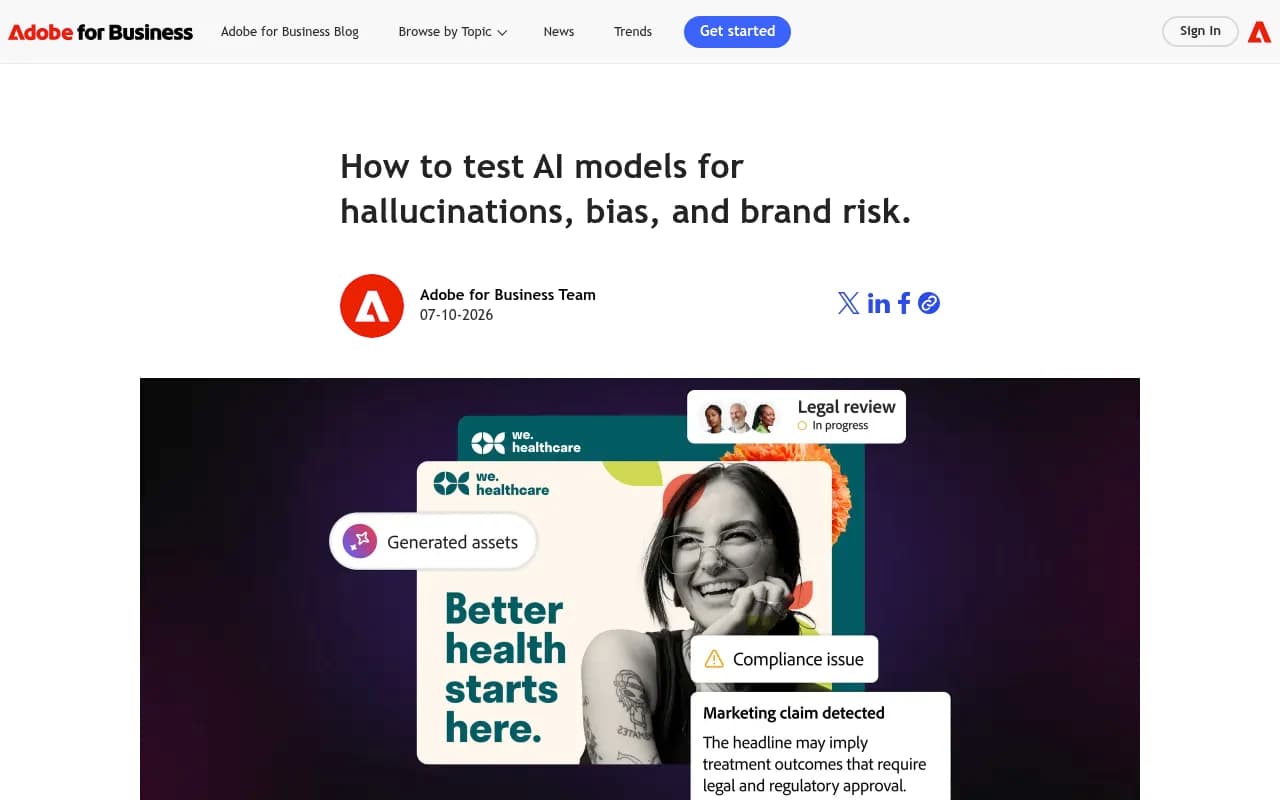
What that means in practice: keep a fact base (pricing, features, positioning, tone) that AI writing tools draw from, and require human review for any claim about numbers, partnerships, or compliance.
A one-page incident checklist
Pin this somewhere your comms and SEO people can both find it.
- Capture: prompt, engine, location, date, full response, sources.
- Reproduce: five runs, three engines, two phrasings.
- Classify: stale, missing, third-party, entity confusion, fabrication, or negative framing.
- Assign: one owner for comms, one for source tracing.
- Trace: cited sources first, then your own pages, then reviews and social.
- Fix: own pages, stale pages, third-party sources, in that order.
- Hold: send sales and support the correct fact and a short script.
- Verify: crawler access, weekly re-runs, source list changes.
- Review at 30 and 60 days, not at day 7.
- Log what you learned and add the prompt to the permanent monitor.
What I'd do this week
Pick the five questions a prospect is most likely to ask an AI about you, run them in ChatGPT, Gemini, Perplexity, and AI Overviews, and read the cited sources line by line. You will probably find at least one stale page or listing you own or can influence. Fix that first. It is dull work, and it is the part that moves answers.
If you want a partner for the bigger program of making AI describe your brand accurately, agencies like 1001 SEO Media work on AI search and GEO alongside technical SEO and content. For the underlying research on what AI engines actually cite, start with the Promptwatch Data hub.