Key takeaways
- BrightEdge found 96.8% of cited domains had zero week-over-week change across five AI engines, and 87% of the changes that did happen were declines.
- SISTRIX looked specifically at Google AI Mode: each response cites 14-16 domains, and 56% of those sources change every week. Around the brand's own domain, about 70% of the other cited domains rotate weekly.
- Both can be true. Domain-level share across thousands of prompts is stable. Prompt-level source lists are not.
- Drops tend to be binary (cited, then not cited), so you will not get a gradual warning. Promptwatch Data shows ChatGPT has abrupt cliffs while AI Mode moves in gradual steps.
- Track rolling trends, not single-day comparisons, and treat anything above roughly 30% week-to-week swings on your own citations as a signal to investigate.
Why two studies seem to contradict each other
If you have read both the BrightEdge and SISTRIX numbers this year, you probably did a double take. One says citations are "remarkably stable." The other says more than half of AI Mode's sources get replaced every week.
They are measuring different things.
BrightEdge tracked thousands of prompts across ChatGPT, Gemini, Google AI Mode, Google AI Overviews, and Perplexity in nine industries. It asked whether a domain's citation share moved from one week to the next. At that aggregate level, 96.8% of domains showed no change.
SISTRIX analyzed 82,619 prompts over 17 weeks and asked a different question: for a single prompt, how many of the cited URLs and domains are the same as last week? In AI Mode, each response cites 14-16 domains, and 56% of them change weekly.
An analogy helps. A city's population barely changes week to week, yet the specific people on a given bus change every stop. Domain-level share is the population. The source list under one prompt is the bus.
What BrightEdge found: a stable core, a brittle edge
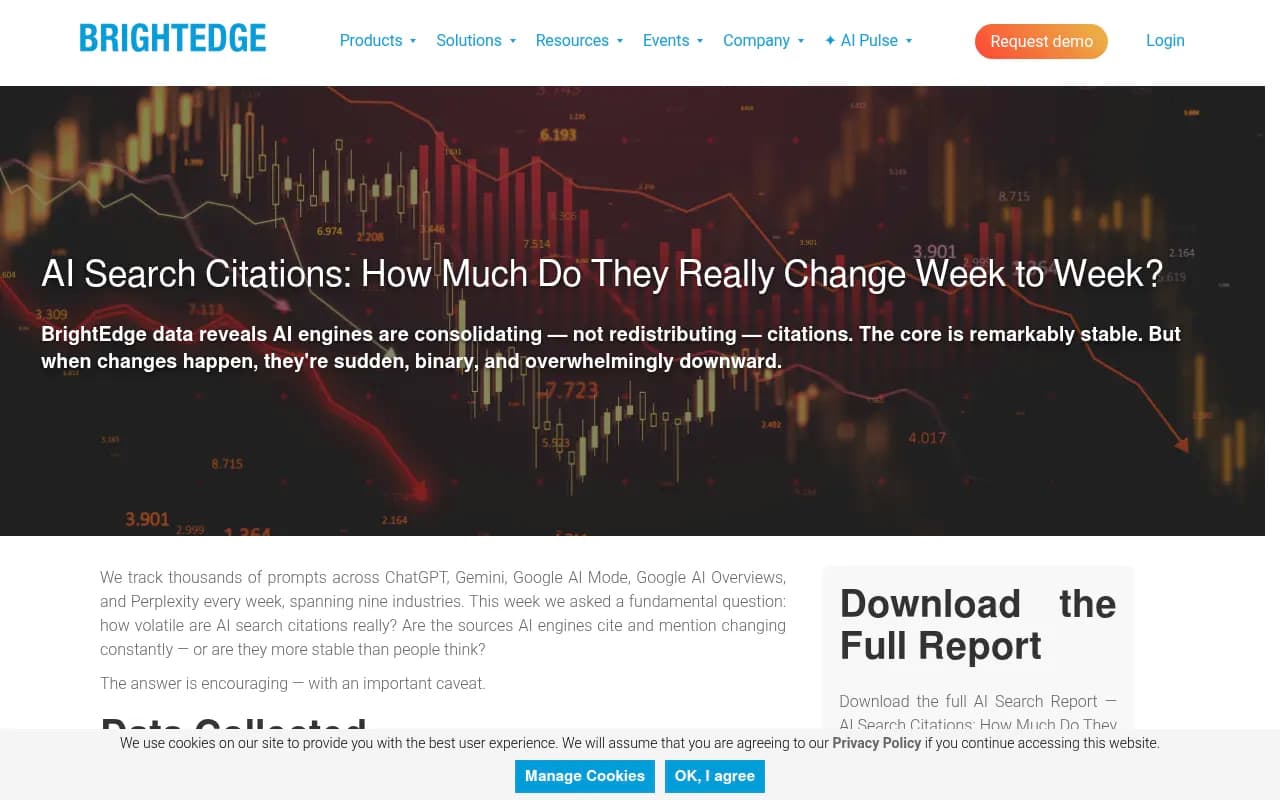
The BrightEdge report (published February 6, 2026) has a clear headline: AI engines are consolidating citations, not redistributing them.
- 96.8% of cited domains and 97.2% of mentioned brands saw zero change week over week.
- Among the roughly 3% of domains that did move, 87% were declines and 13% were gains.
- Over 51% of citation volume was associated with declining domains, against only about 5% with growing ones.
- Only 0.4% of domains gained new citations in the week studied.
The last two points matter most. If losses were flowing to competitors, you would see matching gains. They are not. Citations simply disappear, which suggests engines are narrowing the number of sources they link to rather than swapping one for another.
Top positions barely move
| Mention rank position | % that changed | Avg change |
|---|---|---|
| Top ranked (1-2) | 0.6% | 0.6% |
| Mid ranked (2-4) | 4.1% | 3.1% |
| Lower ranked (5+) | 3.0% | 2.3% |
Positions 1 and 2 held 99.4% of the time. The action is in the middle and the tail.
Concentration makes entry harder
Citations are heavily top-loaded. The top 1% of domains take 64% of all citations, the top 5% take 78%, and the top 10% take 84%. For brand mentions, the top 1% take 44.5%. If you are outside that group, the stable core is working against you.
What SISTRIX found: AI Mode rotates its sources
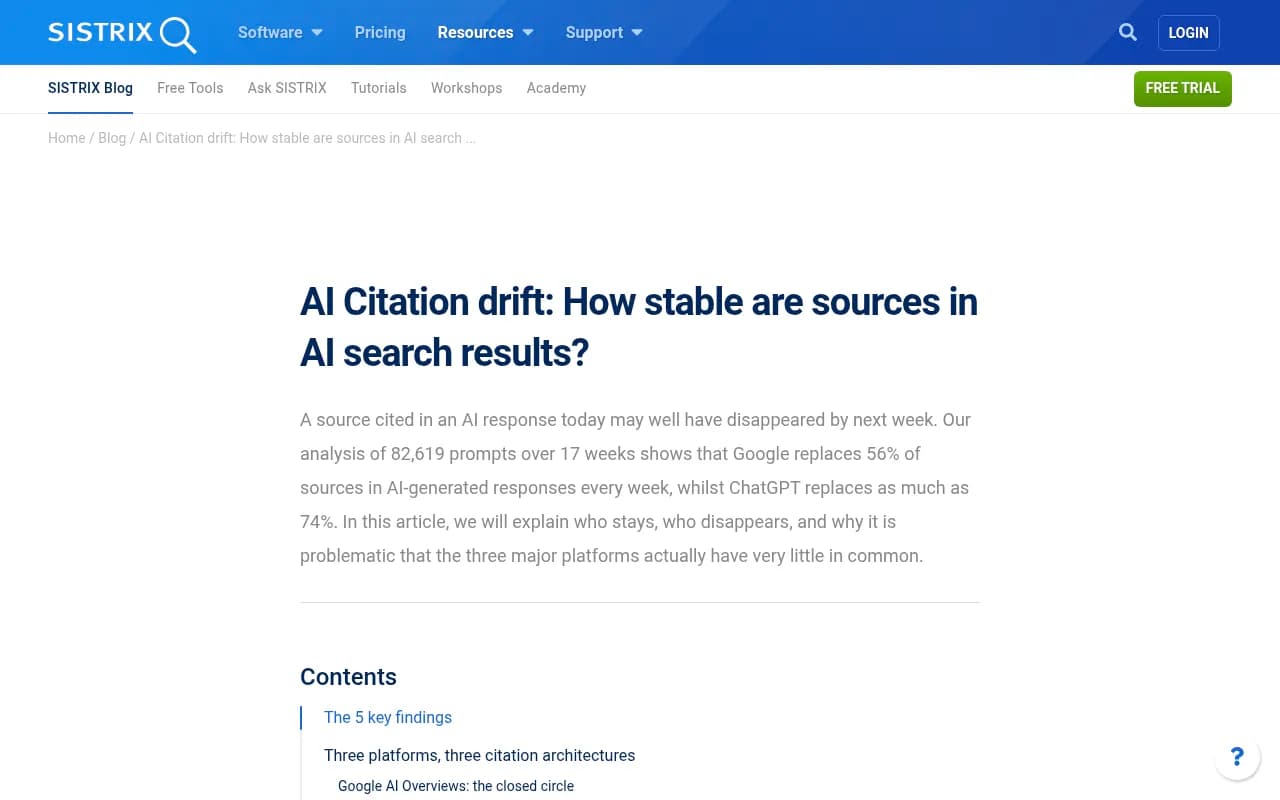
SISTRIX published its citation drift analysis in May 2026, and it is the most direct measurement of AI Mode churn I have seen. Two numbers stand out:
- 56% of the 14-16 domains cited per AI Mode response change every week.
- Of the 12-15 other domains cited alongside a brand's own domain, about 70% change each week.
The second number is the interesting one for brand teams. Your own domain tends to stay in the answer. The supporting cast around it rotates heavily. If you rely on third-party mentions (review sites, listicles, forum threads) to carry your brand, expect those specific pages to come and go.
Reconciling the numbers
| Measure | BrightEdge | SISTRIX |
|---|---|---|
| Unit analyzed | Domain citation share across prompts | Sources cited per prompt response |
| Engines | Five (ChatGPT, Gemini, AI Mode, AI Overviews, Perplexity) | Three platforms, AI Mode highlighted |
| Result | 96.8% of domains unchanged | 56% of AI Mode domains swapped weekly |
| What it tells you | Your overall footprint is steady | Any single answer is a moving target |
My read: the aggregate is sticky because big domains keep getting cited for many prompts, so one prompt dropping them does not move the total. But on any single prompt you care about, assume the source list is churning. Both facts should shape how you report.
Volatility by website type
BrightEdge broke out how often domains changed by category, and the spread is wide.
| Website type | % of domains that changed | % of changes that were declines |
|---|---|---|
| Finance | 51.1% | 91% |
| Review sites | 45.5% | 100% |
| News/media | 44.8% | 92% |
| Reference/encyclopedia | 38.5% | 80% |
| Health/medical | 34.2% | 100% |
| Video platforms | 33.3% | 100% |
| eCommerce/retail | 23.1% | 73% |
| Tech | 15.2% | 91% |
| Government/institutional | 3.6% | 77% |
Finance, reviews, and news are the shakiest. Government sources are close to locked in. eCommerce was the most balanced, with 27% of changes being gains. If you work in a volatile vertical, build in more buffer when you set targets.
Binary drops, not slow fades
One finding changes how you should monitor: domains do not erode gradually. BrightEdge saw most changes go straight from cited to not cited on a given prompt. A weekly dashboard line that looks flat can hide a prompt that fell off a cliff.
Promptwatch Data shows the same pattern at the engine level, and also shows it differs by engine. In ChatGPT, Reddit held a steady 3.83% average citation share from July 18 to August 7, 2026, then collapsed to a 0.52% average from August 14-17, an 86.4% relative drop. That started the same day ChatGPT changed its fanout behavior. You can read the details in Promptwatch's Reddit citation data, which also notes the drop is provisional and a data-collection issue cannot be fully ruled out.
AI Mode behaved differently in the same report. Reddit's share there fell from 2.22% to 1.54% (-30.5%) across the period, in steps rather than a cliff, with the clearest step at the end of July. AI Overviews slid gently, from 2.37% to 2.10%. The takeaway: ChatGPT shows abrupt breaks, AI Mode shows gradual steps, and Promptwatch recommends rolling trends over single-day comparisons for AI Mode.
Month-level shifts in AI Mode
At the domain-share level, AI Mode can still move a lot over a month. In Promptwatch's AI Mode citation share report for June 2026 (May 31 to June 26, month-to-date):
- google.com rose to 7.31% of citations from 4.24% in May (+72%), after a sixfold jump in May.
- YouTube fell from 3.42% to 2.88%, the first decline in the series.
- Reddit rose from 2.36% to 2.52%, Instagram from 0.57% to 0.68%, and Quora from 0.12% to 0.18%.
- Below the top three, every domain is under 1%.
So the stable-core story has a caveat. Google's own properties are gaining at the expense of everything else, and the long tail is where open-web publishers fight for fractions of a percent.
Organic rankings are not a safety net
Two other 2026 data points complicate any plan that assumes strong Google rankings protect AI citations:
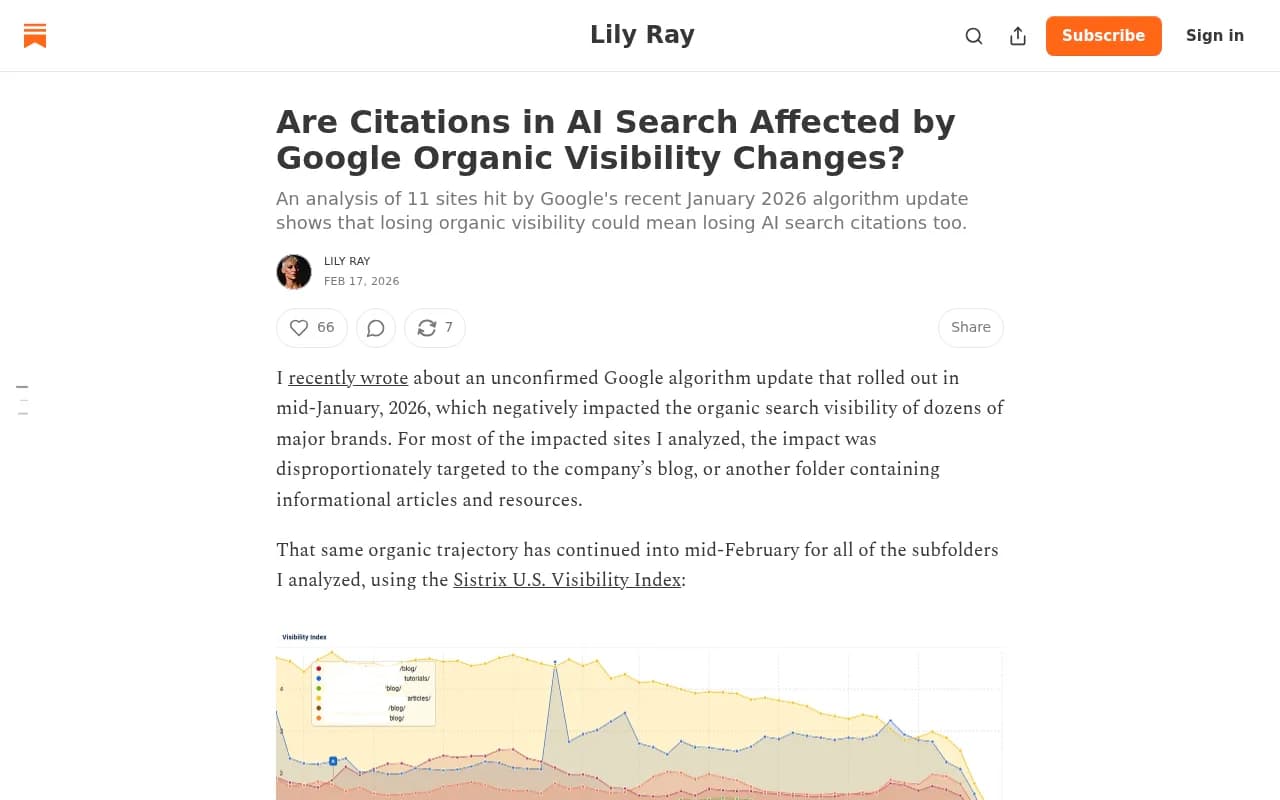
- Lily Ray analyzed 11 sites hit by Google's January 2026 update and found an average citation decline of 22.5%, with AI Mode at -23.8% and ChatGPT a milder -2.9%. Losing organic visibility can mean losing AI citations too, with AI Mode most exposed.
- A LinkedIn analysis of the May 2026 core update claims about 62% of AI Overview citations come from pages outside the top 10 organic results for the original query. I have not verified that figure, so treat it as directional.
Together they say: organic strength helps AI Mode, but ranking well is neither necessary nor sufficient.
How to monitor weekly volatility without panicking
1. Separate domain share from prompt-level presence
Track two numbers: your overall citation share per engine, and the share of tracked prompts where you are cited at all. The first will look calm. The second is where cliffs show up.
2. Use rolling windows
Compare 7-day or 14-day rolling averages, not day-to-day. This matters most for AI Mode, which moves in steps.
3. Set a volatility threshold
The Digital Bloom's 2026 citation report lists week-to-week citation volatility above 30% as a risk signal for unstable authority, pointing to freshness and backlink decay as first suspects. That is a sensible tripwire, though I would calibrate it per vertical given the category spread above.
4. Separate your own pages from third-party pages
Given SISTRIX's 70% rotation of co-cited domains, keep your own-domain citations apart from mentions on other sites. If third-party pages are carrying you, diversify them.
5. Check crawl access before blaming the engine
A drop can be an access problem rather than a trust problem. Server logs showing AI bot errors are the fastest way to rule that out.
Tools for tracking citation churn
The right tool depends on whether you need monitoring only or monitoring plus action. Here is how a few options line up for this use case.
| Tool | Strength for volatility tracking | Notes |
|---|---|---|
| Promptwatch | Real-UI tracking, citation trends, crawler logs, and content actions | Covers monitor, trace, act, measure in one loop |
| BrightEdge | Enterprise-scale AI engine tracking across industries | Source of the weekly volatility study |
| SISTRIX | Strong organic visibility index alongside AI tracking | Source of the AI Mode drift analysis |
| Profound | Enterprise AI visibility analytics | Monitoring-focused |
| Peec AI | Lightweight prompt-level tracking | Basic tracker |
Promptwatch is the one I would reach for when the goal is to explain a drop and then fix it, since it pairs citation tracking with IP-verified AI crawler logs and a content workflow, so you can tell an access problem from a content problem. The AI crawler logs feature is what separates those two cases.

BrightEdge covers the enterprise side of the same question, and its research is where much of the weekly data above originates.

Profound is a common enterprise alternative if monitoring is the main need.

Peec AI is a lighter option for teams that just want prompt-level tracking.

If you want to browse more options, the GEO software directory at bestgeosoftware.com lists a wide range of trackers.
What to do when a citation disappears
- Confirm it is real. Re-run the prompt across a few days and check whether data collection changed, as the Reddit report cautions.
- Check whether the page was crawled and returned errors.
- Look at what replaced it. BrightEdge suggests most lost citations are not replaced, so a smaller source list is possible.
- Refresh the page with current facts, then watch whether it comes back over the next two to three weeks.
- If you lost a third-party mention, look for replacement placements on pages AI already cites.
The bottom line
AI Mode citations are stable in aggregate and noisy in detail. Your domain-level footprint will rarely swing in a given week, but any single prompt's source list can flip more than half its entries. Measure both, smooth the trend lines, and assume drops arrive without warning. That is a monitoring problem first and a content problem second.
One limit on all of this: the BrightEdge, SISTRIX, Lily Ray, and Digital Bloom figures here come from their own methodologies and I have not independently verified them. Promptwatch Data reports are monthly or daily share snapshots rather than week-over-week churn counts, so there is no single dataset yet that gives a clean AI Mode weekly churn rate across every method.