Key takeaways
- Managing 10+ brands is mostly a structure problem: separate workspaces, per-brand competitors, per-market prompts, and roll-up reporting. Prompt counts matter less than how a tool partitions them.
- Brandlight is an enterprise, sales-led product with unpublished pricing. That suits Fortune 500 groups that want a named strategist, and frustrates teams that want to trial and buy self-serve.
- Agency-style plans with unlimited projects (Promptwatch Agency, Scrunch, Slate, Search Party) usually fit portfolios better than per-brand enterprise contracts.
- Measure each brand per engine. Promptwatch Data shows ChatGPT cites about 5 sources per answer, while AI Overviews and Perplexity cite about 10, so a single blended score hides what is happening.
- Per-brand limits were not verified for several vendors in our research. Ask for them in writing before you sign.
Why a portfolio is a different problem from one brand
Tracking one brand is easy. You add 50 prompts, pick competitors, and watch a line move. At 10 brands, the same approach turns into a spreadsheet nightmare, because every brand has its own competitor set, its own markets, its own languages, and often its own CMS and owner.
I have seen teams buy a single-brand tool, create ten projects, and discover three months later that nobody can answer the question the CMO actually asks: "Which of our brands is losing ground in AI answers, and why?" Roll-up reporting is the feature that decides whether a portfolio tool works.
There are three typical buyers here:
- Holding companies and consumer groups with 10 to 50 brands under one roof.
- Agencies running 5 to 50 client portfolios (the range LLM Pulse's comparison uses for agencies).
- Franchise and multi-location businesses where each location or region behaves like its own brand.
Each one needs a slightly different answer, which is why no single alternative wins everywhere.
What Brandlight offers, and where buyers push back
Brandlight positions itself for large brands that track visibility across different brands, products, regions, and languages in one platform. It covers ChatGPT, Gemini, Perplexity, Copilot, and Grok, adds sentiment, citations, technical health audits, and a multi-brand command center, and has raised a $30M Series A. One comparison describes it as a platform plus a dedicated AI strategist, a CX lead, biweekly working sessions, and quarterly planning.

That is a real strength if you want a managed programme. The common complaints, reported in a competitor's comparison (so treat them as vendor-biased), are:
- Pricing is not published, so every buyer needs a custom quote.
- Onboarding is sales-led, with no self-serve checkout, only a team trial handled through sales.
- Methodology transparency is limited. Technical evaluators say they want public docs on prompt execution, citation extraction, and rate-limit handling.
If you are a 40-person agency, that sales cycle is a lot. If you are a global consumer group with procurement and security reviews anyway, it may be fine.
What to check before putting 10+ brands in one platform
Skip the feature checklist for a minute. These are the questions that actually separate tools once you have a portfolio.
Workspace and brand structure
Can each brand have its own prompts, competitors, aliases, and tone rules? Can you roll them up? Brand aliases matter more than people expect, especially when a brand name is also a common word. Look for brand-level analysis rules that define what counts as a mention.
Pricing model
Some tools price per brand, some per prompt, some per response, and some per workspace. At 10+ brands the per-brand model gets expensive fast. Agency plans with unlimited projects and a response budget are usually cheaper at this scale, but you then need to watch the response cap.
Market and language coverage
A brand sold in six countries is effectively six monitors. Check that location and language are set per monitor, so results from different markets do not blend.
Data collection method
Answers from real interfaces can differ from API output. If you report visibility to a brand director, you want the numbers that match what a customer sees. Ask how the vendor collects data.
Per-engine reporting
Engines give you different citation slots. Promptwatch Data's average sources per response report shows ChatGPT citing about 5 sources per web-search answer, Google AI Overviews about 10, and Perplexity almost exactly 10 every day. Copilot swung from under 2 to nearly 17 within weeks before settling at the low end. Practical consequence: report every brand per engine, and judge Copilot on monthly trends, not weekly snapshots, because those swings look like retrieval changes on Microsoft's side, not something a brand did.
Team access and audit trail
With 10 brands you will have brand managers who should only see their own data. Role-based access by project, scoped API keys, and an audit log save you from a lot of awkward Slack threads.
From monitoring to action
A dashboard for 10 brands gives you 10 sets of problems. Without a way to prioritize and fix them, you just have 10 sets of charts. Check whether the tool gives you a work queue, content generation, and a way to see whether fixes worked.
Brandlight alternatives compared
Pricing below comes from vendor sites and a vendor-written comparison, so confirm everything on the vendor's own page. Brand and workspace limits were not verified for most of these.
| Tool | Starting price (reported) | Multi-brand angle | Best for |
|---|---|---|---|
| Promptwatch | Agency Kick-off $199/mo, Growth $399/mo, Scale $799/mo | Unlimited projects and team seats on agency plans | Agencies and groups that want monitoring plus execution |
| Brandlight | Custom quote | Multi-brand command center, managed strategist | Fortune 500 groups wanting a managed programme |
| Profound | 7-day trial, enterprise custom | Enterprise focus, compliance | Large enterprises with security requirements |
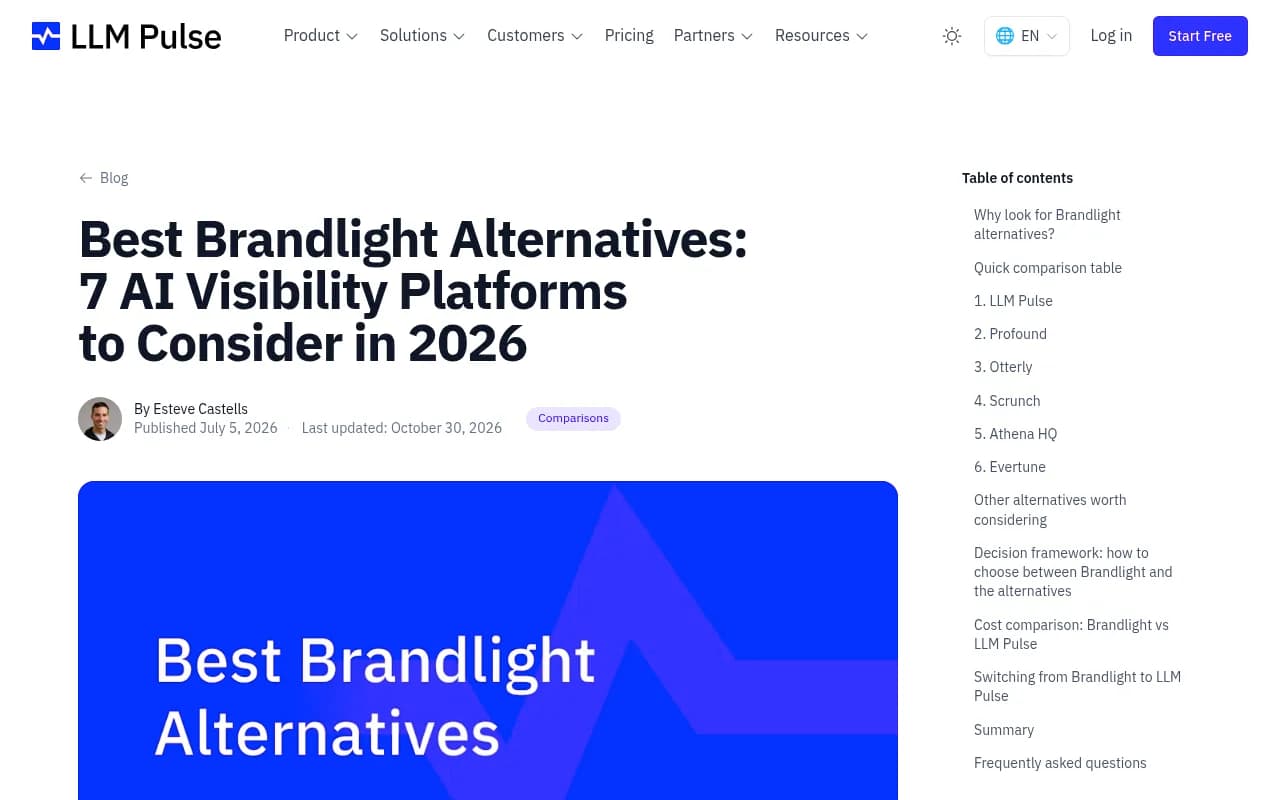
| LLM Pulse | From EUR 49/mo | White-label and embed for agencies | Cost-sensitive agencies |
| Scrunch | $250/mo Starter, billed annually | Agency and brand workspaces, agent traffic | Agencies wanting audits and agent-ready pages |
| Slate | Check vendor | Built for agencies running multiple client brands in one workspace | Content-heavy agency teams |
| AthenaHQ | Free Essential, Starter $295/mo | Monitoring focus | Small multi-brand teams |
| Otterly.AI | From $29/mo | Basic tracking | Solo operators |
| Evertune | $800/mo Pro | Statistical analysis of AI descriptions | Research-led brand teams |
The alternatives in more detail
Promptwatch
Promptwatch is the option I would look at first for a portfolio that needs more than a dashboard. The agency plans give you unlimited projects, prompts, and team seats, with all supported AI models, country, state, and city tracking, Brand Narrative, Ads Radar, crawler logs, visitor analytics, site audits, and API and MCP access. Kick-off is $199/mo (10,000 responses), Growth is $399/mo (25,000 responses), and Scale is $799/mo (65,000 responses, plus tracking every 12, 6, or 1 hours, local targeting, Fact Check, and an audit log). Confirm current numbers at promptwatch.com/pricing.

What makes it work at 10+ brands is that each monitor has a fixed language and location, so markets never mix, and the heatmap can put brands on one axis and models, topics, or countries on the other, colored by visibility, sentiment, position, or share of voice. That is the "which of my brands is slipping" view in one screen. Tracking comes from the real interfaces of ChatGPT, Google AI Overviews, AI Mode, Gemini, Perplexity, Copilot, and others, not only API output.
The gap versus Brandlight's managed model: agency plans don't include the Content Agent, Knowledge Base, or white-label client portal. Agencies that need content generation, a white-label portal, or SSO go to Enterprise. Brand teams with one big house of brands can use the Business plan ($579/mo) with the Content Agent, and the agencies page explains the split. The Promptwatch vs Brandlight comparison goes through the details, and there is a 7-day free trial on monthly billing, plus a free AI visibility report if you want to see one brand first.
Profound
Profound is the usual enterprise rival to Brandlight. It leans toward compliance-heavy buyers and has a 7-day trial with custom enterprise pricing. Strong monitoring, but higher price points and no agentic execution. See Promptwatch vs Profound.

Scrunch
Scrunch combines AI visibility, page audits, and agent traffic, starting at $250/mo billed annually with a 7-day trial. One agency roundup says it monitors visibility across answer engines for 500-plus brands, which suggests it was built with scale in mind. Good if you also want agent-ready pages for client sites.

Slate
Slate describes itself as built for marketing agencies managing multiple client brands from a single, unified workspace. It is closer to a content operations platform than a pure tracker.

LLM Pulse
LLM Pulse starts at EUR 49/mo for 50 prompts, EUR 99 for 150, EUR 299 for 450, with enterprise on quote. White-label and embed options, unlimited seats, a REST API, MCP server, Looker Studio connector, and server-log based Agent Analytics are included. Claude, Copilot, Grok, DeepSeek, and others are paid add-ons. It is cheap, but I could not confirm whether tiers limit brands or workspaces, so ask.

AthenaHQ, Otterly.AI, and Evertune
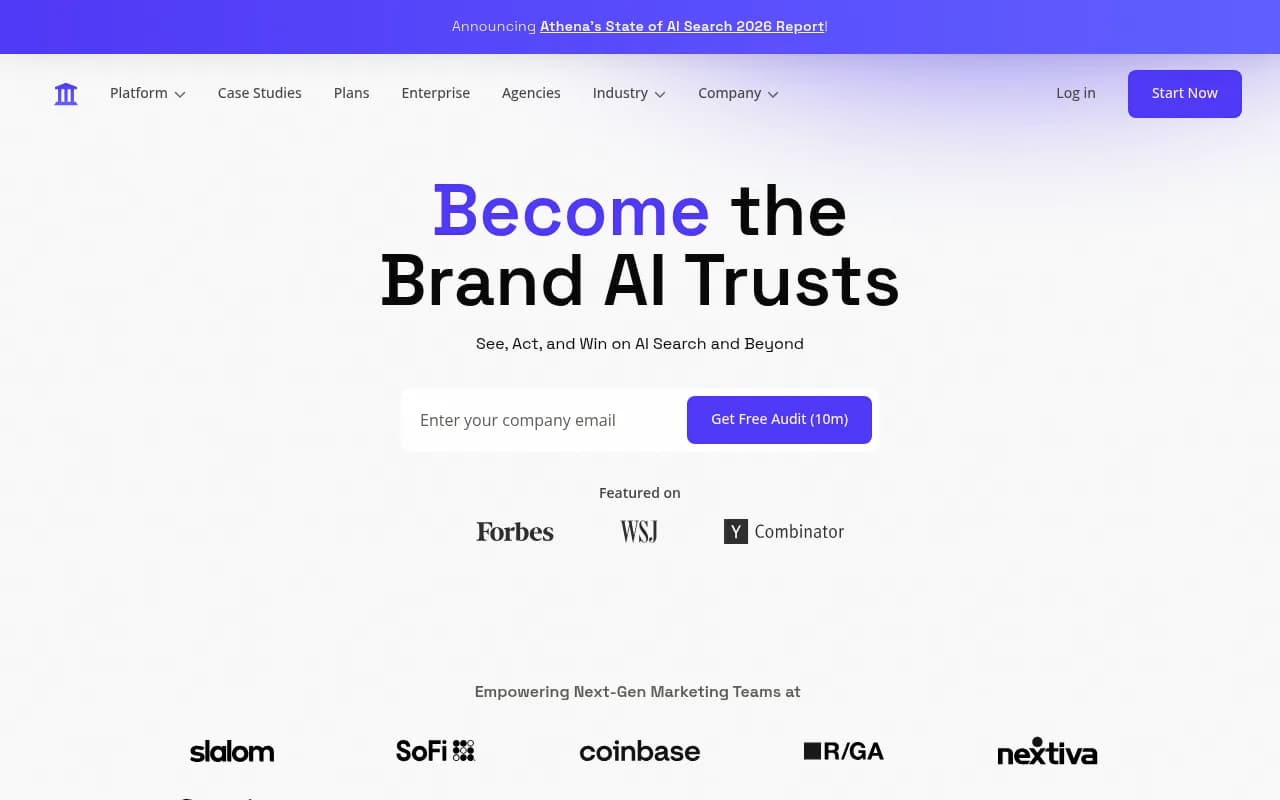
AthenaHQ has a free Essential plan and Starter at $295/mo. Otterly.AI starts at $29/mo and suits very small teams, not portfolios. Evertune runs $800/mo for Pro with no trial and focuses on statistical analysis of how AI describes brands, which is useful for brand-perception work but narrower for operational portfolio management.


Ecommerce and local variants
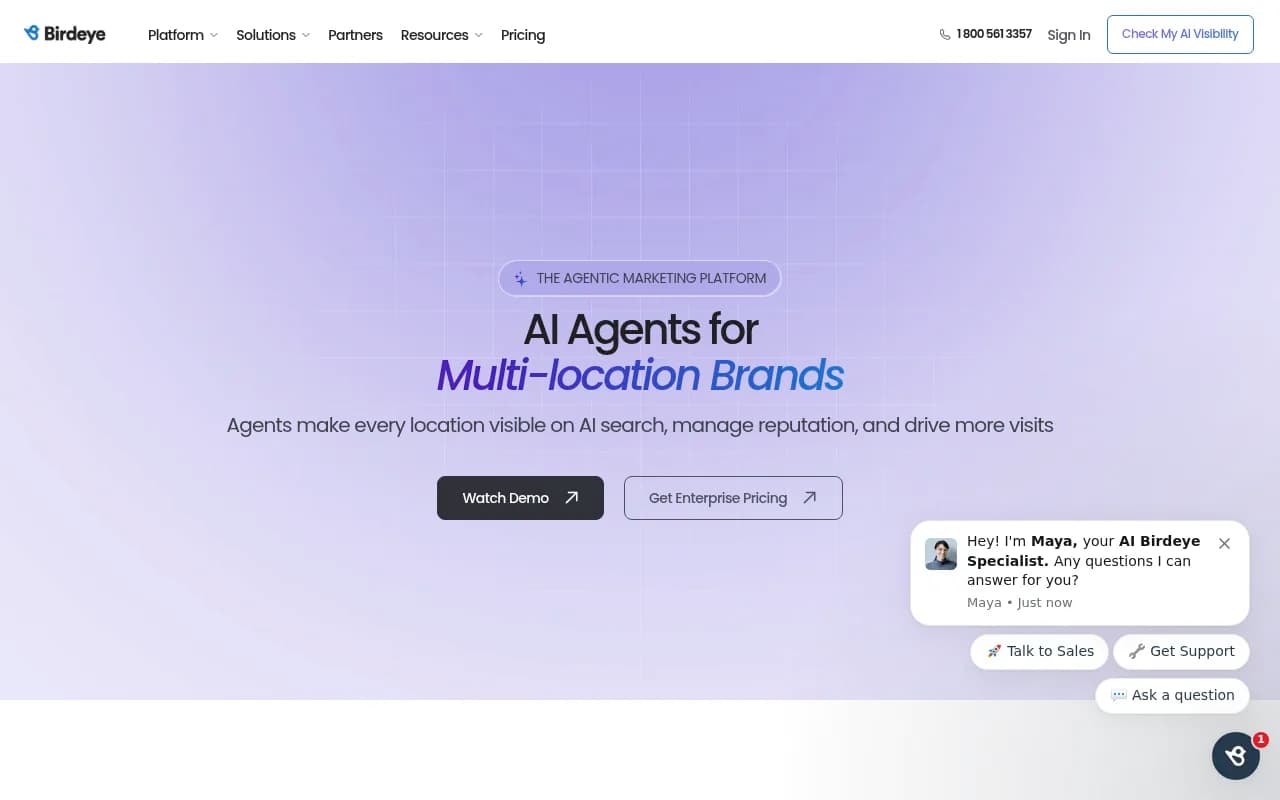
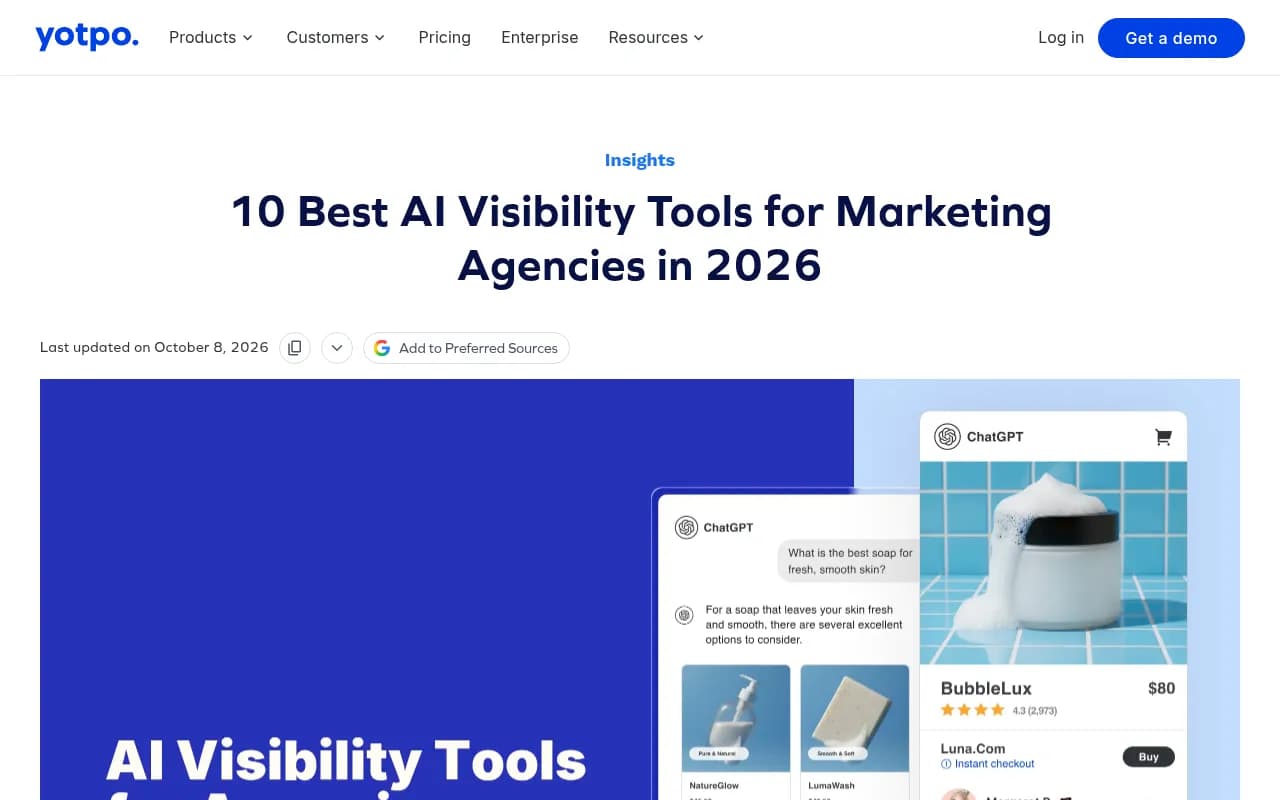
If your 10+ brands are product catalogs, Yotpo Discover is built around commerce data and reviews, and Yotpo ranks it first in its own agency roundup (a vendor ranking, so weigh accordingly). For brands with many physical locations, Birdeye Search AI tracks at location level.
Yotpo Discover
Which setup fits which portfolio
Holding company with 10 to 30 consumer brands
You want governance first: roles per brand, audit log, SSO, and a security review that passes. Brandlight and Profound are built for this, and Promptwatch Enterprise covers it with ISO/IEC 27001 certification, GDPR compliance, SSO, and a white-label portal. Expect procurement cycles for all three.
Agency with 5 to 50 clients
Unlimited projects matter most, plus pitch projects for prospects and PDF reports on a schedule. Agency plans from Promptwatch, Scrunch, Slate, and LLM Pulse fit here. Watch the response cap, because 25 clients at 100 prompts each eats responses quickly.
Franchise or multi-location group
You need coordinates-level tracking, not just country. Promptwatch's local targeting (Business, Agency Scale, and Enterprise) pins a monitor to exact coordinates for "near me" prompts.
A rollout plan that works for 10+ brands
Do not onboard all brands at once. A staged approach avoids burning your response budget on noise:
- Pick the three brands with the most revenue exposure and set up monitors per market.
- Define aliases and analysis rules for each, especially any brand with a common-word name.
- Use 30 to 50 prompts per brand covering branded, competitor, and category queries. Add more only after you see which prompts return answers.
- Build one roll-up dashboard for leadership and one per-brand view for owners.
- After four weeks, add the next batch and retire prompts that never trigger a useful answer.
- Review per engine monthly, not weekly, so that noise like Copilot's swings does not trigger false alarms.
If you want a human to run this for you, an SEO and GEO agency is a legitimate option. 1001 SEO Media, the agency that publishes this site, works with Promptwatch for AI visibility, but plenty of in-house teams run it themselves.
For more options in the category, the GEO software directory at bestgeosoftware.com lists a wider set of tools than fits here.
Questions to ask every vendor
- Is there a cap on brands, workspaces, or projects, and is it contractual?
- How are responses counted, and what happens when you hit the cap?
- Is data collected from real interfaces or APIs?
- Can I export everything, including raw responses and citations?
- What are the role and audit options per brand?
- What is the minimum term, and can I trial it without a sales call?
The last one is the quiet filter. A tool you can trial in a day on two of your brands tells you more than a polished demo.
Bottom line
Brandlight is a credible choice if you want a managed enterprise programme and have the procurement patience. For most portfolios the better fit is an agency-style plan with unlimited projects, a heatmap-style roll-up, and a way to act on what you find. Start with three brands, check per-engine numbers, and get brand limits in writing.