Key takeaways
- A misinformation fix is only a win if you can show the before, the cause, the action and the measured result. Document it while you work, not afterwards.
- Borrow SCQA (situation, complication, question, answer) from consulting. It keeps the story short enough for an exec and structured enough for AI engines to quote.
- For branded prompts, owned pages matter most. In Promptwatch Data (Sep 28 to Oct 4, 2026), product pages and landing pages together earn almost half of ChatGPT's branded citations.
- A Reddit or forum rebuttal is no longer a dependable lever in ChatGPT. Fix the facts on pages you control.
- Publish the finished case study in a format AI can extract: facts first, named entities, real numbers, question-style headers.
Why a misinformation fix deserves a case study
Most teams treat an AI error as a fire drill. Someone spots ChatGPT saying the wrong thing about your pricing or security, there is a flurry of Slack messages, a page gets edited, and everyone moves on. Nothing is recorded. Six months later, nobody can say what happened or why it worked, and the budget conversation starts from zero.
That is a waste, because these incidents are unusually good raw material. They have a clear villain (a false claim), a concrete fix and a measurable outcome. They also show leadership something abstract budgets rarely do: what AI engines say about the company is a real business risk, and it can be managed.
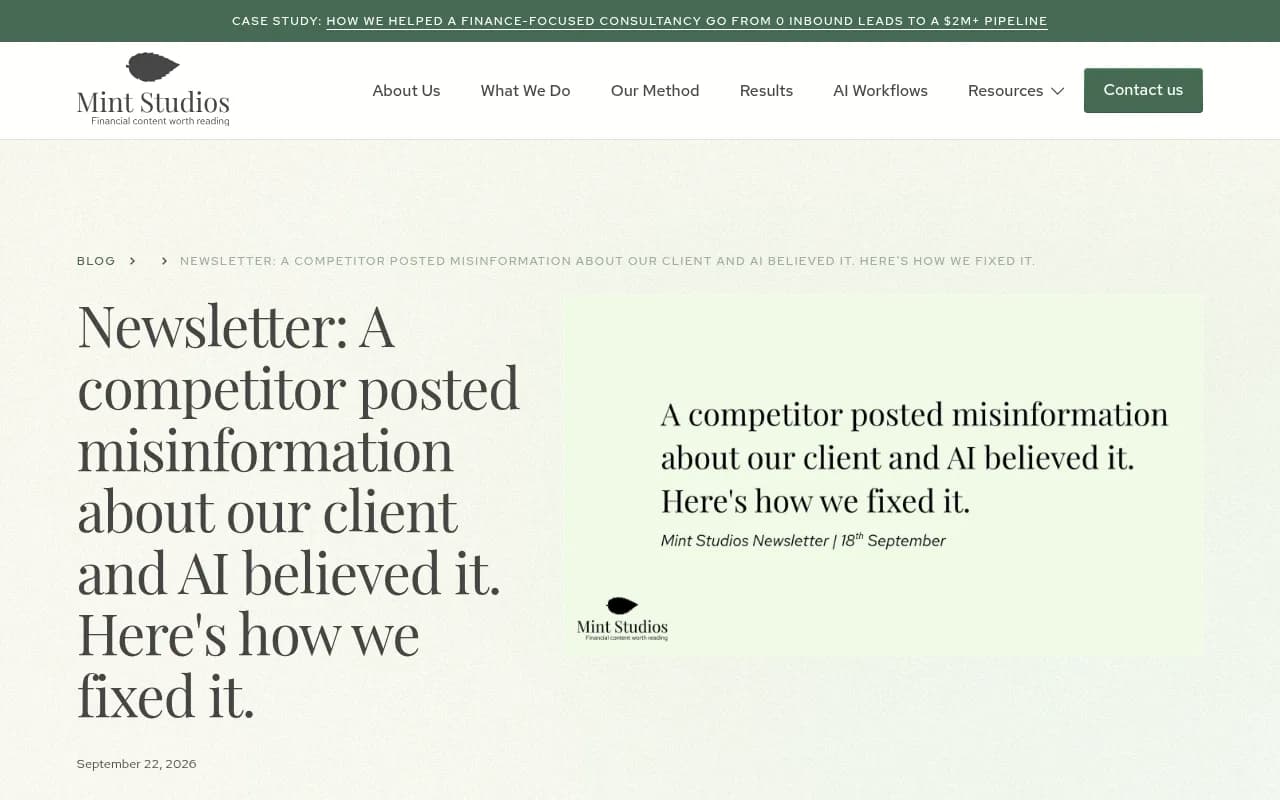
There is a public example worth reading. Mint Studios published a post on September 18, 2026 describing how AI search repeated a competitor's false claims about a client, and how they say they corrected it within 24 hours with one focused article. I could only verify the summary, not the full steps or the measured outcome, so read the original write-up yourself before borrowing details. What it does show is the shape of a good story: one problem, one action, a short timeline.
Choose the framework: SCQA plus a measurement layer
Consulting case frameworks exist for a reason. As StrategyU's guide puts it, the value is not memorizing a template. It is thinking at a level above the raw information so others can follow. Two ideas carry over directly.
- SCQA. The Situation is what everyone agrees on. The Complication is what changed or went wrong. The Question is what the team had to answer. The Answer is what you did.
- MECE. Your buckets should not overlap and should leave no gaps. For a misinformation incident, that stops you from blending the claim, the source and the fix into one muddy paragraph.
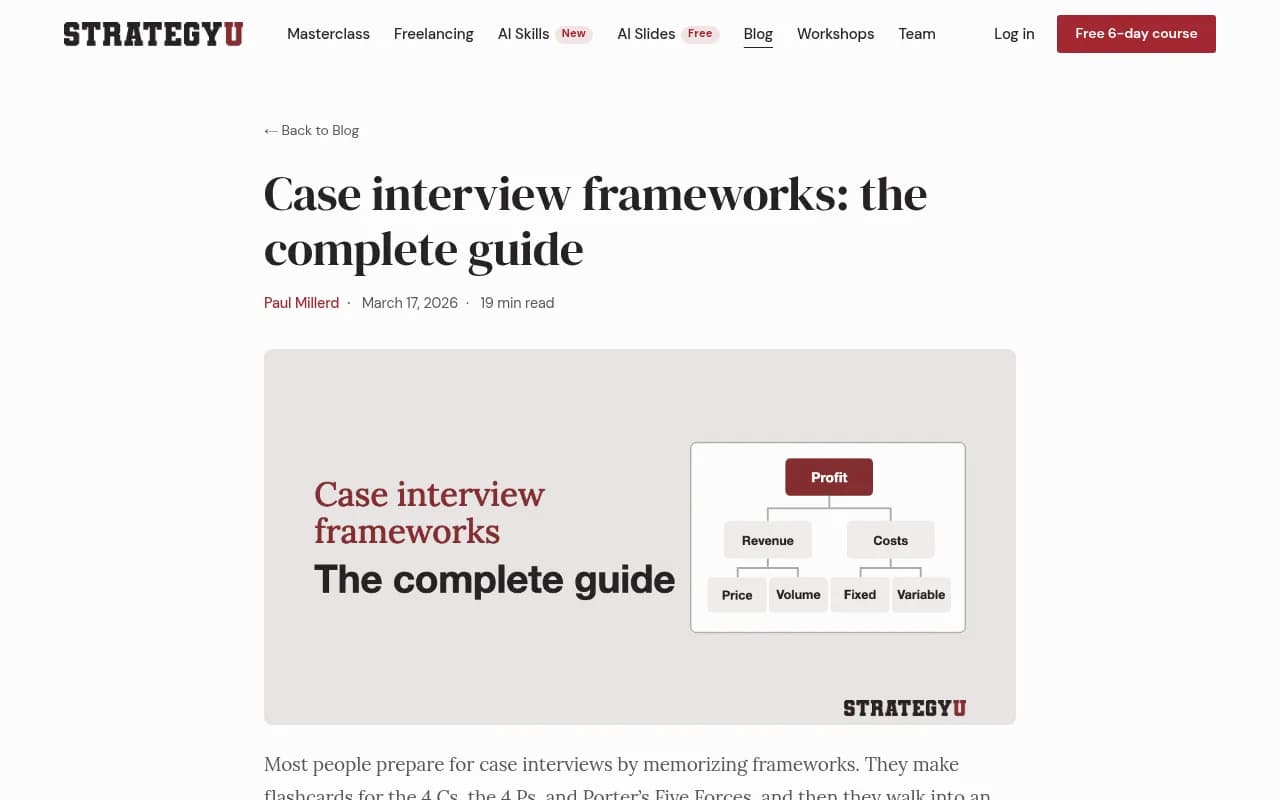
One caution from the same guide: don't announce the framework, just use it. Your readers care about the incident, not the acronym. Hacking the Case Interview adds a useful check, the TRIM test (tailored, relevant, insight-driven, MECE), which is a good gut check before you publish.
Then add a fifth step consulting cases rarely need: measurement. Here is the full structure.
| Section | What you write | Evidence to capture |
|---|---|---|
| Situation | What the brand does and what AI should say about it | Baseline answers, screenshots |
| Complication | The false or outdated claim and where it appeared | Prompts, engines, dates |
| Question | What the team had to decide | Risk, owner, deadline |
| Answer | The fix you shipped | Page URLs, publish date |
| Result | What changed afterward | Re-run answers, citations, traffic |
Step 1: Capture the situation before you touch anything
The most common mistake is fixing first and documenting later. By then the evidence is gone. Before editing a single page, record:
- The exact prompts that produced the wrong answer, with the date and the AI engine.
- The full response text and the sources it cited.
- How often the error appears. One run proves little, since answers vary between runs. Re-run the prompt several times and note the share of responses that repeat the claim.
- Which personas or countries see it, if you track those.
Screenshots help, but data you can export helps more. A tracking platform such as Promptwatch stores prompts, responses and citations from the real interfaces of ChatGPT, Gemini, Perplexity and others, which gives you a timestamped baseline without manual screenshotting. Its Brand Narrative feature also pulls individual claims out of responses, which is handy for spotting a false claim you didn't know existed.

If you want to explore alternatives for this step, the GEO software directory at bestgeosoftware.com lists a long field of trackers.
Step 2: Trace the source of the claim
A false claim in an AI answer has to come from somewhere. Usually it is a page the model retrieved, a stale page on your own site, or a third party's content. Find out which, because the fix depends on it.
Look at the citations behind the bad answer. Ask three things:
- Is the claim stated on your own site, perhaps on an old pricing page or a deprecated doc?
- Is it stated on a third-party page, such as a competitor's comparison post or a review site?
- Is it not stated anywhere, meaning the model is guessing from missing information?
The third case is more common than people expect, and it is a content gap, not a smear campaign. Promptwatch's Fact Check feature is built for the first case: you mark a claim inaccurate and it finds the crawled pages on your site that state it. Sometimes the culprit is your own outdated page.
Also check whether AI crawlers can read your site at all. If bots are blocked or erroring, the model never sees your correction. Crawler logs (Promptwatch's AI crawler logs cover this) tell you whether GPTBot, ClaudeBot and PerplexityBot are reading the page you are about to fix. For a quick free check, try the Agentic Readiness Check.
Step 3: Decide where the fix goes
This is where the data should change your plan. Branded prompts are the ones that name your company, and they behave differently from generic ones.
According to Promptwatch Data on ChatGPT citations by content type (Sep 28 to Oct 4, 2026), for branded prompts:
| Content type | Share of branded ChatGPT citations |
|---|---|
| Product pages | 23.3% |
| Landing pages | 22.8% |
| Reviews | 5.6% |
| FAQ pages | 4.8% |
| Social posts | 3.0% |
| Press releases | 2.1% |
Product and landing pages make up almost half. Reviews are more than three times their share across all prompts, and FAQ pages also punch above their overall weight. So the order of operations is clear: correct your own product and landing pages first, add a plain-language FAQ that answers the disputed question directly, and then work on reviews on trusted sites in your category.
The social option is shrinking. The same research shows ChatGPT drew only 0.46% of its citations from social platforms in that week, and Reddit fell to 0.09%, after a collapse in Reddit citations on August 14, 2026. Google AI Overviews is different, with social platforms at 12.2% of citations (see social media citations by AI model). The practical point for your case study: a forum rebuttal may help in one engine and do nothing in another. Owned, structured pages work across all of them.
One more consideration is how many sources the model blends. Almost half of ChatGPT responses cite 10 or more unique domains, so your correction competes with many other pages. A single sentence buried in a blog post may not win. A clear, dedicated answer page has a better chance.
Step 4: Ship the correction and write it for extraction
The fix itself should be boring and precise. A page that states the correct fact in the first lines, names the entities involved (product, plan, feature, date), and answers the question the way a user would ask it.
Things that work:
- A header phrased as the question people ask, followed by a one or two sentence direct answer.
- Specific numbers and dates instead of adjectives.
- A short FAQ block on the page that addresses the false claim without repeating it more than once.
- Consistent facts across your homepage, docs, pricing and any structured data.
Resist the urge to write a long defensive post naming the competitor. It reads as spin and can put the false claim in front of more crawlers. State the truth and move on.
If you need to produce and publish quickly, content agents help. Promptwatch's Content Agent can draft and publish to WordPress, Webflow or Framer, but a human should review any factual correction. Speed is only a virtue if the facts are right.
Step 5: Measure whether it worked
This is the section most case studies skip, and it is the one that makes yours persuasive. Re-run the same prompts you captured in Step 1, on the same engines, after the page is live and crawled. Then compare.
Useful before and after measures:
- Share of responses repeating the false claim.
- Whether your corrected page now appears among the citations, and at what position.
- Sentiment and Brand Narrative scores for the affected theme, such as Pricing or Security.
- Crawler hits on the corrected page, which tell you whether bots have even seen it.
- AI-referred visits and conversions to that page, if you track them.
Be honest about timing. Different engines refresh at different speeds, and a live-search engine like Perplexity may reflect a change faster than a model answering from training data. The content half-life data is a reminder that how long a page stays cited depends on its type: landing pages and docs last longest, while news loses half its pages within 36 days. A correction on a landing page should hold up better than one buried in a news post.
If the claim persists, that is not a failed case study. It is a finding. Record what you tried and what you will try next.
Tools for the job
You don't need all of these. Pick based on what step you are weakest at.
| Need | Examples |
|---|---|
| Baseline, citations and re-checks | Promptwatch, Profound, Peec AI, Otterly.AI |
| Brand perception and claims | Waikay, LLM Pulse |
| Content gap and drafting | Surfer SEO, Clearscope, AirOps |
| Crawl and technical access | Botify |
A few notes. Monitoring-only tools such as Peec AI or Otterly.AI can cover Step 1 and Step 5 at a lower price, but they stop there, so tracing the source and shipping the fix happen elsewhere. Profound is a strong monitoring option for enterprise teams. Promptwatch covers the whole loop (monitor, trace, act, measure), which matters when you want one dataset behind the case study. Pricing starts at $95 per month for Essential, with a 7-day free trial; confirm current plans at promptwatch.com/pricing. For a wider list of rank and visibility trackers, see ai-rank-tools.com.




Turning the incident into a win for your team
Now package it. There are two audiences: leadership, and the AI engines that will read the finished piece.
For leadership
One page. Lead with the result in the first sentence: what the AI said, what it says now, how long it took. Then the SCQA story in four short paragraphs, then a single chart of before and after. End with a request that follows from the evidence, such as budget for ongoing monitoring, an owner for brand facts, or a quarterly fact-audit of key pages.
The argument writes itself: the incident was detected and fixed because a process existed, and the process cost little compared with the damage a false claim does in front of buyers who ask AI for vendor recommendations.
For AI engines and public readers
If you can publish a sanitized version, do. Duda's guidance on writing case studies for humans and AI is practical here: put a cheat sheet of facts at the top, use named entities and specific numbers, and write headers as answers to real questions. Treat the case study as structured, citable ground truth.
A simple fact block at the top works well:
Company: [Name]
Issue: AI answers repeated an inaccurate claim about [topic]
Engines affected: [ChatGPT, Perplexity, ...]
Fix: [Page updated / FAQ published] on [date]
Result: [x of y responses corrected after z days]
Do not publish numbers you did not measure. A modest, accurate result beats a dramatic one that falls apart when a prospect asks how you got it.
Mistakes that weaken the story
- Fixing before recording the baseline, so you have no before.
- Running one prompt once and calling it proof. Answers vary, so sample.
- Declaring victory in a single engine.
- Treating a competitor as the cause without evidence. Often it is your own stale page or a content gap.
- Writing the case study so vaguely that it could describe anyone.
A reusable checklist
- Log prompts, engines, dates and full responses.
- Quantify how often the claim appears.
- Trace citations to find the source type.
- Fix owned product, landing and FAQ pages first.
- Confirm crawlers can read the updated page.
- Re-run the same prompts on a schedule.
- Write the one-page SCQA summary with a fact block.
- Ask leadership for a standing process, not a one-off thanks.
The point of all this is repeatability. The next false claim will show up, and the team with a documented process fixes it in days while everyone else starts from a blank page.